
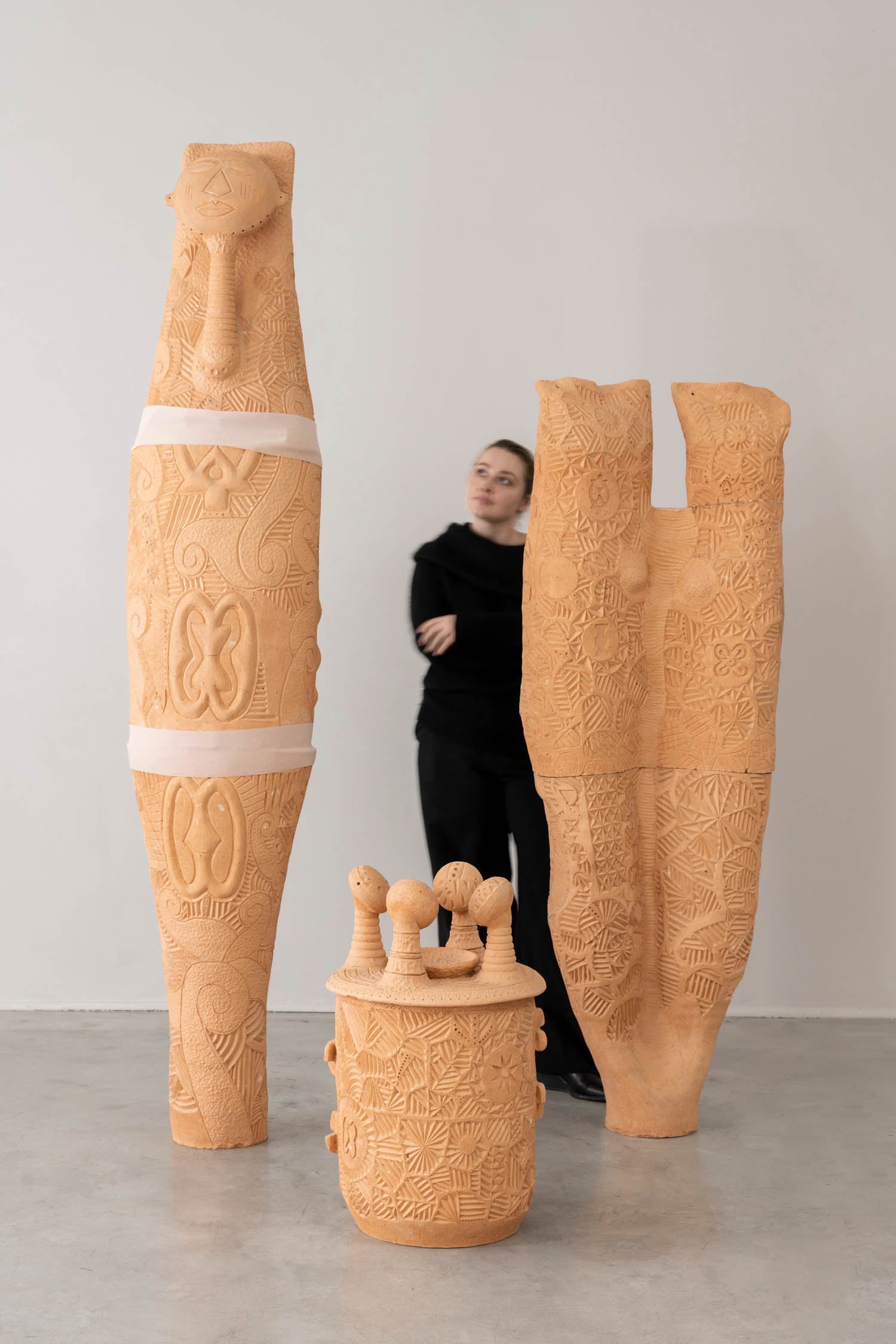
10 Questions With… Ceramic Artist Kobina Adusah
Kobina Adusah is foremost in love with clay and then scale. He is the ceramicist who wants to make his works feel monumental—and maybe that stems from a place of discipline, but it’s also because he grew up with the infatuation of sculptors and ceramicists like James Kwame Amoah, Kingsley Kofi Broni known as KK Broni, and Kwame Akoto-Bamfo. That early fascination continues to shape his practice, which he insists is defined by patience and physical commitment.
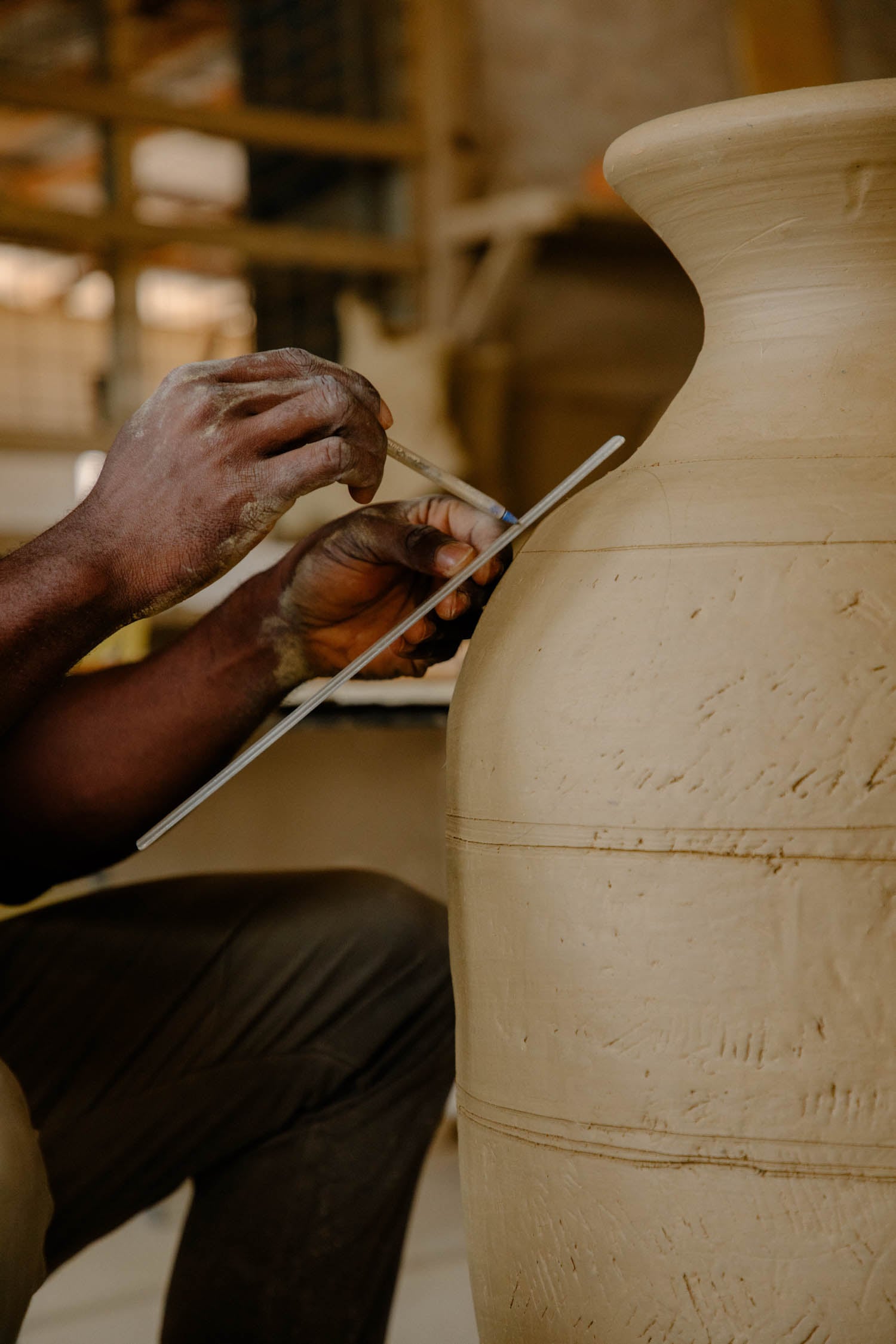
Adusah’s journey with clay began in Kwame Nkrumah University of Science and Technology, Ghana, where he spent four years carving his own visual language. Now working primarily with slab construction, he builds his forms incrementally, treating each work as an architectural process rather than a singular gesture. The resulting objects are often large-scale and artistically textured while exploring the themes of ancestry, migration, fragility, and personal memory.
It’s this very artistic and monumental nationality that has placed his work in a growing international conversation around contemporary craft. In 2025, he was named a finalist for the Loewe Foundation Craft Prize, a milestone that asserts his ability to expand the sculptural possibilities of ceramics. Still, he remains clear-eyed about what he wants his works to invoke especially at first glance.
While pursuing an MFA degree in ceramics at Kwame Nkrumah University of Science and Technology, Ghana, he also has an exhibition titled “Inherited Beings,” currently open at Gallery FUMI until March 15 that expands his exploration of ancestry, memory, and the vessel as a carrier of lived experience. The exhibition is also part of Gallery FUMI’s partnership in Collect 2026 at London’s Somerset House.
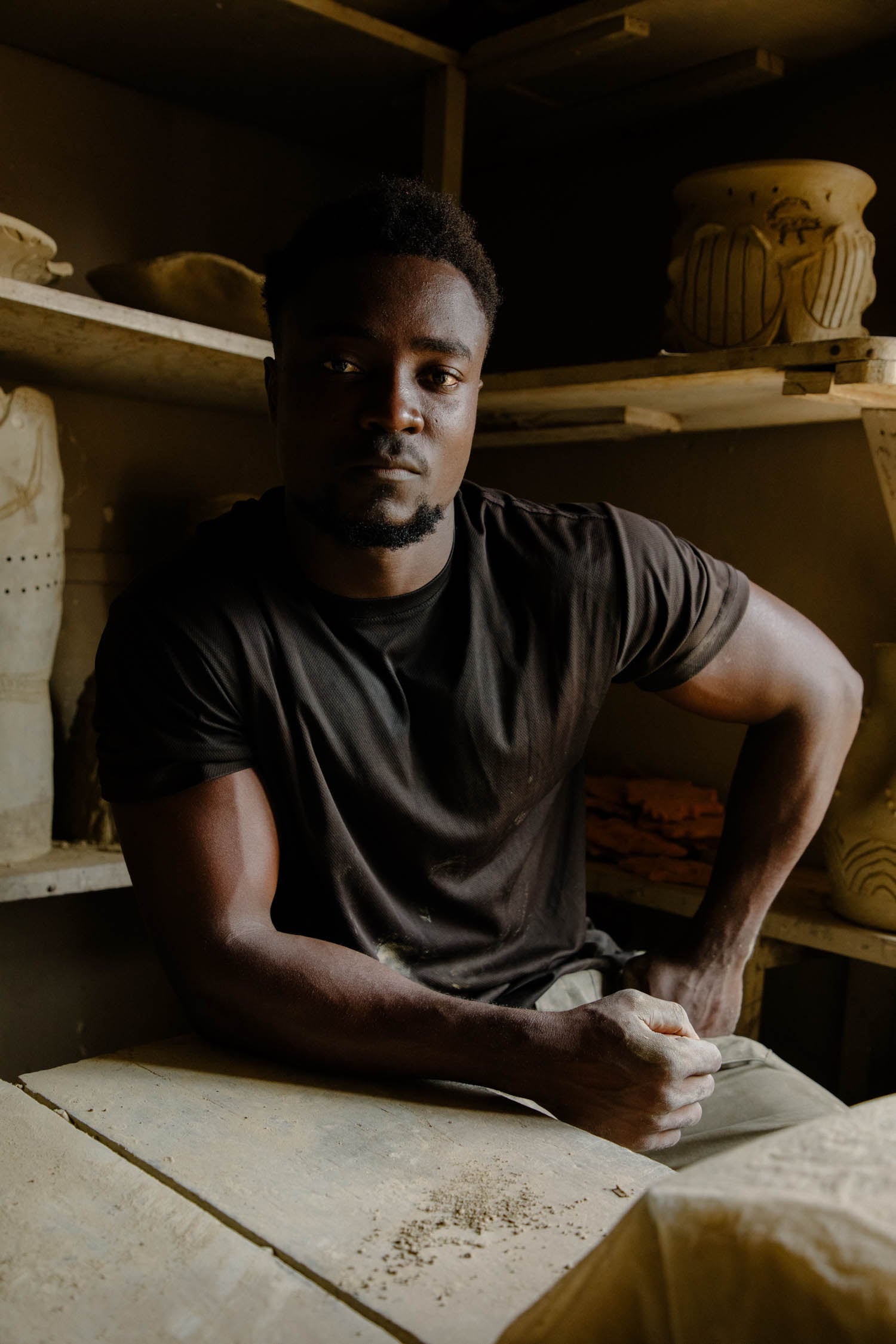
Interior Design sat with the Ghanaian ceramic artist to speak about his practice, his relationship with material and scale, and the ideas shaping his evolving body of work.
How Kobina Adusah Sculpts With Scale
Interior Design: When did your journey with ceramics begin?
Kobina Adusah: My journey with ceramics started during my senior year of high school. I studied visual arts and took courses related to design, art, and ceramics, so I already had some exposure early on. By the time I was preparing for university, I had a basic understanding of materials and form. When I applied, I actually wanted to study communication or graphic design. I was very interested in animation, branding, and making flyers but when my admission letter arrived, I had been placed in ceramics.
At first, I was disappointed. I even thought about changing courses, but eventually I decided to accept it and commit fully. I already had some background in art, so I told myself I wouldn’t fumble too much. Looking back now, that decision changed everything for me. I spent four years at Ghana’s Kwame Nkrumah University of Science and Technology. After graduating, I stayed for another year as a teaching assistant. That extra year was important. Teaching helped me understand clay more deeply; it forced me to explain processes, techniques, and decisions, which made me more confident in my own practice.
ID: At what point did you realize ceramics could be a serious career for you?
KA: From the beginning, I came in with a mindset of wanting to stand out. Even in class, when we were given assignments, I always felt the need to push further. Not in a competitive or negative way, but I wanted my work to feel different. If we were asked to submit something small, I wanted to go bigger. If a technique was introduced briefly, I wanted to explore it deeply. I remember using slab construction in ways people around me hadn’t really seen before, and sometimes lecturers would ask where I learned a particular approach. That gave me confidence, it made me realize I could develop my own voice within ceramics.

ID: You’ve become known for making large scale sculptures that have this monumental feel. Why is that important to you?
KA: Scale allows me to spend time with a piece. I enjoy the slow process, building form by form, slab by slab. I often describe it as building a house, brick by brick. That method requires patience, and I like that discipline.
Even when lecturers placed size limits on projects, I often exceeded them. Sometimes it affected my grades, but I didn’t mind. I wasn’t interested in rushing or making something just to meet a requirement. I enjoy being in the studio. I don’t really enjoy distractions, I don’t even like football, so for me, the studio is where I feel most grounded. Large works also demand attention. They occupy space and ask viewers to slow down, just as I do while making them.
ID: Your approach to texture is very fresh, but it also evokes this sense of curiosity—for me, at least. Are there symbols you are trying to make reference to or threads you choose to add?
KA: Texture is very personal for me. When I was younger, my mother used to ask me to sew buttons onto shirts. It required focus. I didn’t realize it then, but it stayed with me. When I started working seriously with clay, I realized I could translate that same repetitive gesture into the surface. Clay is very malleable; you can press, layer, carve, and repeat movements. That repetition becomes almost meditative. I also draw inspiration from historical vessel forms, especially Greek amphorae. Those objects were used for storage: oil, water, grain but they were also symbolic. I think of my works as vessels too, not just in a functional sense, but emotionally and spiritually. The surface is my signature.
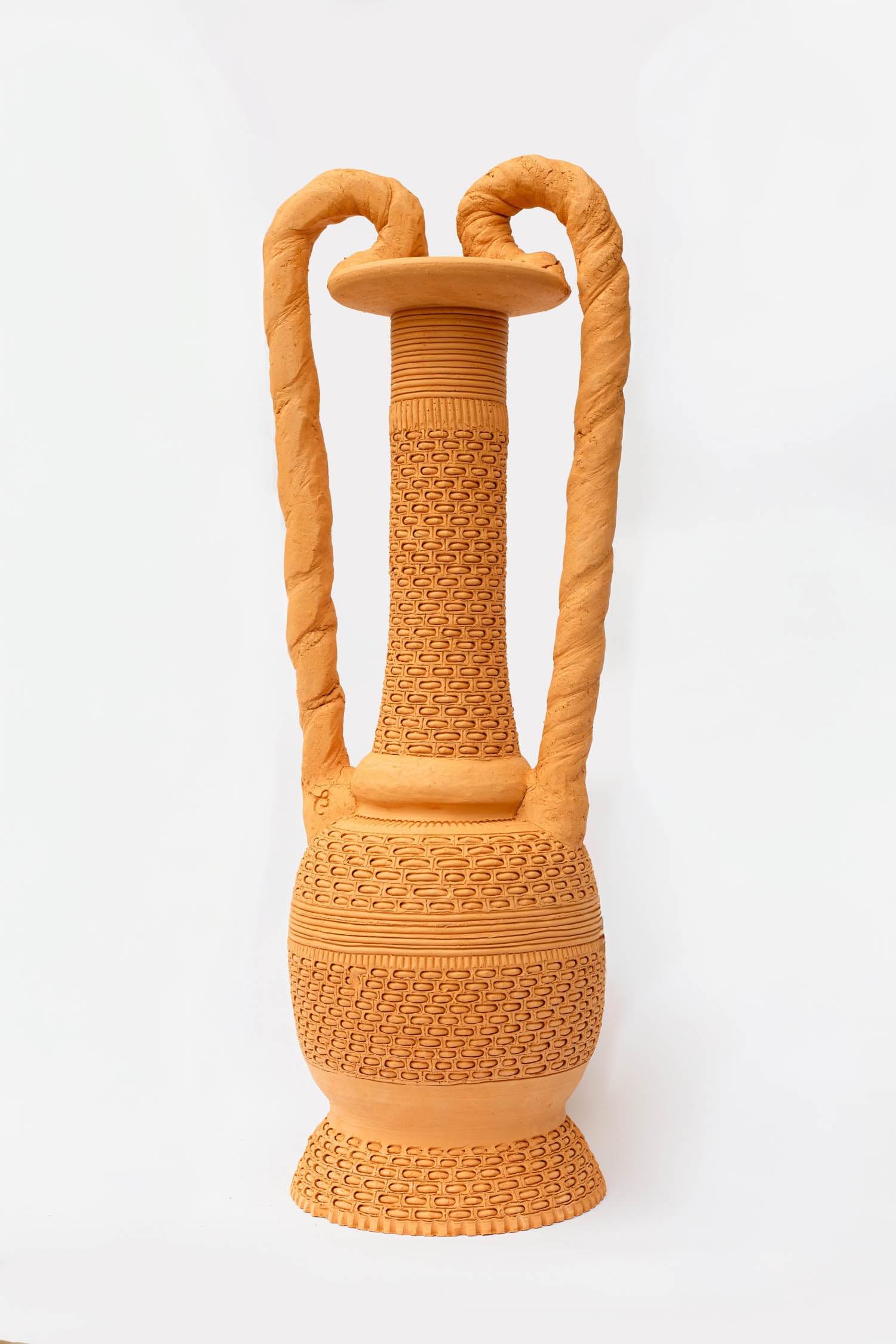

ID: Do you tell personal stories through your ceramics?
BA: Yes, very much. Before I entered university, my parents divorced, and that experience affected me deeply. Growing up without my father shaped how I saw the world and myself. That emotional weight stayed with me, and clay became a way to process it. I prefer telling stories that are personal rather than invented. When the story comes from lived experience, the work feels more honest. It allows me to speak freely through form, texture, and scale.
ID: Do the symbols and markings on your work have fixed meanings?
BA: Earlier in my practice, I used more recognizable symbols inspired by Ghanaian visual language. Some of those works were even selected for exhibitions like the Loewe Foundation Craft Prize. But as my practice evolved, I started developing my own language. Now, many of the marks don’t have fixed meanings yet. They come from feeling and more of a research cypher. Sometimes people say the patterns look Japanese or calligraphic, but for me, they’re intuitive. They help balance the rhythm. I think meaning can emerge over time. Right now, it’s part of an ongoing research process rather than a final statement.
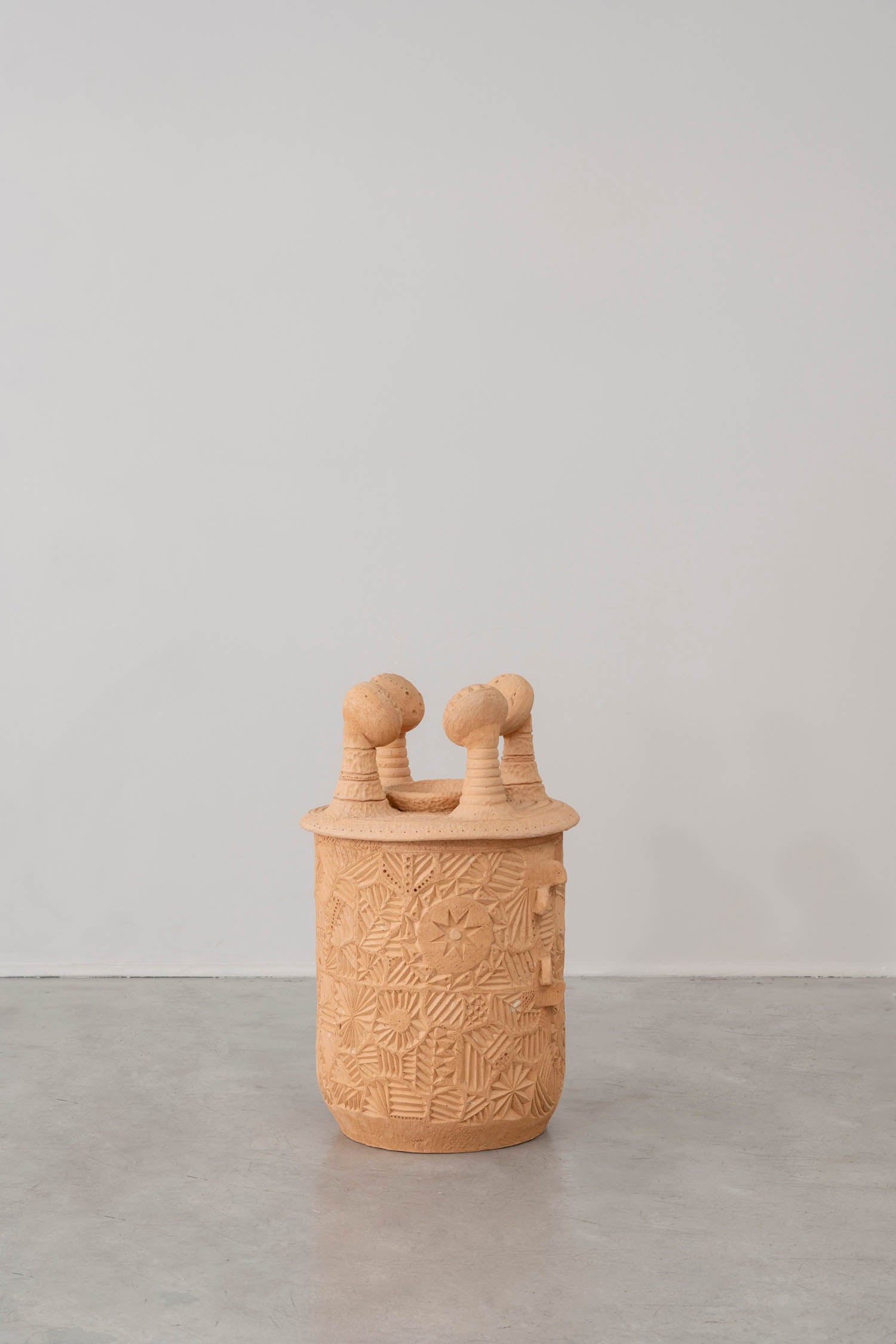

ID: Your work feels more spiritual and ancestral.
BA: That’s intentional. Lately, I’ve been researching ancestry, rituals, silence, and memory. Clay has existed for centuries, it has witnessed human history, movement, and transformation. I think about footprints a lot. When people walk through space, they leave traces behind, even if they’re invisible. My vessels act as containers for those traces. They hold memory, emotion, and presence. I like to think of them as objects that connect the past, present, and future.
ID: You mostly work with clay, but are you open to working with other materials?
BA: Very open. I’m especially interested in wood right now. It’s lighter and allows me to work at a large scale without the weight and fragility of clay. I’ve been studying wood-turning techniques and how surface textures can be translated into wood. Bronze and glass also interest me, but they require heavy machinery and resources. Wood feels more immediate and accessible at this stage of my practice.
ID: As a ceramicist who makes large-scale works, do you go through the process of sketching your works or do you let your process guide you instead?
BA: No, I don’t sketch. Everything starts in my head. I prefer letting the work evolve naturally. Sketching fixes ideas too early for me. I want the piece to remain flexible but also because as I work, new ideas emerge, and I respond to them in real time.
ID: You have a forthcoming exhibition at Gallery FUMI London, tell us about it?
BA: I recently showed work in Togo, and some pieces were also presented in San Francisco. And yes, I’m currently finishing another series that builds on this same research. All of the exhibitions I’ve done feel like a continuation rather than a conclusion. I’m currently preparing for an exhibition titled “Inherited Beings,” which will be a continuation of this conversation I have started on migration and fragility.
read more

DesignWire
Designers And Manufacturers On The Move: September 2026 Edition
Interior Design‘s latest On the Move includes must-know industry promotions and hires, like Perkins&Will’s strategic move to expand its design capabilities.
DesignWire
10 Questions With… Artist and Designer Conie Vallese
From sculpture and ceramics to glass, textiles, and furniture, Conie Vallese embraces a multidisciplinary practice shaped by curiosity and creativity.