
10 Questions With… Multidisciplinary Artist Oksana Levchenya
Before Oksana Levchenya began what she calls her second life as an artist, she was a surgeon who spent years in medicine and was working toward a PhD. But her career trajectory changed when she resolved to pursue art, leading her to study painting, design, and architecture in Kyiv, Ukraine.
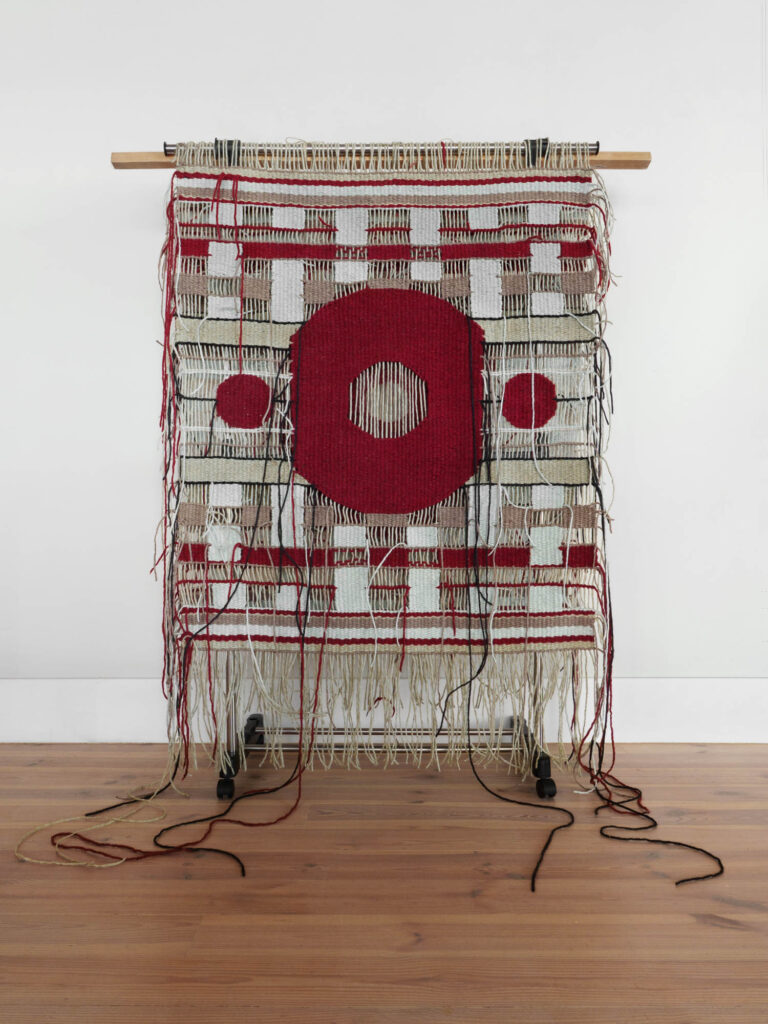
Levchenya’s turn to textiles was, in many ways, personal. Kilims—flat-tapestry woven rugs—occupied a near-sacred place in Ukrainian cultural memory, she says, noting they were among the first objects lost in moments of displacement and exile, and among the first sought again in acts of return. For Ukrainians, kilims were more than decorative artifacts, having served as markers of belonging and communal identity in a country repeatedly subjected to forced erasures, particularly under Soviet communism’s drive toward cultural homogeneity.
Honoring that tradition, Levchenya makes patterned masks, flat-woven carpets, and tactile sculptures that speak to her culture, transforming traditional Ukrainian craft into contemporary works that preserve memory while resisting cultural erasure.
What perhaps makes Levchenya’s practice especially distinct are two defining qualities. First, it’s multidisciplinary scope, spanning painting, sculpture, photography and video installation, each medium informing the other. Second, is her extraordinary manipulation of color illusion. Through intricate gradations and compositional precision, she transforms yarn into something unexpectedly painterly, allowing thread to function almost as pigment.
Oksana Levchenya Talks Surgery, Textiles, And More
At the moment, Levchenya is expanding the material language of her practice. She is currently working on a panel composed of thin, dyed recycled textiles, having recently completed a work that brings together wool and iron wire. Another piece she is completing combines wool, metal and found materials, evoking what she describes as an anthropological dimension; an exploration of memory, survival and the traces left behind by human experience.
These new works arrive in the shadow of war. For a long time, Levchenya says, the ongoing conflict in Ukraine left her unable to express herself artistically. Only recently has she found a way to speak through her work again. Levchenya speaks with Interior Design, reflecting on her decade-long practice, intersections of craft with memory and cultural survival, and how her work transforms traditional Ukrainian weaving into a contemporary language of form and meaning.
Interior Design: How did your journey as a textile artist and designer begin?
Oksana Levchenya: From childhood, I felt equally drawn to both science and art; ultimately, medicine claimed priority. I graduated from the National Medical University with a specialization in surgery. After several years in medicine, while working toward my PhD, I resolved to live a second life as an artist. I completed a course in painting under the guidance of Oleksandra Prakhova, and went on to study design and architecture, thus embarking on my career in the arts.
Before I became interested in design, I had already completed a number of painting projects and participated in prominent international and local exhibitions as a painter. I sought to bring art into dialogue with craft practices intrinsic to different regions of Ukraine, recognizing in craftsmanship a kind of universality, an intergenerational continuity through which cultural codes are transmitted from ancestors to descendants. My search led me to the origins of Ukrainian object design. In a country like Ukraine, which endured a profoundly traumatic integration into the Soviet Union, lineage and folk art carry exceptional weight. They are, quite literally, a condition of survival for an entire people. I discovered textiles as a medium for articulating the eternal within the everyday.
ID: Describe your background, growing up and how that shaped your artistic career now?
OL: Our family history carries memories of exile and political repression; my ancestors repeatedly built their fortunes only to lose everything again. As a result, we were raised with a strong emphasis on education and self-development, things that cannot easily be taken away.
My mother was compelled to leave me in the care of her sister, a physician, during my early years in order to pursue her own career as a surgeon. I grew up feeling somewhat solitary among others, with an irrepressible and restless nature. I always needed multiplicity in how I expressed myself. Sport, drawing, and an intrinsic curiosity for science merged into a continuous rhythm of living. I excelled both in biology competitions and in art contests.
Some of my warmest childhood memories are of making toys from medical gauze and doing handicrafts with my cousins. The periods I spent living with my biological mother are marked by a particularly intimate, almost mystical sense of unity with her during sewing and craftwork.
I believe it was precisely this sense of making, working with hands, the tangible presence of a completed form, that first drew me toward surgery and ultimately shaped my choice of profession. In surgery, I found a convergence of inheritance as a bond with my mother, biology as the science of life’s mysteries, and craft as a way of connecting with ancestral continuity beyond the immediate structure of family.
ID: What about textile attracted you closely to explore it as a medium, why not clay or wood?
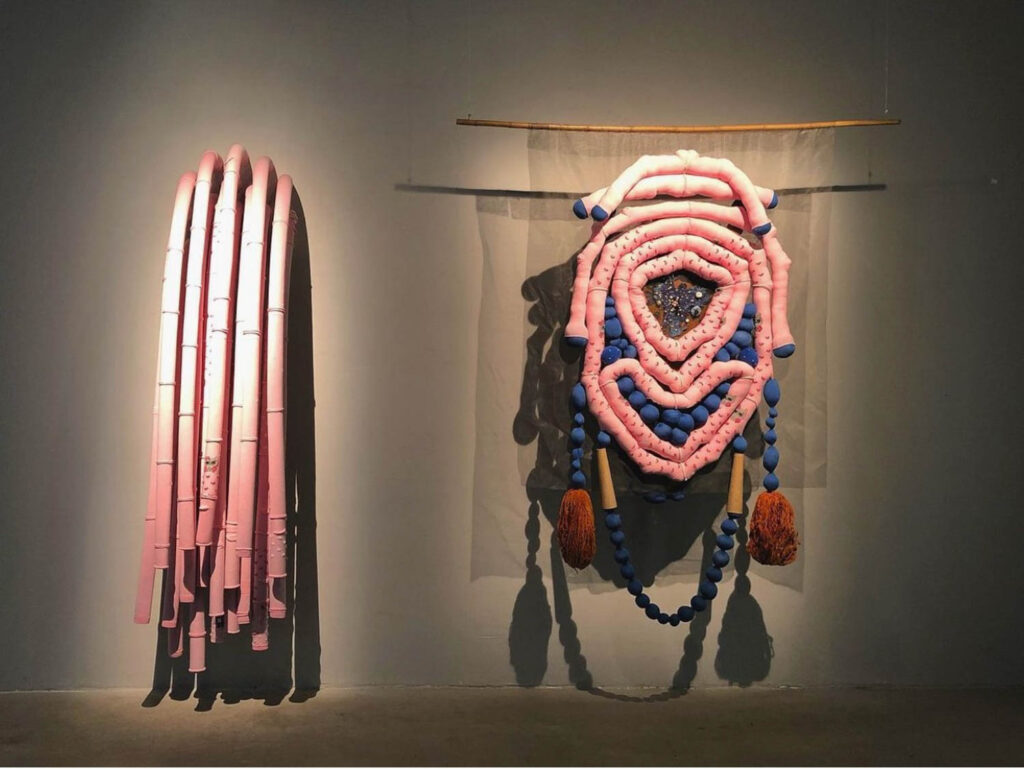
OL: I did not want to confine myself to a single medium, yet I became fascinated by the adaptability of textiles, their capacity for transformation, and at the same time their inherent transience as material. I was drawn to their tactility and their almost maternal quality. It is the first material that meets a newborn, and the last to accompany us on our final journey at burial.
Equally important to me is working with my hands: my hands seem to possess their own form of intelligence, emerging from something subconscious, inherited, and not entirely knowable. I distinguish between works developed from sketches or inspired by folk ornamentation in collaboration with traditional craftspeople, and those made entirely by hand, from the first stitch to the last.
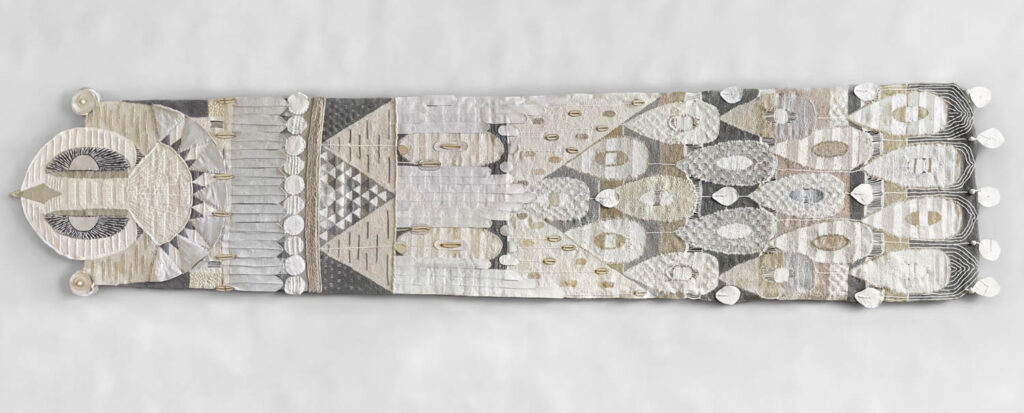
In my personal practice, I never begin with a preparatory sketch; I trust the hands as a distinct kind of intellect. If I were to define their visual language, I would describe it as the attributes and objects of an imagined human tribe, belonging at once to universal ancestral memory and to our speculative descendants in a distant future. [I am referring to totems and textile panels].
ID: One of the beautiful aspects of your craft is its deep-rootedness in your Ukrainian tradition. How did that influence your work and why did you want to showcase that?
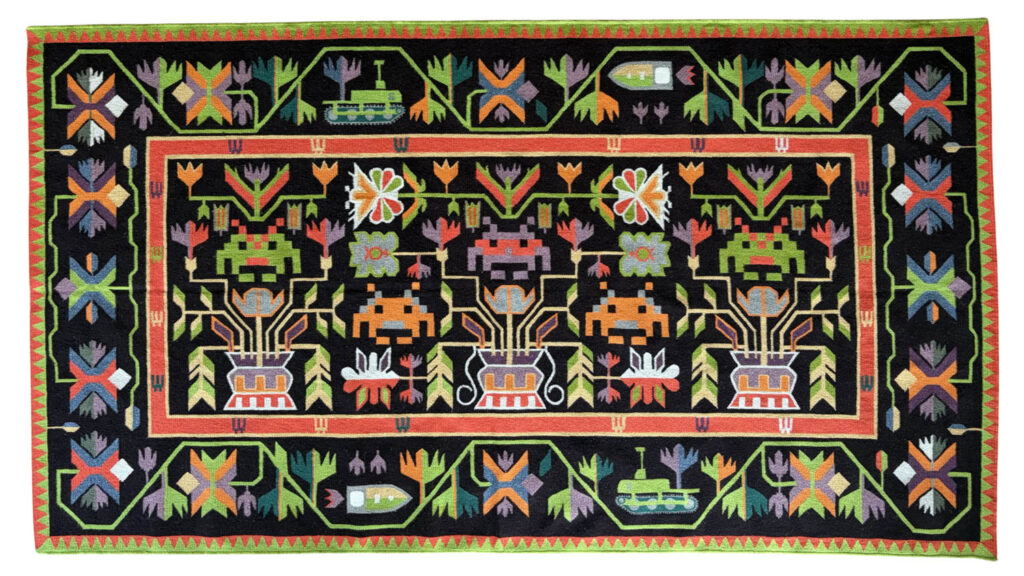
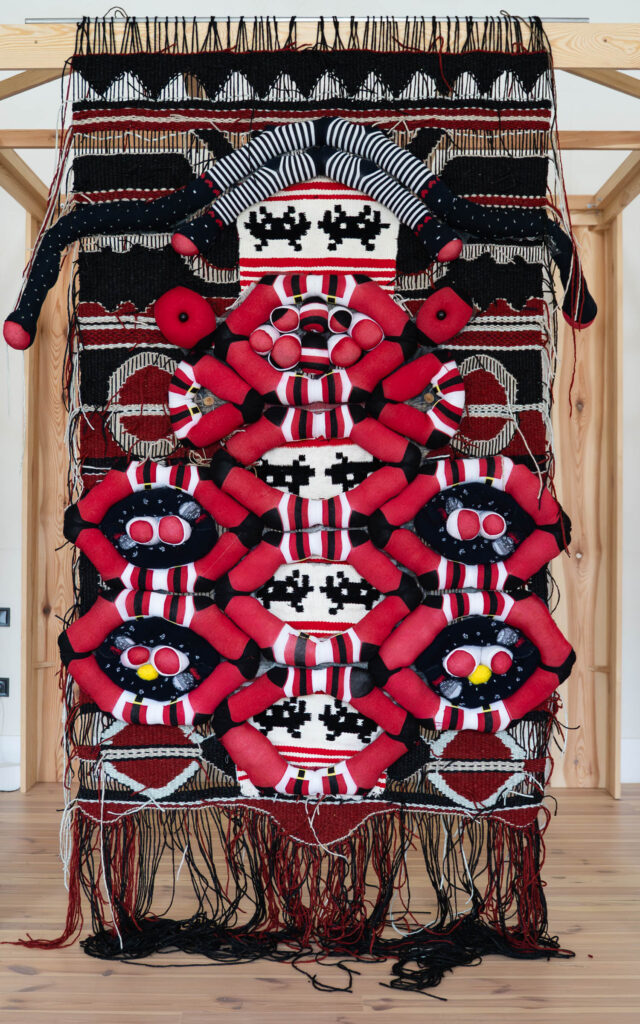
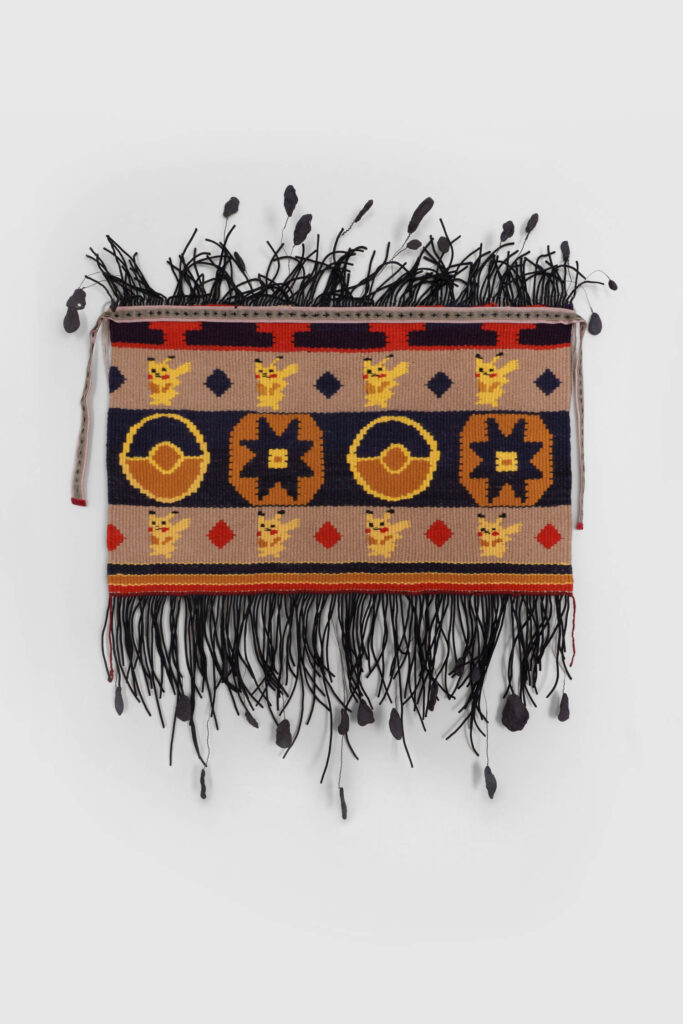
OL: Tradition is most present in the works where I attempt to reimagine it, reframing it and infusing it with new meaning through the juxtaposition of folk ornamentation with contemporary characters and symbols. Each work deserves to be discussed individually, yet I would highlight a few particularly significant ones: transformed Soviet-era propaganda carpets into which I have ironically integrated images of Homer Simpson, Master Yoda, Pac-Man, and the Space Invaders, replacing the portraits of communist leaders. This series is conceived to, through irony and historical paradox, provoke a sense of critical distance and skepticism toward any ideology that seeks to override or suppress reason.
ID: Do you see your pieces as design objects, artworks, or both?
OL: I believe that history will ultimately define this. My intention is to express myself in time and to manifest thought in material form; how it is interpreted, and to which field it is assigned, I leave to the discretion of viewers and specialists. On a personal level, categorization often feels limiting, it seems to diminish potential and constrain meaning through definition and classification. Objects, in my view, should be capable of speaking for themselves.
ID: Your work includes masks and sculptural forms, where did that come from?
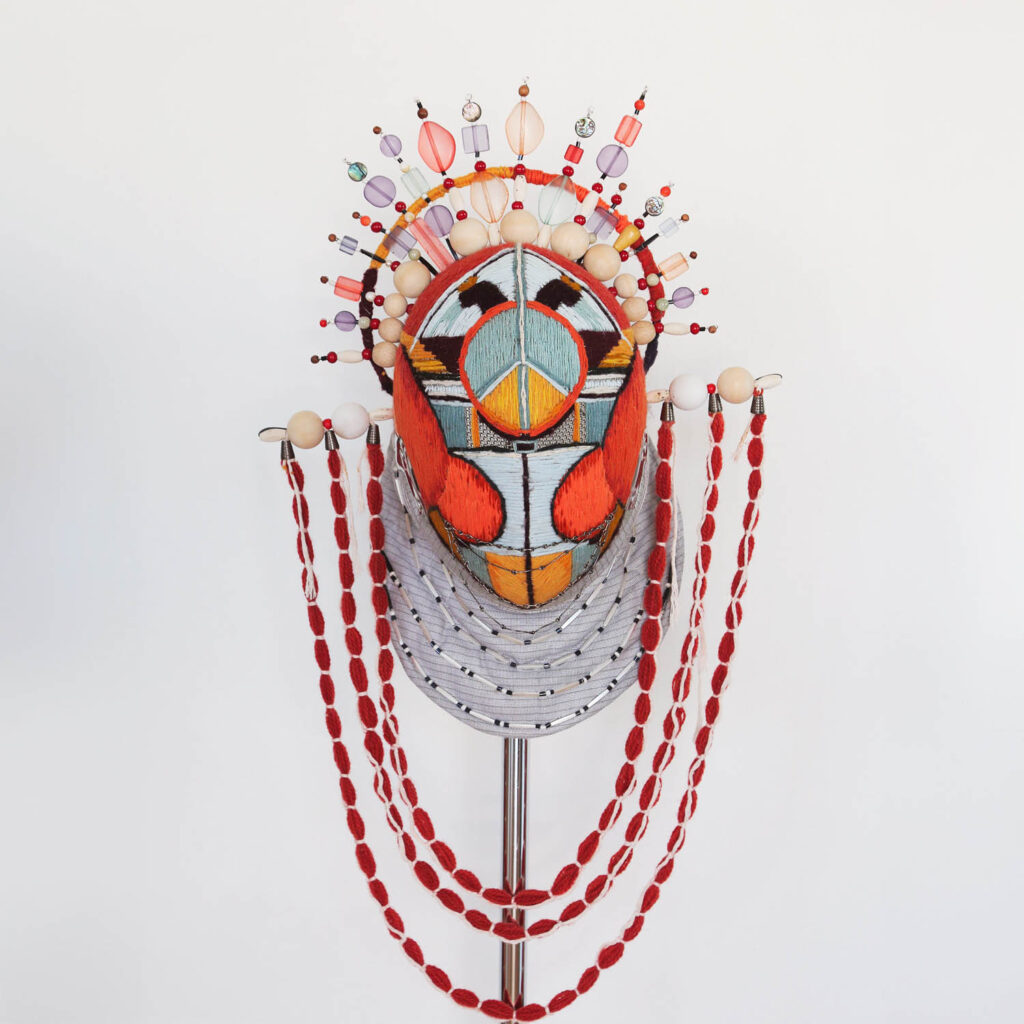
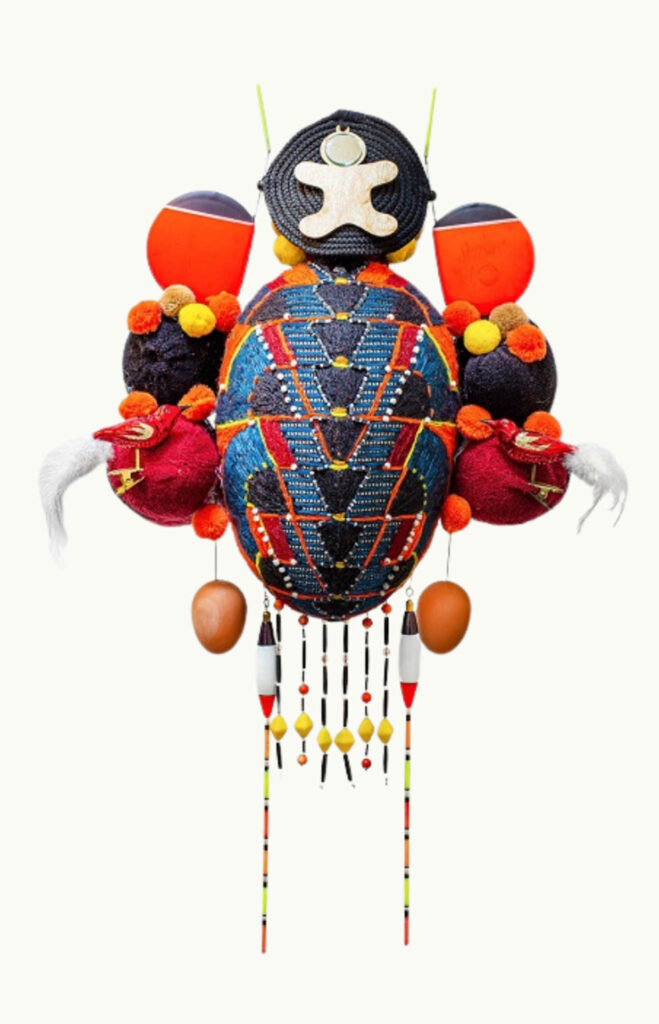
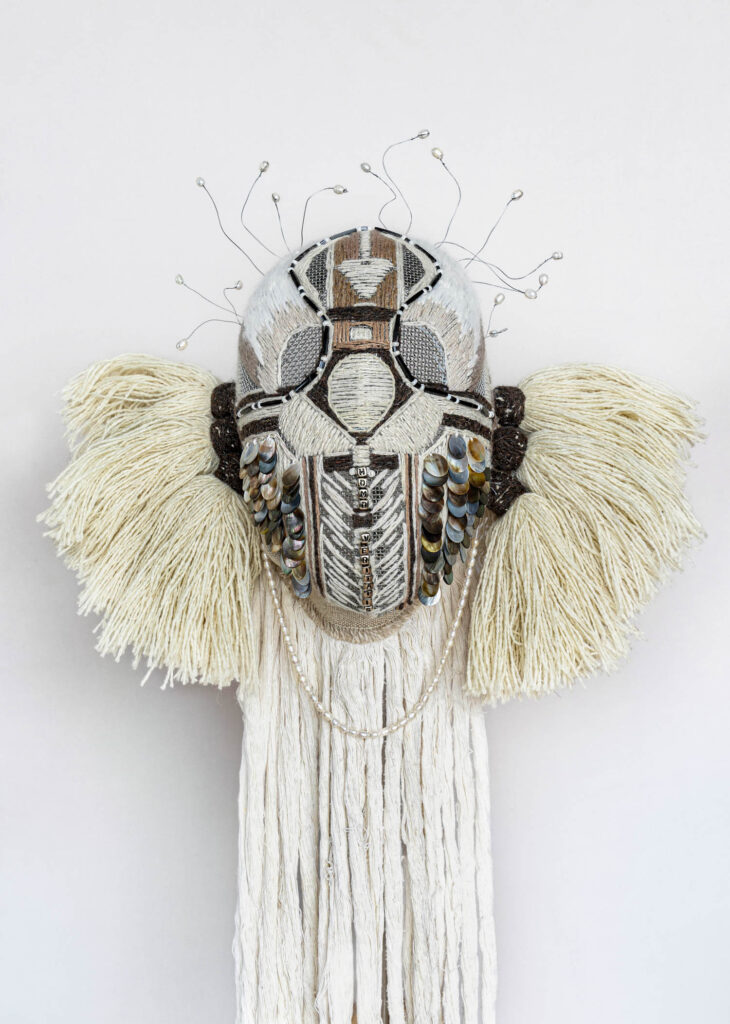
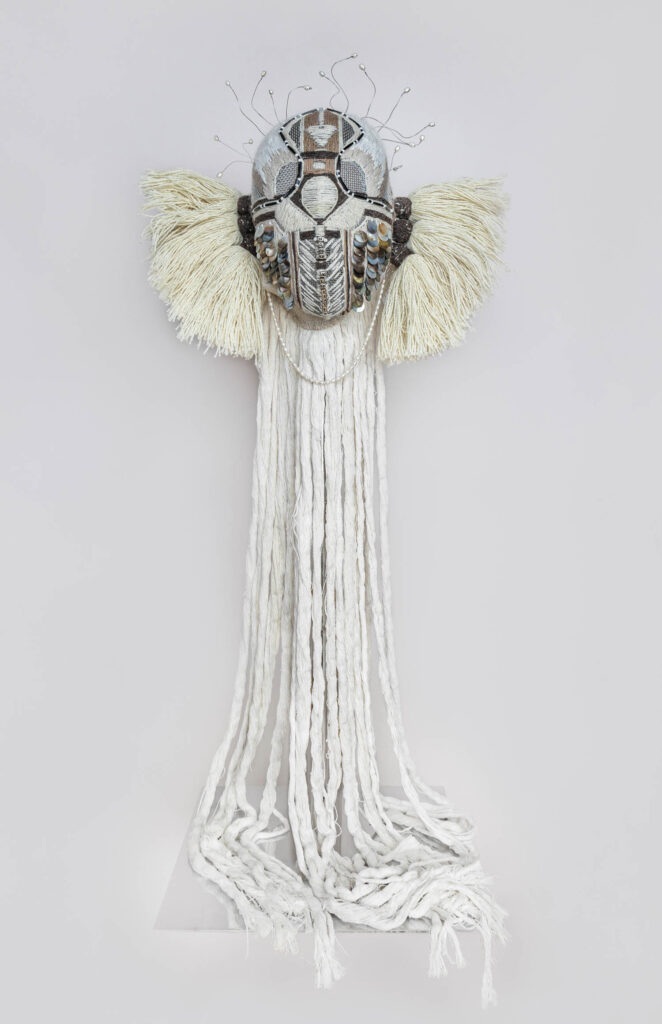
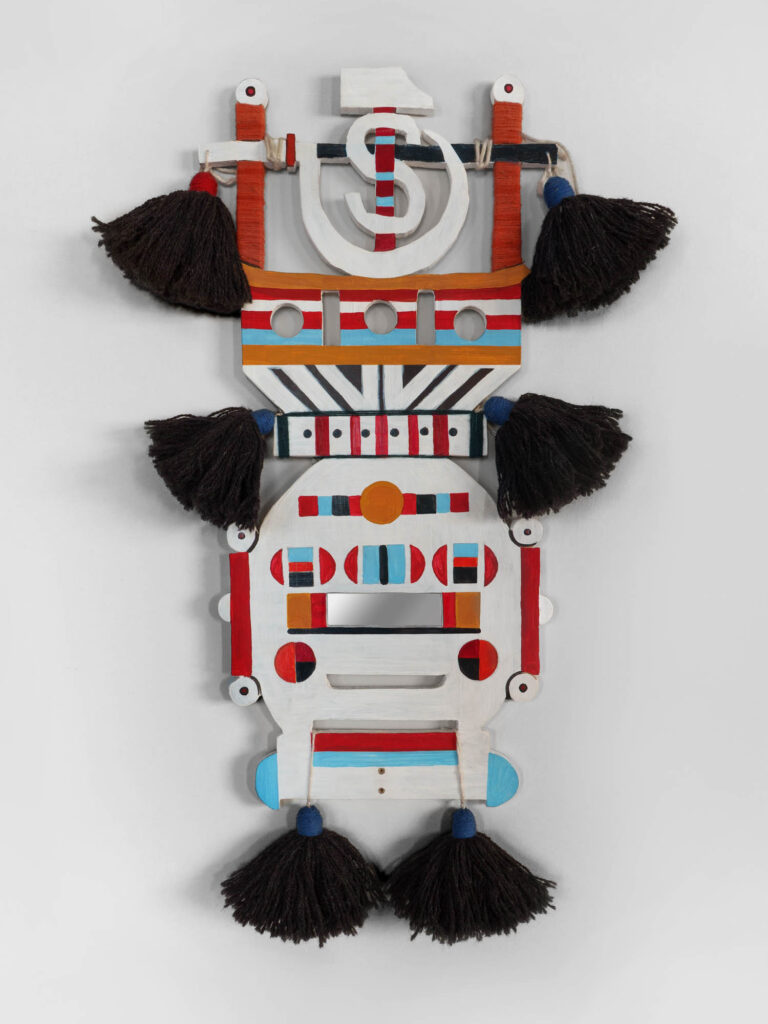
OL: These are objects from the project Imagined Tribes or Non Existent Tribes. Through it, I sought to embody the idea of self-expression beyond the stereotypes of any single group. These are individualities that construct themselves outside of collective identities, coming together only within humanity as such. Literally, they take the form of masks and ritual attributes of an imagined, fictional tribe, one without fixed groups, existing instead as a constellation of irreducible individuals. I believe that grouping people according to specific traits lies at the root of stereotypical patterns of behavior and ultimately divides people into “us” and “them.” This idea deserves a separate discussion; it stems from biological evolution and the behavioral patterns of humanity as a species.
One of these works is the mask Nomen–Phenomen, also referred to as Homo Faber. Its origin is rooted in my childhood. My uncle, a distinguished surgeon, in whose household I grew up—possessed extraordinary erudition and considered me his student, a role I was deeply grateful for. Our relationship continues to this day, and I owe much of my intellectual formation to our conversations and his guidance. To return to the story: one of the recurring themes of our discussions in my childhood was the concept of Homo Faber, the human as a maker, a being defined by creation, which later became the conceptual foundation for one of my masks.
ID: Your work plays on traditional symbols that we might not understand but you embed them to propel the story, yes?
OL: I remain continually astonished by the richness and profound symbolism embedded in traditional signs. At the same time, one of my preferred gestures is to incorporate my own hidden meanings and codes into the work. As in the mask described above, I often introduce signs and symbols that define the essence of the object, its conceptual manifesto. For instance, in the panel Beregynia, ceramic inlays appear bearing the letters ATGC. These are the initial letters of the nucleotides that encode all amino acids in the human organism. Their sequence constitutes the language of the genetic code. In a way, they store information much like the binary digits 0 and 1 in computer programming.
This represents one of the most extraordinary examples of the universality and precision of biological form, and of the deeper mystery of life itself. These four letters, and their permutations, describe all biological functions and construct the genetic code of the human being.
ID: Who has influenced your craft the most?
OL: I did not have reference models before my eyes. My choice of medium and my engagement with textiles emerged as an intuitive experiment. If I were to name the artists whose work has profoundly impressed me, they would include Marta Lukas, Magdalena Abakanowicz, and Joana Vasconcelos, Teresa Hastings, among many contemporary practitioners whose work astonishes me with its imaginative inventiveness and depth. If I were to describe the phenomena and processes that have shaped my inquiry, they would undoubtedly include biology in all its manifestations, the evolution of humanity as a species, and folk, naïve, archaic-mystical art traditions. Within molecular structures lies a form of aesthetics and harmony that humans have echoed in ornamentation for centuries.
ID: About the non-existent project, it’s a unique one, what inspired it?
OL: Imaginary or Non Existent Tribes is a project about a speculative humanity in which each individual constitutes their own personal tribe. I sought to explore the nature of conflict and opposition between human groups formed along various lines of identification, such as social status, race, gender, age, profession, and others. By moving beyond collective affiliation and toward individual self-presentation, a person gains the possibility of perceiving the shared conditions and questions that concern the human species as a whole. In other words, the articulation of oneself as an individual allows for a form of freedom from stereotypical group preferences, as well as from the mechanisms of manipulation and inherited patterns of thought embedded within them.
ID: You are the founder and CEO of OLK Manufactory, what was the mission and how has the journey been?
OL: I founded the studio in 2016. Its aim was to reimagine carpet-making as both an art form and a field of design. Everything began with my exploration of object design. Through reflection and experimentation, while attempting to use craft as a vehicle for my own ideas, I arrived at the Arts and Crafts movement, and was struck by the fact that as early as 1869, William Morris had already named and shaped a movement seeking to unite artists and artisans, thereby laying the foundations for decorative arts and design as a discipline.
This led me to study Ukrainian decorative traditions, where I was deeply impressed by the richness and diversity of techniques and approaches developed by figures such as Mykhailo Boychuk, Oleksandra Exter, Kazimir Malevich, and others who shaped modern visual language. The studio continues to operate today, though I have become increasingly drawn to uniqueness and intentional artificiality rather than large-scale production. We are gradually moving toward collectible design and limited-edition works, rather than mass-market production.
read more
DesignWire
11 Top Picks From Feria Hábitat València 2026
Highlights from Feria Hábitat València, which featured over 1,200 exhibiting brands spread across 110,000 square meters of exhibition space.
DesignWire
Designers And Manufacturers On The Move: September 2026 Edition
Interior Design‘s latest On the Move includes must-know industry promotions and hires, like Perkins&Will’s strategic move to expand its design capabilities.