
How AI Is Changing The Way Commercial Leaders Work
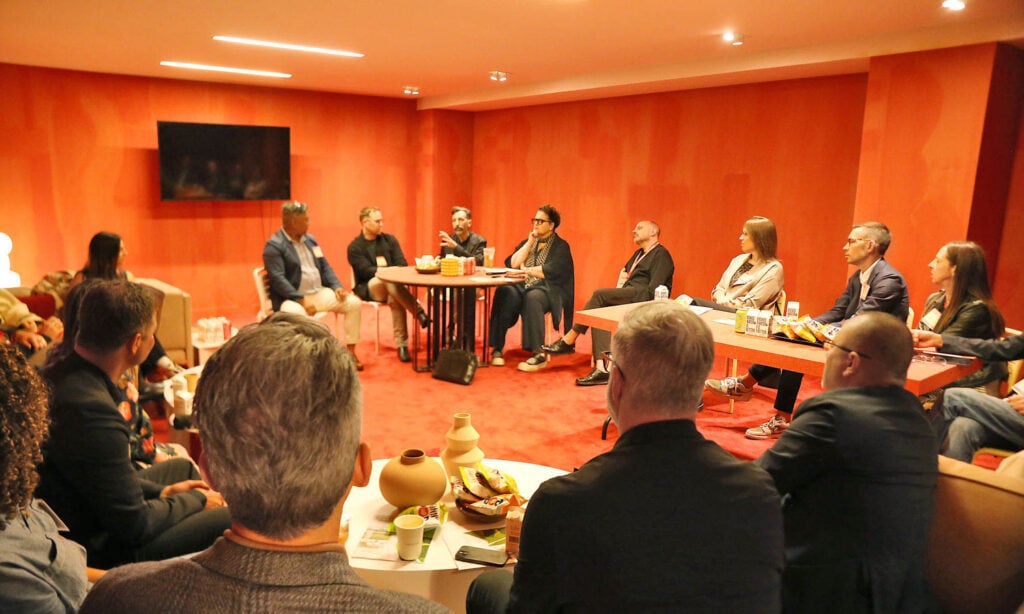
Artificial intelligence is here, heralding in an era of rapid change akin to innovations as monumental as electricity, designers agreed during Interior Design‘s Commercial Leaders roundtable at NeoCon held on June 8, 2026. Joined by nearly 20 commercial design leaders, Editor-in-Chief Cindy Allen started the discussion by noting that the conversation around AI is changing as quickly as the tools themselves, moving beyond a moment of speculation to the urgency of adaptation.
“Do we want to start with AI?” Allen asked the group gathered within a private area of SANDOW Design Group’s DesignScene lounge at The Mart. It didn’t take any further prompting to get the conversation going, as attendees weighed in on their use of AI platforms. From designers and senior leadership to clients and manufacturers, everyone involved in the design process brings their own approach to AI to the table.
AI Creates A New Language Of Design
“Clients live in a faster world, and they themselves are creating and producing their output faster,” shared one attendee. “We have not been able to keep up with that expectation until now,” he continued, stating that AI helps his team meet such demands. “For me, the value of AI for design is not in visuals, but it’s in the context and content [of a project].” He added that AI is, in fact, a language—its results are only as strong as the prompts put into the tools.
Aware of the need for strategic AI prompts, one designer said young hires are asking more articulate questions about what they’re trying to solve. “They’re doing that work versus some of the more mundane stuff they were doing before,” he shared. But another, who teaches graduate students, noted that younger generations also express skepticism toward the technology that has been present throughout their lives, equating the analog with authenticity. “I see people interested in making things and then using AI to clarify the message they want to deliver,” he shared. “They are cautiously embracing it.”
Ultimately, the group agreed that building client relationships and delivering innovative ideas remain at the heart of the job. “We have to spend more time building relationships—there is more emphasis on building trust,” offered one participant. This rings especially true in the age of AI, when clients are creating their own renderings with free digital tools. “We see a trend of polarization with client requests coming in very different ways,” said another. “We need to validate all of those and say: This is what you want to do, and this is how you will get there.”
Talent And Retention In The Age Of AI
AI also raises questions about ownership and, with that, about what the A&D profession will look like in the not-so-distant future. “Right now, we trade in documentation—what if documentation goes away?” asked one participant, who noted that the tools will not make CAD more efficient; rather, they will enable designers to skip that step entirely. If this is the case, many traditional A&D roles could disappear. “We are at a dangerous inflection point,” said another. “We need to move away from selling hours and toward selling value.”
As the field adapts to new technologies, there is a disconnect between what young people are learning about architecture and design in universities and the job market they then enter after graduation. “Are we being authentic to young people by telling them to stick it out?” reflected one designer, who noted that RFPs have been “bonkers.” He has been told by loyal clients that they are essentially reusing a design deck from one project to guide another, allowing them to skip the designer-client step. Despite this, the designer noted that even these clients are returning, saying: “I can’t figure out this really important question on my own.”
But young designers, including some in Interior Design‘s 1st NeoCon cohort (a program that offers them an opportunity to experience the show and meet with top brands) are expressing fear and uncertainty around where the profession is heading. “A lot of the designers said, ‘We love design, but how can we grow and not have to change careers completely?’,” shared one attendee, noting that they are also concerned about rising costs of rent in major cities.
In response, the room agreed that those at every level of the design process need to rethink how they approach—and hire for—their work. “I think there has to be a restructuring—the old ways of bringing people up through the system are hard,” said one commercial leader. “We need to hire with different intent, looking at different skillsets, like critical thinking.” To this, another noted the value of people skills, which some young designers lack. “I want an architecture school to also teach acting,” he said, noting the value in articulating ideas with confidence. “I want people who can light up a room.”
Passion Drives Design
In a changing design landscape, the group agreed that passion and drive set apart those who have what it takes to lead the industry forward. “When we see drive, we step in and put the accelerator on because those people end up being the role models for those around them,” one participant said. “One of the things we talk about as a company is that as leaders, we need to get our people to fall in love with the pursuit,” another said. To this, the group agreed that explaining the “why” behind decisions matters more than ever.
As AI continues to change how designers work, taking a broad rather than a nuanced approach to processes may prove beneficial. “The opportunity today is to expand our influence—not to focus it,” said one participant. “We’re focusing on one thing slipping away, which is production, but the edges are where the real value is. How do we point our value away from the middle?”
Ultimately, like any other disruption, AI asks designers to innovate—a principle that continues to drive the profession. One attendee concluded: “This is about designing the future, and we do it every day.”
A very special thank you to our Commercial Leaders event partners: Artistic Tile, Garden on the Wall, Kimball International, Keilhauer, Parador, and Turf.
Editor’s note: See our latest news and coverage from NeoCon 2026.
read more

DesignWire
10 Questions With… Sculptor Aminata Mboup
Aminata Mboup discusses her practice, inspirations, fluidity between disciplines, as well as her unique approach to materials.
DesignWire
10 Highlights From Amman Design Week
Amman Design Week 2026 gathers a host of regional designers and architects under the theme ‘Accumulations.’