
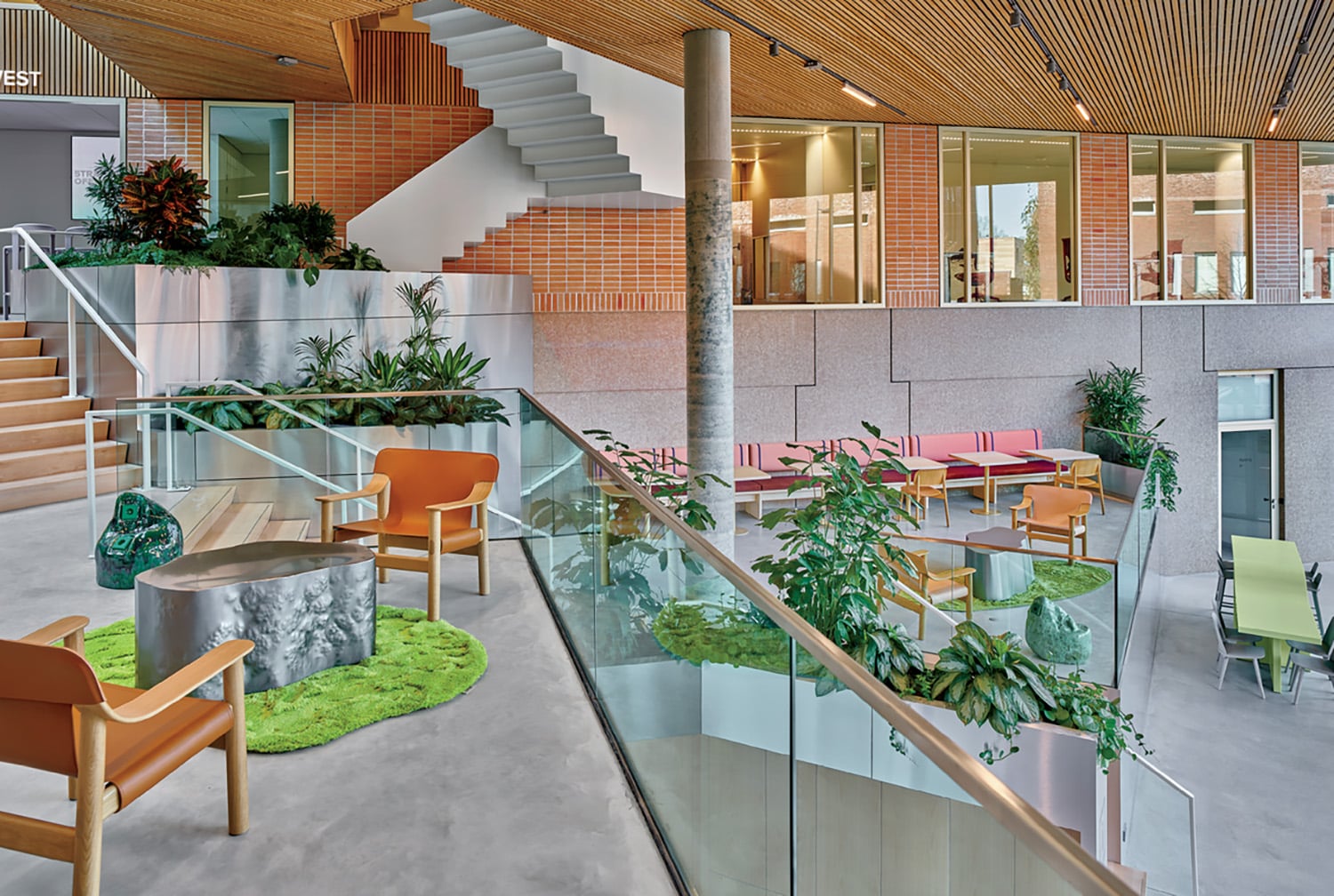
How Biophilic Design Shapes This Coworking Hub In The Netherlands
As the website of Dutch Invertuals proudly declares, the studio is “unconstrained by ‘the way things are done.’” Founded by Wendy Plomp in 2009 as a collective of Dutch designers—hence the moniker, which includes a portmanteau of inverted and individuals, signaling the group’s experimental ethos—it has evolved into a three-person multidisciplinary practice based in Eindhoven, supported by a network of collaborators across Europe and beyond, several of whom are graduates of the city’s eponymous Design Academy.
The firm approaches every assignment with curiosity and candor, unafraid to rip up the rule book and start afresh. Recently, it has been deconstructing and reimagining an entire system—the workplace—catalyzed by the pandemic-era rise of remote, solitary work, to which many people have now grown accustomed. But as design director Plomp points out, the arrangement is not necessarily good for us. Exiled from the communal workplace, “you don’t feel, you don’t touch, you don’t experience the environment or enjoy the spontaneous coffee moments,” she observes—and that’s a problem, one addressed in an exhibition Dutch Invertuals presented during Milan Design Week in 2023. “Objects for a New Kind of Society: The Way We Work” featured contributions from 10 designers in the studio’s network exploring how new applications and emerging technologies are boosting productivity and efficiency even as they alienate us from the jobs we do.
Dutch Invertuals Designs A Biophilic Coworking Hub In Breda, The Netherlands
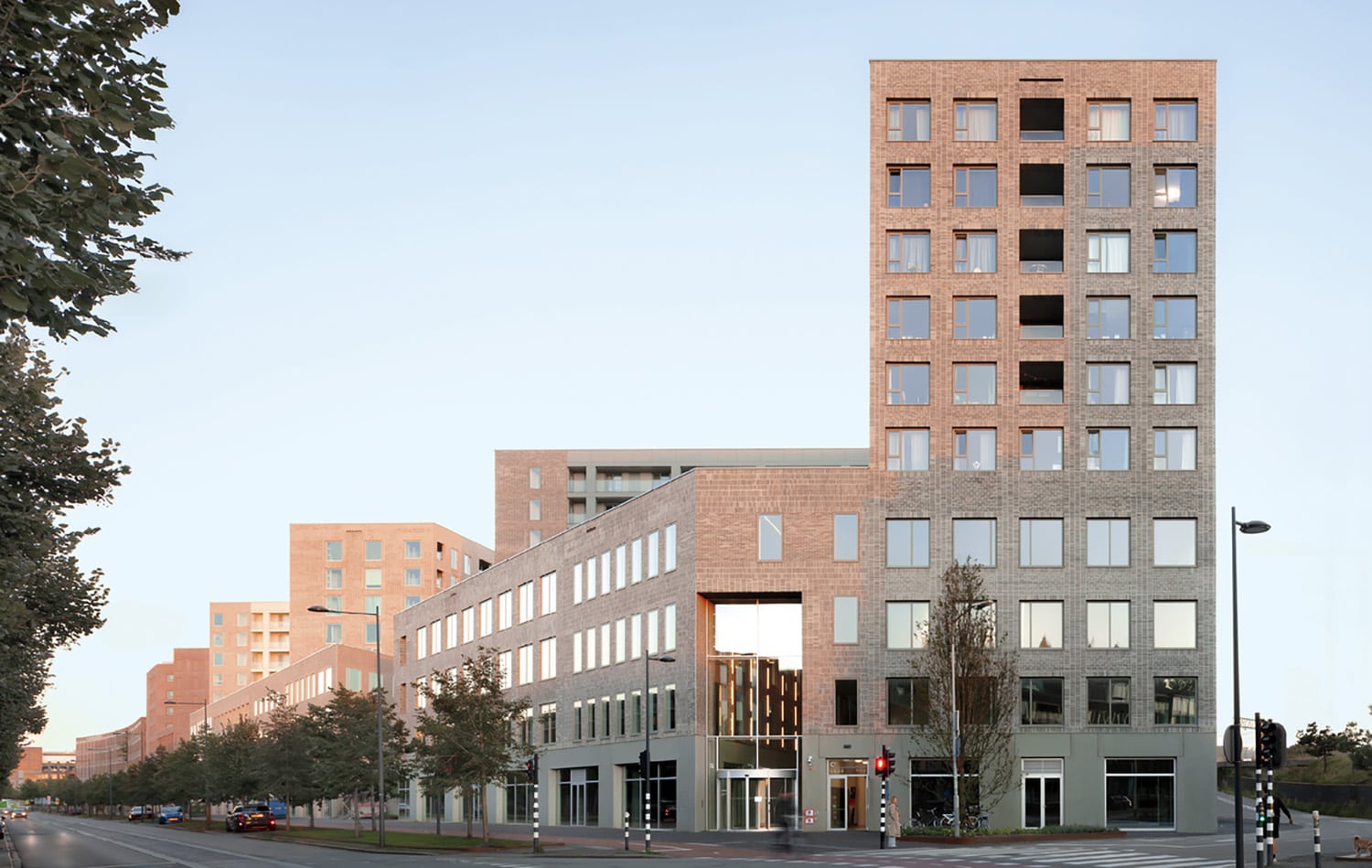
Concepts and products generated by that exhibition—transformed “from abstract ideas to new form languages,” as Plomp puts it—have found their way into 5Tracks, a new mixed-use development near the central train station in Breda, the Netherlands. Named for the railway tracks it sits beside, the complex comprises three triangular reinforced-concrete buildings clad in brick and glass by Powerhouse Company and Shift Architecture Urbanism. They house residential apartments, a hotel, and retail and hospitality spaces, as well as roughly 168,500 square feet of office real estate arranged around large central atriums in two of the buildings, dubbed Platform_B and Platform_C.
Initially brought on board to provide critical insights into the use of shared spaces in these two structures, the scope of Dutch Invertuals soon expanded to include outfitting the atriums and adjacent common areas as flexible coworking, meeting, and relaxation environments for tenants and visitors. The development’s identity centers on five themes—hybridity, connectivity, creativity, wellness, and new rituals—which guided the designers’ conceptualization. “We always try to dive into the identity and function of the space,” Plomp asserts.
Biophilia Meets Infrastructure In This Coworking Hub
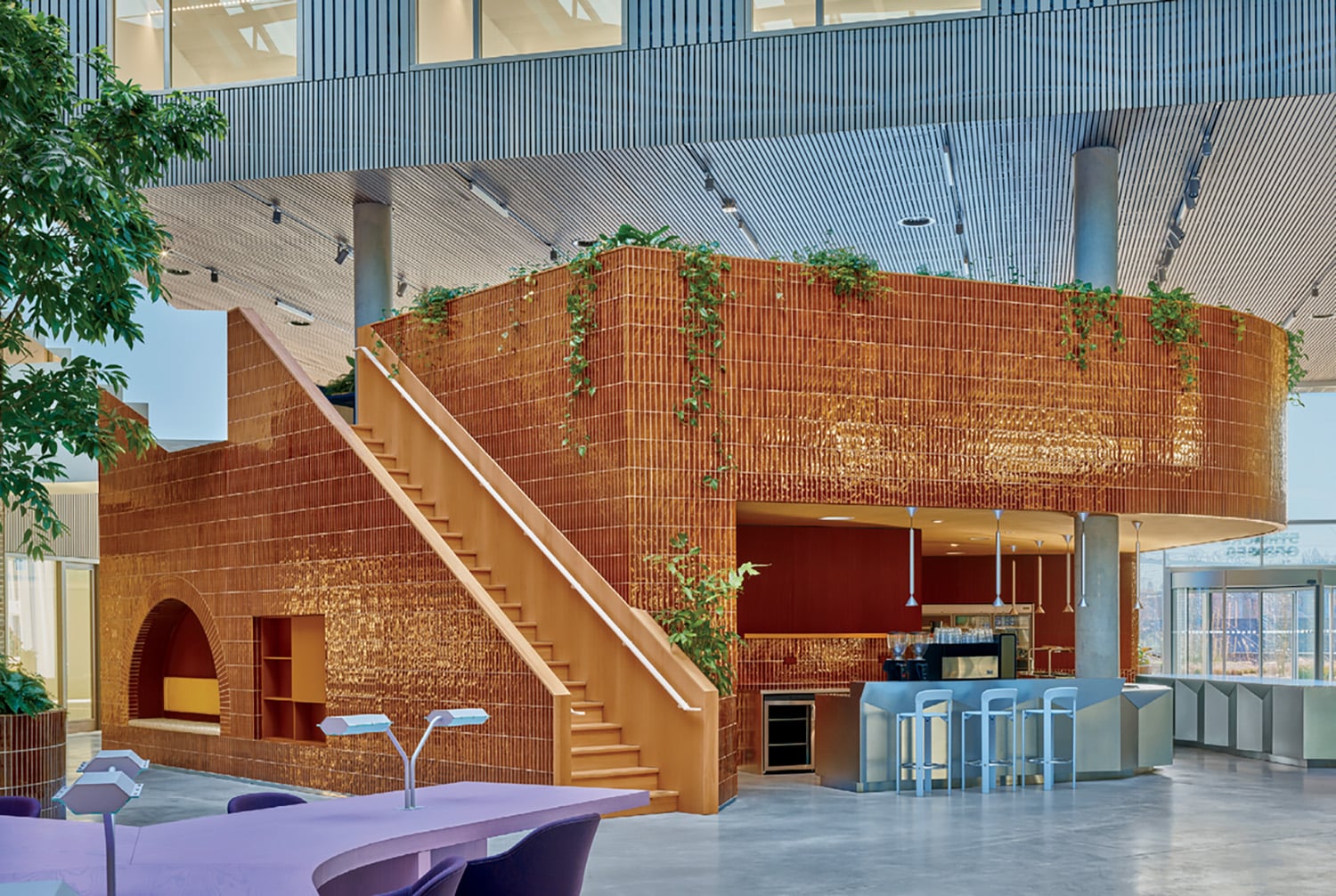
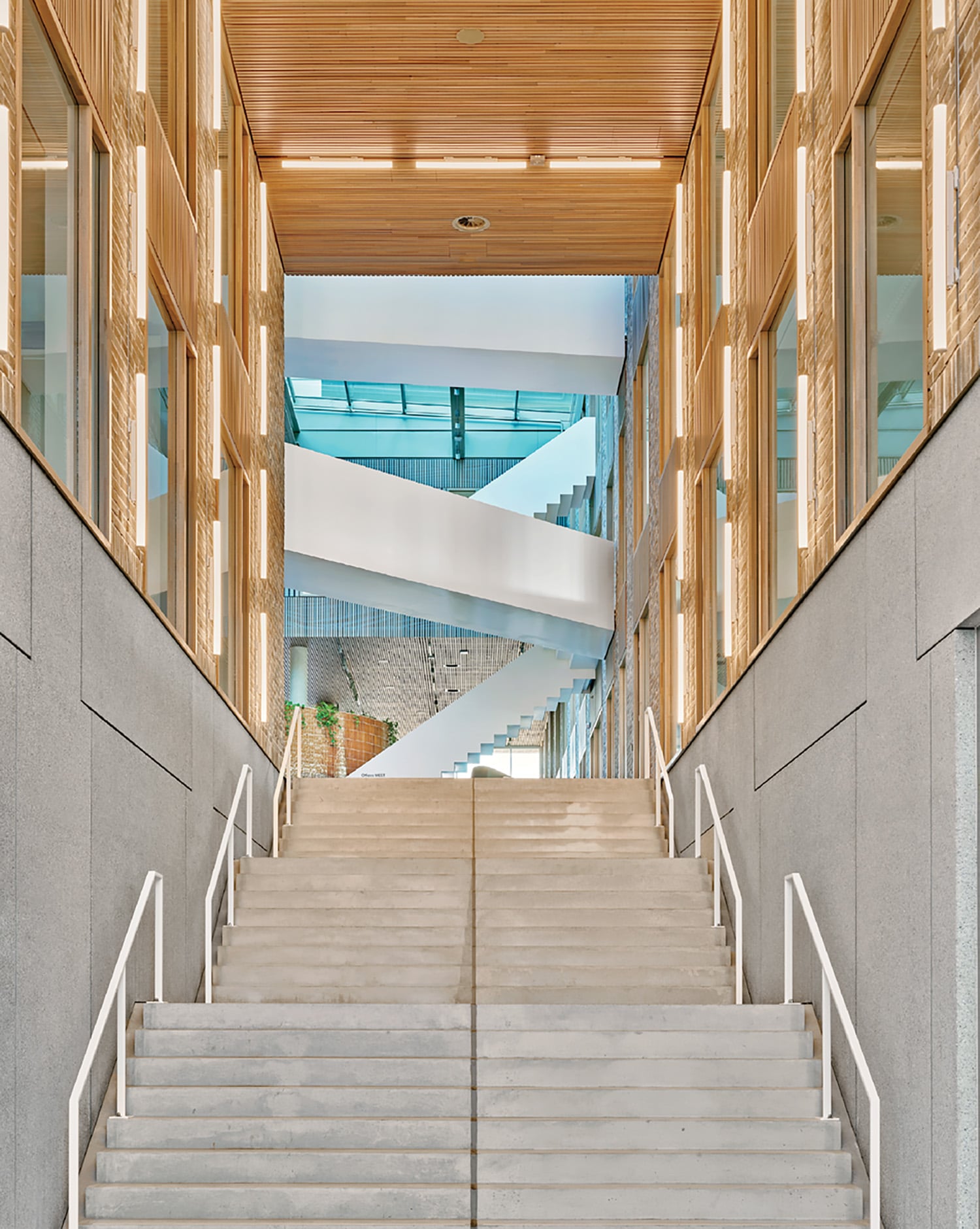
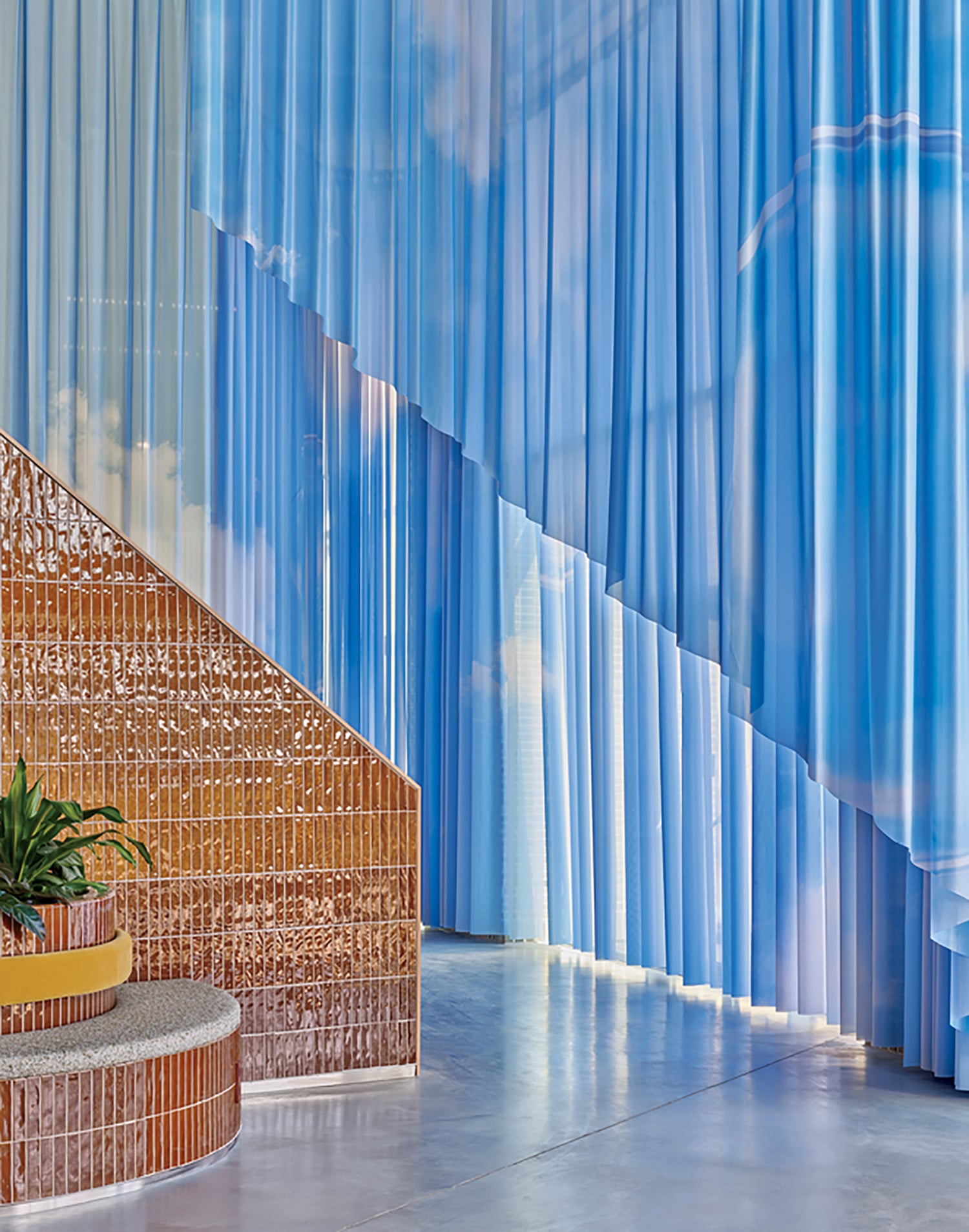
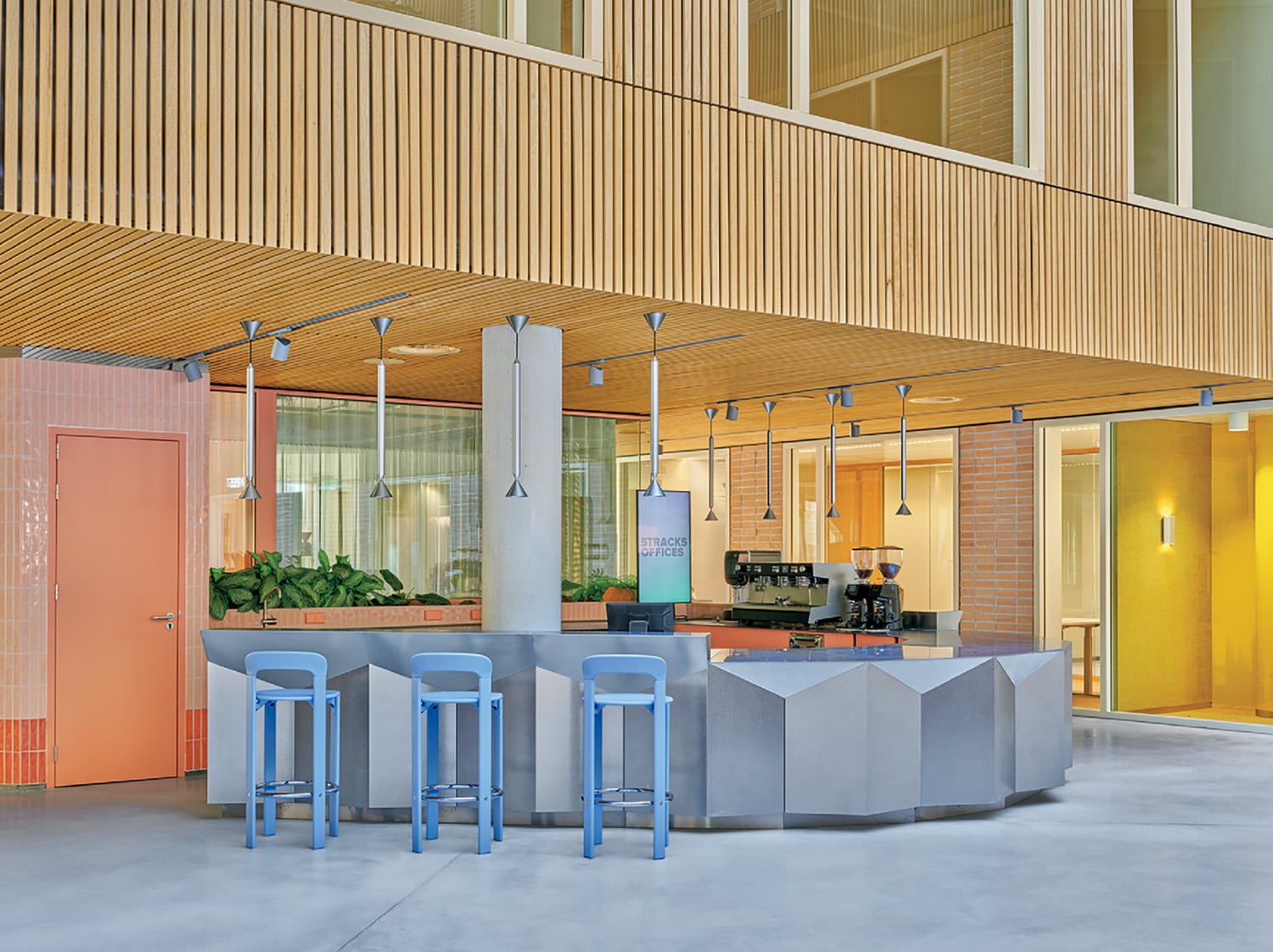
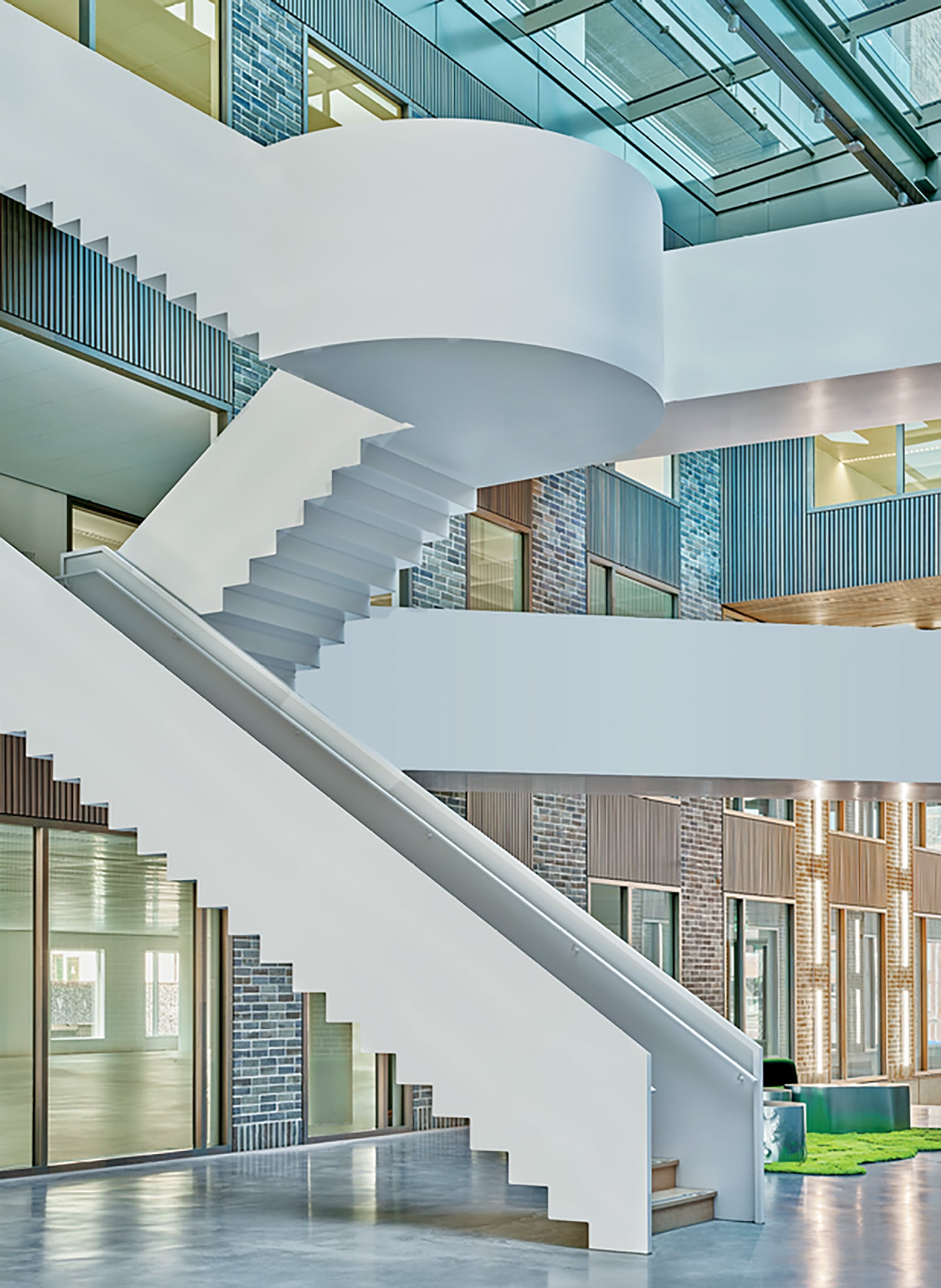
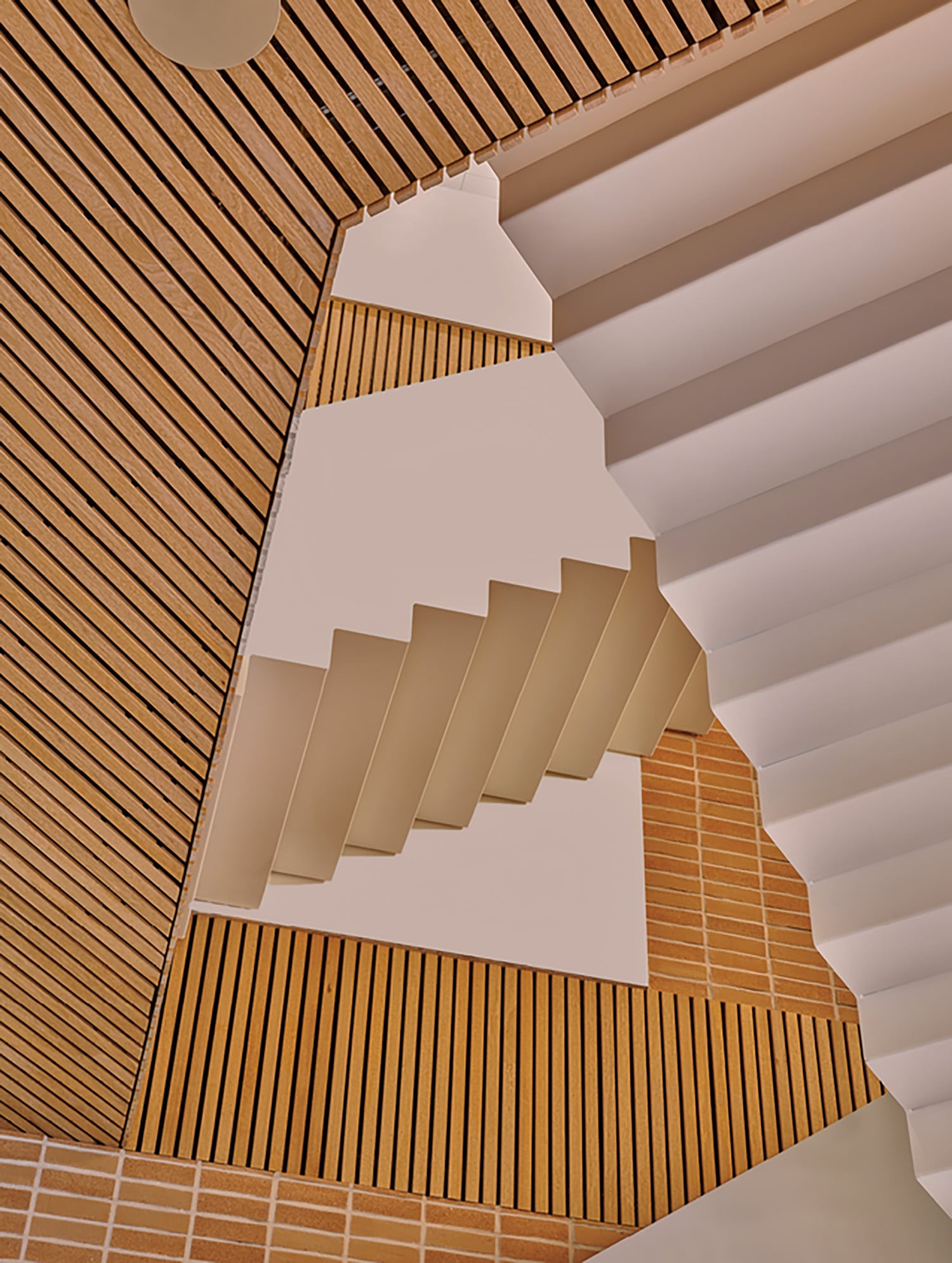
Each three-story atrium, topped by an enormous skylight, has two entrances: a rear one that opens onto the landscaped garden and a front one on the lower street level—reached in Platform_B via a series of broad terraces and in Platform_C by a grand three-flight staircase. One end of the latter—and larger—atrium features a floating ribbon stair serving all floors, along with a pair of aerial walkways that connect opposite sides of the trapezoidal volume. Its other end is anchored by a multifunctional two-story pavilion wrapped entirely in glossy burnt-orange Portuguese ceramic tile. Occupying its base is a coffee bar with a sculptural stainless-steel counter by Michael Schoner, a German architect based in Rotterdam and one of the several Dutch Invertuals collaborators involved in 5Tracks. A stair leads to table seating on the pavilion’s rooftop, while bleachers for lectures and large meetings cascade down one side, facing a stage area set against sky-blue, cloud-printed curtains—a cerulean shade echoed by the surrounding brick walls and timber slats lining ceilings and other architectural surfaces.
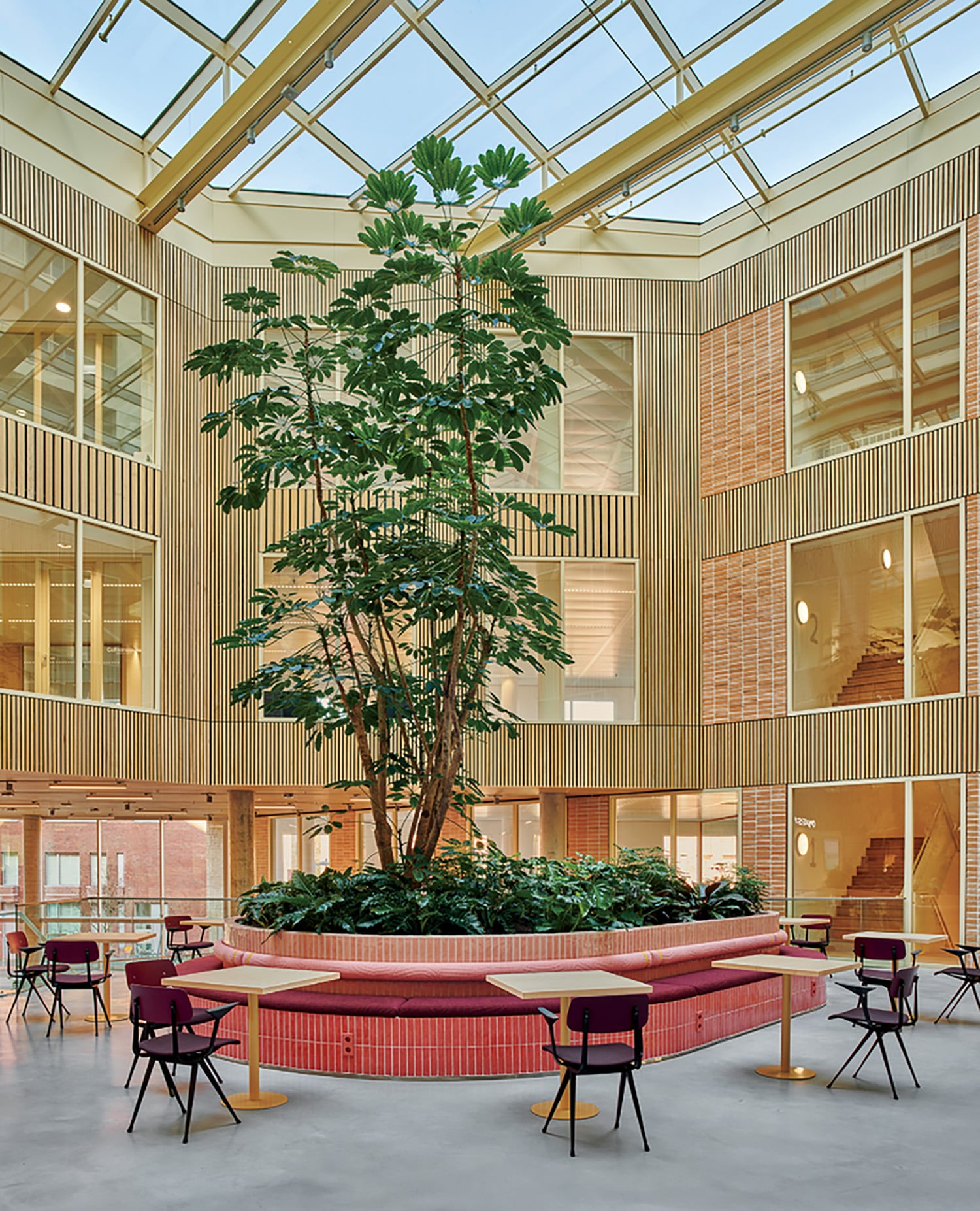
Appropriately, a smaller version of Schoner’s faceted coffee bar appears in the smaller Platform_B atrium, where the palette is generally quieter: terra-cotta brickwork, natural wood slats, and salmon-pink or faded-russet tilework. Beneath the center of the skylight, a banquette, tables, and chairs encircle a large ovoid planter sprouting a tall umbrella tree and a mass of lush, tropical groundcover—a biophilic gesture multiplied across the greenery-dotted seating terraces that spill like hanging gardens down to the street.
Organic Elements and Textures Are Found Throughout
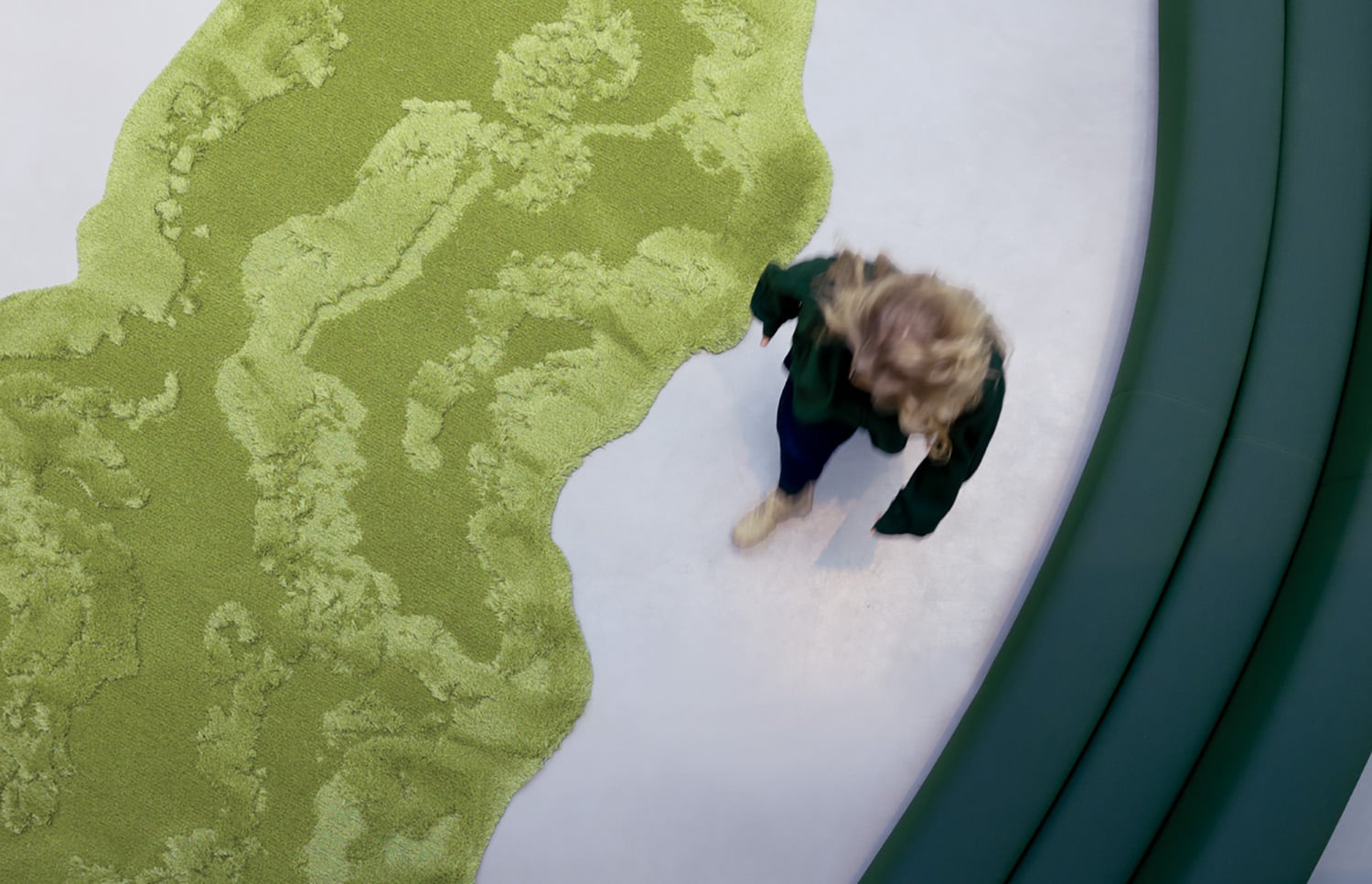
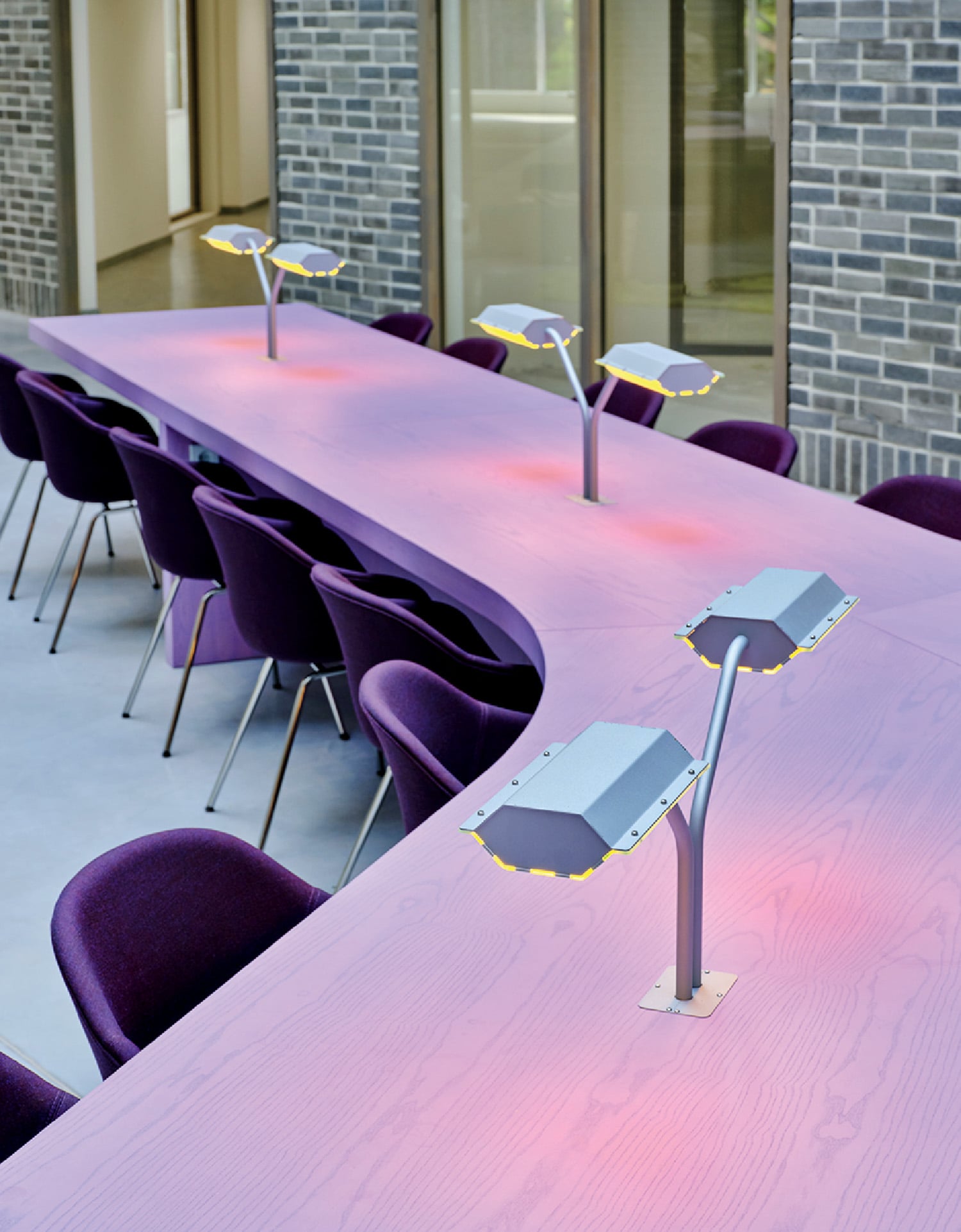
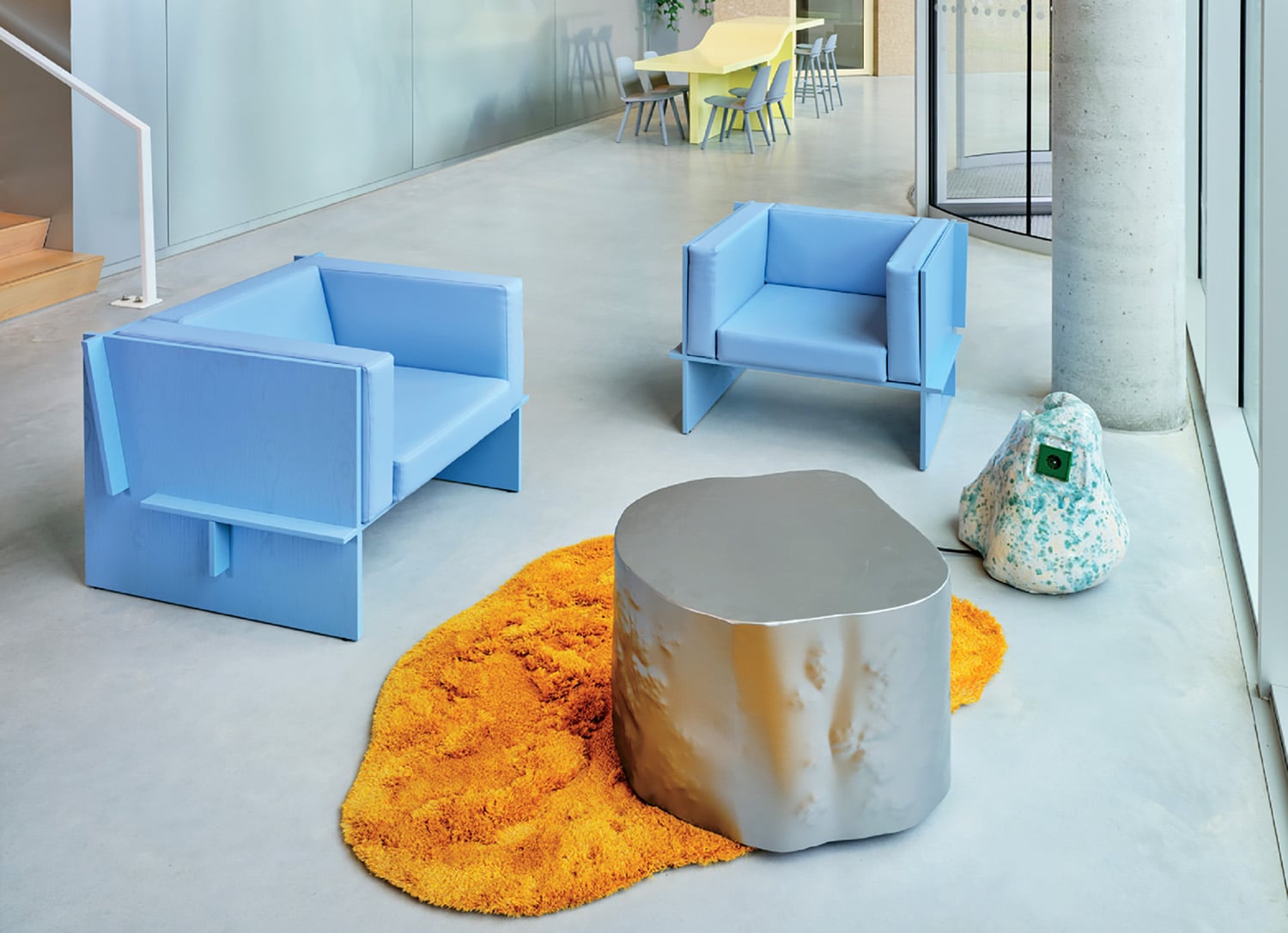
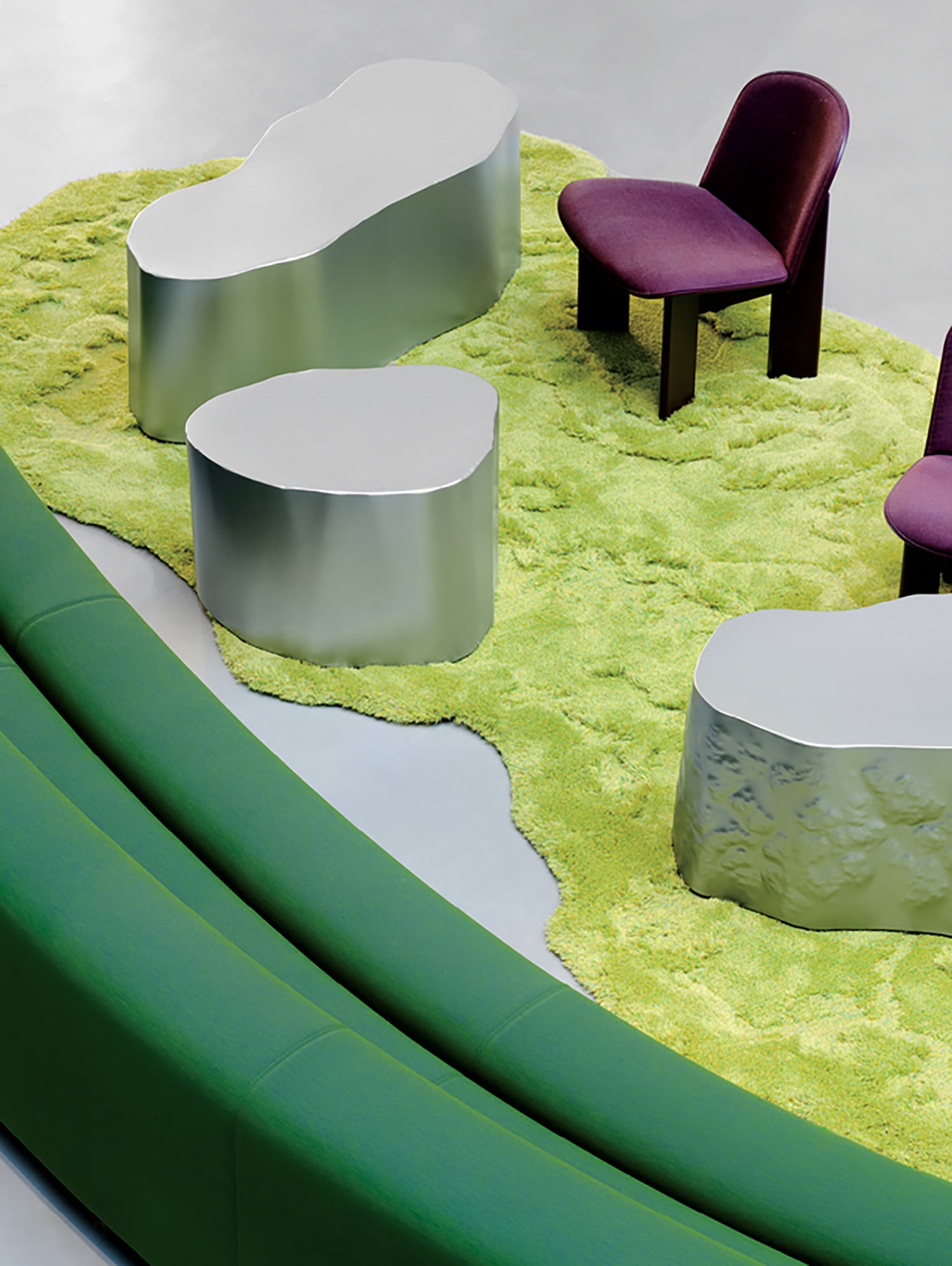
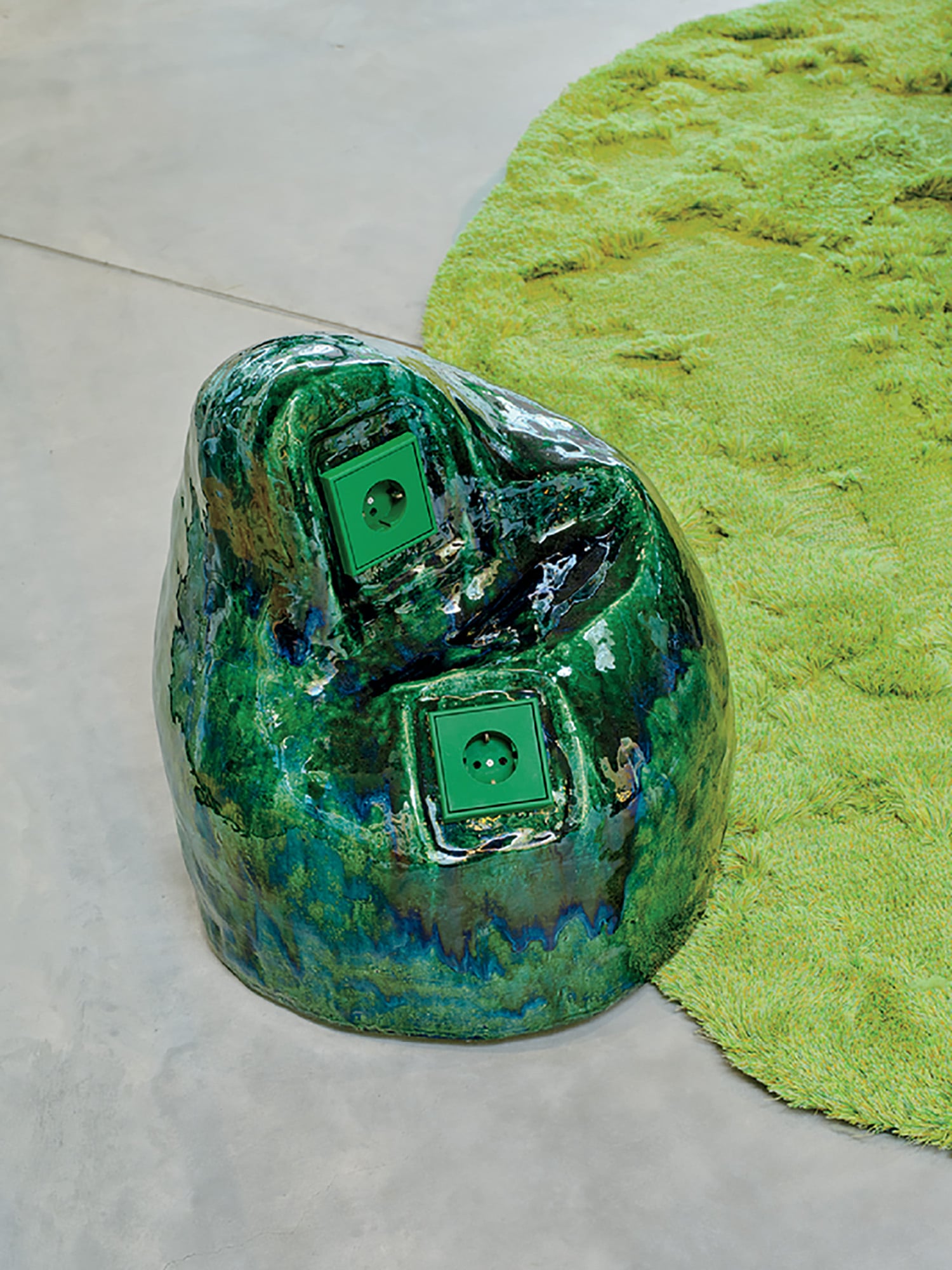
Other organic touches include products developed following the Milan exhibit. Verdant in hue and shaggy in texture, the freeform wool rugs that anchor seating groups in both atriums are like patches of fresh meadow. “We chose very colorful, very tactile materials,” Plomp says. “It’s like walking through nature and discovering all these wonders.” Joining them are boulderlike ceramic objects with integrated power outlets and amoeba-shape hammered stainless–steel side tables by two more of the firm’s collaborators, Dutch designer Willem van Hooff and Studio Kloumi founder Clémentine Buffa, respectively. The surrounding urban infrastructure gets a nod with a pair of communal worktables—one in the form of a giant lavender Y resembling diverging railway lines, the other a long yellow slab that smoothly changes height like a road going up a hill—both by Dutch Invertuals collaborators and Daphna Laurens founders Daphna Isaacs Burggraaf and Laurens Manders, and each topped with custom fixtures recalling streetlamps. These custom pieces form a collection that Dutch Invertuals plans to incorporate into future projects.
All this results in a multihued, slightly surreal workscape that knits together connectivity, creativity, and well-being. Plomp reports that 5Tracks tenants are already “embracing the funkiness” and strong identity, making them feel more motivated to go into the office rather than work from home. “We can’t underestimate the importance of coming together,” she emphasizes, “and finding a common language as humans.”
Inside 5Tracks, a Mix-Use Space Designed By Dutch Invertuals

Rooted in The Intersection Of Rail + Nature

PROJECT TEAM
DUTCH INVERTUALS: LOENA VISSER; CEZANNE Q CUYPERS; DAPHNA ISAACS BURGGRAAF; LAURENS MANDERS; MAX LIPSEY; MICHAEL SCHONER; WILLEM VAN HOOFF; CLÉMENTINE BUFFA. POWERHOUSE COMPANY; SHIFT ARCHITECTURE URBANISM: ARCHITECTS OF RECORD. EDHV, ARCHITECTS OF IDENTITY: GRAPHICS AND BRANDING CONSULTANT. CULD: LANDSCAPE CONSULTANT. LPB SIGHT: BUILDING-ENVIRONMENT AND FIRE-SAFETY CONSULTANT. TECHNIPLAN ADVISEURS: MEP. IMD RAADGEVENDE INGENIEURS: STRUCTURAL ENGINEER. J.P. VAN EESTEREN: GENERAL CONTRACTOR. DEVELOPMENT PARTNERSHIP: SYNCHROON AND J.P. VAN EESTEREN.
CONCEPT AND DEVELOPMENT MANAGEMENT: VIGO
PRODUCT SOURCES
FROM FRONT
LA CIVIDINA: SECTIONAL SOFA (SEATING AREA). HAY: LOUNGE CHAIRS (SEATING AREA), PURPLE SIDE CHAIRS (ATRIUM C), BARSTOOLS (ATRIUMS, MEETING ROOMS ENTRY), ARMCHAIRS, OAK SIDE CHAIRS (TERRACES), SIDE CHAIRS (ATRIUM B). DAPHNA LAURENS: CUSTOM LAVENDER WORKTABLE (ATRIUM C), CUSTOM YELLOW WORKTABLE (B ENTRANCE). MICHAEL SCHONER: CUSTOM BARS (ATRIUMS). PHOLC: BAR PENDANT FIXTURES. WILLEM VAN HOOFF: CUSTOM SOCKET ROCKS (TERRACES, B ENTRANCE). MUUTO: WORKTABLE SIDE CHAIRS AND STOOLS (B ENTRANCE). ATELIER MAX LIPSEY: CUSTOM BANQUETTE (TERRACES). THROUGHOUT CSRUGS: CUSTOM RUGS. STUDIO KLOUMI: CUSTOM STAINLESS-STEEL SIDE TABLES.
- No tags selected
read more
Projects
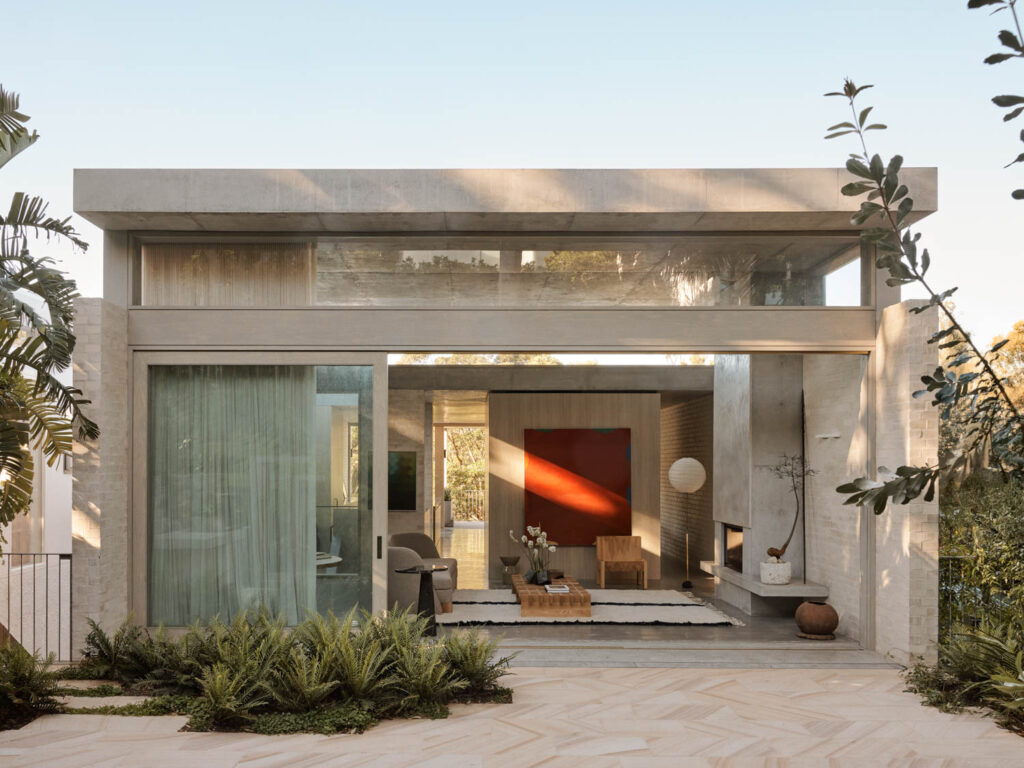
A Coastal Home In Australia Built Into The Canopy
Madeleine Blanchfield Architects distils architecture to its essentials in a Bronte home where raw concrete, brick and timber form a richly tactile backdrop to family life and artistic practice.
Projects
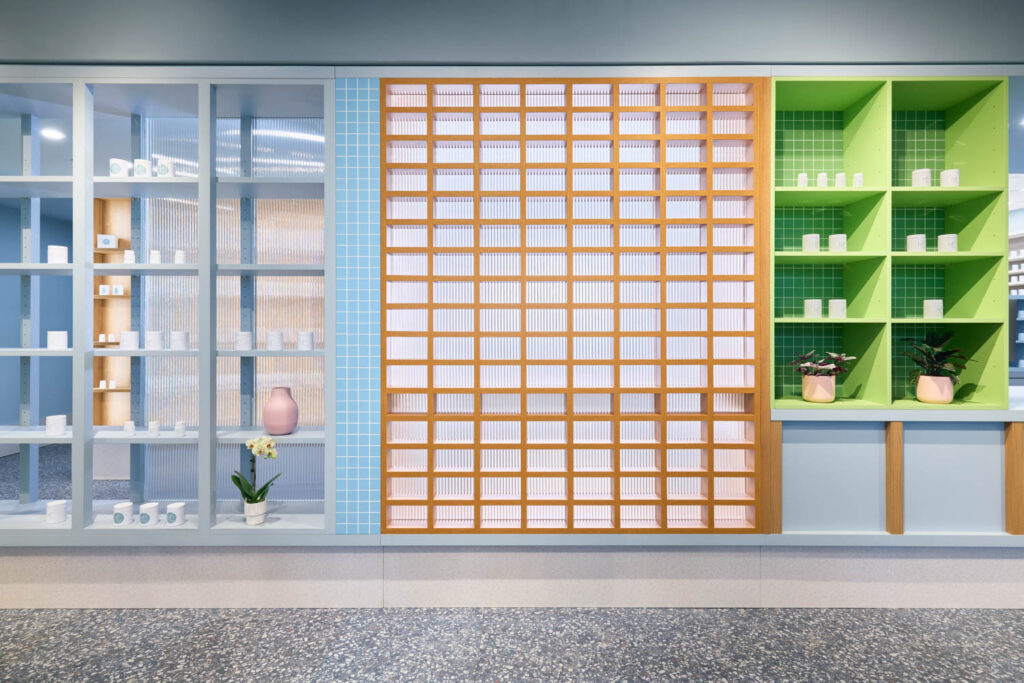
Inside A Colorful Health Choice Pharmacy In Coney Island
Sergio Mannino Studio reimagines a Coney Island pharmacy as a flexible, design-forward wellness hub.