
A Sumptuous New York Town House Takes Center Stage
Australian designer Greg Natale’s stylistic evolution could be viewed through the lens of American movies. He established his reputation with a bold, contemporary take on Hollywood Regency’s high-contrast glamour. Later, he refined his approach by reimagining the sleek sophistication of streamline moderne for today. But it’s a slightly different movie-informed sensibility—the art deco era as refracted through 1970’s European cinema—that seems to pervade his eponymous firm’s recent makeover of a narrow 19th-century town house in New York. Not literally—with one or two exceptions, nothing in the 3,330-square-foot residence dates from the prewar period—but as a poetic infusion from the sumptuous 1930’s world evoked in the films of Bernardo Bertolucci, Luchino Visconti, and other masters of historical lyricism.
The project’s continental aura came with the brief from repeat clients Leticia Francini and Stephen Ninnes, Australians who had acquired the four-story, mixed-use property on Manhattan’s Upper East Side as an above-the-shop pied-à-terre. The ground-floor retail space would become a white-box studio for their Art With Love Foundation—an organization with outposts in Brisbane, Australia, and Florence, Italy, that offers free workshops in Renaissance painting techniques. The couple, who have homes in both countries, called Natale with the assignment while—as the designer reports—“They were in Paris eating at maximalist restaurants like Mondaine de Pariso.” They wanted some of that color, pattern, and layering in their new American bolt-hole, telling him, “We have this green and pink vision in our heads.”
Greg Natale Gives A New York Gem A Hollywood Makeover
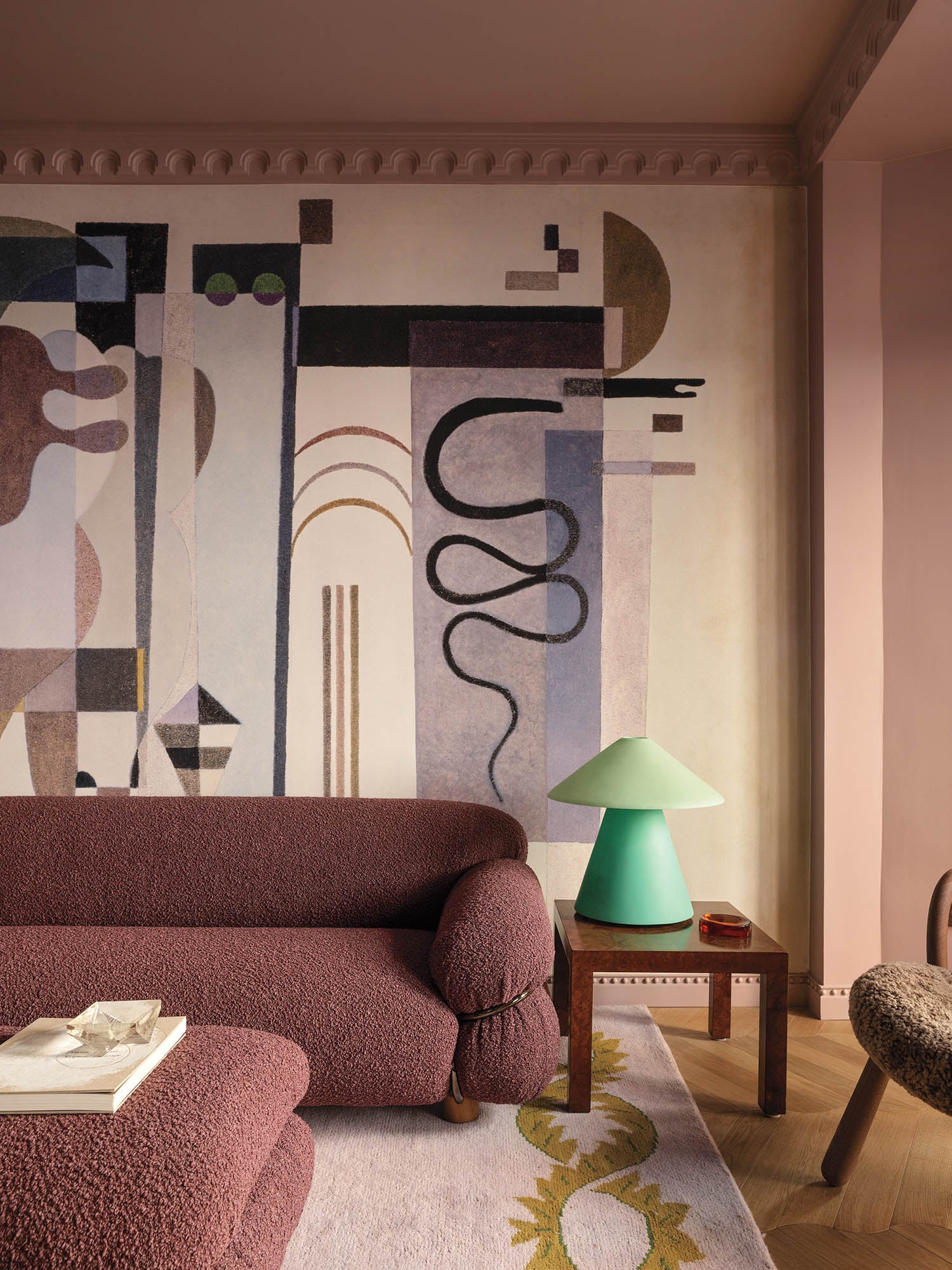
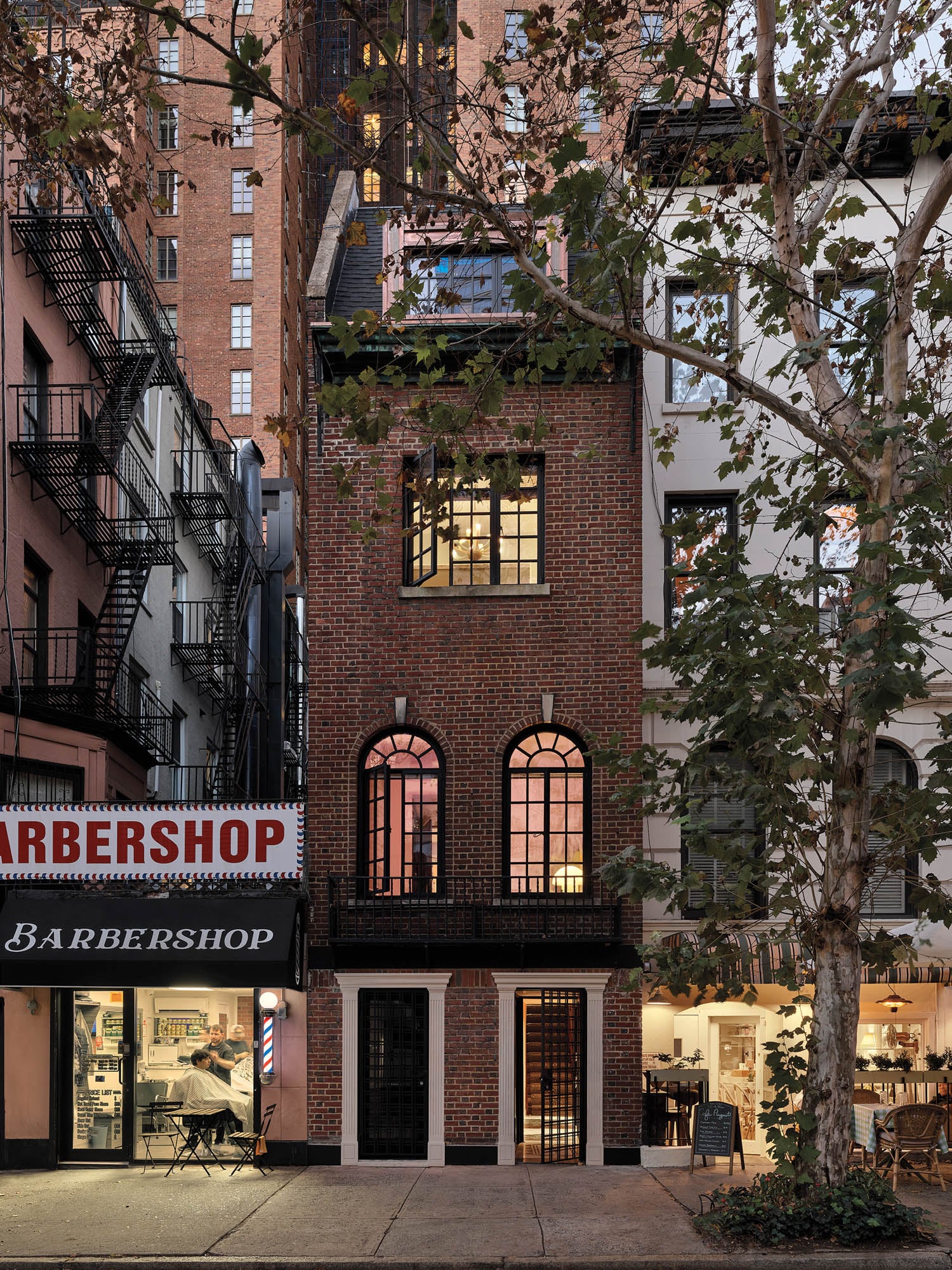
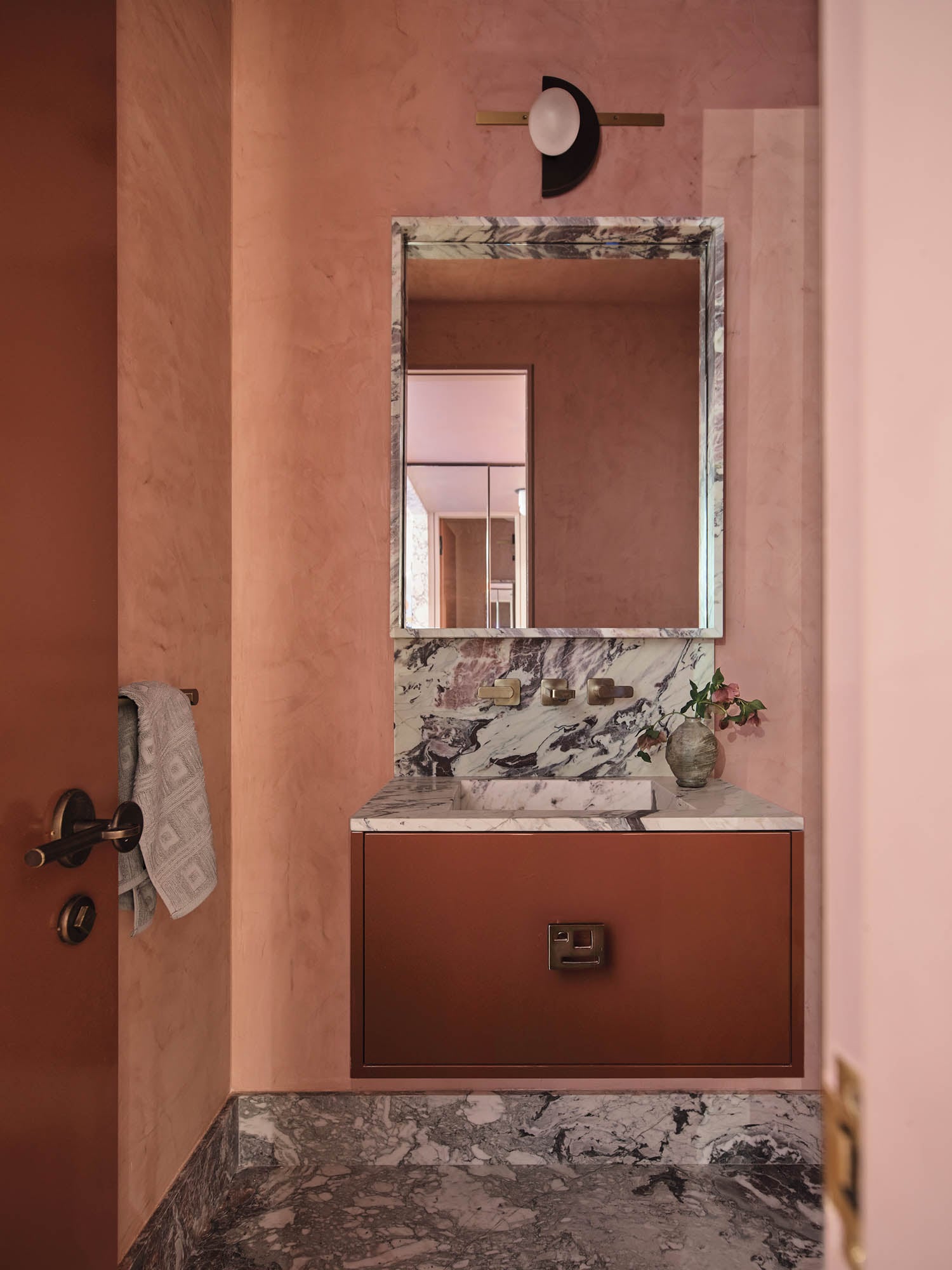
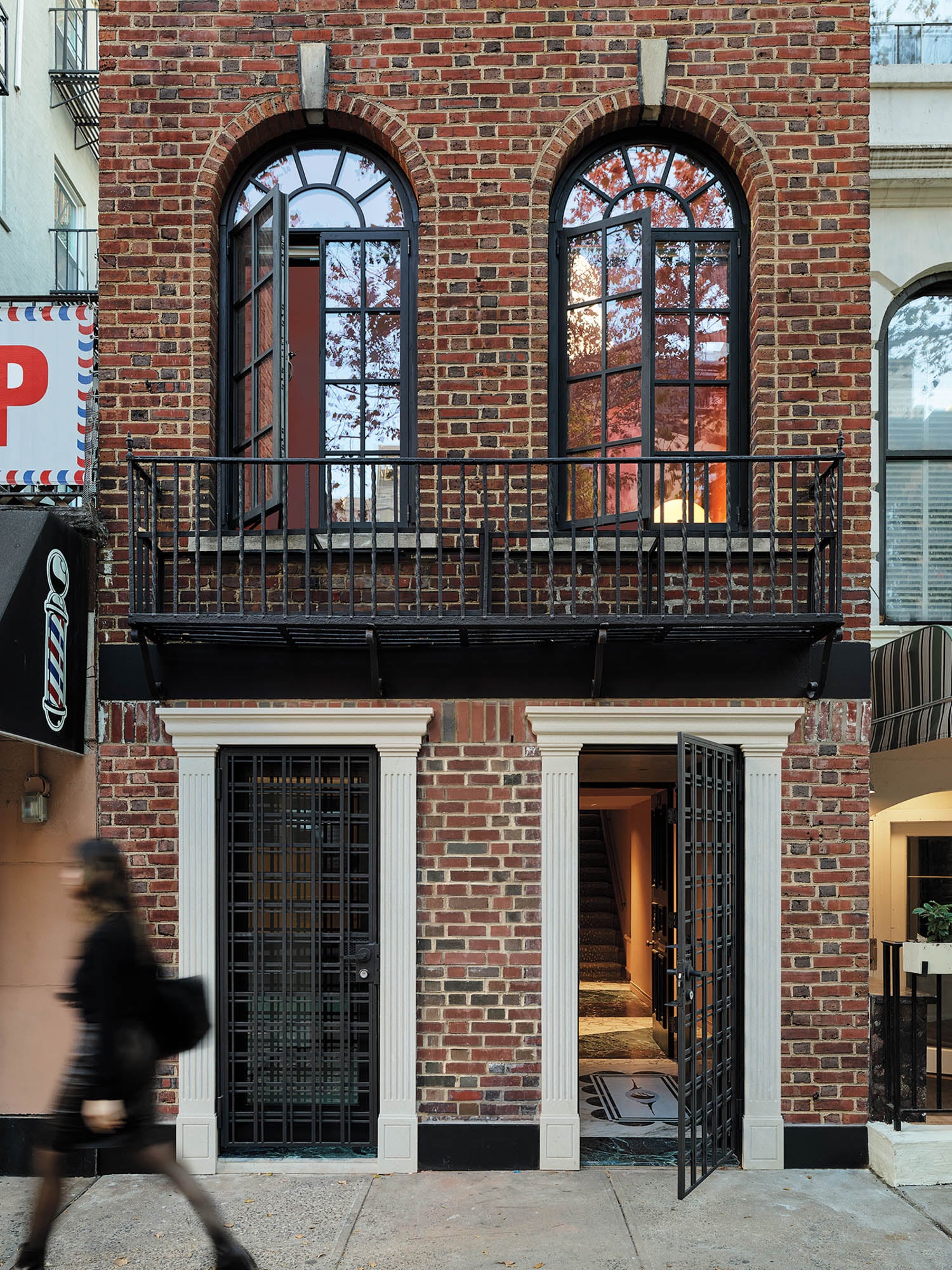
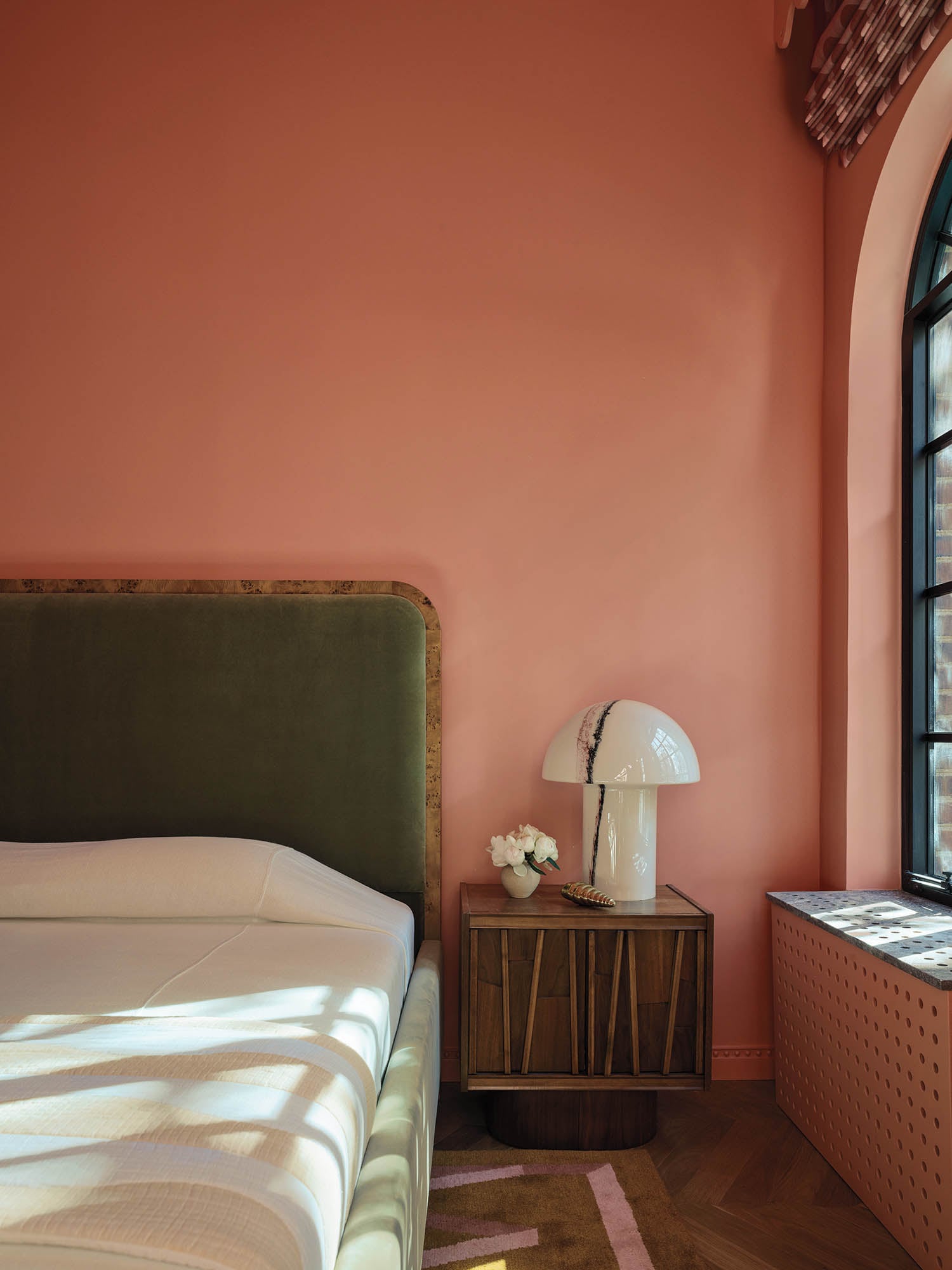
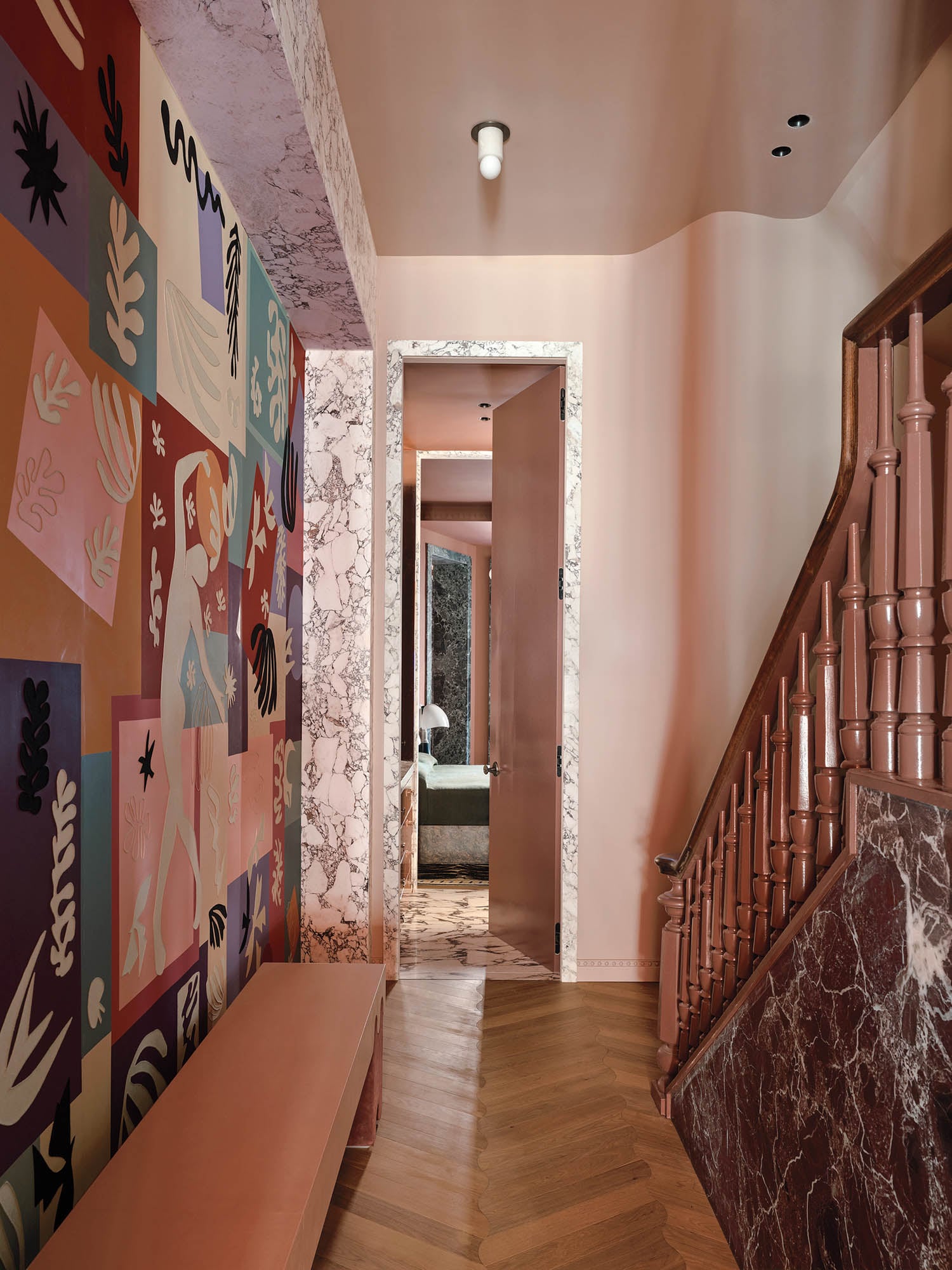
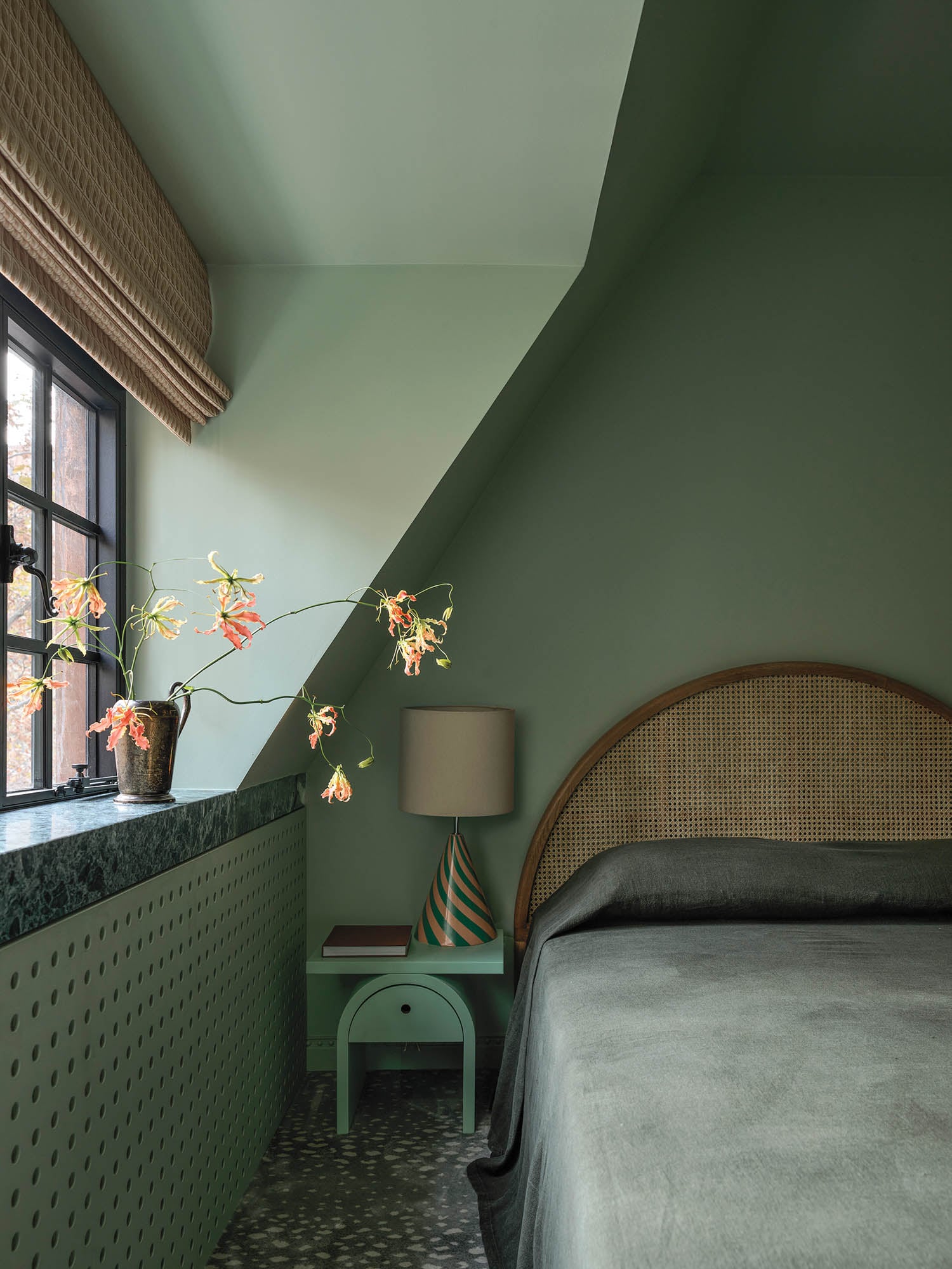
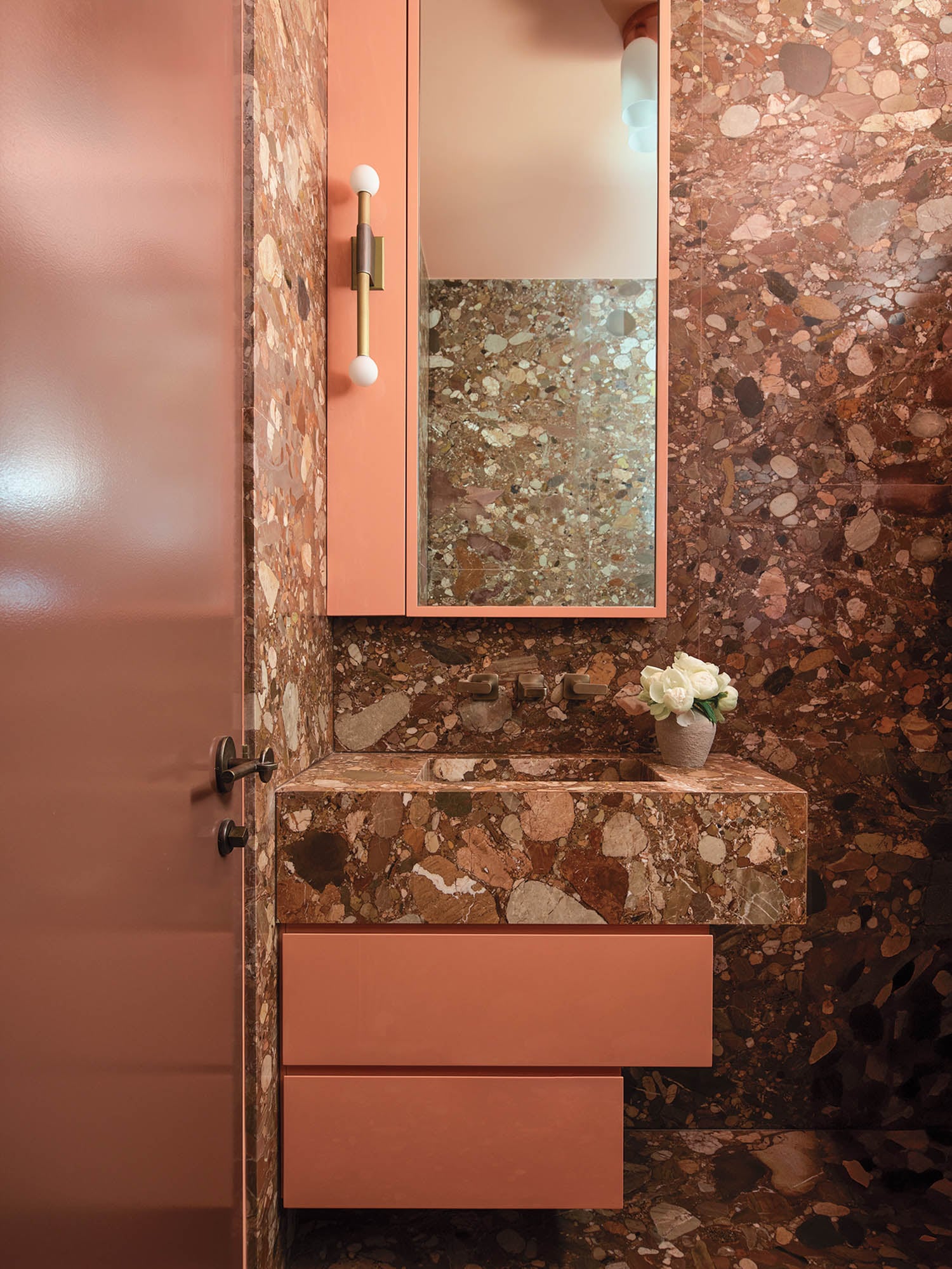
Natale obliged by painting the rooms—both walls and ceilings—in a rich palette of blush, plum, and terra-cotta, paired with greens that range from deep and muted to light and breezy. Colorful shades of veined marble—Calacatta Viola, Rosso Levanto, Verde Alpi—are deployed just as expressively, not only on floors, walls, countertops, and a fireplace but also in framing nearly every portal and door. The lavishly detailed stonework was facilitated by the clients’ close relationship with an Italian quarrier and fabricator near their Forte dei Marmi villa; the company cut all the marble there before flying masons over for an installation that took several months. This included an exterior intervention: the reinstatement of a historically appropriate double street entrance—two doors, defined by fluted limestone pilasters, leading to the art foundation and the residence, respectively.
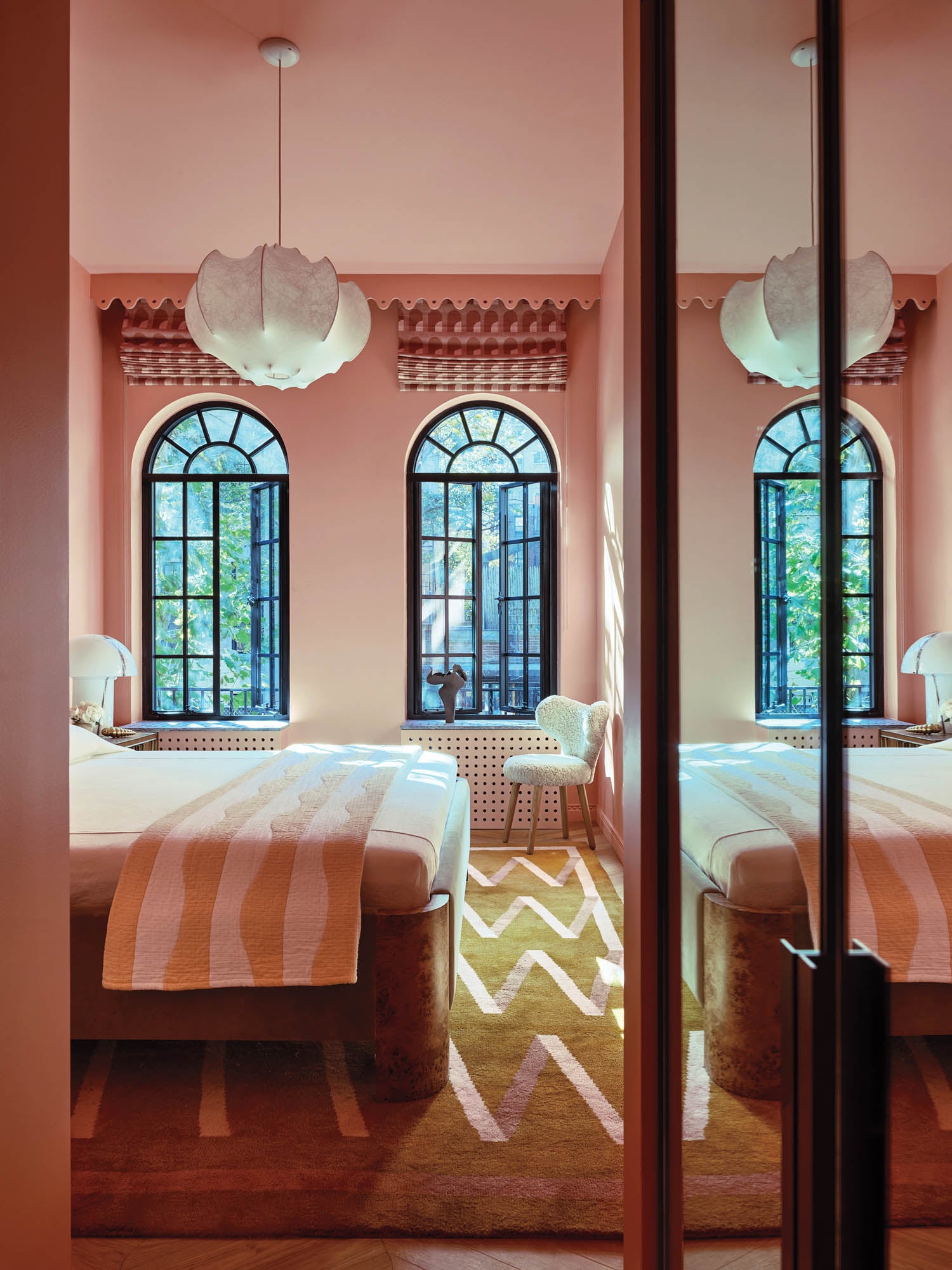
Much of the flooring is engineered oak in a herringbone pattern of Natale’s design. The paint, marble, and wood create a vivid yet warmly welcoming interior envelope, made even more intimate by the modest scale—the brick building is only 12½ feet wide. The town house had been renovated in the ’70’s, and Natale retained the general layout but stripped it down to the studs. “Because they’re not living there full-time, they just needed a sitting room, a kitchen, and a dining room,” notes the designer, who placed the living spaces on the middle level, sandwiched between a pair of two-bedroom floors—enough to accommodate the couple’s five adult children when visiting New York.
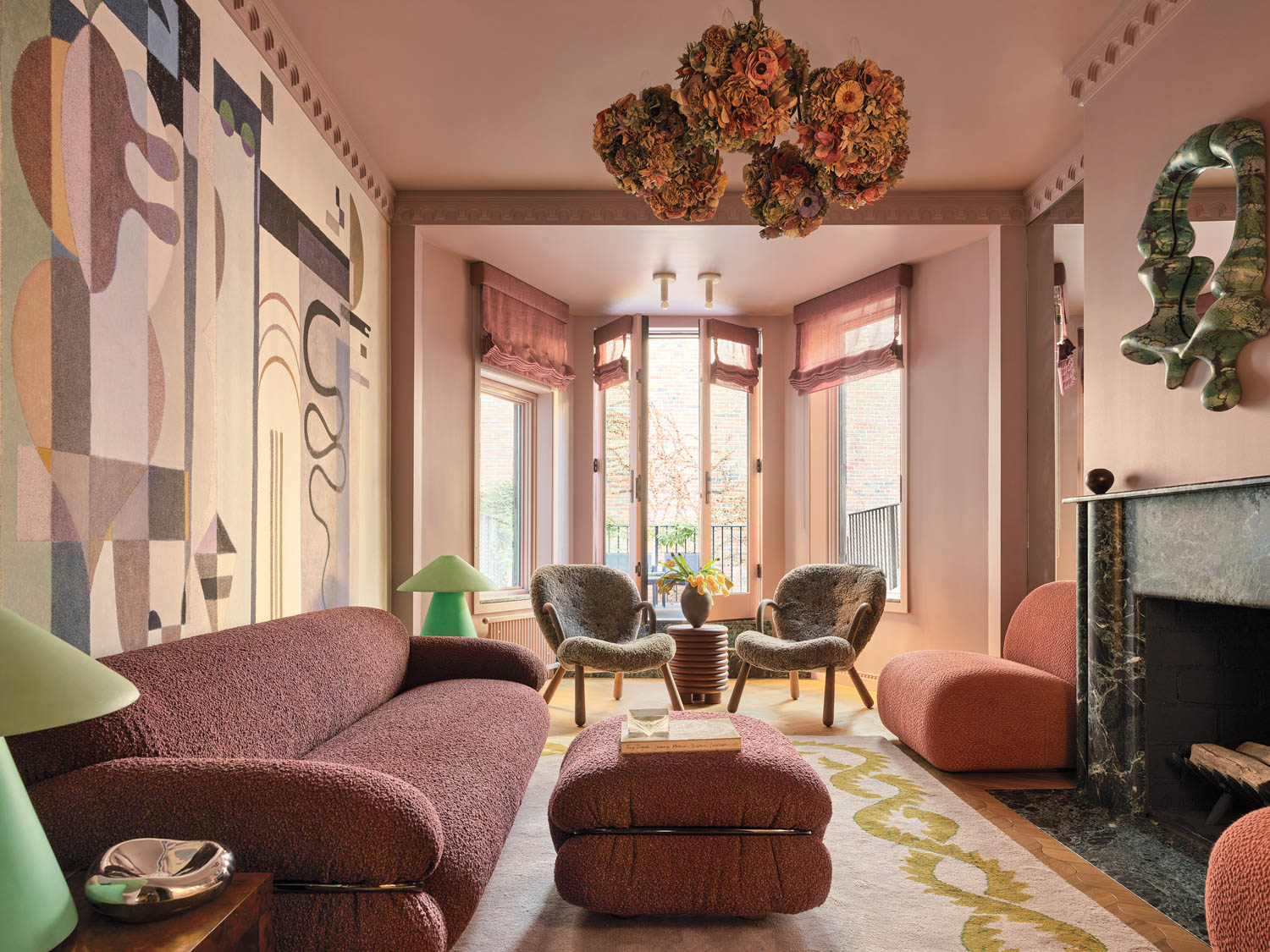
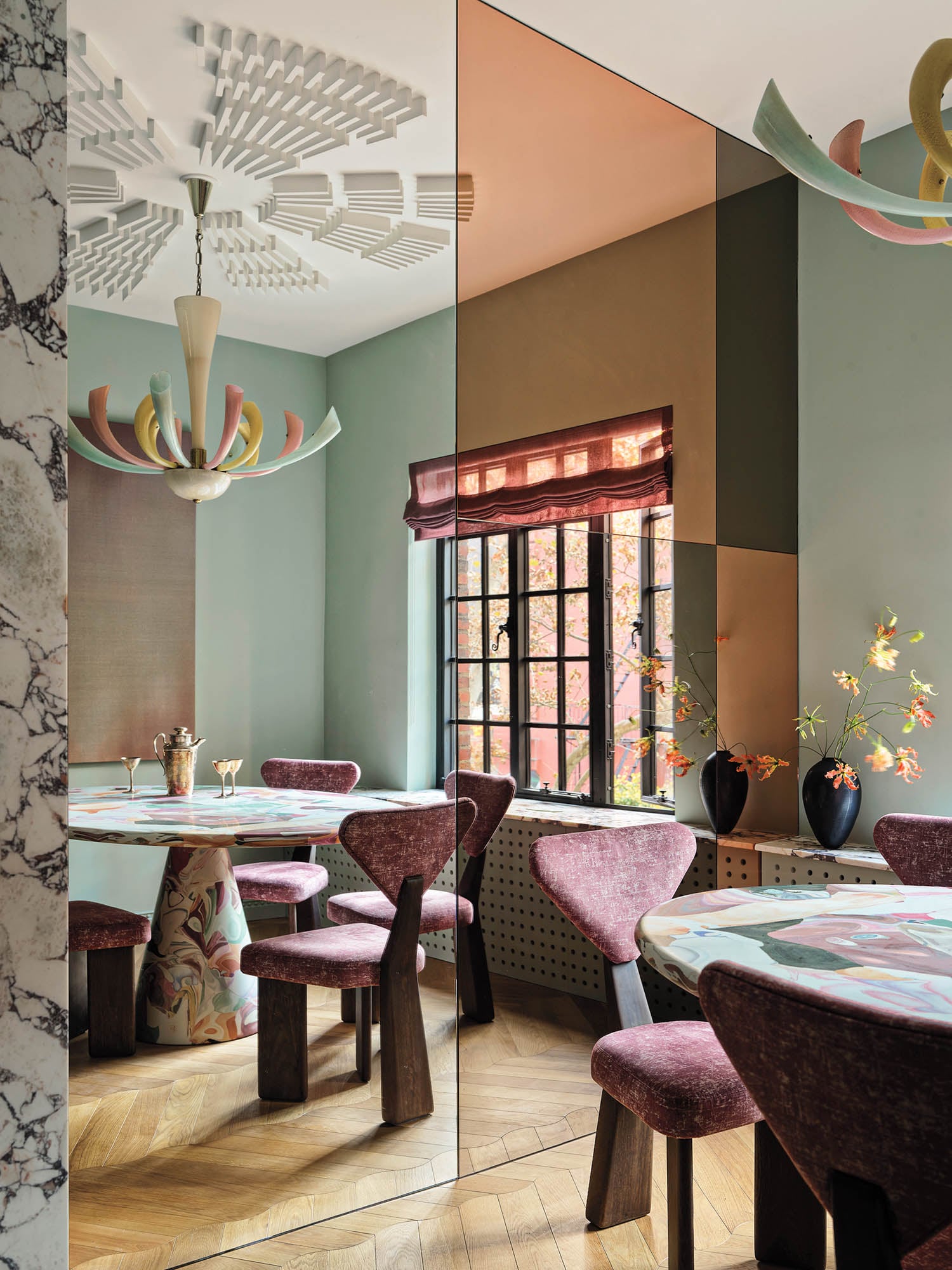
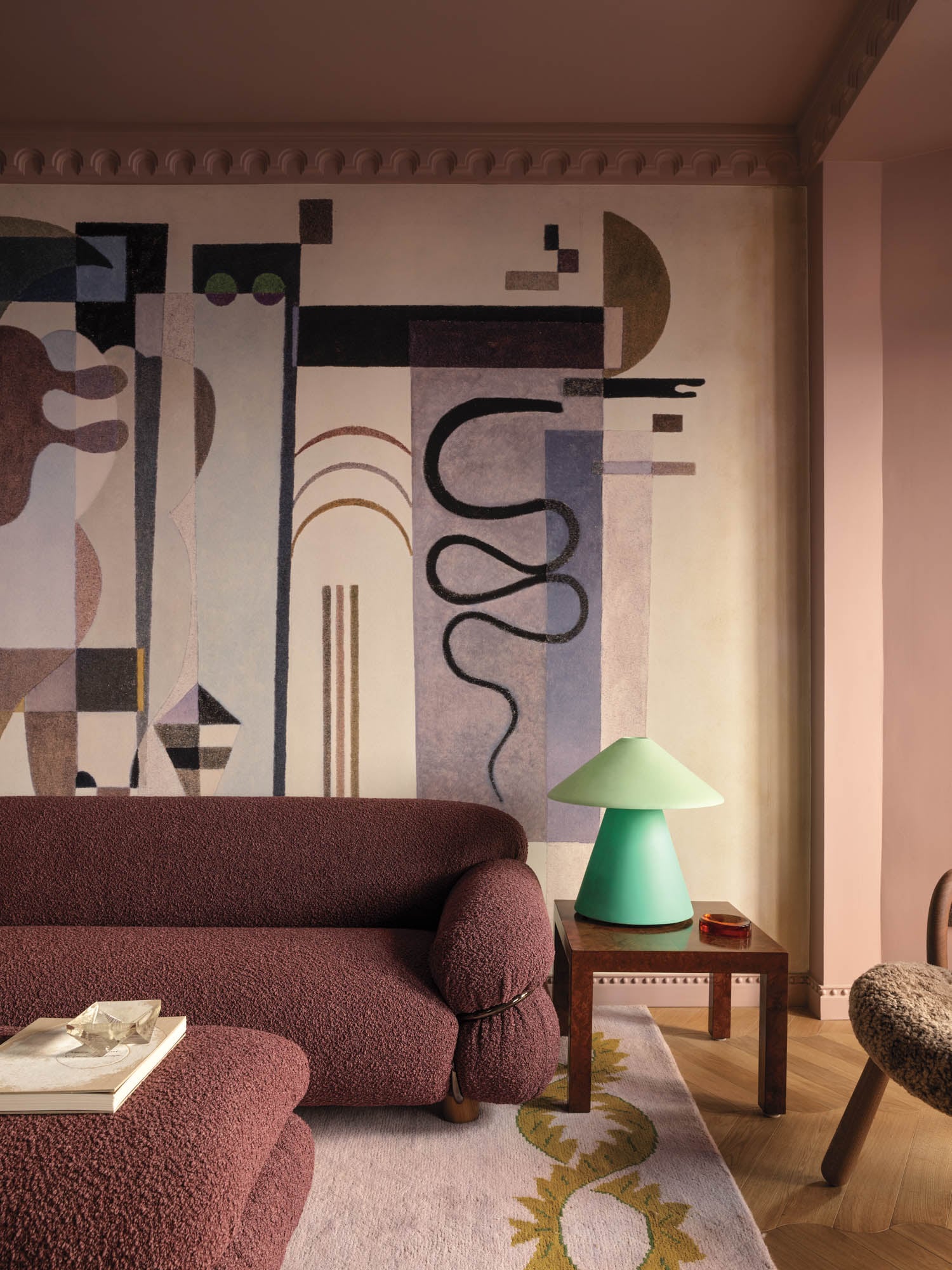
Energizing, room-expanding mirror paneling appears throughout, most notably as an art deco–inflected arrangement of bronze- and smoke-hued rectangles in the dining area—the only space with a white ceiling. Natale uses that blank canvas for another period flourish: a starburst molding centered on an ’80’s Murano-glass chandelier that’s like a modern take on Italy’s flowing Liberty style. But it’s a couple of murals that set an overt ’30’s- and ’40’s-European tone: An embroidered linen-and-silk riff on Henri Matisse’s Jazz cutouts runs the length of the second-floor hallway, while one side of the living room is spanned by a wallpaper blowup of Wassily Kandinsky’s 1935 painting Deux points verts, a work in which rectilinear Bauhaus meets biomorphic surrealism.
The furniture—vintage and contemporary pieces, most of them Italian—echoes that potent mix. “Even though I’m a bit of a maximalist, my foundation lies in minimalism and plain lines,” Natale acknowledges. “So I look on a project like this through a clean, modernist lens.” Ergo, the living room’s Gianfranco Frattini ’70’s Sesann sofa—an expanse of sybaritic softness constrained by chrome tubing—faces the Daliesque profile of Shawna and Matt Heide’s concrete-framed Iris mirror above the elegantly simple Verde Alpi fireplace. Overhead, a custom Anna Bonino pendant fixture—a constellation of paper-flower globes—blossoms like festive fireworks. A similar playfulness animates the dining area, where the multicolored chandelier finds a counterpart in the painterly swirls of Dirk van der Kooij’s recycled-plastic Meltingpot table, surrounded by Juliana Lima Vasconcellos’ Giraffe chairs, their triangular backs suggesting constructivist sculpture.
Soft Hues Give This Town House A Rich Glow
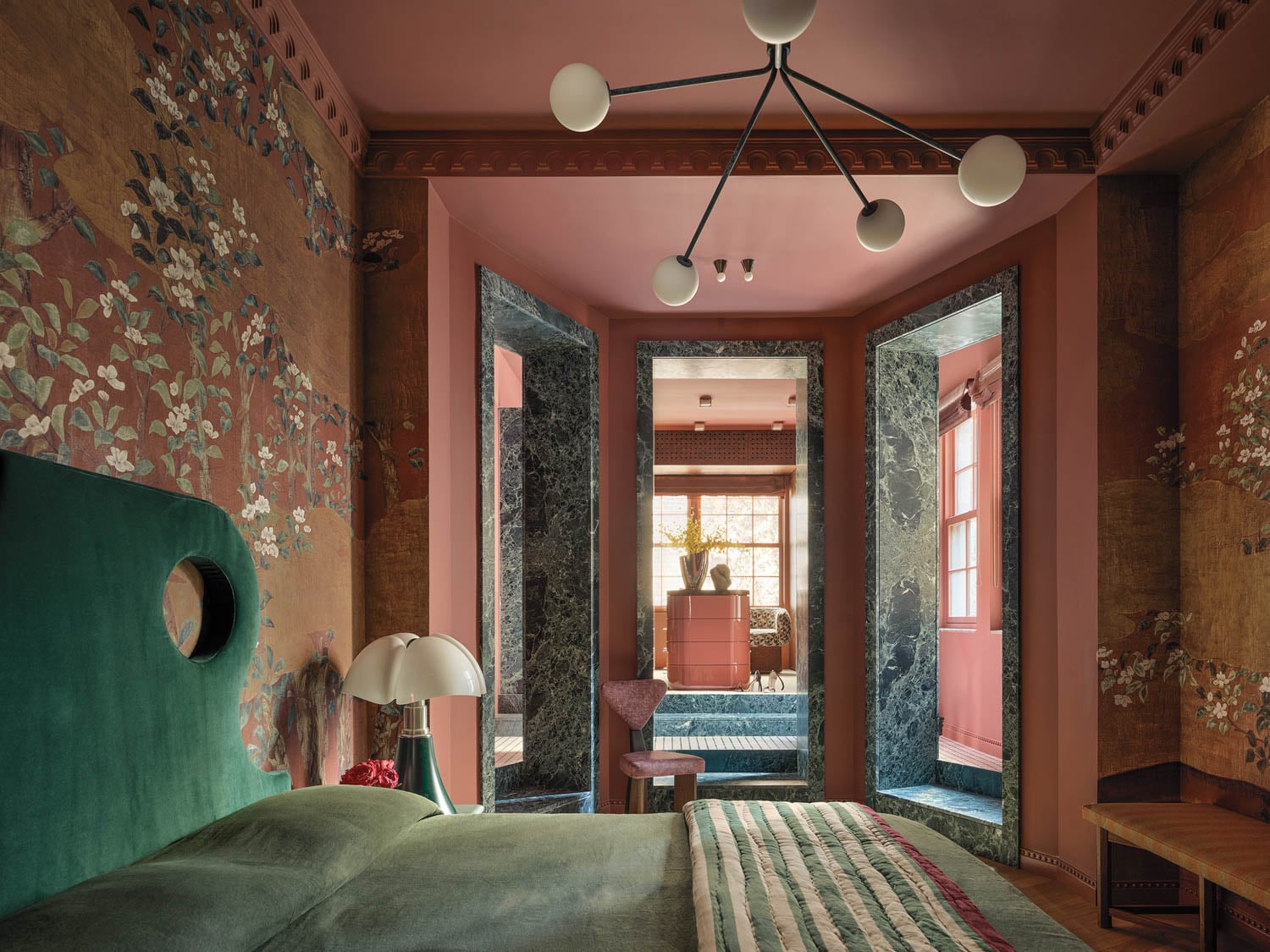
Italian rationalism—strongly influenced by constructivist ideas—is evoked in the complex inlaid-marble pattern on the main bathroom’s shower wall. In the adjacent bedroom, a touch of art deco Japonisme surfaces in Mehmet and Dimonah Iksel’s hand-painted White Blossom wallpaper, inspired by Edo-period art. It backdrops another Daliesque silhouette—Vincent Darré’s Neofutur headboard, its witty, asymmetrical outline a prelude to the residence’s coup de théâtre: the dressing room. Connected to the bedroom by a trio of marble-encrusted portals, the windowed space is raised a few steps, with a lacquered, altarlike cabinet at its center. Sculptural slabs of marble, cut into surreal shapes, project from the sidewalls like totemic sentinels, creating open closets. “The client asked that the room look like a shop,” Natale explains, but it could just as easily be a movie set awaiting Dominique Sanda or some other ’70’s screen siren to make her entrance.
Inside the Home’s Theatrical Makeover By Greg Natale



PROJECT TEAM
GREG NATALE: RENEE ALAM; GEORGA GOODWIN. MONDO MARMO ITALIA: STONEWORK. VECTRA CONSTRUCTION: GENERAL CONTRACTOR.
PRODUCT SOURCES
FROM FRONT PAPIERS DE PARIS: WALLPAPER (LIVING ROOM). TACCHINI: SOFA, OTTOMAN, LOUNGE CHAIRS, LAMPS. DAGMAR: ARMCHAIRS. CONCRETE CAT: MIRROR. CRIZU: CUSTOM PENDANT FIXTURE. NORDIC KNOTS: RUGS (LIVING ROOM, BEDROOM 1). GIOBAGNARA: STOOL (LIVING ROOM), BENCH (HALL). SQUARE IN CIRCLE: SCONCES (POWDER ROOM, BATHROOM). KOOIJ: TABLE (DINING AREA). THE INVISIBLE COLLECTION: CHAIRS (DINING AREA), HEADBOARD (MAIN BEDROOM). SOHO HOME: BED (BEDROOM 1). FLOS: PENDANT FIXTURE. APPARATUS: SCONCE (KITCHEN). IKSEL: WALLPAPER (MAIN BEDROOM). MARTINELLI LUCE: TABLE LAMP. ORNÄS: BENCH. ALLIED MAKER: PENDANT FIXTURE (MAIN BEDROOM), CEILING FIXTURE (HALL). DE GOURNAY: WALLPAPER (HALL). DESIGN WITHIN REACH: HEADBOARD (BEDROOM 2). MYHOME COLLECTION: NIGHTSTAND. STARK: CARPET (BEDROOM 2, DRESSING ROOM). LORENZA BOZZOLI DESIGN: CHAIR (DRESSING ROOM). THROUGHOUT THROUGH 1STDIBS: VINTAGE FURNITURE AND FIXTURES. KOHLER CO.: SINK AND SHOWER FITTINGS. TONGUE & GROOVE: ENGINEERED OAK FLOORING. BENJAMIN MOORE & CO.: PAINT.
read more
Projects
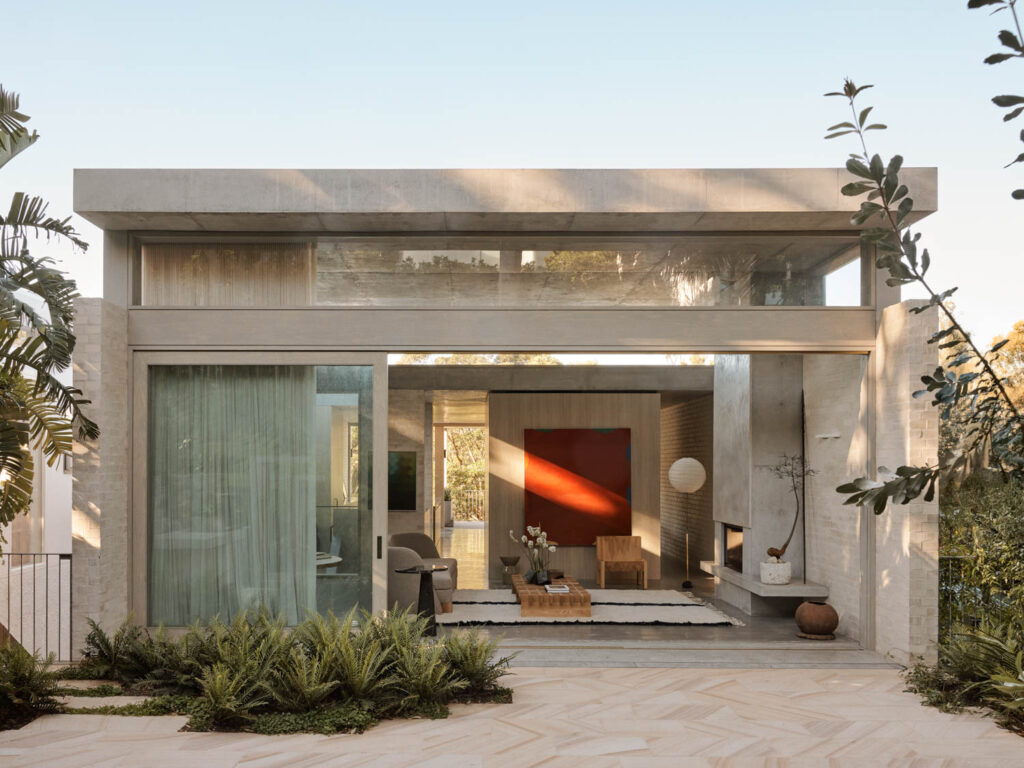
A Coastal Home In Australia Built Into The Canopy
Madeleine Blanchfield Architects distils architecture to its essentials in a Bronte home where raw concrete, brick and timber form a richly tactile backdrop to family life and artistic practice.
Projects
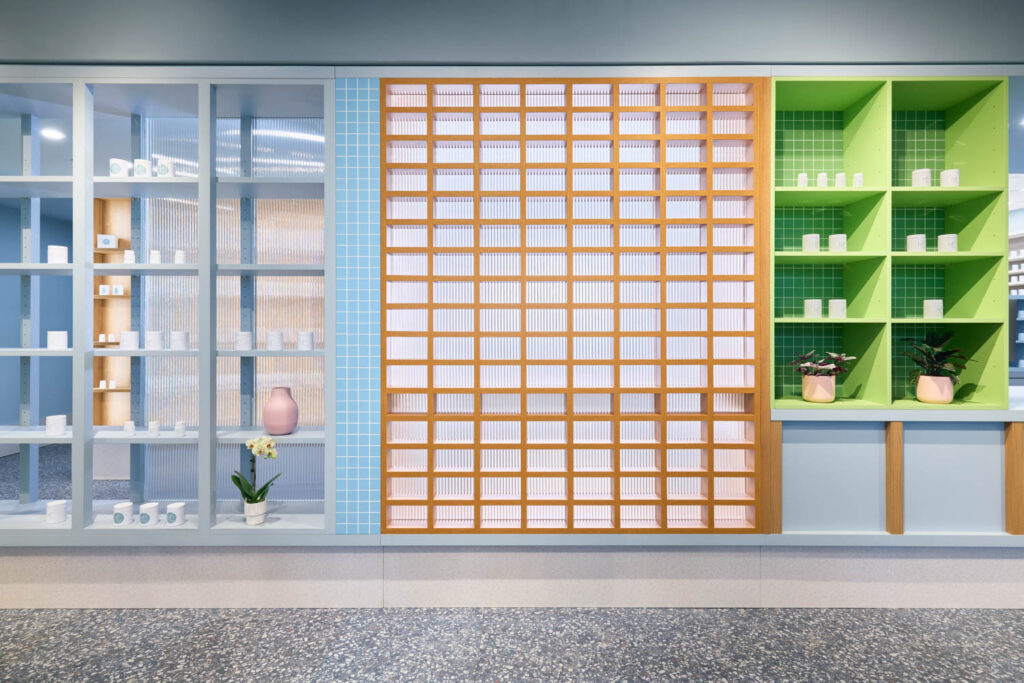
Inside A Colorful Health Choice Pharmacy In Coney Island
Sergio Mannino Studio reimagines a Coney Island pharmacy as a flexible, design-forward wellness hub.