
A Futuristic Showroom Elevates A Popular Clothing Brand In China
The origins of Chinese business attire can be traced to the city of Ningbo, on the southern coast of Hangzhou Bay opposite Shanghai. It was here that traditional Hongbang tailors began adapting Western suits in the 1980’s, creating customizable professional attire that was quickly adopted by major corporations. Progen Group was at the forefront of this shift, introducing business wear to the domestic market. Today, the brand continues to supply corporate and municipal clients with made-to-measure suits—typically outfitting hundreds of employees per order.
After more than 40 years in business, Progen sought to refresh its image and create a showroom within its Ningbo headquarters where corporate clients could learn about both the brand’s heritage and technological capabilities. The company enlisted Greater Dog Architects—previous collaborators on the Progen Suit retail store at the building’s street level—to conceive a futuristic, nearly 11,000-square-foot showcase on the seventh floor that reflects the brand’s identity and future ambitions. “Our client needed a new space to tell its story to potential customers, or anyone interested in Progen,” explains Zhihong Hu, design director and cofounder with Jin Xin of the Shanghai-based firm.
For Progen Group, Heritage Meets High-Tech In This Showroom Design
The showroom unfolds in sequence “as a journey from raw materials to ready-to-wear garments,” Hu continues. To enliven the arrival experience from the elevator lobby—which is constrained by a low ceiling and, in her words, was previously “very boring”—Greater Dog installed a wall of mysterious dark-tinted glass panels to greet visitors. Behind the glass, 48 rolls of suiting fabric are stacked with their ends facing outward. White text printed on the glass introduces a timeline of Progen’s history.
The same tinted glass wraps the building’s structural columns, transforming them from eyesores into design features. Concrete remains partially visible behind the material, onto which interactive digital display elements and signage are overlaid to add to the visitor experience. “You can still see the different layers, while also receiving information here,” Xin says.
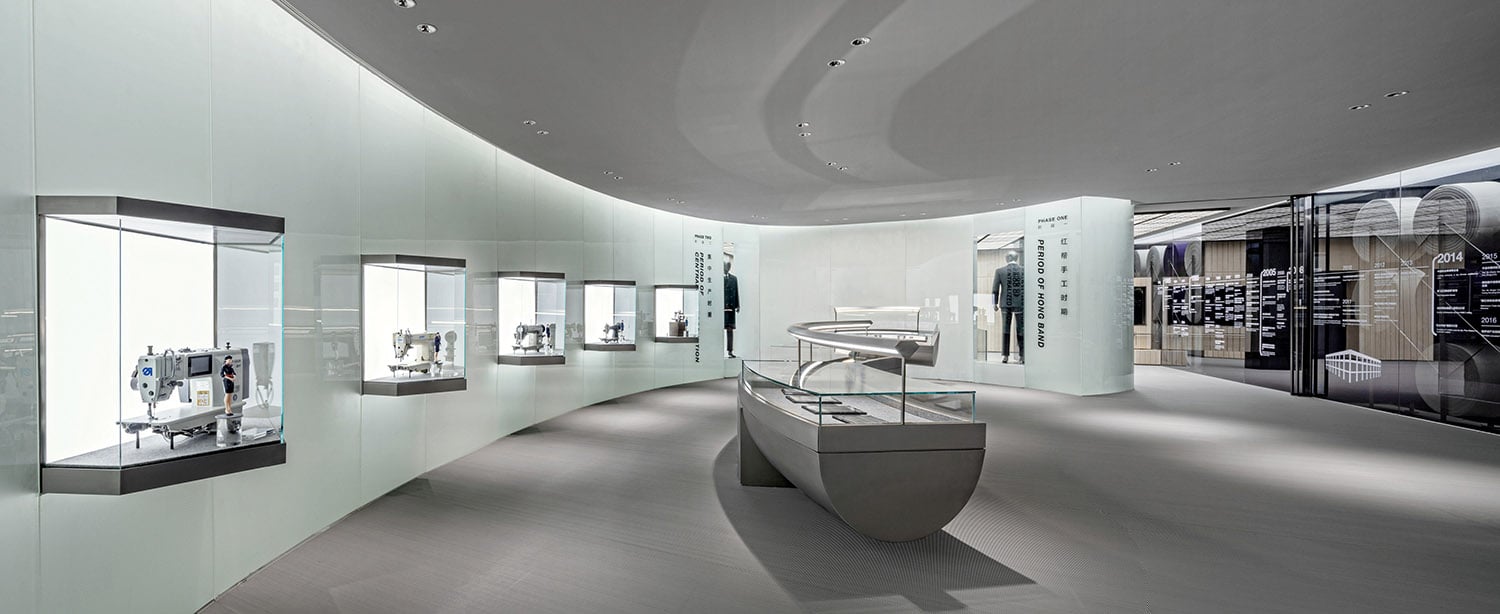
The reception area transitions into a monochromatic, oval-shape gallery space. Traditional tailoring tools are presented in curved, glass-topped vitrines, while archival sewing machines are displayed in backlit cases that protrude from translucent wall panels. “The way suits were made in the ’80’s is quite different from today,” acknowledges Hu, who together with Xin aimed to highlight Progen’s evolution over the past four decades. To achieve this, mannequins outfitted in archival garments are set within transparent breaks in the milky surfaces at the four “corners” of the room.
Greater Dog Architects Spotlights The Brand’s Narrative
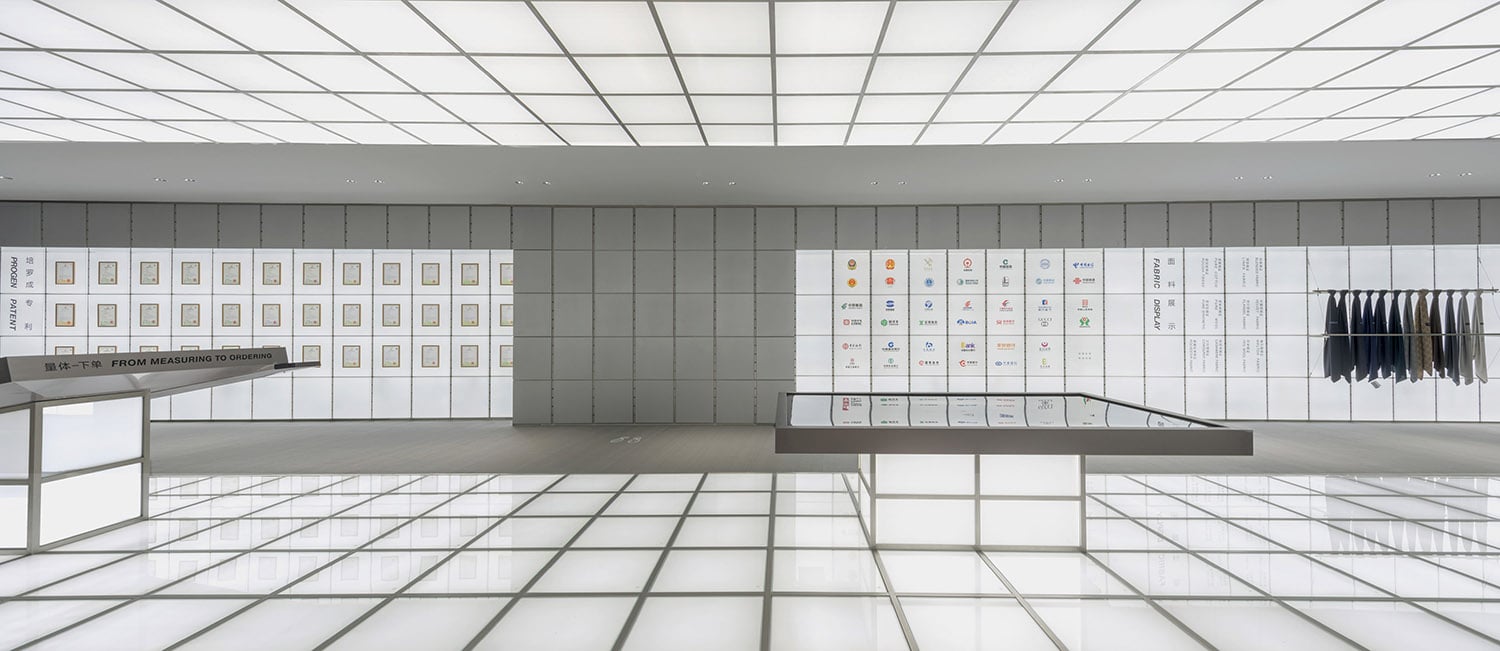
Beyond lies a darkened, curved-screen media room where an immersive montage conveys the brand’s story through imagery and film rather than text. Emerging from this near blackness into the bright white space that follows creates a striking contrast. Here, a minimalist custom modular bracket system spans the walls, allowing displays, installations, and lighting elements to be easily reconfigured. For example, illuminated square panels present patents, fabric samples, and infographics that together outline Progen’s four primary tailoring techniques. “We tried to translate all the information into one cohesive language,” Xin notes. “The light boxes make it clearer and cleaner.”
A Flexible Design Offers Room For Reinvention
The glowing grid extends across the floor, ceiling, and display podium bases, evoking the spacecraft interiors of 2001: A Space Odyssey. Greater Dog’s modular system continues into the final gallery, which highlights Progen’s current collections of garments and accessories. Again formulated for flexibility, the fixtures are simple to mount and remove, with peg holes spaced every 4 inches to accommodate various display elements. “You can move a panel or switch materials from metal to soft fabric,” Hu explains.
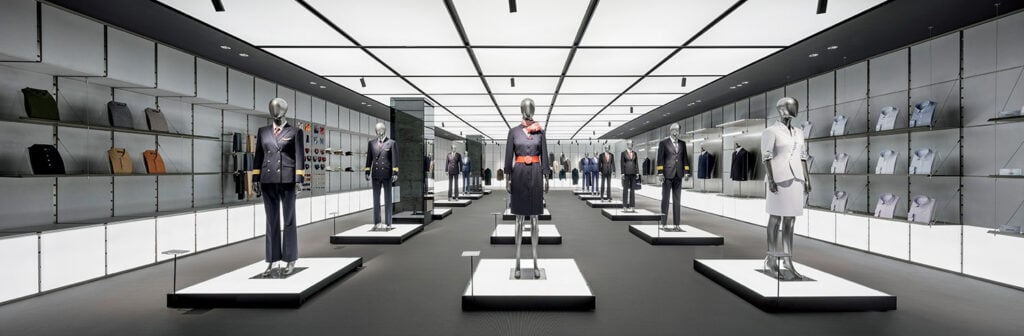
Illuminated podiums for mannequins can be repositioned across the floor, while thin stainless-steel cables attached to ceiling tracks can support hangers for seemingly floating shirts and jackets. Shelves and rails attach seamlessly to the grid as needed; the track lighting follows the same modular logic, allowing for easy adjustments. “We considered both functionality and how staff could adapt the space effortlessly,” Hu states.
Walk Through Progen Group’s Fashion Showcase
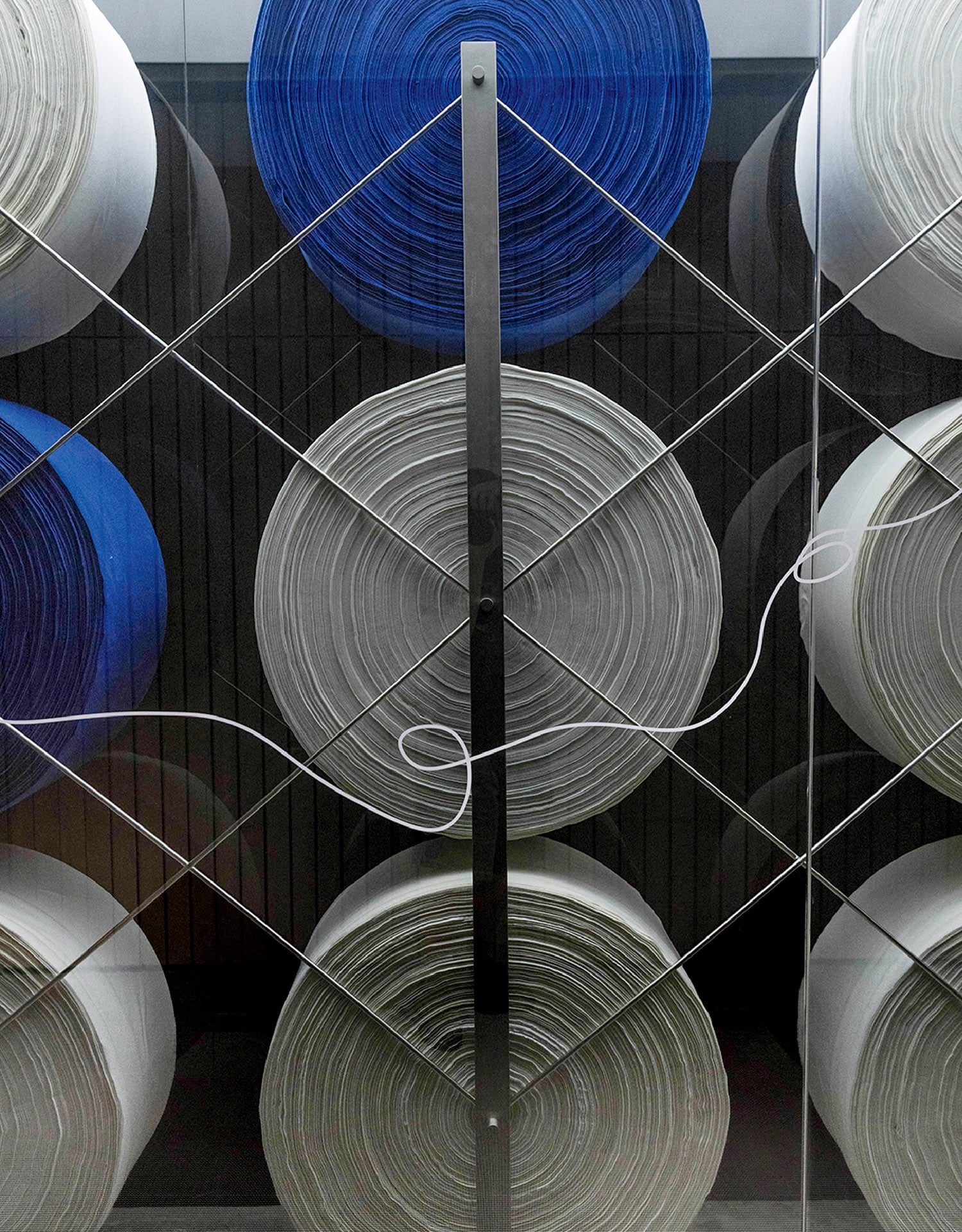
The corridor leading from the elevator lobby to reception is installed with 48 stacked rolls of suiting fabric behind tinted glass. 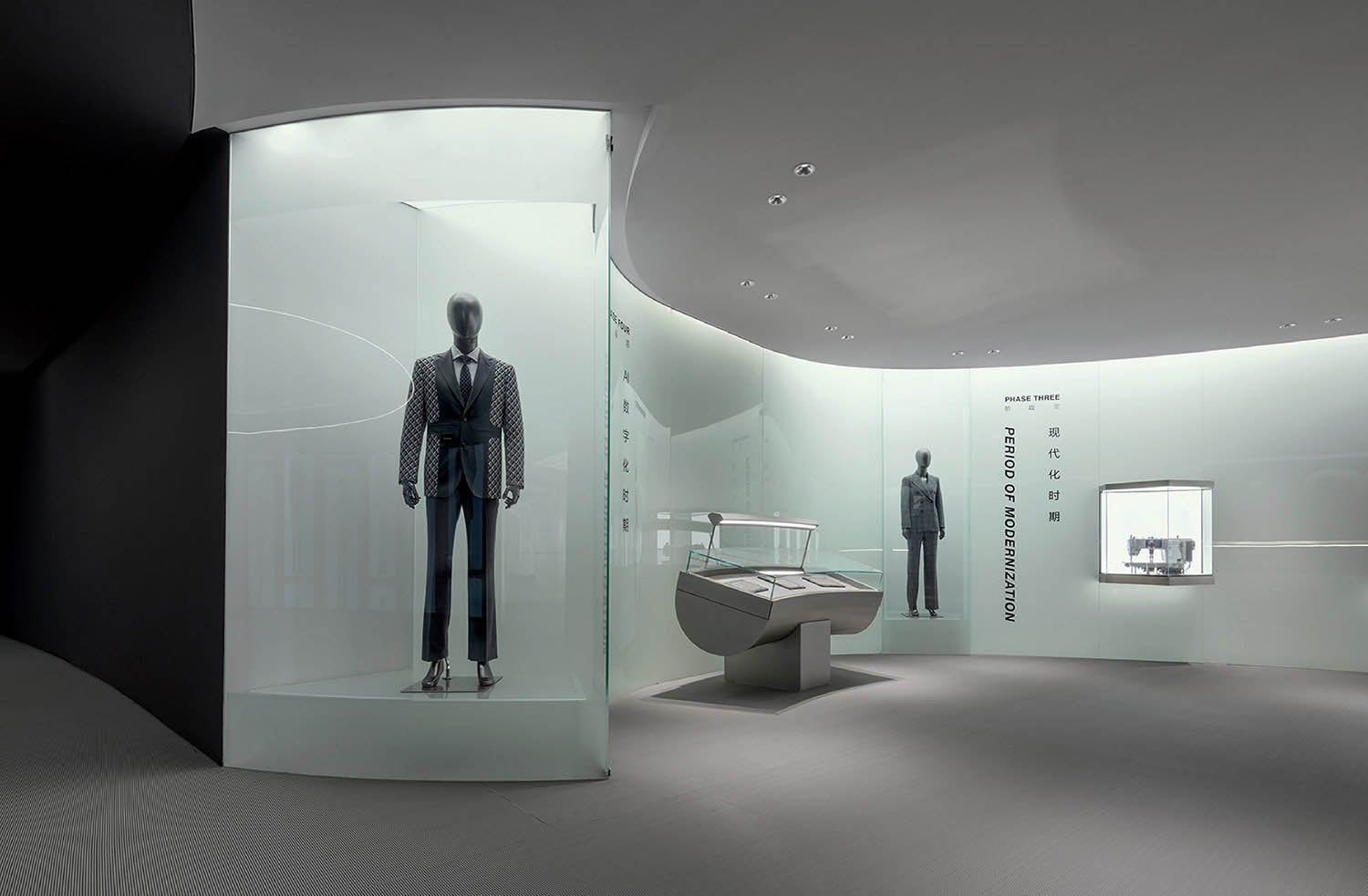
In part of the garment gallery, mannequins are dressed in suits dating to the 1980’s. 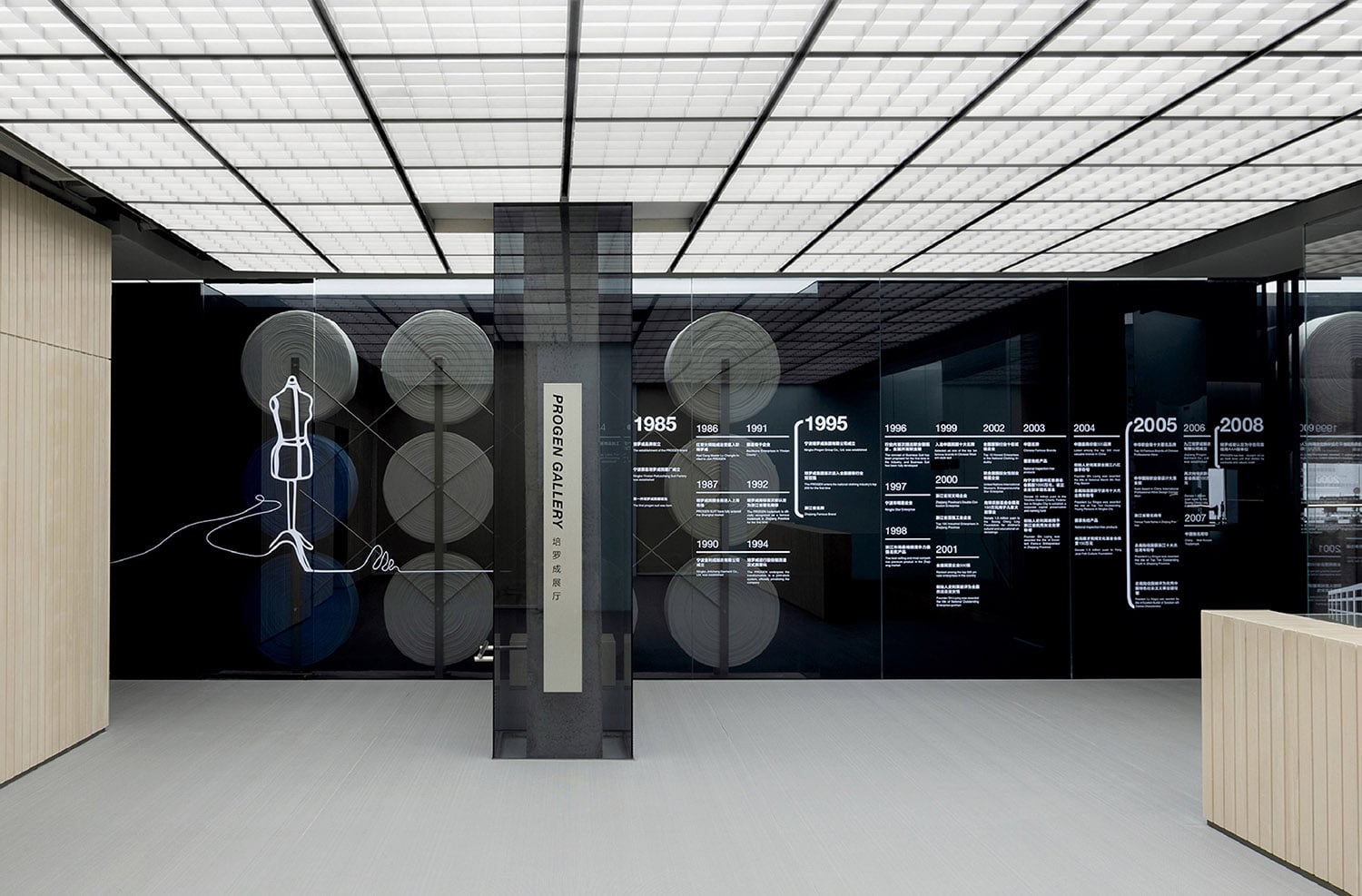
Tinted glass also surrounds existing columns. 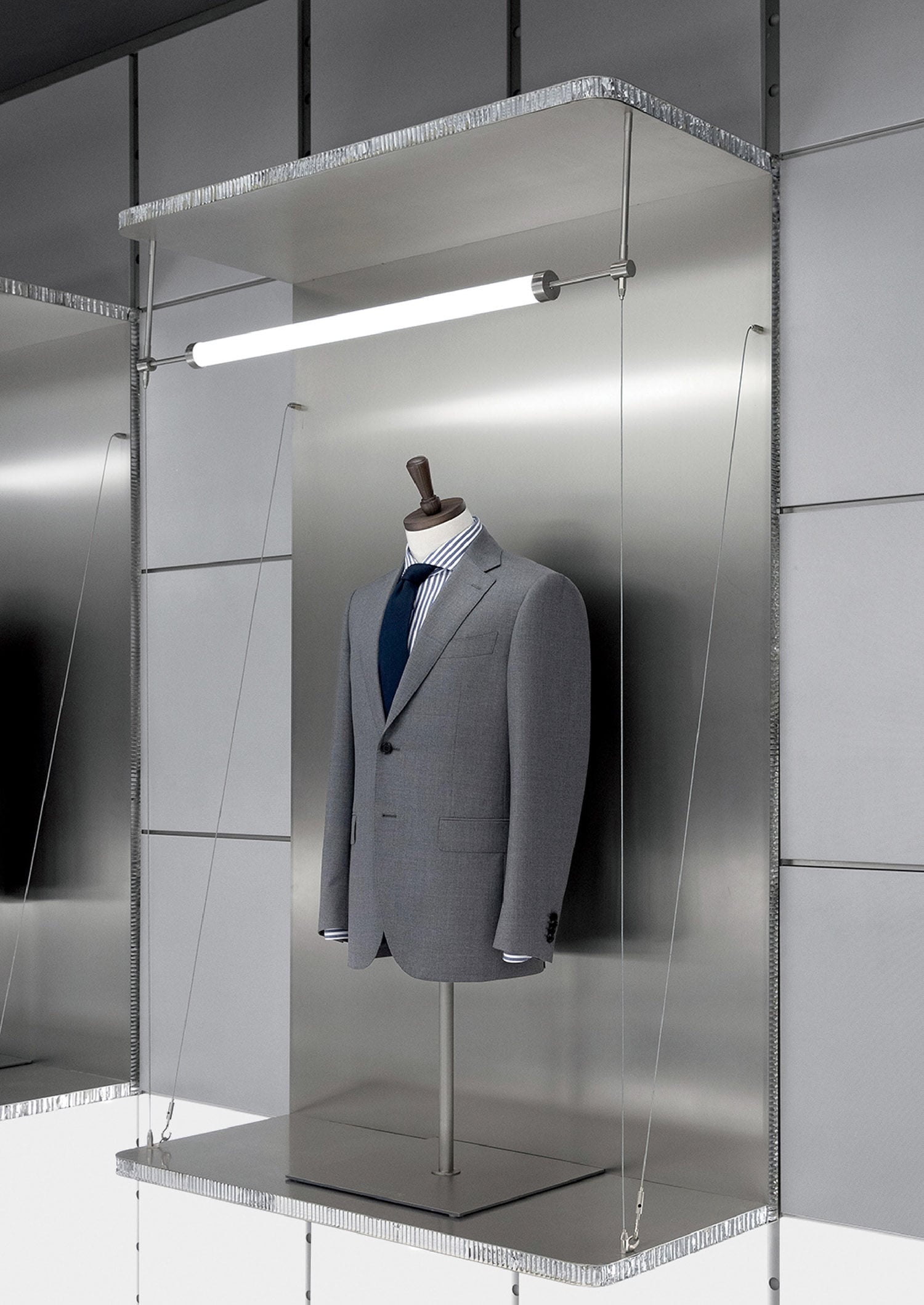
A custom modular system allows display elements such as aluminum shelves to be mounted onto walls. 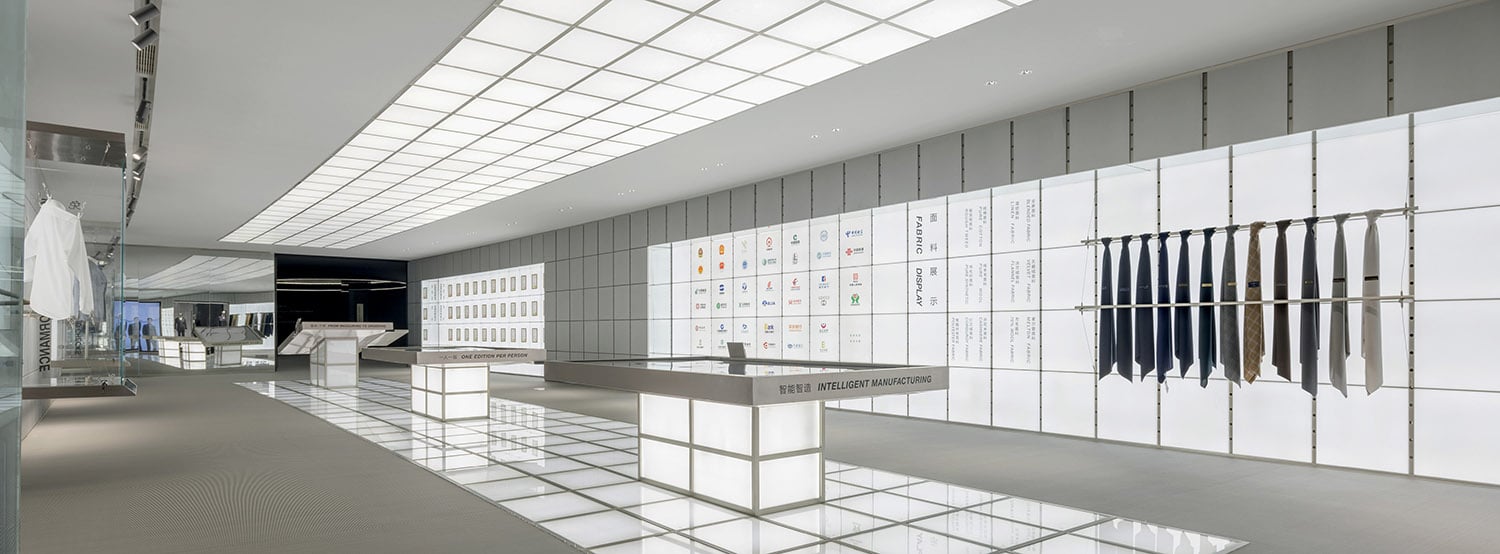
The palette throughout is intentionally colorless. 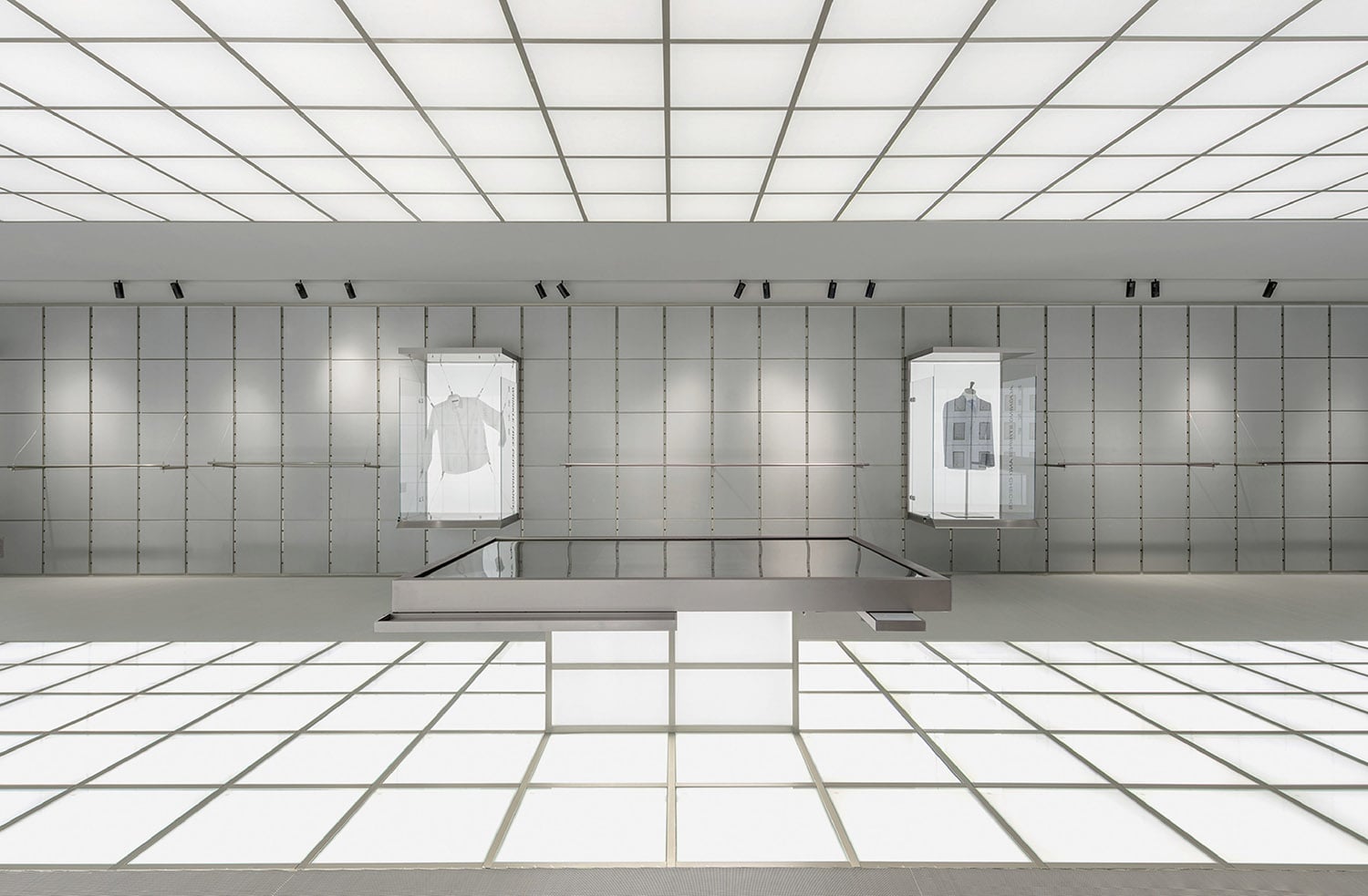
LED panels back the acrylic floor and ceiling. 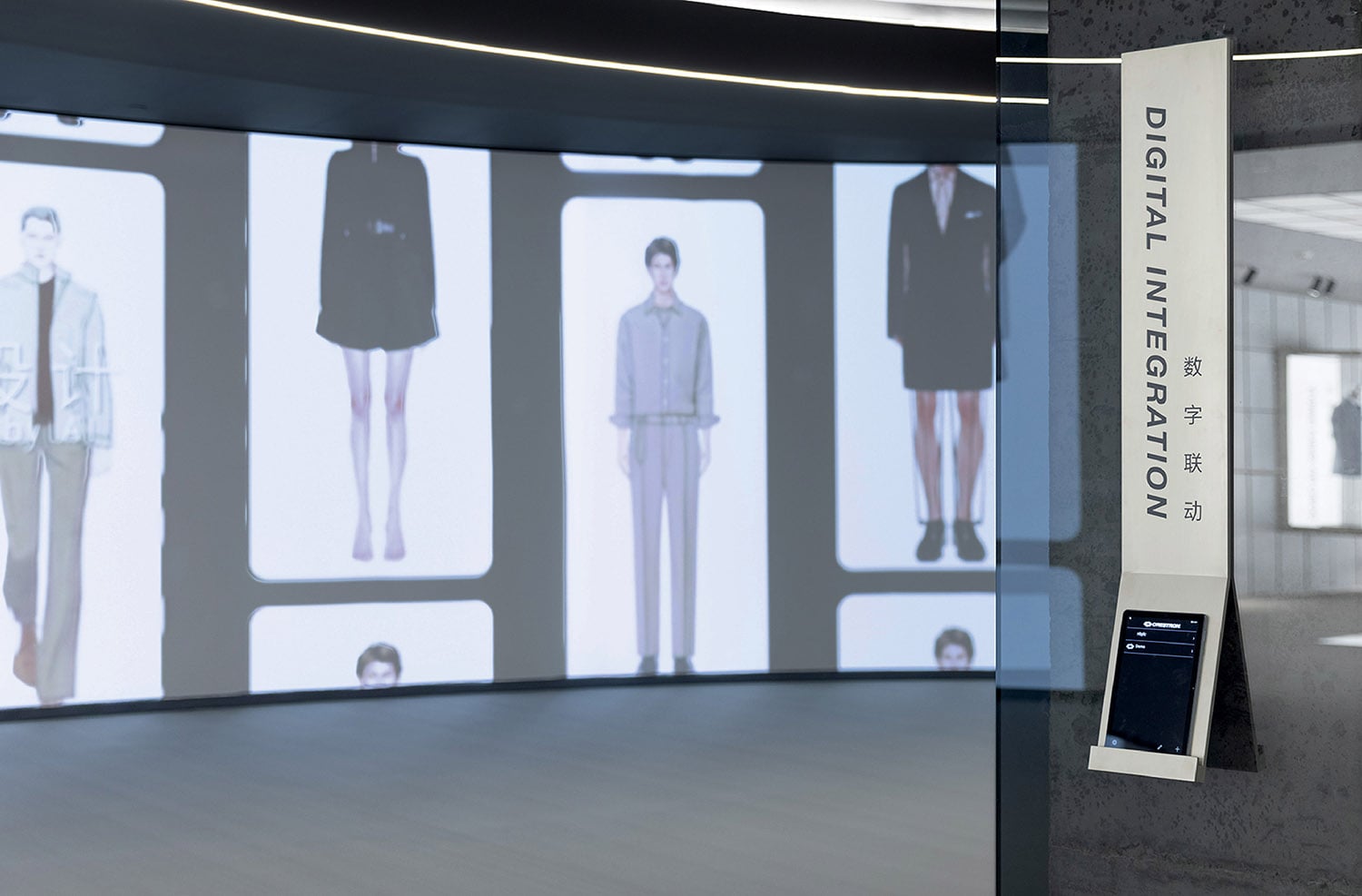
The glass-wrapped columns integrate signage and interactive tools. 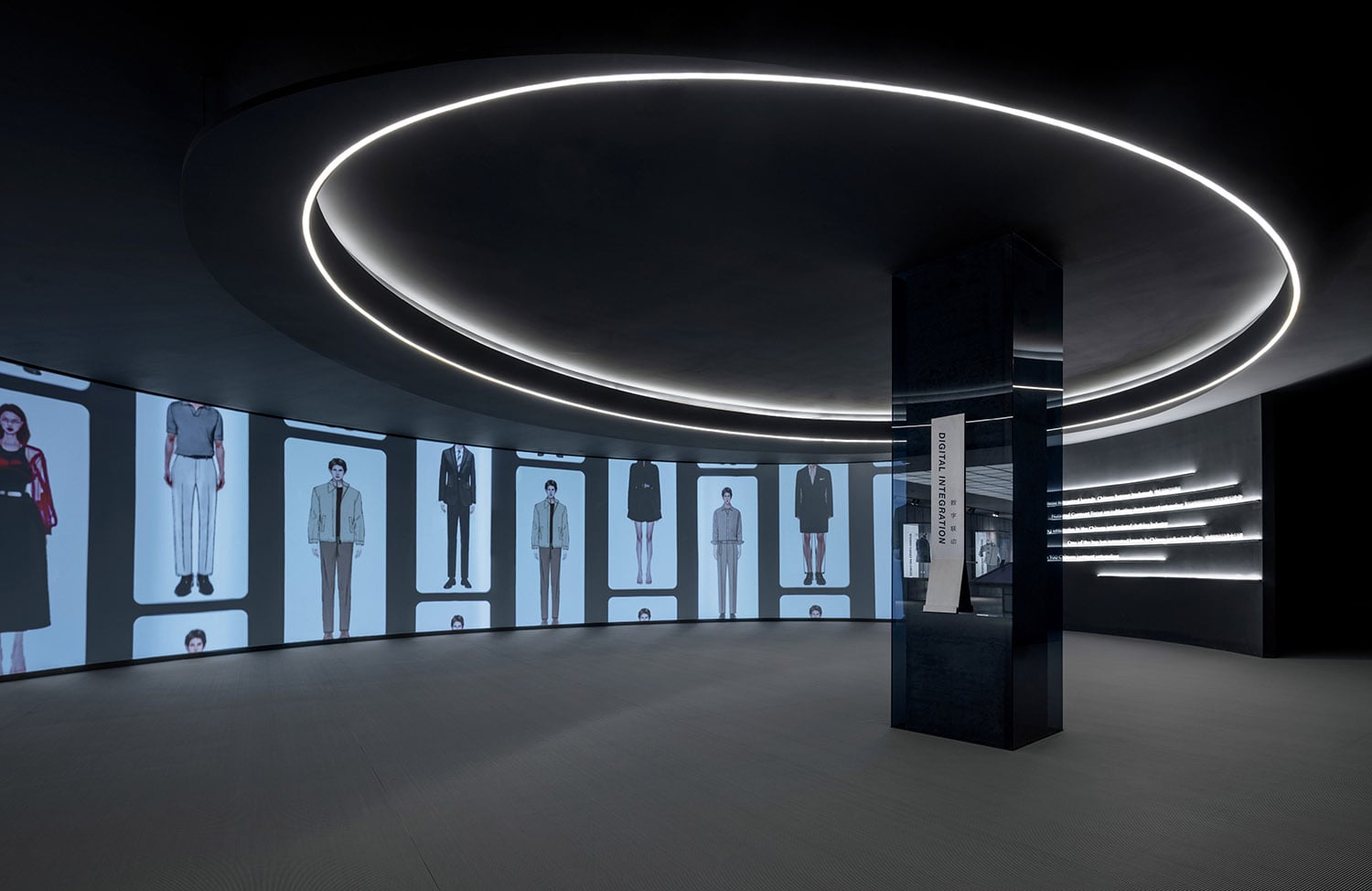
In the media room, which allows for digital interaction, videos detailing Progen’s history loop on a screen, its curve echoing that of the ceiling cove lit by LED strips. 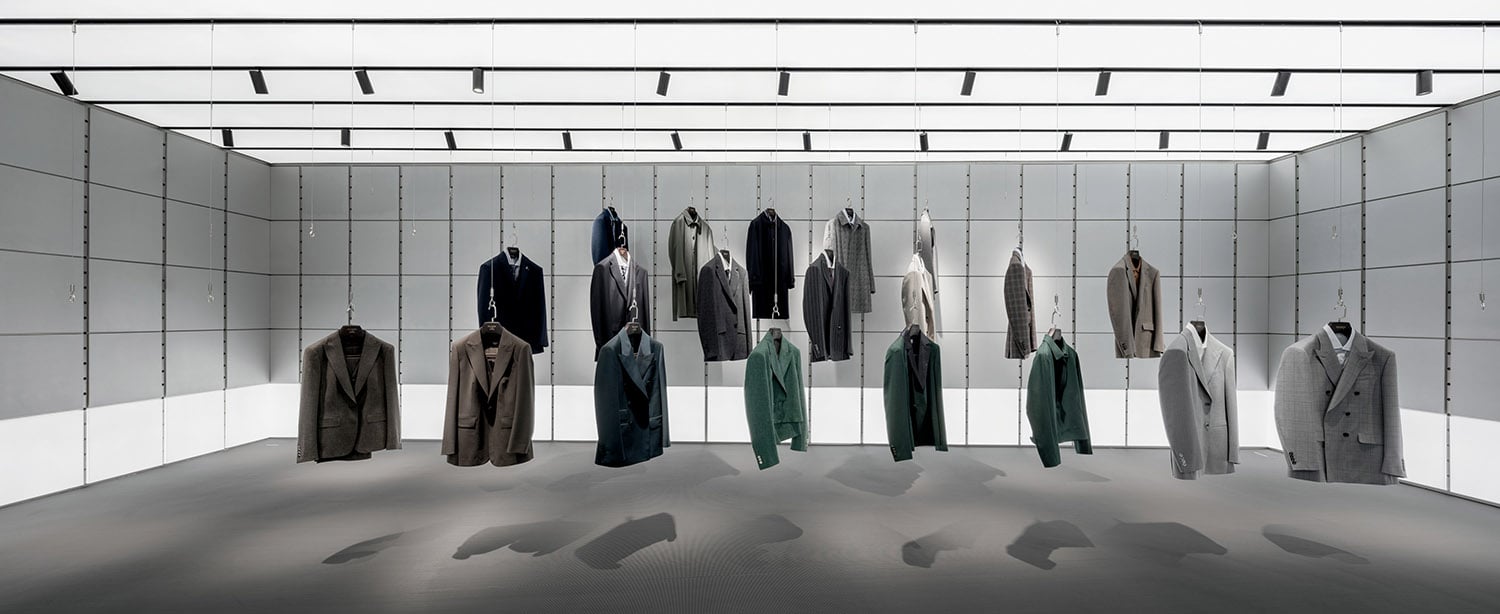
In between the garment gallery’s track LED spots, thin stainless cables attach to different ceiling tracks to suspend samples of current suit jackets. 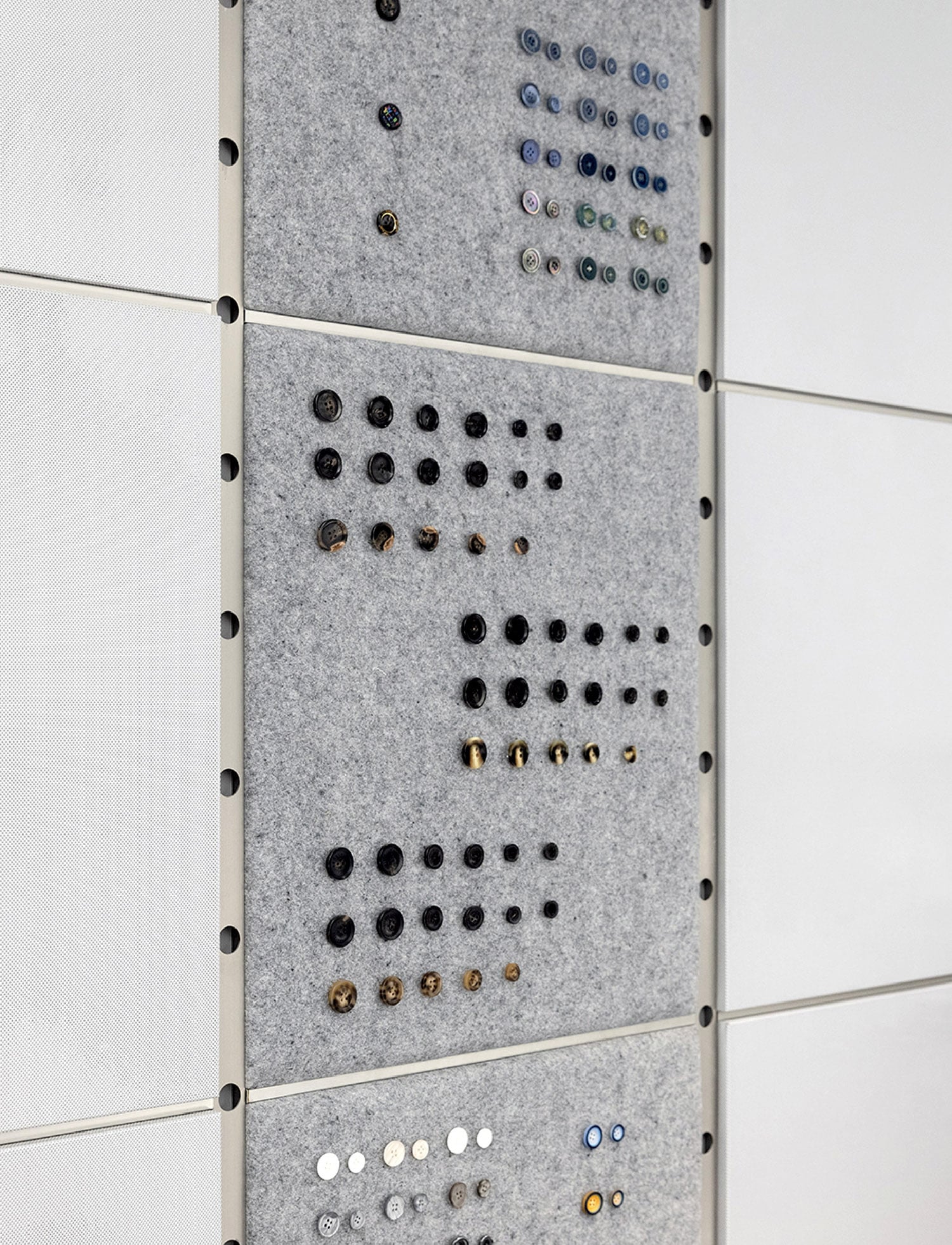
Flanked by panels wrapped in wool-nylon, details such as micro-perforated aluminum emit a futuristic vibe. 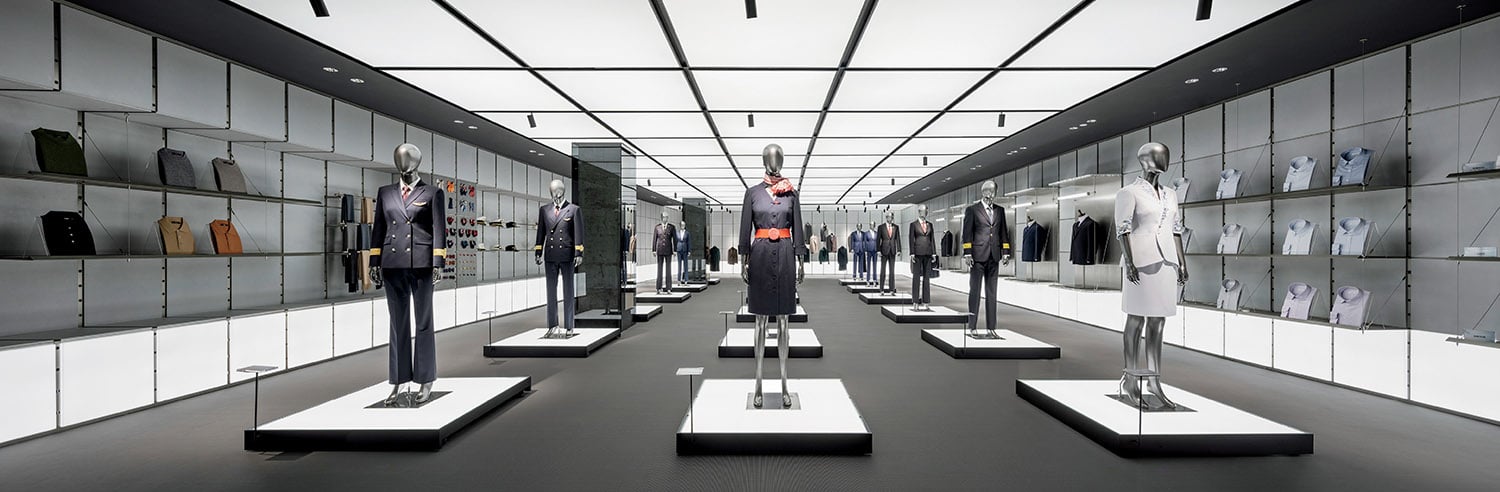
Modular fixtures—including shelving, podiums, and lighting—allow the large main showroom to be easily configured as desired.
Rather than creating an exuberant fashion showcase, Greater Dog leaned into the brand’s inherent formality—referencing the precision of tailoring and the industrial nature of large-scale production. The restrained palette—silver, white, black—mirrors classic suiting fabrics; materials such as gray carpeting and perforated aluminum emphasize a deliberately flat, disciplined aesthetic. “It’s not a fashion brand, so there aren’t any bright colors,” Hu says. “It feels more formal.”
Through a simple yet highly effective modular system and a dramatic interplay of light and dark, Greater Dog has crafted a space that thoughtfully honors Progen’s history and Ningbo’s broader tailoring heritage, while projecting the company confidently into the future. “Our client still wants to be recognized as a traditional brand, but they also want to be future facing,” Hu concludes. For this purpose, the interiors are very—shall we say—well-suited.
PROJECT TEAM
KEITH GUO; VIVI XIAN; ALEX WU; ZOE CAO; BEN CHEN; REMI LI; MINNIE JIAO; ASTER ZHU: GREATER DOG ARCHITECTS. NINGBO CRAFTSMANSHIP YIHE CONSTRUCTION: GENERAL CONTRACTOR.
PRODUCT SOURCES
THROUHGOUT SHENG MING PROPS FACTORY: CUSTOM DISPLAYS. SHENDING CARPET COMPANY: CARPET. MAHARAM: WALL PANEL FABRIC. RE-SENSE LIGHTING: LIGHTING.
read more
Projects
This Mexico City Lounge Centers The Act Of Listening
Sona, located in Mexico City and designed by Épico Estudio and Panorama, invites visitors into a sonic immersion.
Projects
A Milan Storage Unit Transforms Into A Meditative Home
Giovanni Muzio’s arching 1930s La Triennale di Milano inspires an artful 570-square-foot Milanese apartment designed for travelers exploring the city.