
10 Questions With… Belinda Blignaut
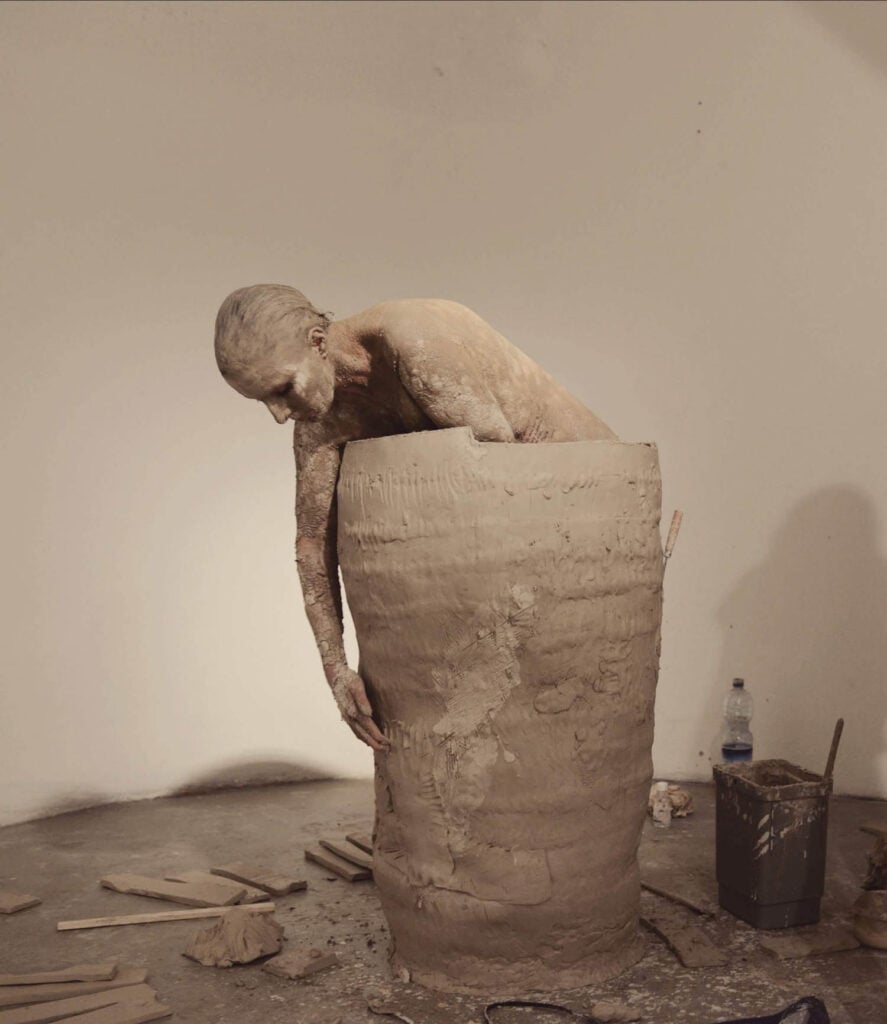
In an empty studio, an artist steps into a molded slab; naked, she baths herself in mud water. Her flesh almost completely molted in patched earth. Slowly, she begins to build layers of clay around her body, letting it take her form as she submerges into the material. She goes on to replicate the work in a studio full of viewers and in an exhibition alongside a sound installation where she communicates to those who find it hard to communicate in a language almost all can understand—that of the body.
This is the art of South African ceramicist Belinda Blignaut titled Working From The Inside, a phrase that comes from her desire to surrender to her work while also finding a way to facilitate expressions for people with Alzheimer’s, dementia, and other neurodivergent conditions.
Born on a remote dairy farm along the Eastern Cape coast, Blignaut grew up immersed in mud, forest, and ocean. With no formal art education, creativity became an instinctive way of processing the world. Clay, she says, felt like a return home—a malleable, unpredictable, and forgiving way of expressing herself. Her journey began on a visit to her aunt in the Overberg region of South Africa’s Western Cape. It was there, surrounded by raw earth and farmland, that she began gathering and testing hand-dug clay, noticing the subtle differences between soil, stone, and fired surface.
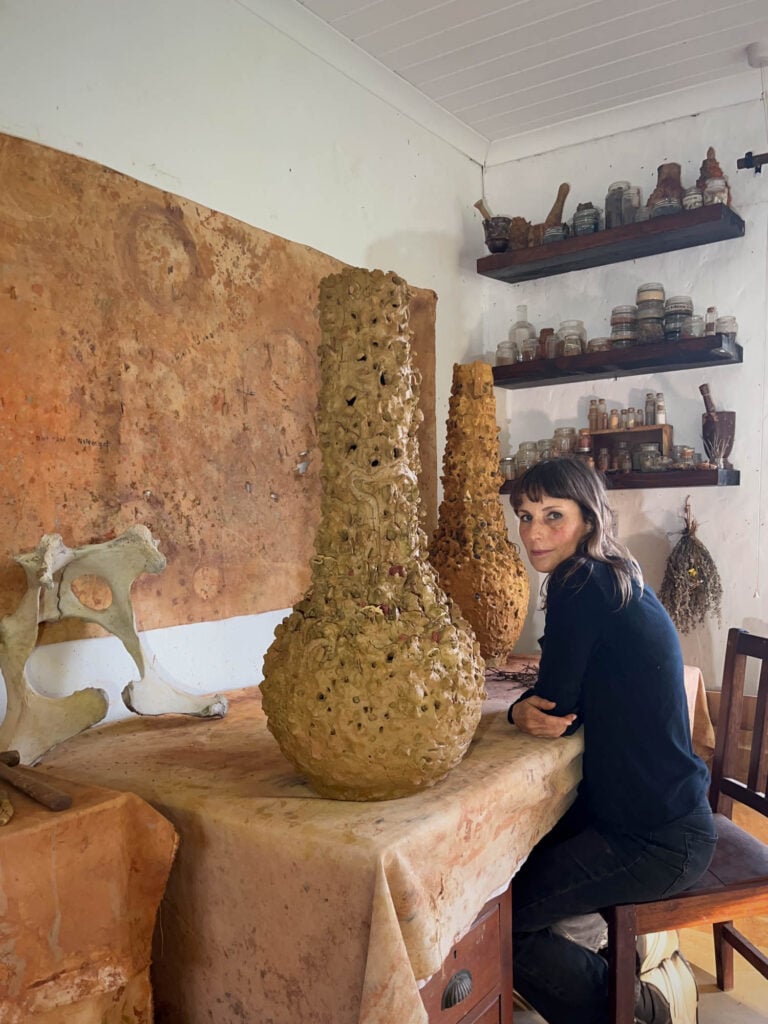
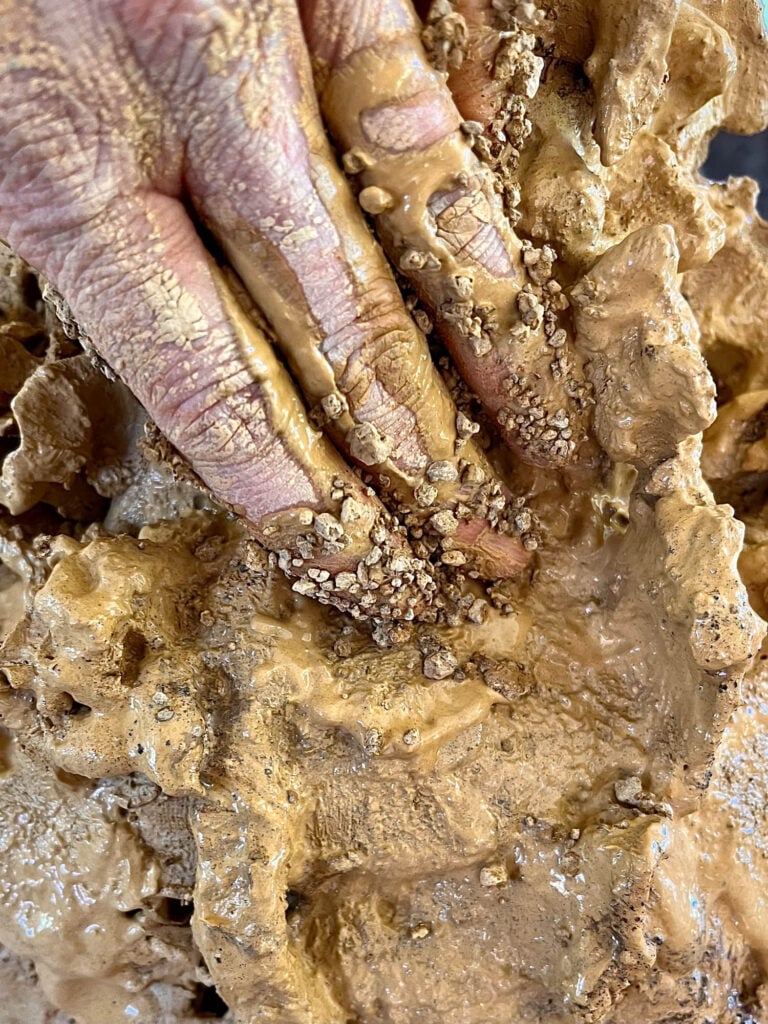
Blignaut’s work is renowned for its movement. Rather than forcing the material into submission, she allows it to lead. She operates on a theory of letting the clay be what it is—a philosophy rooted in observation of the natural world. Texture in also a renowned context in her work, which often feels skin-like, and that connection is intentional. She references what she calls “Earth skin” a thin layer of pure clay that rises to the surface after rain, drying and cracking like human flesh. While she consciously simplifies her silhouettes, the surface becomes the primary site of narrative and feels like something that allows us return to nature.
Interior Design talks with Blignaut about her evolving relationship with clay and the raw processes that shape her work.
How Belinda Blignaut Lets Form Reveal Itself Through Clay
Interior Design: How did your journey into ceramics begin?
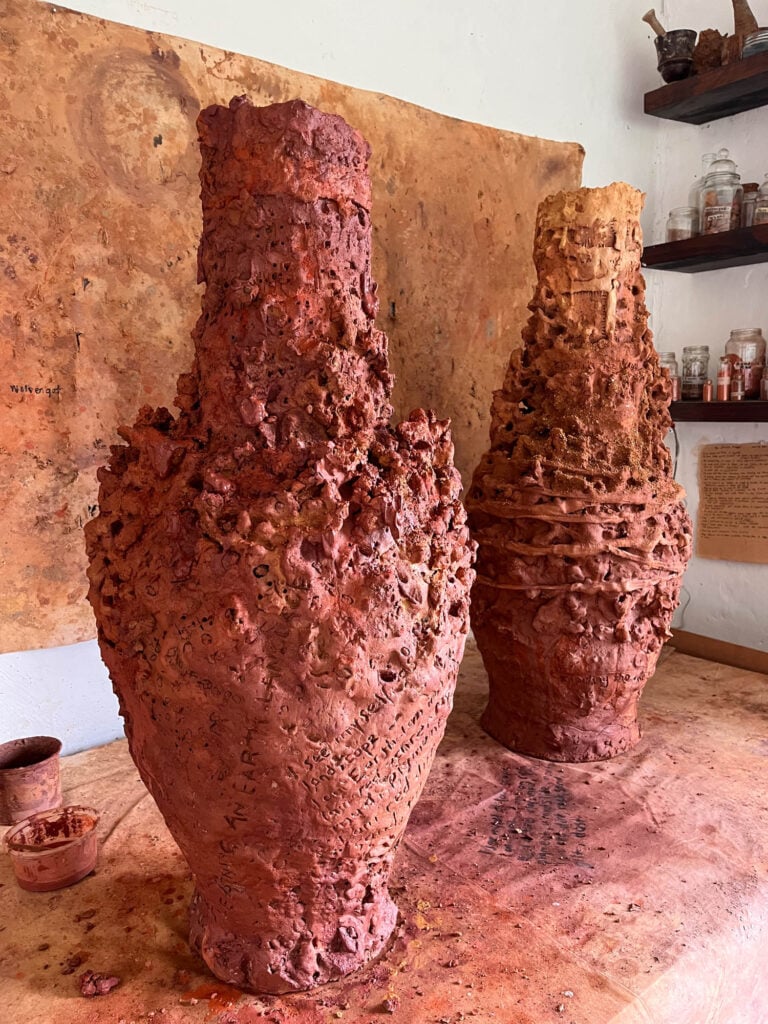
Belinda Blignaut: My journey into wild clay began 10 years ago, in 2016, when I visited my aunt in a small town in the Overberg, Western Cape, South Africa. She complained that she couldn’t make a garden for all the clay. I’d opened a clay studio three years before, when I’d rediscovered clay as an adult. My art practice until this time had been more conceptual. Once I got my hands into the Earth, something in me woke up. I visited every farm in the area that I could, gathering samples to test in my kiln in my studio. I began noticing the different types of stones found at different clay sources—that there were similarities between the stones and the fired clay. There was one type of stone I was particularly drawn to “Koffieklip” (coffee stone), a conglomerate found near the surface, formed during a process of percolation in the Earth. To me, observing this porous stone—full of holes, held together by iron rich sections, with sandy parts in between, little tunnels home to insects, roots growing right through—was like witnessing transformation in progress. As I tested and experimented during firing processes, I knew I’d found my medium. It was this working experimentally with only organic matter that slowly began to turn my art practice, and my life, around.
ID: Describe your background, your earliest years in South Africa, and what guided you towards your career as an artist?
BB: I was born on a dairy farm along a remote part of the Eastern Cape coast, an area so small it hardly had a name. I grew up playing in mud, running wild in forests, eating from the land and swimming in dams and the ocean. I spent a lot of time with the workers on the farm, playing and eating with them, and also being part of their spiritual practices. This impacted my life in a very real way. My family was not wealthy, our lives remained simple even after leaving the farm. I had no formal education. I began working while I was still in high school. Art was always a part of my life. It was what I loved most as a young child and all during my school years—I’d get home from school and draw and paint as a way of processing life. Art was the most natural thing to do as I became an adult.
ID: What first attracted you to clay as a material?
BB: What first attracted me to clay was its malleability, adaptability, unpredictability, and it’s tactile nature. It’s a forgiving material, accepting human marks, allowing cracks and errors, embracing texture, inviting experimentation. It took me right back to playing in mud as a child. It felt like a return home.
ID: I know saying this sounds metaphorical but you seem to push clay to its limits. Does that stem from a place of fragility or your expression of forms?
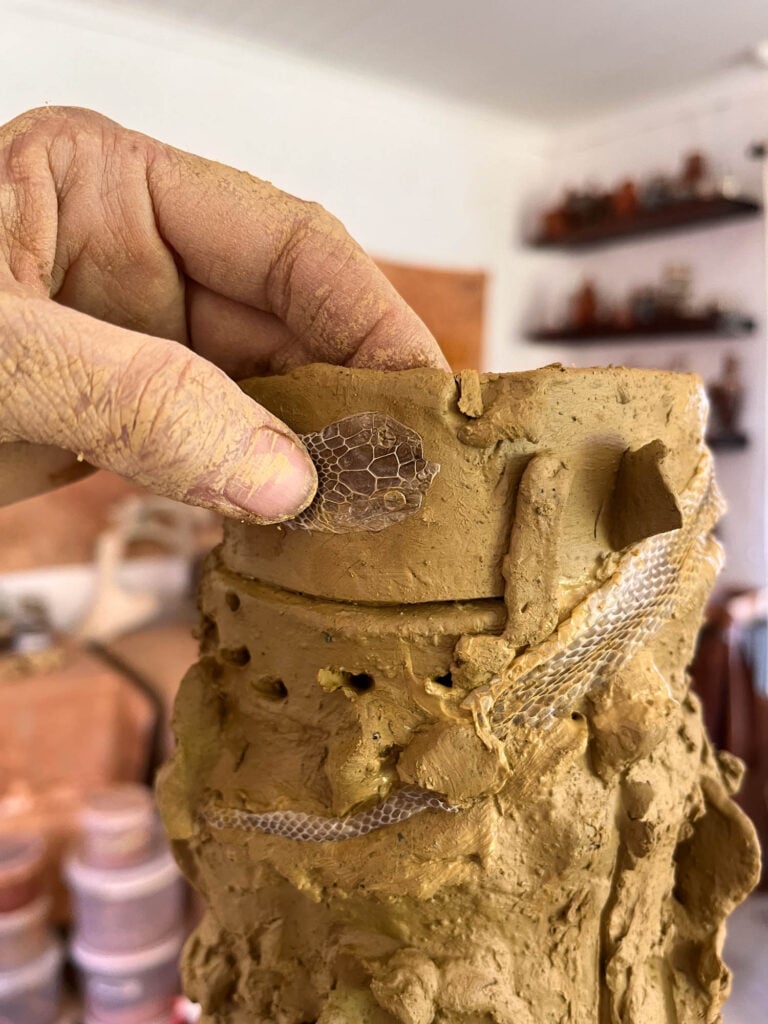
BB: I love to be true to my medium, which is unpredictable, unstable, hand dug clay. I love to discover what the clay wants to do during making and during firing, to emphasise or work with those qualities. I like the making process to be visible in the finished piece, which may be visible joins, rough edges or marks from my fingers. This type of fragility speaks to me of our own messiness and growth as humans.
ID: Your work often feels like it’s unfolding or collapsing on itself; where does that sense of movement come from?
BB: This movement comes from a conscious surrender to my material, from letting the clay be what it is, from not trying to control it more than I need to create a form. I’ve become increasingly interested in how clay forms on the Earth, how stones form from clay, how water and plants change the clay body in the natural world. I like my work to speak of this process, of the rawness of something not quite fully formed, along with the mark making of the building process.

ID: Many of your pieces feel almost skin-like or geological, especially in their texture. Are you consciously referencing the body or something else?
BB: I am both consciously and subconsciously referencing our bodies and our skin. Very often in nature, when there is or has been water, we’ll see a thin layer of the purest clay particles rising to the surface. This clay looks like skin, “Earth skin” both when it’s damp or when it dries and cracks. I reference the body in the abstract figurative form of my vessels too. When I make the basic form, I’m often thinking about the body, back, front, foot, neck, and the curve of the spine.
ID: Do you plan your forms in advance, or do they evolve while you’re making them?
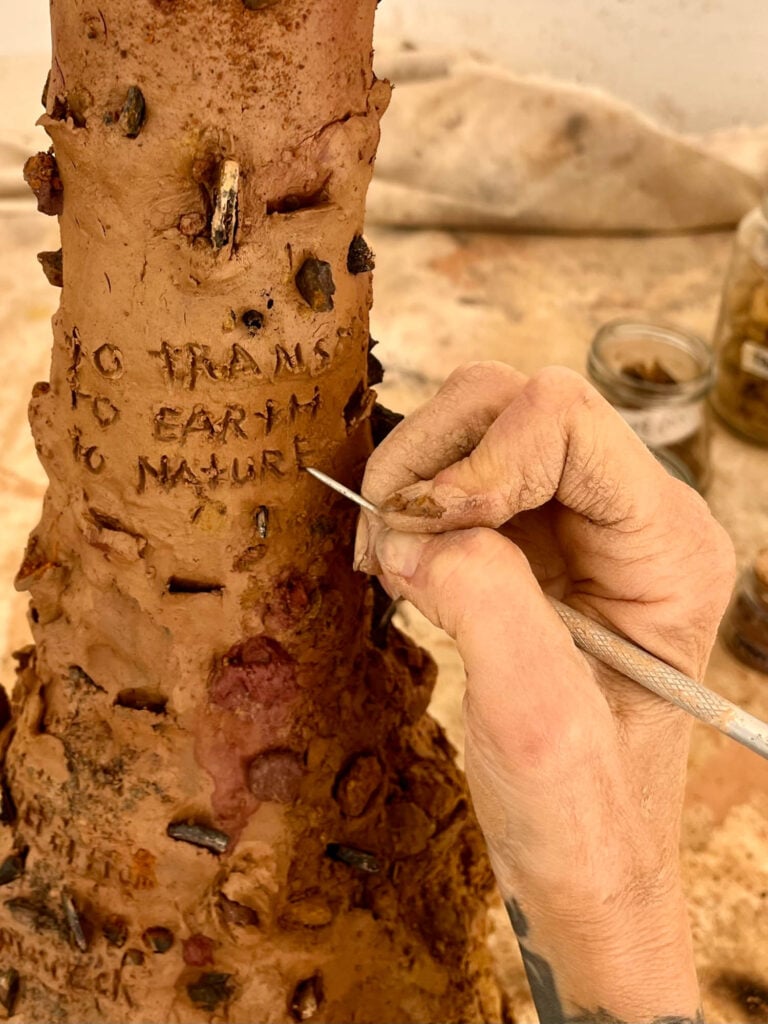
BB: At the moment I’m realising my thinking is shifting towards a combination of planning and allowing form to evolve. I’ve given up sketching my ideas—when I work, the clay does not respond to that. I’m seeking to work from an intuitive place, to lose myself in the building of the basic form. At the same time there’s a conscious simplification or honing down of forms, a meditative repetition. This is to allow more creative space and energy for the surface work, which is where a large part of the story of each piece becomes visible.
In building, the technique I most often use is slab work. Once I gather the clay, I prepare it, keeping as much of the other organic matter, and then roll into slabs or strips. I do not process much. During firing, I tend to do 3 to 5 firings per piece. I like to combine both electric and pit firings in one piece, ending with a lower temperature to keep the roughness and rawness in texture and colour.
ID: You have been someone renowned for the way you submerge yourself into your art until it breaks, how did that idea come to you and what have you tried to communicate through that experience?
BB: The title of this piece is Working From The Inside and comes from a desire to surrender to my material. I began building a clay vessel around myself in the back corner of my shopfront studio with it’s huge windows. I had no idea how to make the piece or if it would even be possible. It took a few days of climbing in and out to continue building. At the time, I was teaching various groups of people with special or other needs, from my studio. I was working together with psychologists and health care workers, facilitating expression for those who find it impossible or difficult to communicate. This included people with Alzheimer’s and dementia, Autism and other neurodivergence [conditions], physical disabilities and children who were living in safe houses—having been removed from their parents’ homes due to severe abuse. I learned from their raw expression, play, and simpler ways of making. So really, this performance piece was a combination of my own inner learning and their impact on my life.
There are also other themes I hope to communicate, and these originate very much from my perception of the natural world; my observation and witnessing as part of the landscape, not separate from it. There is a conscious listening to the land, sitting or lying on the ground in stillness, observing seasons, or shifts in the land through the slowness of time, natural events or even natural disasters. This forms the story in matter I include with the clay and on the surface of the vessels. I hope the detail invites people to look closer. Added to this is the desire to introduce others to a kinder way of working -kinder to the Earth in that it’s not necessary to buy packaged and mass produced materials, many of which come from massive mines, and some that aren’t even natural. Almost everything we need to make art can be found in nature, gathered with care and respect, not taking anything we don’t need.
ID: Has your relationship with clay changed over time?
BB: My relationship with clay has changed me over time. The relationship has deepened in profound ways over the past few years of living in nature. I left the city when I became physically ill, bedridden for some time, and sought a softer life in nature. As the landscape healed me, my work process deepened. I intentionally want the works to be as close to the natural world as they can be. If I want glaze, I use plant or wood ash which I prepare myself in my fire pit. I very much want the vessels to speak of the rawness of transformation seen in nature, to be true to the textures and colors of the earth.
ID: What are you currently working on in the studio, or maybe a forthcoming exhibition?
BB: I’m very excited to be beginning a series of larger scale works that have been incubating for some years. I felt a need to stop making plans for a few months (which is unusual for me), and to work with ongoing dreams that seemed to be speaking loudly. My work, every single day, was walking in the wild and writing about my dreams in relation to my own inner growth and creative process. During this time, which was deeply meditative and reflective, forms began to emerge, bringing together images from dreams, and works I’d been hoping to make. The aesthetic hasn’t changed much but the language has. It’s gone from product to offering, the place from which the work is made has shifted.
- No tags selected
read more
DesignWire
Designers And Manufacturers On The Move: September 2026 Edition
Interior Design‘s latest On the Move includes must-know industry promotions and hires, like Perkins&Will’s strategic move to expand its design capabilities.
DesignWire
10 Questions With… Artist and Designer Conie Vallese
From sculpture and ceramics to glass, textiles, and furniture, Conie Vallese embraces a multidisciplinary practice shaped by curiosity and creativity.