
10 Questions With… Designer Sofia Karakatsanis
Sofia Karakatsanis is inspired by the visceral nature of wood, not just as a material that shapes her creative and artistic practice but the concept of what a wood is and the many things it could do. Firstly, she understands that trees are more than just trees—they are elements that shape time, both past and present. They also shape life. She tells interior designers that no two pieces of wood are ever identical and as a material that has been a lifeguard for humans for a thousand years she asserts it’s in some way part of our DNA.
Karakatsanis’s journey into woodworking and sculptural furniture began during an art foundation course, when she made her first piece of furniture almost by instinct. Hoping to deepen that path, she went on to study interior product design at university only to realize that making was not central to the program. While at furniture school, a pivotal design session changed her direction. When she was asked what she liked, she spoke of artists Louise Bourgeois and Larry Burrows. Then a spidery table sketch followed, an angle grinder was suggested, and carving became her language. It’s that subtractive process that has come to define her practice.
Her techniques make her craft distinct. She works with old methods like the tongue and groove to shape the joint and uses steam bending to create eccentric forms. For Karakatsanis, honoring tradition does not mean resisting experimentation. She begins each work with powerful carving, often using an angle grinder to establish the initial form, but the true refinement happens slowly by hand.
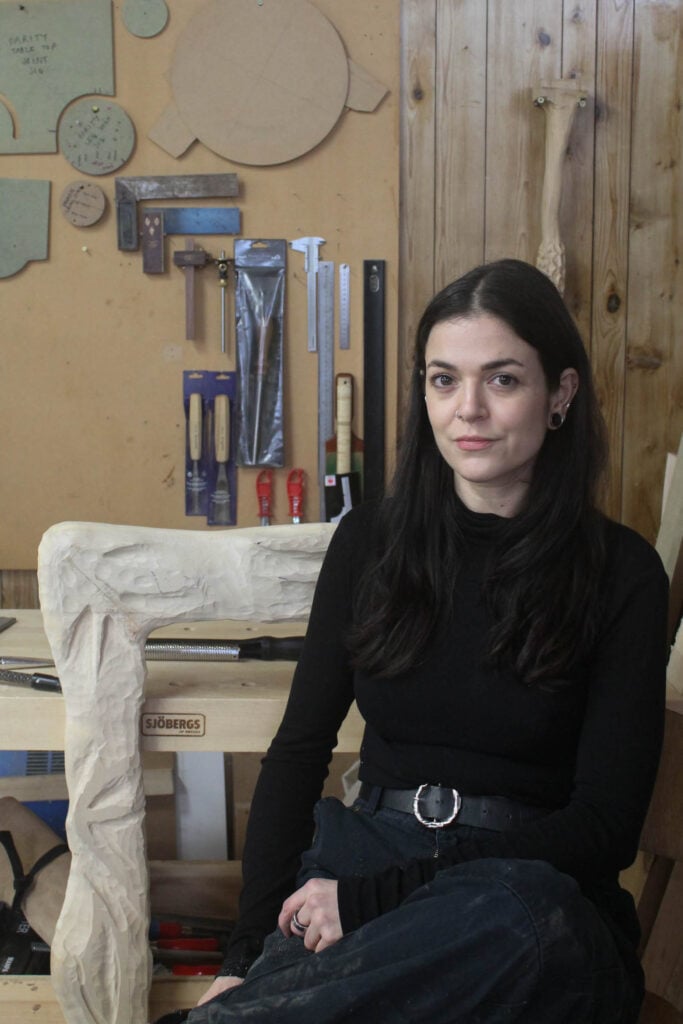
At some point, her work feels almost biomimical. While she doesn’t dispute, she’s quick to add that she’s inspired by organic forms or things that are or were alive but as of late, she’s exploring certain ideas and getting inspired by the concept of forms that grow, morph, and undergo evolution.
Interior Design sat with the furniture designer to discuss her evolving work, her journey with wood, her fascination with transformation, and why she continues to gravitate toward concepts that refuse to be ignored.
Sofia Karakatsanis Shares Insights Into Her Carving Process
Interior Design: How did your journey into woodworking and sculptural furniture begin?
Sofia Karakatsanis: I made my first piece of furniture while studying an art foundation course, and went on to study interior product design at university hoping that I’d learn to make, but that wasn’t what the course I was on was about. I worked as a joiner for a bit, then bespoke designer, and project manager. During that time I became aware that furniture schools existed and I was able to attend a weekend course where I made a pair of dovetailed bookends (which my mom still has!) I was completely hooked and desperate to learn. The school advised me that there is a charity here in the U.K. that funds craftspeople to train, called the Queen Elizabeth Scholarship Trust. The scholarships were more geared towards established makers to expand their skill sets, so my first few applications were unsuccessful. I ended up self funding 15 weeks in 2021.
At the school, as well as being taught to make, students get design sessions with Jane (my woodwork mom). She asked me ‘what do you like?’ Rather than reeling off furniture pieces/makers, I talked about Louise Bourgeois and Larry Burrows, two artists whose work has impacted me on the deepest level. As we talked, I drew a spidery looking table. We discussed construction, and I asked how I’d make these shapes. Jane told me to get the angle grinder out, and the rest is history. I worked for another furniture making studio for around 18 months which really helped me to continue learning and hone my skills. Off the back of that, I secured a scholarship in 2022 to access more training, finishing in early 2023. It allowed me to continue exploring and developing my own style. Carving in this subtractive way feels the most natural to me. It’s like drawing in a way. I like the freedom and flexibility to respond to the wood as I remove material. I look at the grain, see shapes emerging, chase a little back here and there, it can change and develop in the moment. It feels like a dialogue between myself and the wood.
ID: Can you tell us about your background and your childhood and how that shaped your current career?
SK: I was so lucky to grow up around artists and makers. My mom did stained glass and my dad was a woodworker too, he made field shelters and stables for horses. My mom has great taste, she always had beautiful objects in the house: ceramics, wall art etc. Carefully made objects were part of the background of my childhood. I spent a lot of time with my grandparents growing up. They live in the Black Country, which is historically an industrial area in the West Midlands. So many things have been made there, it is full of amazing makers, people who work with their hands and materials. I loved art at school, and design technology—even back then I was into woodwork. I spent a lot of time drawing.
ID: When you create, do you think of your pieces as furniture, sculpture, or something in between?
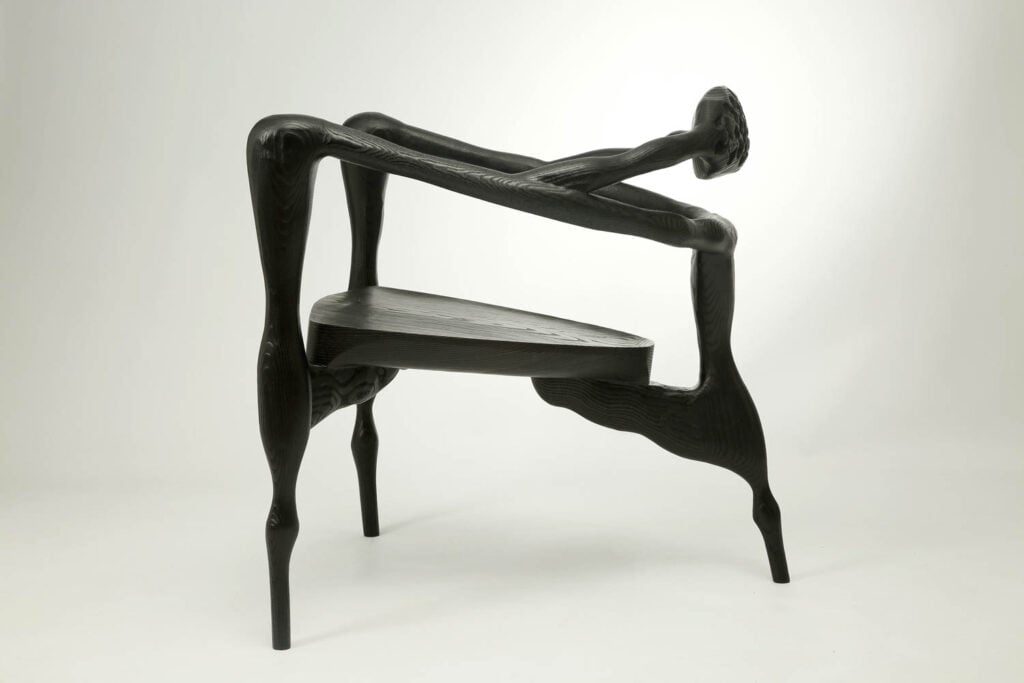
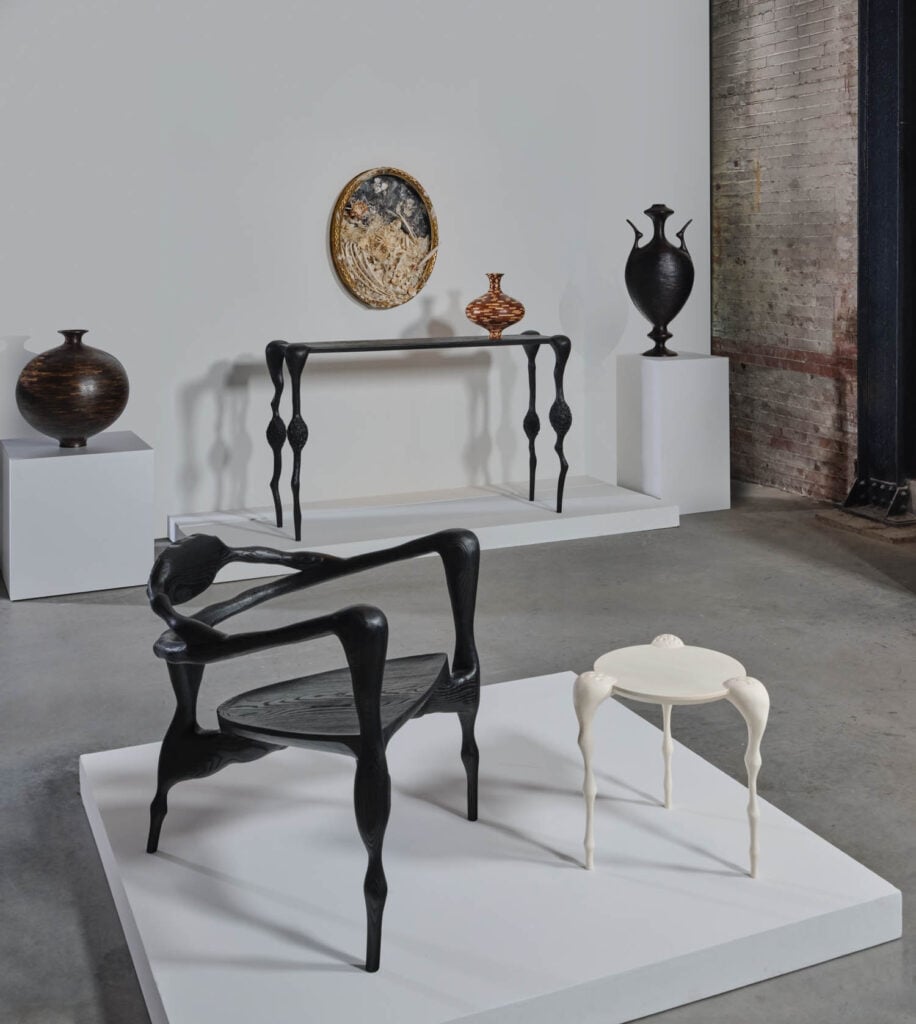
SK: I think they sit somewhere in the middle. I can see them in my head before I make them, my brain thinks in furniture so more often than not there is a function, but the form always takes precedence. I guess I consider sculpture to be functional in a way, it has an effect on your environment. It is important that they are functional pieces, and I do ensure that they remain functional while not compromising the form.

ID: Crafted texture is a significant element in your work—it reminds me of the master wand in the Harry Potter series. But I want to know the story behind that concept.
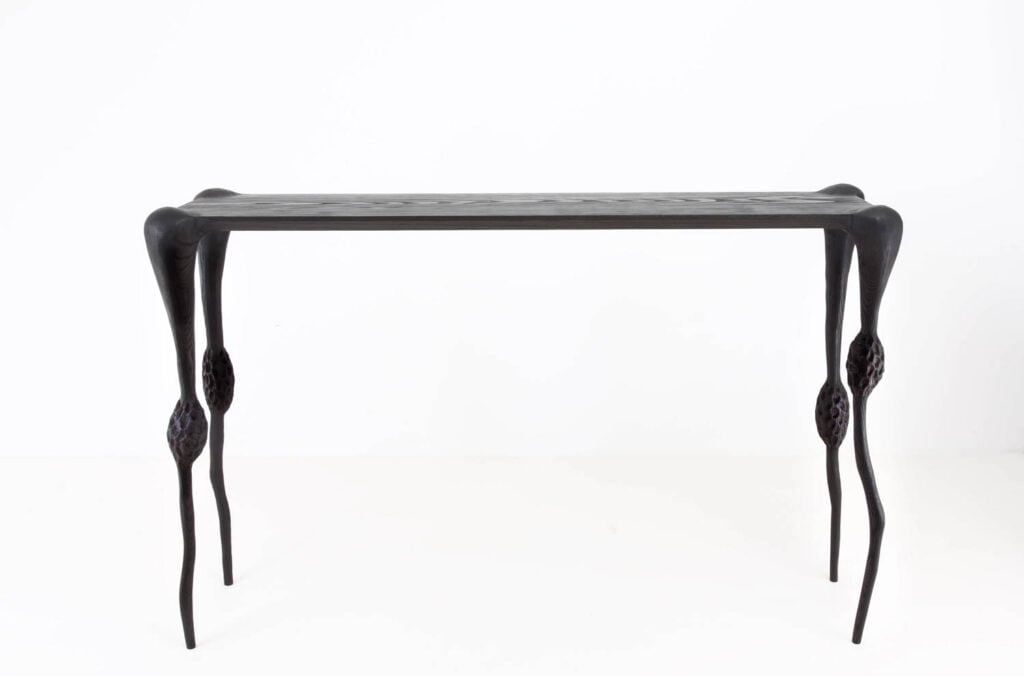
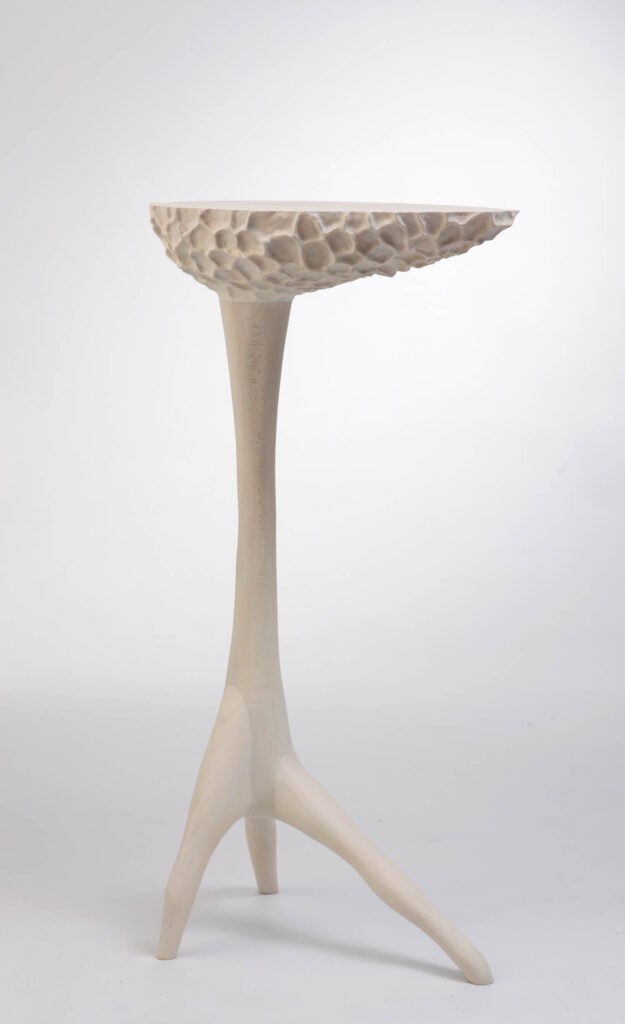
SK: Working with wood, the texture is a massively important aspect. I want people to know that they are made from wood, once close up it becomes familiar, but from a distance it can be confusing as the finishes really transform the timber. All of my black work is scorched. Scorching is exactly what it sounds like, burning the surface of the wood. This removes the softer growth, brushing it away with a wire brush really enhances the natural grain. It invites you to engage with it, it is tactile and natural. I think it speaks to a more ancient part of us. I use the grain patterns in the wood to guide my carving. I always start with a sketch but like to keep things fluid, adjusting the carve to suit the flow of the timber.
ID: Is there a traditional element in your work?
SK: Definitely. I have used many old techniques in the construction of the work, like tongue and groove in joints, and steam bending to create forms. While I do power carving with an angle grinder for the first carve of all my work, the bulk of the refinement is done using hand tools like spoke shaves, rasps, and cabinet scrapers. Cabinet scrapers are actually my favorite tool. They are just pieces of steel that you put a cutting edge on, scraping them across the wood you can take off tiny curls of material at a time. It allows very focused shaping, and it is so satisfying to do.
ID: What inspires your work, especially your approach to shapes, are they a product of biomimicry?
SK: I want the work to have a living quality, like it is or was alive, so I definitely pull from organic forms. When I think about the type of work that affects me, it has always been things that make me uncomfortable in some way. Organic forms can make us uncomfortable—legs that are long and distorted in ways, bulbous areas, hollows. I want my work to stay with someone, the way other works have stayed with me. That doesn’t always need to be because it was beautiful, or sweet. The things that affect me are confronting, so I try to create that with my furniture. I hope to strike the balance of something that is beautiful, while being a little bit grotesque. The art I have been exposed to throughout my life has shaped my aesthetic choices. I can appreciate things that are objectively beautiful, but the things I remember are more complex than that. There will be some aspect of them that is strange, or unsettling or confusing. I like to look at objects that demand that from you, that you can’t ignore.
ID: What themes or ideas are you exploring in your recent work?
SK: I have been thinking a lot about being between states. Things growing, morphing and evolving. When making tables, I keep the tops flat and perfect, then give them shoulders with these distorted legs growing from them. I am continuing to explore this with new pieces. Using different carving techniques to see what shapes those lead me to. I am still very much into wood bleaching too, that is how I finish my white works. Bleaching is such an interesting (and kind of frustrating) process. It works by using chemicals to oxidize the compounds within wood that give it its color. No two trees will bleach exactly the same as results will relate directly to the makeup of that particular piece of wood. I test every piece I bleach, chasing that bone white color. It feels like something that I learn something new about every time I do it.

ID: What has working in the U.K. craft scene taught you?
SK: That there are a lot of incredible people making incredible things. One of the most wonderful things about entering this world has been meeting so many brilliant people making really special work. Hearing about other people’s inspirations and processes and seeing their passion is inspiring. It has also shown me that there is a space for everyone’s work, no matter what you choose to make. The range of works in all mediums being made is so insanely vast, the limit does not exist.
ID: Are you open to exploring other materials aside from wood?
SK: Very much so. I am really hoping to incorporate glass and metals this year. I am planning to work with a local glass artist who makes blown sheet glass (a severely endangered craft) on a piece later this year hopefully. Not exactly sure what that looks like just yet, but I will start with some test panels and go from there. I tried repoussé during a short residency a couple of years ago, using my wood carvings as the form to hammer the metal into, which I want to explore further. I have plans to start casting metal too, I think my style lends itself to that, and introducing metal will allow me to go thinner with the wood than I do with wood alone.
ID: What are you currently working on?
SK: I have three pieces in the recent show “Material Voices” at Wexler Gallery, Philadelphia, alongside Jennifer Trask and Erin Sullivan, which was on display through March 6, 2026. The show was beautiful, Jen & Erin both make such amazing work, it is an honor to show alongside them.
I am making new pieces at the moment, continuing to build on the themes behind my work and exploring more transformation. I will be sharing the latest piece in the next few weeks. A lot of hand carving went into this one, and I think it shows the development of form. My plans for this year are to focus on these new pieces. I have an ambitious speculative piece in the works that I am so excited about. Hopefully it turns out. I was picked up by Wexler Gallery last year and the whole team is exceptional. They are really supportive, it makes me excited to make new work knowing that there are people who believe in it and want to put it out there.
read more
DesignWire
Designers And Manufacturers On The Move: September 2026 Edition
Interior Design‘s latest On the Move includes must-know industry promotions and hires, like Perkins&Will’s strategic move to expand its design capabilities.
DesignWire
10 Questions With… Artist and Designer Conie Vallese
From sculpture and ceramics to glass, textiles, and furniture, Conie Vallese embraces a multidisciplinary practice shaped by curiosity and creativity.