
10 Questions With… Eleanor Lakelin
Eleanor Lakelin’s fascination for wood is grounded in specificity. The British sculptor only uses felled tress from the British countryside, hollowing the outer skins to reveal the material’s soul. She is constantly searching to explore burrs, which are densely formed and often have eerily burgeoned rots that appear inside wood as result of trauma.
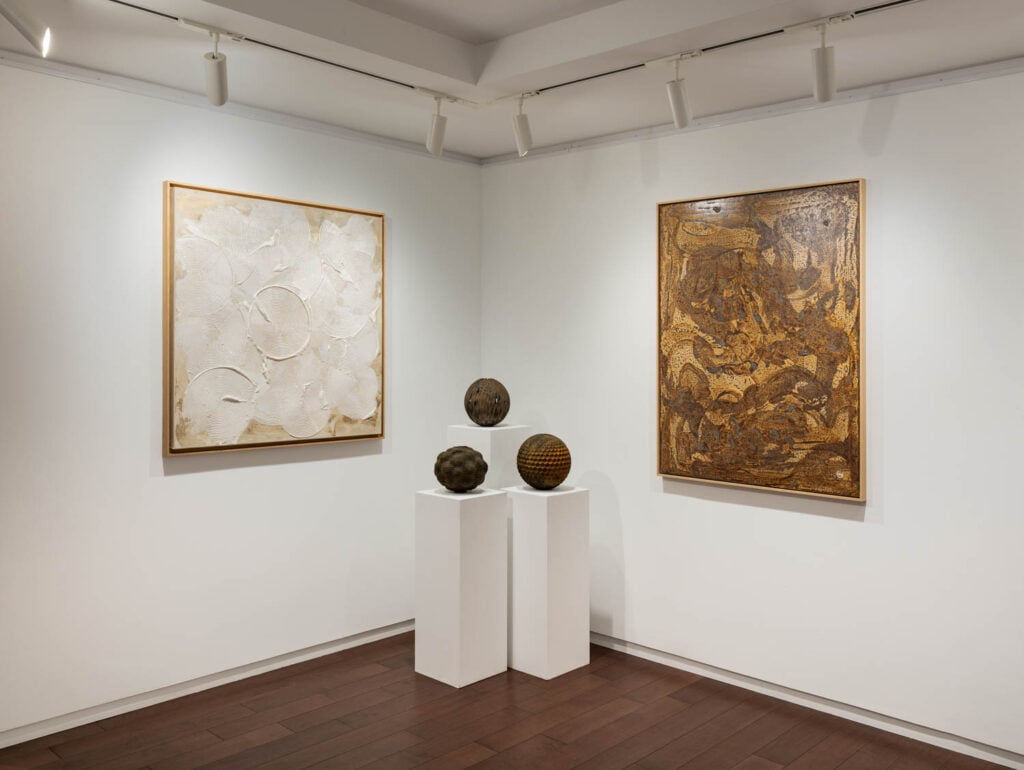
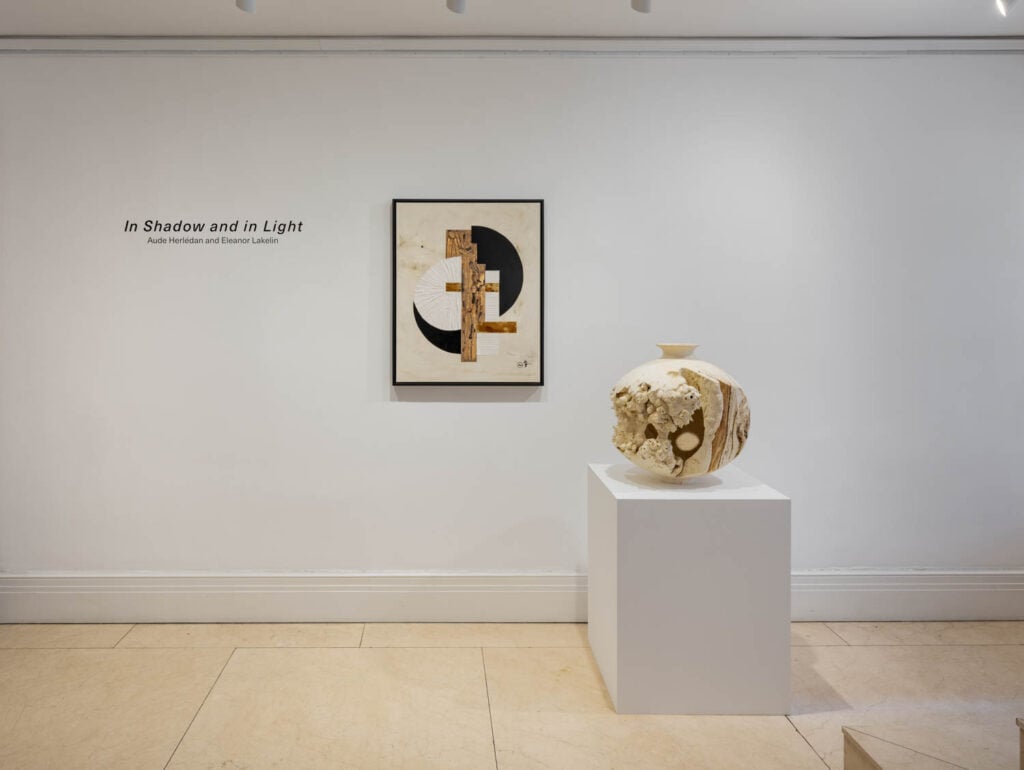
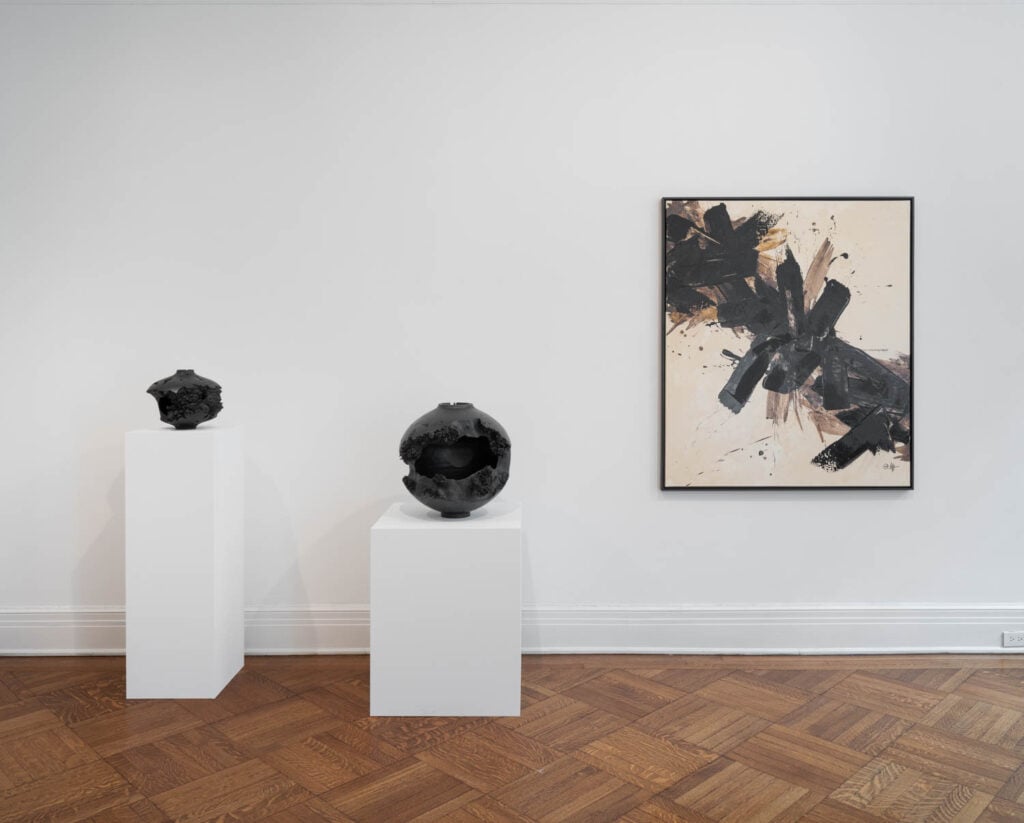
The Londoner artist’s variously scaled wooden vessels and other forms constitute a portion of the dual exhibition, “In Shadow and in Light,” on view at Rosenberg & Co. The other half of the Upper East Side gallery’s two-artist outing is the French painter Aude Herlédan whose earthy abstractions echo Lakelin’s grandly still exploration of wood which she transforms into breezy surfaces with often marble-like effects. “There is something about the way that wood appeals to all our senses,” Lakelin tells Interior Design. “I feel like it’s not just a visual thing—it is a sensation.”
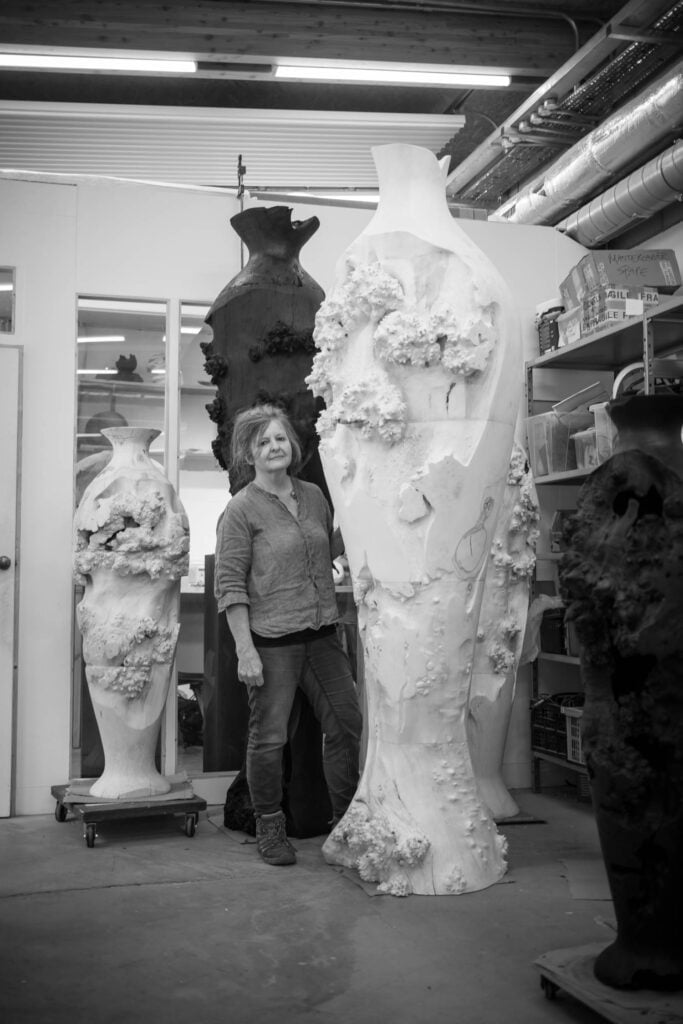
At her Greenwich studio, the artist spends months to cast her take on a fallen tree—more than not, a year goes by for her to create life-size sculptures which balance a clean surface with gutted interiors. She often finds herself outside of London to source dead trees—back at the studio which is located at what was once the parking lot of an old council building, Lakelin zigzags between different scales and types of wood which always reveal their surprises along the way.
How Eleanor Lakelin Turns Fallen Trees Into Life-Sized Sculptures
Interior Design: Lets start with your fascination with wood. Where did it begin?
Eleanor Lakelin: When I first discovered this material, it felt like a whole different language, because I have always loved archeology and the idea of fragmentation and not getting the whole story. You get a disrupted line which often feels like ruins. Ruins more attractive to me than—let’s say—palaces, because they are not about power and they are more human. Wood is a natural phenomenon, but it never grows symmetrically, so it’s automatically going to give me that sense of fragmentation, things breaking down. In the sculptures, there is something that seems to be dissolving or appearing like being poured down. For example, I am interested in the Italian sculpture Medardo Rosso who poured wax over things.
ID: There seems to be an element of chance in your way of letting different parts of the material speak. Would you expand on that?
EL: You have to let chance take part in order to be able to hollow out the inside and sculpt. You have to leave the skin of the tree on, which is the bark, and look at it in the traditional sense of a sculpture in terms of form and material. I can tell from the bark what might be inside. The inside might look like a disease or decay. We’re somewhere on the way to obsolescence, and obviously, I’m interested in all those cycles of birth, growth, and decay. You can say the tree is finding a way to survive, and that is why it’s a really interesting way of looking at loss.
ID: Your work seems to reflect nature’s own way of designing. What is your creative process?
EL: Exactly, nature or the tree has its own life force within itself. Think of all the fungi or bacteria—nature is trying to work with that life force. Sculpting is constantly stopping to see what I am hollowing, so there is an ongoing dialog. I use black and white quite a lot perhaps to transcend the wood vernacular. There is a photographer called William Garnett who was working in 1950s in the U.S. He was one of the first people to go up in a little Cessna plane and take photographs in black and white of American landscapes. The valleys in Arizona, for example, the sand dunes and what not. That abstraction is so appealing. Similarly, there are all sorts of ways in which you can look into a piece of wood.
ID: Yawn (2025) or Bloma #1 (2025) are, eventually, vessel forms. Could you talk about using the recognizable aspect of this silhouette, which suggests function and also disruption to it?
EL: I am interested in how far can I can push the readability of the vessel as a form. This work is entirely non-functional, but we still recognize this as a vessel. I am almost dragging this form through my process. We have the memory of these classical forms, symbolic for us as humans. They are the first cultural tools that weren’t a weapon.
ID: Could you talk about the marble quality you achieve in your coloration of wood? The work ends up feeling almost ghostly.
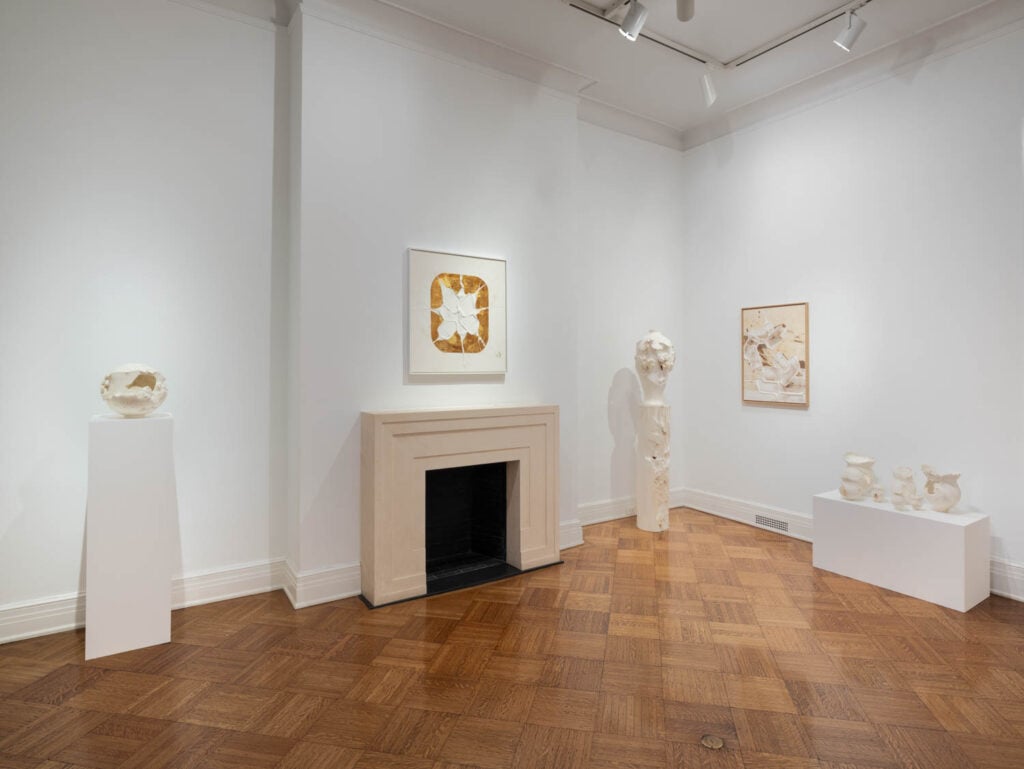
EL: Let me start by explaining that these trees were at a stage of fungal activity, so what you are seeing is all fungal activity with sculpted parts. The color is the tree’s natural color but I often wash it over right at the end with furniture bleach. I sometimes do this because there’re too many competing elements going on. I like that the material feels slightly ambiguous. People often think they’re looking at alabaster which is quite interesting because only when you touch it, you can feel the wood’s warmth, the temperature.
ID: How does the British countryside or the overall fauna inspire your palette for your materials and process?
EL: I grew up on a farm in a really remote area. I had to travel 20 miles to school, so I spent my lifetime having stuff in my pockets like shells, pebbles and all bits of stuff. I love the idea that when you hold onto things you can be connected to the place where you found them, to the landscape. The memory aspect is really powerful. I use this type of wood because it allows me to play around with ideas of time. Each wood grows differently in a year—a work can have wood from the winter of that year or the summer. If you rub your hands onto it, you feel the winter.
I start with a plain block of wood. To make the shape, I hollow it out and I carve away. The grains grow differently through the year. The winter wood is much harder and the summer wood is softer. If I hadn’t carved in the lumps, the lines would just be straight.
ID: There is a bodily element to sculptures. Could you talk about form and scale as organic outcomes?
EL: It is how the wood that grows in Britain is. If one comes down, they’re usually massive. For me to be able to use it, it must be felled because of decay. I am after a scale that pulls you in. I like a good size that can be measured by your hand or your body.
A big part of process is quite meditative. You have to feel where you’re going. I never draw things out. If I stop my brain from getting involved, I just try to do it through muscle memory and by feeling what is right. Intuition is certainly critical.
ID: In the exhibition at Rosenberg & Co, a few vessels, such as Ferrous Sphere II (2023), Eroding Sphere I (2023), and Eroding Earth 1 (2025), are grouped together. Did you always plan to show these works together or did this come out of a curatorial choice on site? Is coloration a factor in your decision to orchestrate them together?
EL: They started off as this whole idea of eroding Earth. These works are spherical, and there is something about them that gives a sense of a planetary calmness. The whole idea of cycles and the organic return of things is important.
They are treated with iron stain, because the wood is full of tannin. I can boil metal nails in white vinegar, and put it on to create a painter’s palette. I can affect the coloration in some way and make sure that I have this yellow splash, for example, or rust. There is an outside surface and an inside surface, but I like to leave a massive third space, which feels like peeling off a skin. I don’t know what is inside a log but I can sense what might be there.
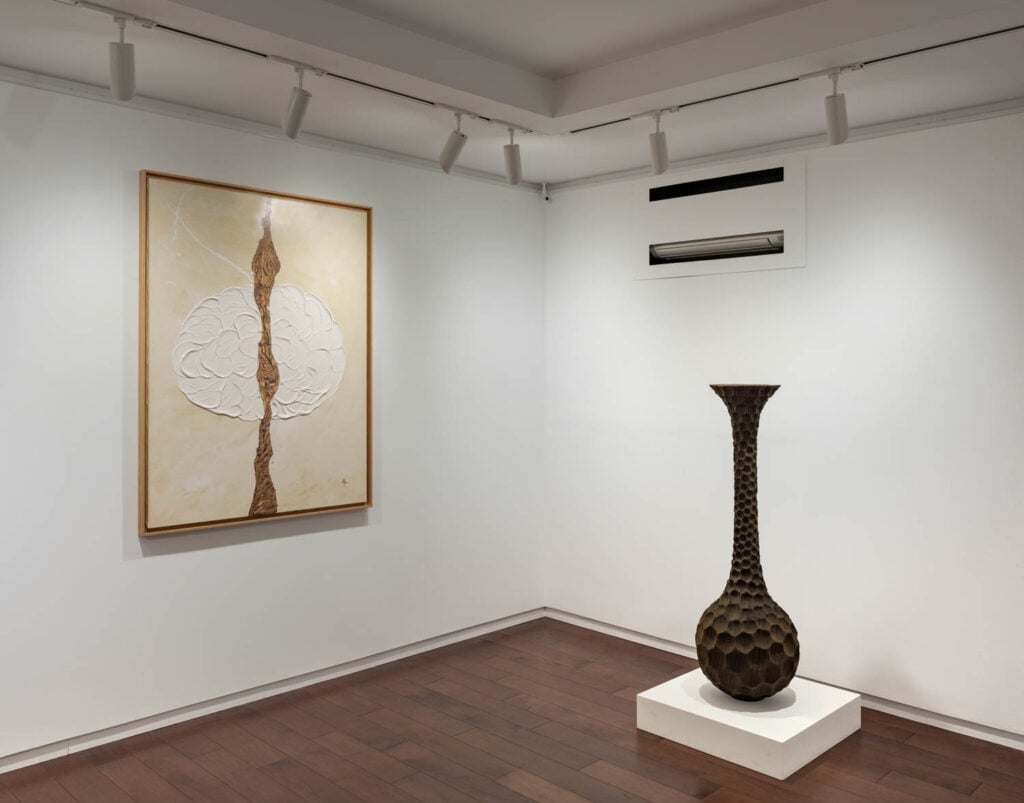
ID: Most of the sculptures resemble archeological findings created many civilizations ago. Is that intentional?
EL: I like that they look like they’ve existed for a long time. Vessels can travel across time, space and cultures. Many of them have been symbolically used as ritual objects, containing our hopes and dreams. I like the idea that mine look as if they’ve been found and they have survived. I also like the idea that they somehow connect to a thousands of years of tradition that carries into the future because people will undoubtedly continue to use vessels.
ID: What intrigued you to use fallen trees?
EL: I, of course, don’t want anybody cut down a tree for my benefit. It started with me making more functional and realizing that the most interesting bits of a material were on the floor. They were gnarly and even unsafe but I found that to be a more interesting way to make things than clean components. They carry some history and different dimensions. As humans, we have a millennia long search for poise and restraint in terms of classical form; and there is this mad, anarchic, and chaotic geological infinity of different timescales.
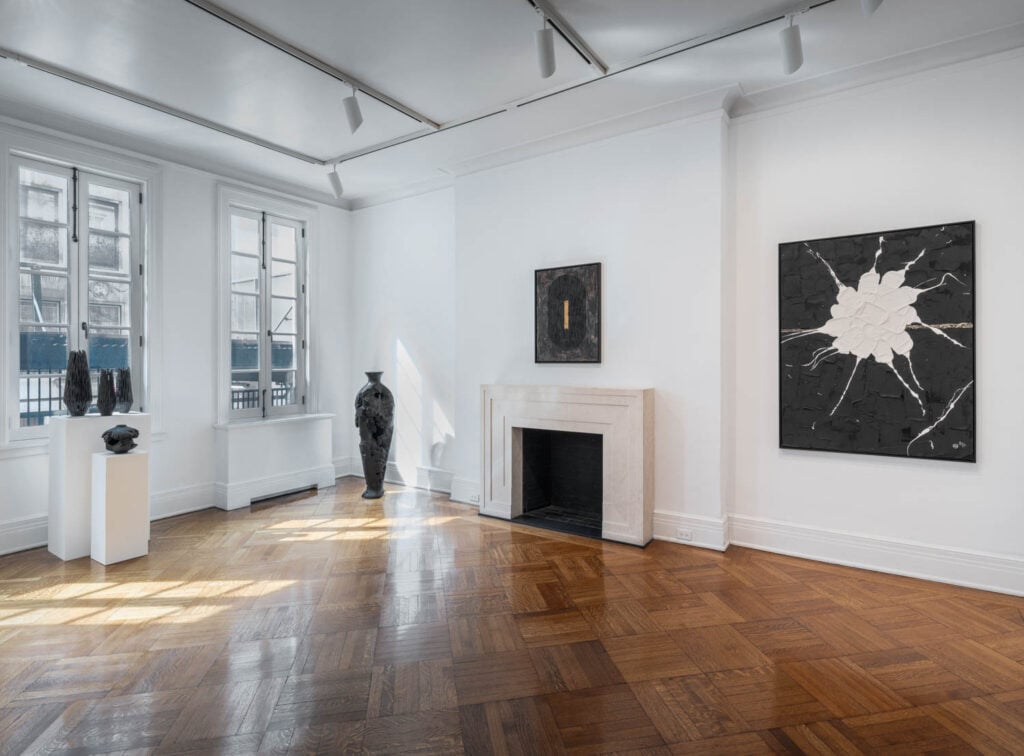
Editor’s note: Aude Herlédan and Eleanor Lakelin: “In Shadow and in Light” is open at Rosenberg & Co in New York through April 25, 2026. Next month, a second part of the exhibition will open at 1831 Gallery in Paris.
read more

DesignWire
New York Design Center Marks 100 Years of Design
Celebrating its centennial, New York Design Center continues its legacy as a design destination, bringing together nearly 100 showrooms and more under its roof.
DesignWire
10 Questions With… Clarisse Merlet
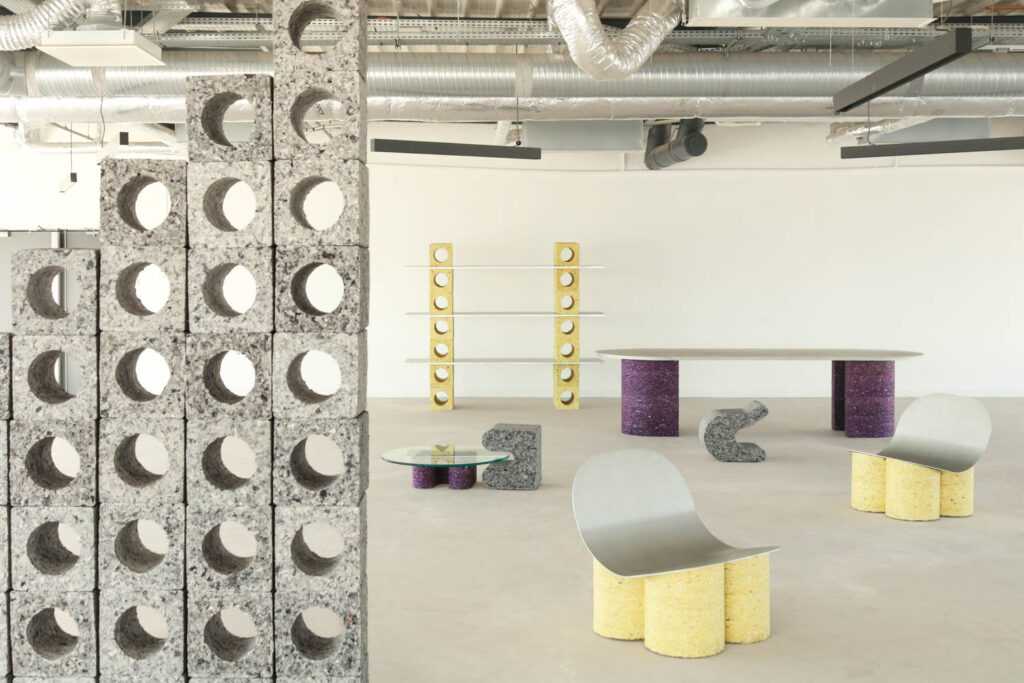
Clarisse Merlet, founder of Paris-based FabBRICK, is transforming discarded textiles into colorful architectural materials, pushing the medium with bold forms.