
10 Questions With… Lighting Designer Lindsey Adelman
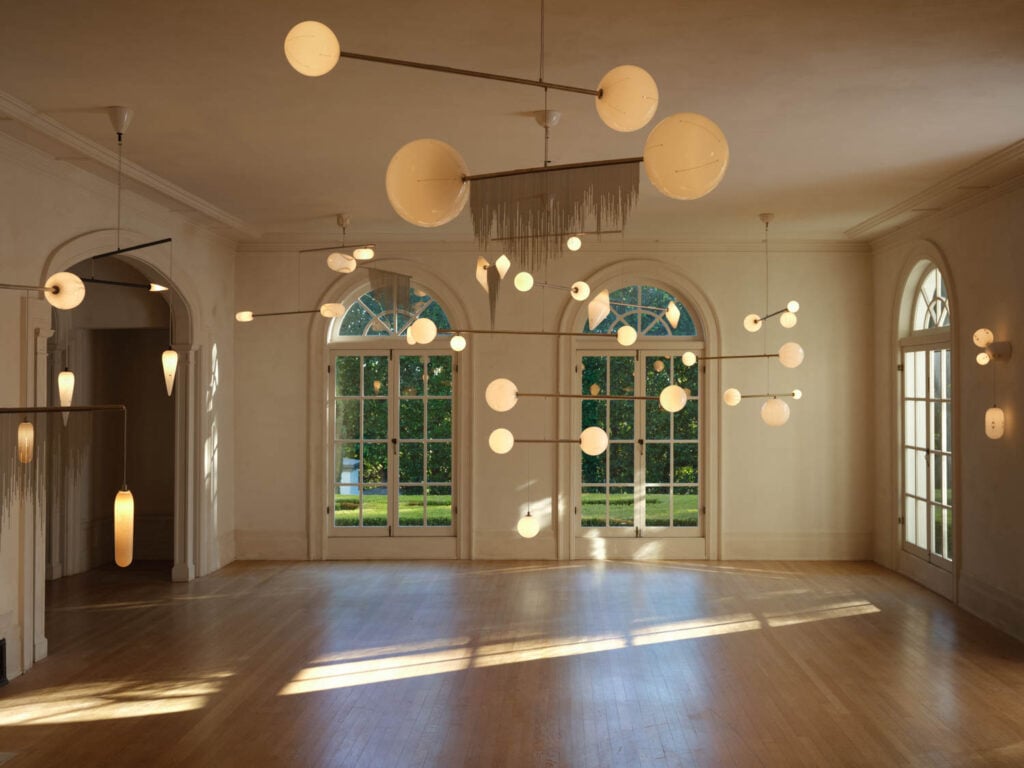
Lindsey Adelman’s arc has been a true designer’s journey. A Rhode Island School of Design graduate in industrial design, the New York native has built one of the most revered careers in lighting design, with a longstanding commitment to organic forms. After two decades in business, the cherry on top has been what most designers strive to achieve at some point, ideally early on, in their development: a signature—even iconic—piece of creation which becomes synonymous with their practice. In Adelman’s case, this accolade came early on in her career path with her Branching Bubble. Sculptural and mysterious, the pendant spreads like a burgeoning tree with metal rods holding glass spheres. The form which skyrocketed her to a household name in 2006 is now amongst the most recognizable lighting solutions in contemporary design. Adelman’s practice has seen over the years different interpretations and material experimentations of the original design.
“The very early prototypes looked so different than to what they look like today,” Adelman tells Interior Design. She remembers being able to afford more engineering and more custom components each year. “The product became more and more robust,” she adds. Different shades, such as a spun press shade, a hammered bronze shade or even ceramic shade have all become into play. “I’ve let things naturally expand,” she remembers.
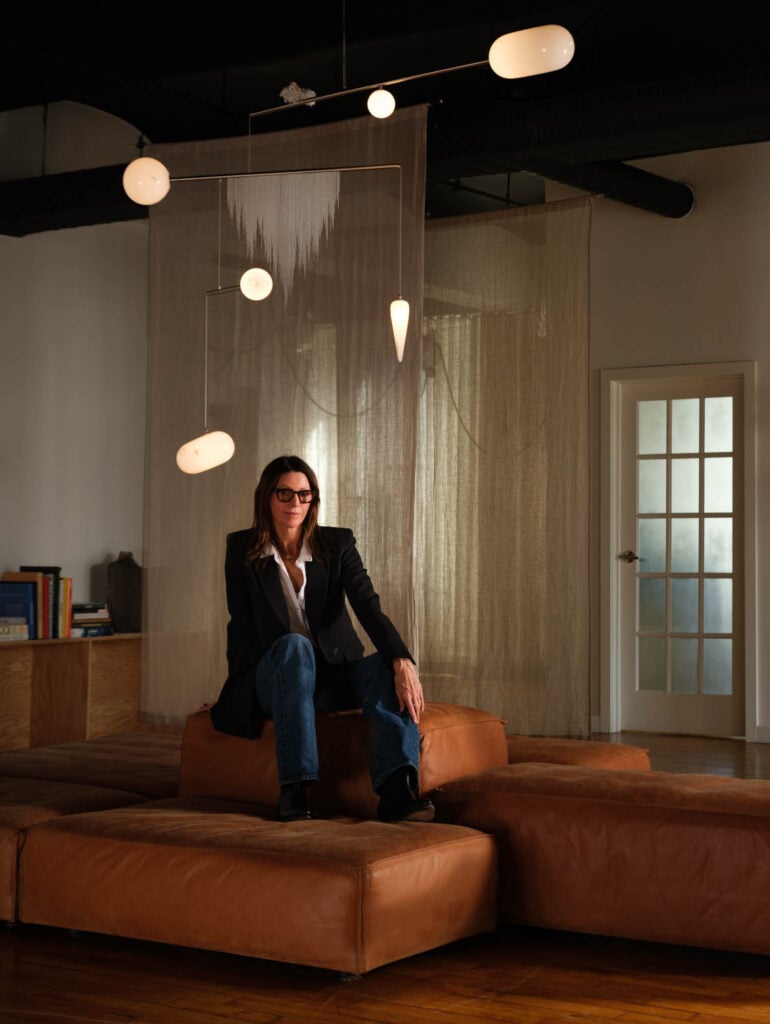
2026 has been a year of reckoning and productivity for Adelman who debuted a new scone series, titled Andromeda, at Matter and Shape in Paris in early March and opened a solo exhibition at The Future Perfect’s Los Angeles space, titled “Hieros Gamos,” featuring ceramic canopies and gold inscribed glass orbs. The designer’s 20th career anniversary also coincides with an expansion of her workspace which she recently remodeled to accommodate her decision to outsource her production. Adelman’s current NoHo, Manhattan studio, which also houses a metal shop and a showroom, will be extended with a prototyping studio on Christie Street at a space that she worked out of over a decade ago. When she looks back at her last two decades, the designer cites her biggest lesson as “following your own voice,” which she admits can be difficult. As for Adelman’s advice to others in the field, she says “be true to your own path, even when there’s rational evidence trying to have you go to another direction.” And she adds: “I’ve certainly fallen off that path many times and come back. Now I feel like I’m very much on it.”
Lindsey Adelman Talks Deadlines, Nurturing Her Connection to Nature, and More
Interior Design: What advice would you give a younger version of yourself and what would you tell a young designer starting out today?
Lindsey Adelman: What I would tell another young designer would be different than what I would tell myself 20 years younger. I would tell myself it’s all going to work out. What I would tell a young designer is to take your time, that life is long, and to be very present for each moment of the adventure.
I don’t know if it’s always enjoyment, to be honest, when you along the way learn a lesson. If you’re present for it, you can learn the lessons more quickly.
ID: You recently changed your studio model and production, which you no longer execute at your own space. Could you talk about this decision?
LA: Yes, and I’ve had more benefits than I could have ever imagined. One of the primary intentions was to create space and resources for me to feel more free and creative again. A lot of the collections we designed were for the industry. They were really well engineered so that someone other than us could make them. I’m so glad that we finally transitioned to working with this beautiful family-owned business to craft them. Now I’m finding myself in a space where I have all of the experience. I have my talented team, I have enough square footage so that I can really prototype on a more extensive level than I could before. I can have multiple projects in development at once and also have the time to make mistakes and experiment—failures happen, and I let the unexpected happen. I am able to follow what the material is actually telling us, and that is a real luxury. A real privilege is to not always work on deadline. We have a nice mix of in-studio projects, some of which are being built on deadlines for clients, and others have no deadlines which is really my ideal state.
ID: Your new approach is based on “going deeper instead of expanding.” What does this decision say about today’s production methods?
LA: Definitely, and this also applies to things that don’t necessarily have a commercial value. For example, last summer, I did a week workshop at the Anderson Ranch in Aspen. I made a kinetic sculpture, so I learned how to work with motors and made these drawing machines, which was so freeing and fun. For five days, I enjoyed the mark-making, and now I can take a similar project and bring it into my studio and my team. We can discuss if this idea stays in the art category or does it want to be wallpaper? Does it want to be embroidered? I don’t have to force myself to stick to lighting. When you’re in a small studio and trying to keep up with filling orders, you feel that weeks go by and then years. I have to say it took a lot of coordination and adaptability on my team’s part. They have openness, enthusiasm and trust. It wasn’t the easiest transition, but we’re really building upon all those relationships and have more time for research.
ID: The Branching Chandelier continues to anchor your career. How does it feel to have an immediate visual marker of your practice?
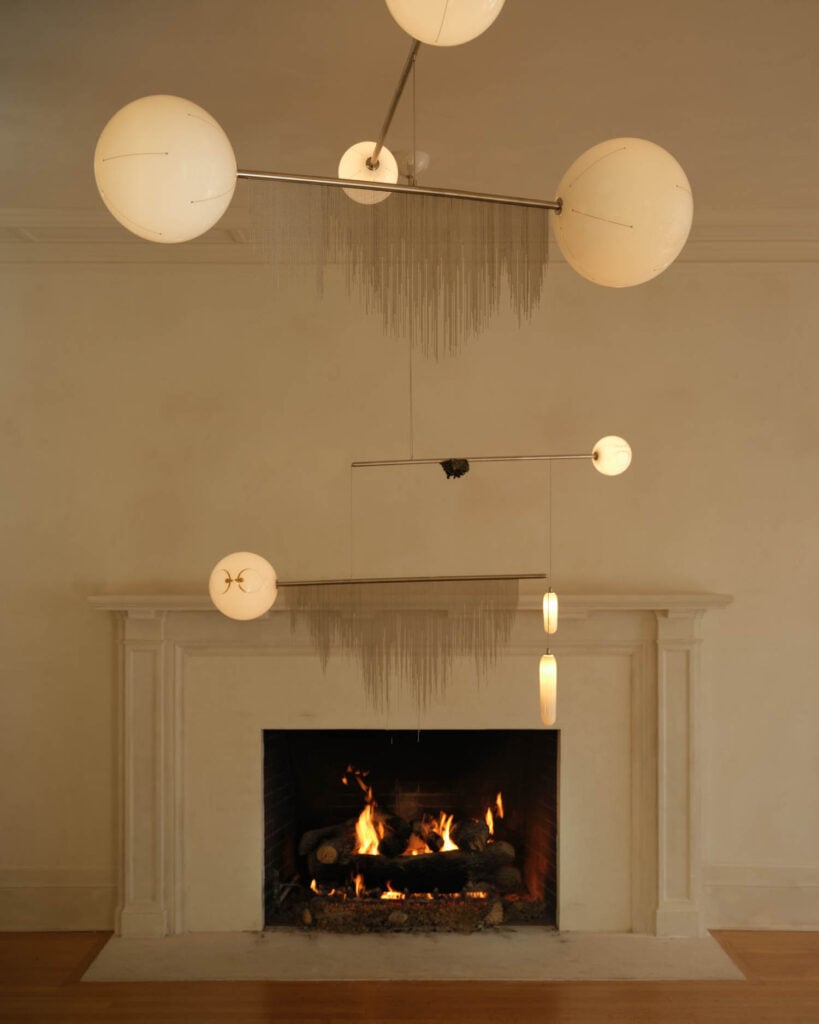
LA: I’m so grateful to the effect that had on my life and my path. I am grateful to what it has opened up for me which is totally unexpected. With new collections, there is definitely a reflection of me following my instinct and my intuition. There is the joy of playing with bound parts and the spidery armature. I just want to capture the quality of hand blown glass and when I look back, this was very difficult to do. My best friends would tell me that the universe was telling me to quit. The amount of trial and error was masochistic. There was a lot of stress with those first orders, but I resisted and I was able to get a response that just made everything grow. It was out of my control to tap into something that’s universal and I couldn’t control what the reaction would be. I appreciated the mystery in that. I’m so proud of that body of work, and it still remains such a leading collection for us 20 years later.
ID: By looking at the Branching series, we can tell nature is a major inspiration. Could you talk about your relationship with nature, especially while living in the city?
LA: Even in the city, I have a strong relationship to nature. We have a wood-burning fireplace in which we put logs and burn every night. I’m also out of the city a lot of the time, whether we are out West skiing or in California or Mexico. When I was first developing the lighting system, I knew I wanted to create an asymmetrical chandelier. I wanted the arms to reach out in different directions. All the prototyping brought me to a structural system that was similar to nature. It wasn’t my original intention to mimic nature. Instead gravity was telling me to do this after a lot of testing. Human brain can figure out some of what nature has mastered way before us.
ID: Glass is a loaded material in terms of process, narrative, and history. How do you see glass today as a woman practitioner in the field who started out small and established a career?
LA: I took a glass blowing class at Corning Museum of Glass with one of my best friends, and there were five women teaching and doing incredible work together. When I first entered RISD in the ’90s, there were plenty of female glass artists. I didn’t really know any history of glassblowing before that. I probably entered the program so naively. At RISD gender was really balanced. When I was learning welding, I remember my instructor gave a comment that women are often better at welding men, because it takes a lot of finesse. The women at my program were unbelievably competent. I often work with Nancy Callan and Michiko Sakano. The creative dialog is so fluid and easy, and that’s probably also what I’m drawn to.
ID: What are the challenges of running a business and helming a design practice at the same time?
LA: That is an age old question, isn’t it? I would say that the difficulty level from 1-10 is an 11. I look at running a business as a creative project. If one looks at their business that way, and also can do math, they will probably be okay. I have to think about the relationships amongst employees but we also have relationships with clients and with press. One has to keep an eye on what’s going to be sustainable. If you want your practice to be around for a long story, everything needs to be calculated and projected carefully. I have over the years understood how much work is involved with management, this being people management and project management. When I first started, I was not aware of how difficult management is. I sometimes can’t believe I hung in there, but I am so glad I did. So much of it has become an inner dialog that is so private and quiet. On the other hand, I feel that the business part has really strengthened me, developed me as a person.
ID: Metal, glass, and ceramic are central in your L.A. exhibition. Could you talk about balancing these three materials which are separately strong presences?
LA: Metal and glass still are the primary elements, and ceramic is just used for the ceiling canopies, for really practical reasons in terms of function. I do still feel like glass is my favorite material to reflect and refract light, and metal is my favorite still for machining, bending forming, and extruding. I also just love that they’re these ancient materials and that they age beautifully. They have a presence on their own and an inherent beauty.
ID: How do you see the parallel between being a designer and doing light design in connection with sculpture?
LA: I am drawn to do a lot of sculpture. I certainly see the differences between design and sculpture, and I feel more like a designer. The work I have on view at the moment is very oriented towards function and service, but sometimes I am drawn to sculpture and I work in that vein, with that intention. I like a wide range of sculpture, such as when pieces involve video projection onto objects, or when the work is a little bit more immersive. I am very drawn to Louise Bourgeois, for example, and all the materials she used, from bronze and marble to sewn fabric. I should also mention Sarah Sze and the way she transforms everyday materials into a magical world with so many layers, colors and meaning. This change in my studio model will give me a chance to make work that is more akin to sculpture and less of an objective of function.
ID: Your Andromeda piece plays with malleability and sturdiness—could you talk about this play of transformative illumination and concrete materialism?
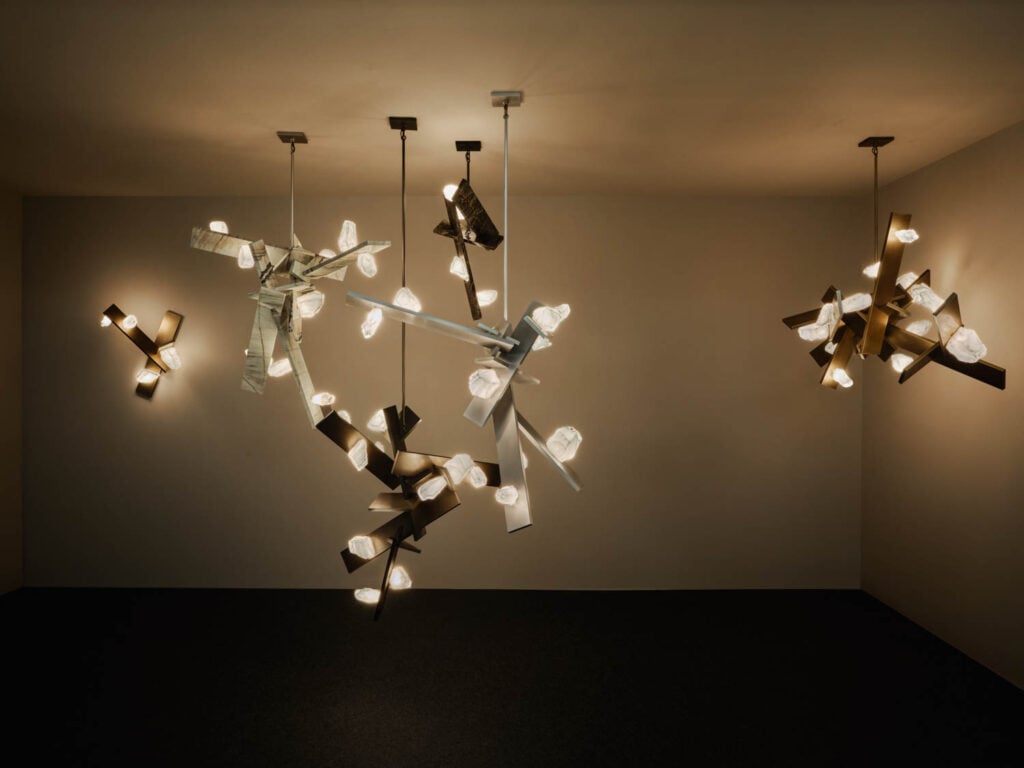
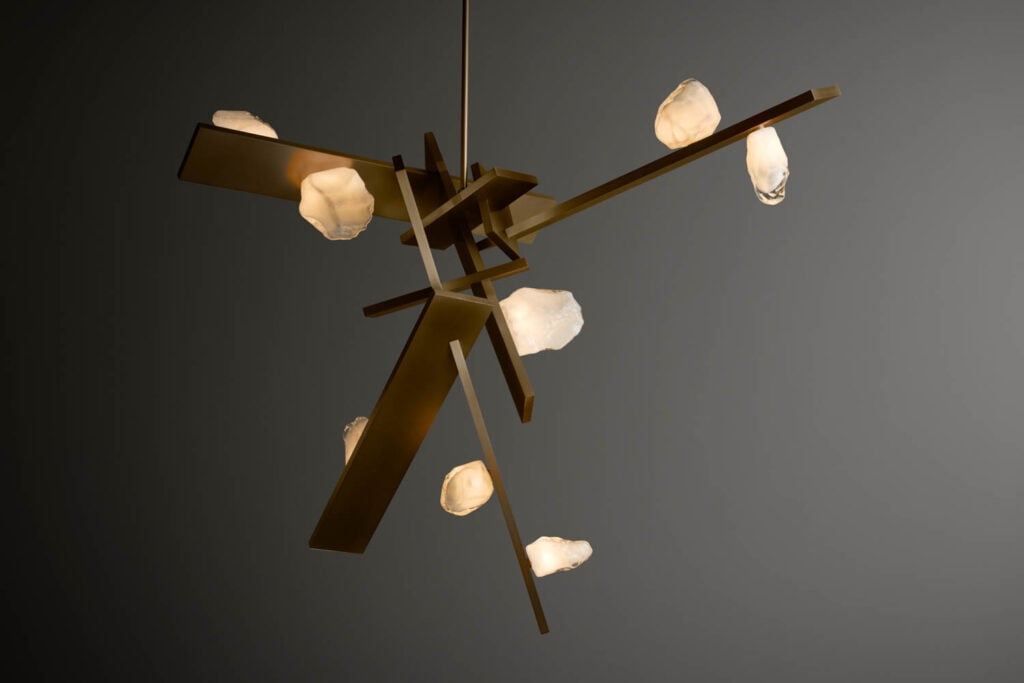
LA: This work feels quite different to me in terms of the amount the bulk. We extruded aluminum to keep the weight light and we clad with a very thin sheet of marble which is a millimeter thick. I wanted to create something that looked like it was erupting or exploding, or like surrendering to a strong force or movement. I wanted to give the feeling of catching a glimpse, mid-movement. The glass rocks echo that effect.
read more
DesignWire
Designers And Manufacturers On The Move: September 2026 Edition
Interior Design‘s latest On the Move includes must-know industry promotions and hires, like Perkins&Will’s strategic move to expand its design capabilities.
DesignWire
10 Questions With… Artist and Designer Conie Vallese
From sculpture and ceramics to glass, textiles, and furniture, Conie Vallese embraces a multidisciplinary practice shaped by curiosity and creativity.