
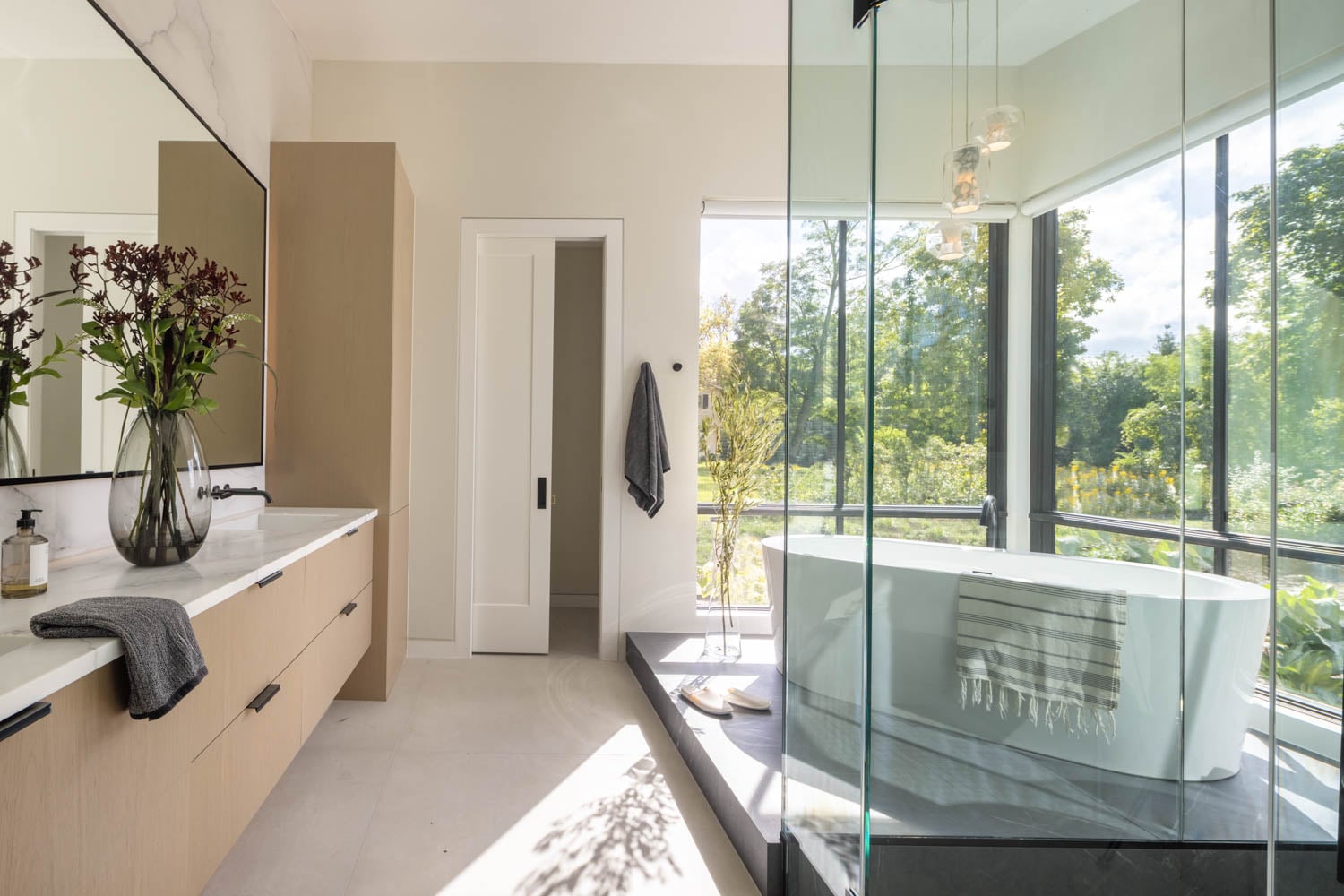
10 Questions With… Sarah Kuchar-Parkinson
In the decade since Sarah Kuchar-Parkinson struck out on her own to found her eponymous Kuchar design firm in Chicago, much of the industry has changed. But her design ethos, with its emphasis on creativity over tradition and risk over repetition, largely hasn’t. Neither has the faith in herself which has powered her firm’s transformation from Chicago upstart to industry go-to. She recently returned from maternity leave, and took a moment for a call with Interior Design to discuss artistic inspiration, the role of the showroom now, and what’s on the boards going forward.

Sarah Kuchar-Parkinson On Creativity Over Convention
Interior Design: Let’s begin with where you grew up and how design first entered into your consciousness?
Sarah Kuchar-Parkinson: I grew up in a very tiny town in western Michigan, actually pretty close to Herman Miller and Hayworth. I had a creative mother and we painted and crafted a lot. In college, I didn’t know what I wanted to be so I tested out some design classes and fell in love with it. I went to the Harrington School of Design in Chicago and then got a job at the Environments Group, which was purchased by Perkins&Will. I got that job pretty soon after graduating because I was very into 3D rendering—also because of my mother, who loved computers.
ID: What was the moment like when you decided you wanted to open your own firm?
SK: I was known at Perkins&Will for doing the quirky projects, the ones that blended in hospitality or weren’t too corporate. I really wanted to explore that on my own. I worked on that for about two years—on the side—going home after work and putting together a website, figuring out a logo, working on the weekends to try to figure out what goes into a business and what I want the business to be. It was pretty overwhelming.
Then I did two small projects, and I got them photographed. I wanted people to be able to go to my website and see projects, not just a landing page. A restaurant owner saw them and asked me to do two restaurants for him. He signed my contract on a Saturday, so I went in and quit my job on Monday. But from the start, I wanted to push it and make it as creative as possible, and hired people who were on board with that ethos. And luckily, we got clients who said yes to a lot of our ideas and built a portfolio that fit the vision of being different, colorful, and creative.
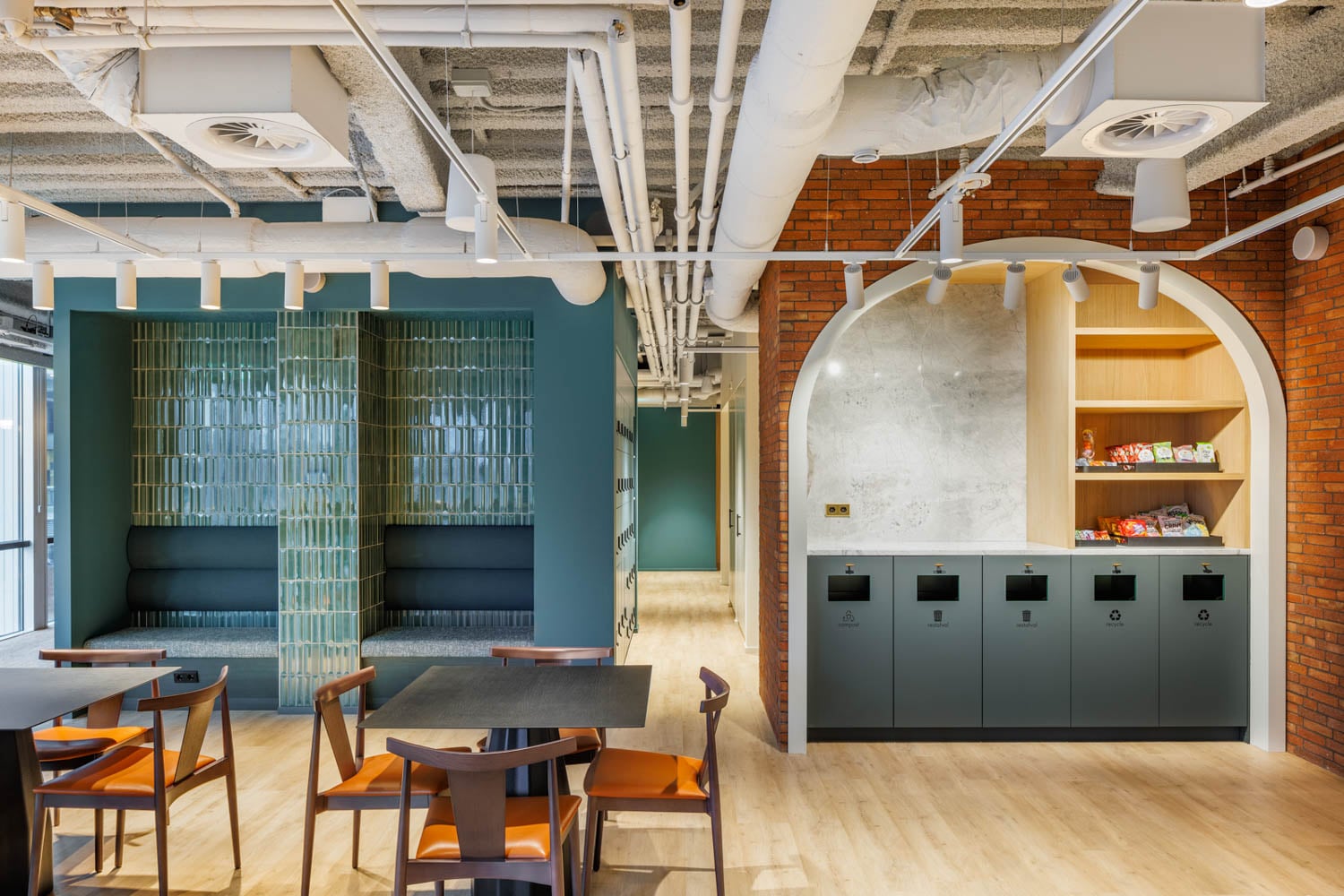
ID: Let’s talk about some of these projects, then. What was the inspiration for the financial office in Amsterdam?
SK: The work we do is rooted in strong concepts and stories. For this, we looked at the architecture and the art history of Amsterdam. Specifically, Van Gogh’s self-portrait inspired the palette of the café. There’s a nod to Vermeer’s The Girl with the Pearl Earring with the pearl-esque lights in a conference room. Architecturally, the beautiful canals were so intriguing to us, so we put a lot of glass cutouts into the brick facade, and referenced the exterior foyers of the houses just off the canal—with their tile—in some of the patterned tile we used.
ID: Patterning seems very important in your work, particular the residential projects. How much of that comes from the clients and the context?
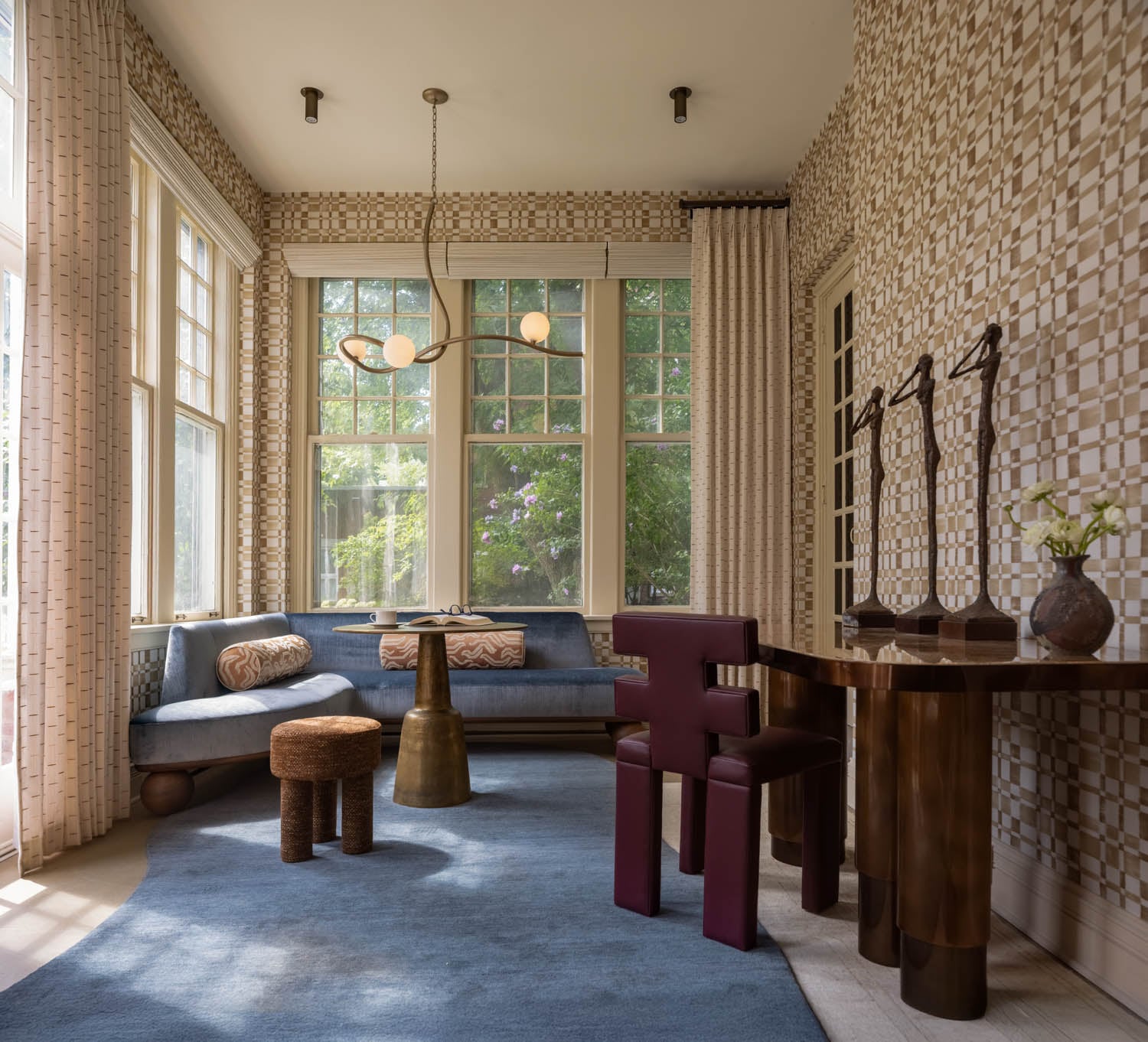
SK: For the house we did in Hyde Park, the clients were empty-nesters, and they wanted the house for themselves now. They wanted a space to have coffee in the morning—with all these beautiful windows looking out into the garden—but also take work calls, and also have as a post-dinner place for a drink. The homeowner is connected to the Museum of Contemporary Art in Chicago and she said she doesn’t like geometric patterns. But we found this very painterly plaid wallpaper and wrapped all the walls in it. She loved it instantly; it’s her favorite part of the room. It makes the place feel like it’s in a cozy hug.
ID: Your Nevis showroom in the Merchandise Mart is equally inviting; what was the idea behind it?
SK: They came to us and said: We don’t even care if our product is in the showroom; we just want people to see the brand and have an experience that is memorable. This was their first showroom in a long time, so they wanted to do something crazy. We were inspired by the company’s first product, which was a planter, to create a space that has a lot of greenery. We set the exterior back a few feet, which is a big deal, because you’re taking out very precious showroom space. But, we wanted to create a front entry experience. When you’re walking through the Mart, it has so many white walls and glass fronts, and then, here is this explosion of plants and dried flowers. Inside, the bar is this big architectural moment, inspired by water. And there’s an idea of concrete jungle, with small plants growing up through the cracks of the concrete structure of the Mart.
ID: You’ve designed spaces in the Mart for a long time. How do you think the role of the showroom has changed?
SK: It’s crazy how much has been affected. One thing we talk to clients about is that the showrooms are there to connect with designers. We’re presenting to clients digitally more often now, so you don’t have physical products as much, and the need for all the samples, brochures, and products has gone away. Now, people want a hospitality area where they can connect with clients over drinks and food. Many showrooms used to be gray and white, so the color of the furniture would pop so people notice them. We steer away from that. We say that people go to trade shows to be inspired, so you want to have a space that isn’t just white with gray floors. When you see a complete space that’s holistic and tight, you can see the product in a beautiful envelope that then could be imagined as a hotel, an amenity space, or your office.

ID: In that decade of working, has your own view changed in terms of what makes a design successful?
SK: One of the things we adopted early on was a culture of no rules, apart from the parameters of code and budget. Part of my early career was people saying, this is the way things are done, this is what good design is, and I just never really believed it. In the early days, we had to be a little more scrappy; we didn’t have a lot to work with, so we had to get creative. Over the years we built up more projects that are, not more serious but more refined and detailed, and it’s fun to push people who are more corporate to shift design details a bit. But our ethos of no rules has really stayed true since the beginning.
ID: One of the changes is that, by owning your own firm, you inevitably spend more time managing than designing. How has that been?
SK: I’m an interior designer who did not go to school for business, so I had to learn everything. My role has really changed towards high-level strategy. In the early days, you’re just in the weeds on everything. But slowly I’ve had to let things go and let others put their stamp on it. And if sometimes they don’t do it the way I would do it, it’s really cool to see how that changes the business and the culture in a positive way. I still love design so much. But now, it’s meeting with teams constantly, editing and giving them feedback. I also really do love the business side of it, which was a bit of a surprise to me.
Figuring how out to grow the business is very rewarding. My dream is to about double the size we are in the next 10 years. We’d love to get more into hospitality, and we’d also really love to get into product design. A furniture piece can be an ongoing part of the business—not just a different revenue stream, but it would be so cool to see how people use something we’ve designed in all of their spaces, year after year.
ID: You’ve just returned from parental leave. The design industry is, like many others, organized in ways that make it difficult to have family and personal lives. Are there conversations you’d like to have around making it easier?
SK: Another big goal of mine with this business was to break the norm or working 60 hours every week. I will say we aren’t without deadlines and late nights, but on average we have very good work-life balance. As a team, I really push people to be supportive of each other. If someone’s got something personal to take care of, let’s help to let them do what they need to do. There aren’t very many design emergencies that absolutely need all of your time at any time of the day. I try to prioritize what’s right and encourage the team to do the same and take care of themselves. We work as a team and we adjust. We’re agile and help each other out.
ID: And with your 10 years of experience, is there one thing somebody out there should know if they’re thinking about opening their own firm?
SK: Take the time to plan. If you’re really itching for it, you believe in yourself, and you’re really excited about it, you will work hard to make sure it happens. When your paycheck depends on it, and when you have the space and energy to ramp it up, you will. And if it doesn’t work out, you can get a job again—but at least you’ll know you tried. And what if it does work out? I don’t have any regrets. I can’t even imagine going back. I’m trying to encourage people to follow after that dream, too.

read more

DesignWire
Designers And Manufacturers On The Move: September 2026 Edition
Interior Design‘s latest On the Move includes must-know industry promotions and hires, like Perkins&Will’s strategic move to expand its design capabilities.
DesignWire
10 Questions With… Artist and Designer Conie Vallese
From sculpture and ceramics to glass, textiles, and furniture, Conie Vallese embraces a multidisciplinary practice shaped by curiosity and creativity.