
10 Questions With… Victoria Wilmotte
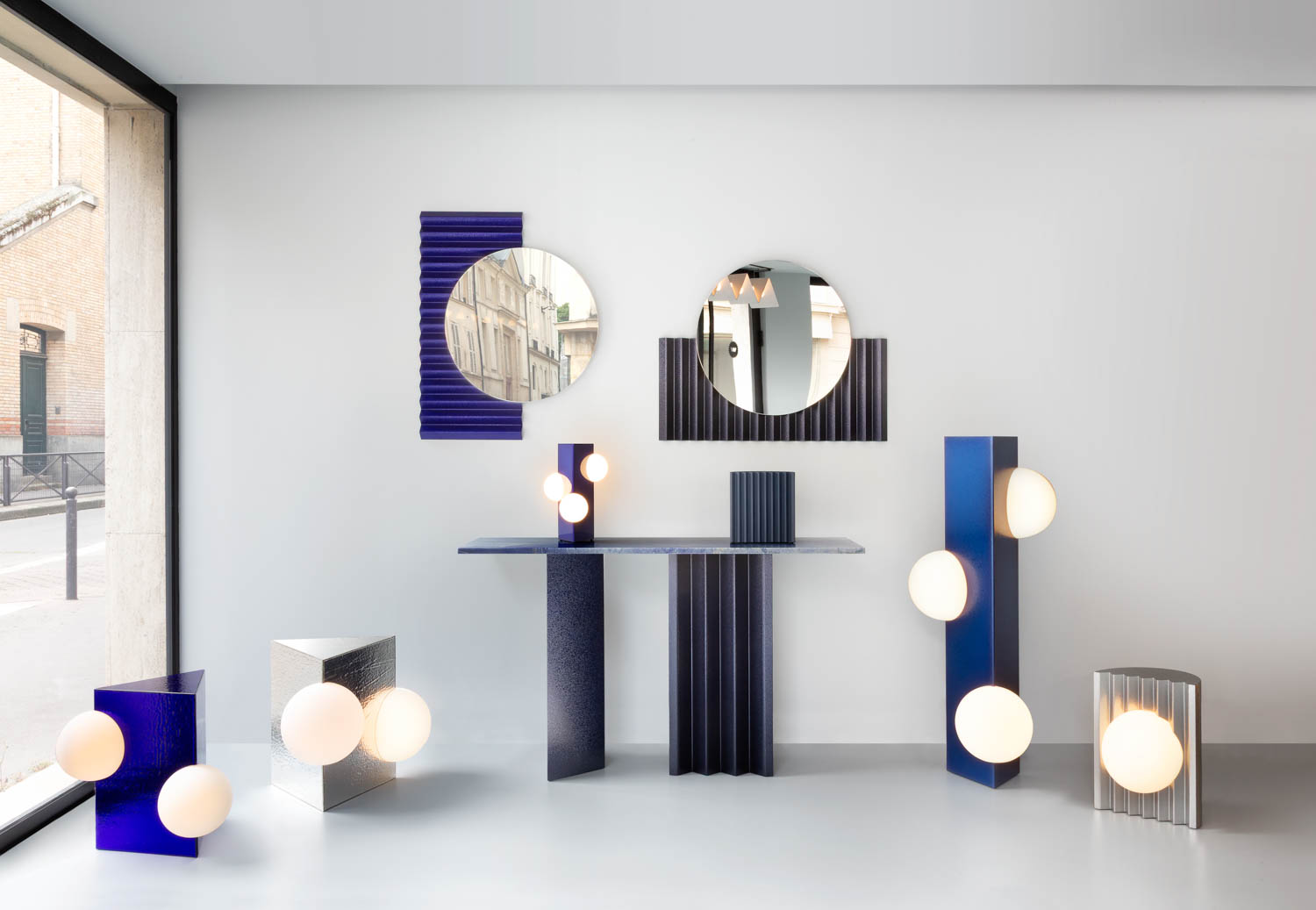
For Parisian industrial designer Victoria Wilmotte, her studio is a laboratory. The proof is her most recent exhibition “Colorscape” at her new showroom in the city’s 6th arrondissement “Everything starts at my studio, from drawing to welding; it’s a place that suits me and where I like to spend time,” she tells Interior Design. The scenography in her show of mirrors, lamps, and tables possesses coherent visual cues, such as sharp edges being interrupted by bulbous forms of lamps or mirrors.
Vibrant but subdued, each piece signals geometric decisions as well as material experimentation. A thick cobalt hue of blue as well as a bright yellow and lime green manifest Wilmotte’s adventurous but determined color palette, similar to dense powder coated finishes blended with marble’s grandiosity. “I’m surrounded by what inspires me and I have the possibility of making what I want (almost) at the minute,” she adds.
The show was something of a walk down memory lane for the designer who received a design products master’s degree from Royal College of Art where she worked with Ron Arad. Upon graduation, she returned to her hometown of Paris to set up her own studio. There, new work is peppered around, creating an entry into Wilmotte’s mind and work as a landscape of her output from the last decade or so. “I like when a show becomes an experience and I would love one day to show an entire, functional space, such as a restaurant, a bar and create a complete universe,” she adds.

How Victoria Wilmotte Plays With Materiality
Interior Design: As a designer, you work sculpturally, exploring volume and mystery at similar levels. Could you talk about this approach?
Victoria Vilmotte: I’ve always been fascinated by form and construction. For me, design is about shaping volumes, not just objects. I treat every piece as a small sculpture that reveals its mystery through angles, reflections, and balance.
ID: Negative space seems to be a critical element as much as the final physical work. How do you balance these notions?
VM: Negative space gives breath to the piece. I like when geometry isn’t too tight, when voids and solids interact. It’s what makes an object alive and dynamic. Also, I like to mix materials and often it is in this space that the other material intervenes

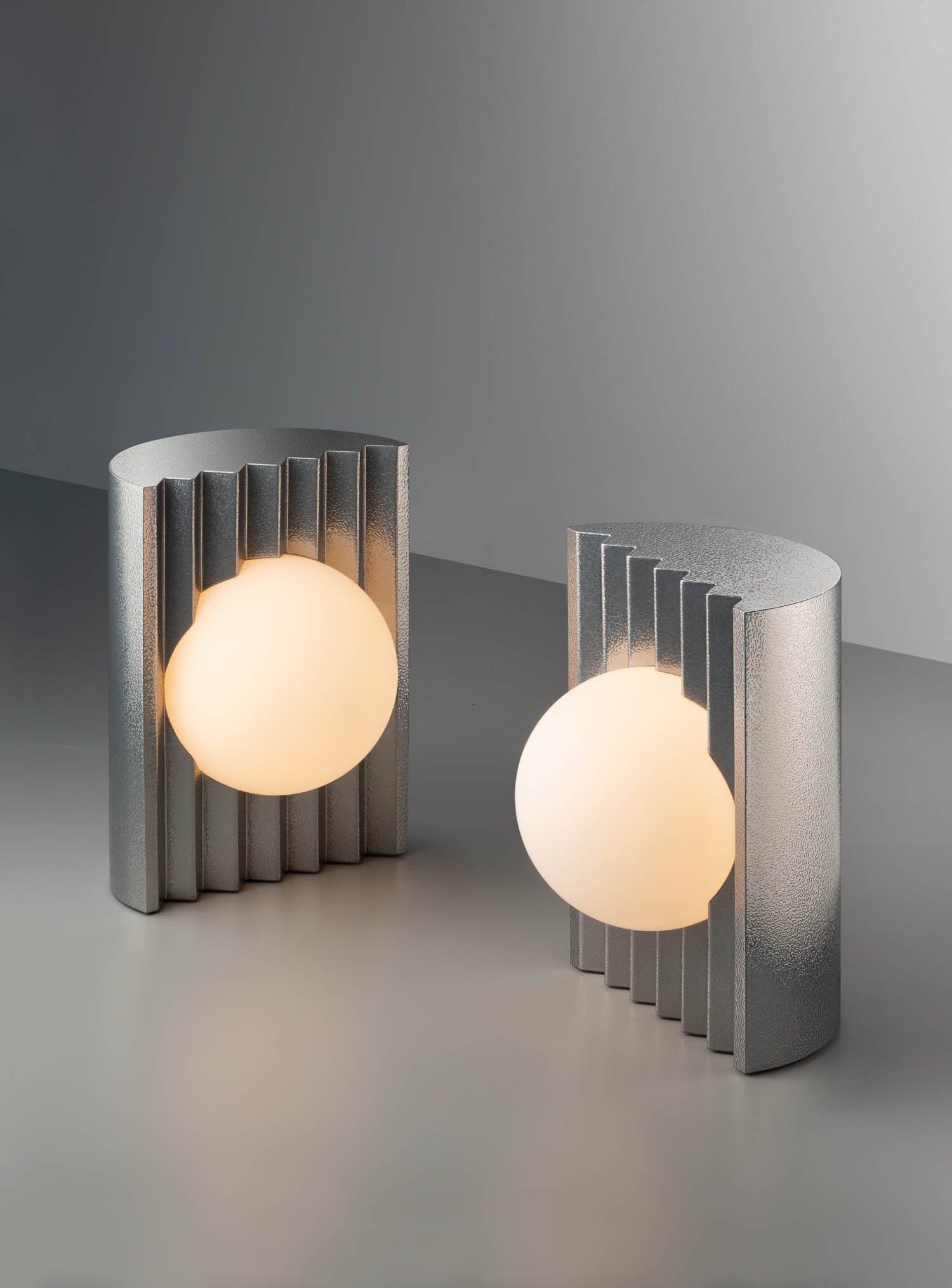
ID: Circularity and sharpness are seamlessly blended in Folded Frame mirror and Sfera lamps. Could you talk about bringing together these two forms in singular works?
VM: I like tension between opposites: softness meeting precision a bit like in industrial mechanics. A curve can become sharp just by light or reflection. That dialogue creates energy in my work.
ID: In your lamps and fireplaces, there is geometry that is occasionally broken and often repetitive. How do you approach the rigidity of geometry to challenge it from the inside?
VM: I start from strict geometry, then I twist it, literally or conceptually. Repetition gives rhythm, but I love when something unexpected happens—a break, a fold, a distortion.
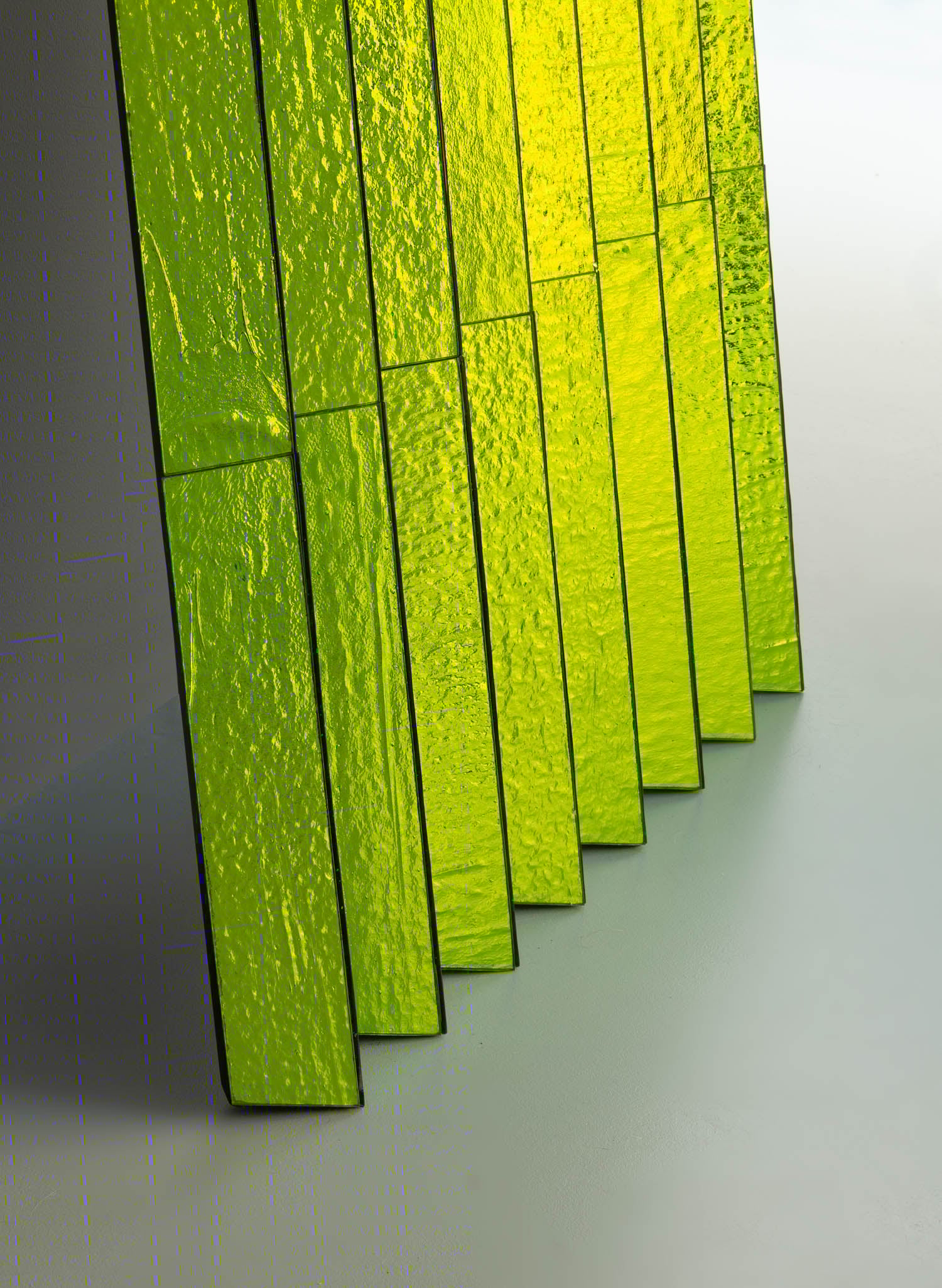
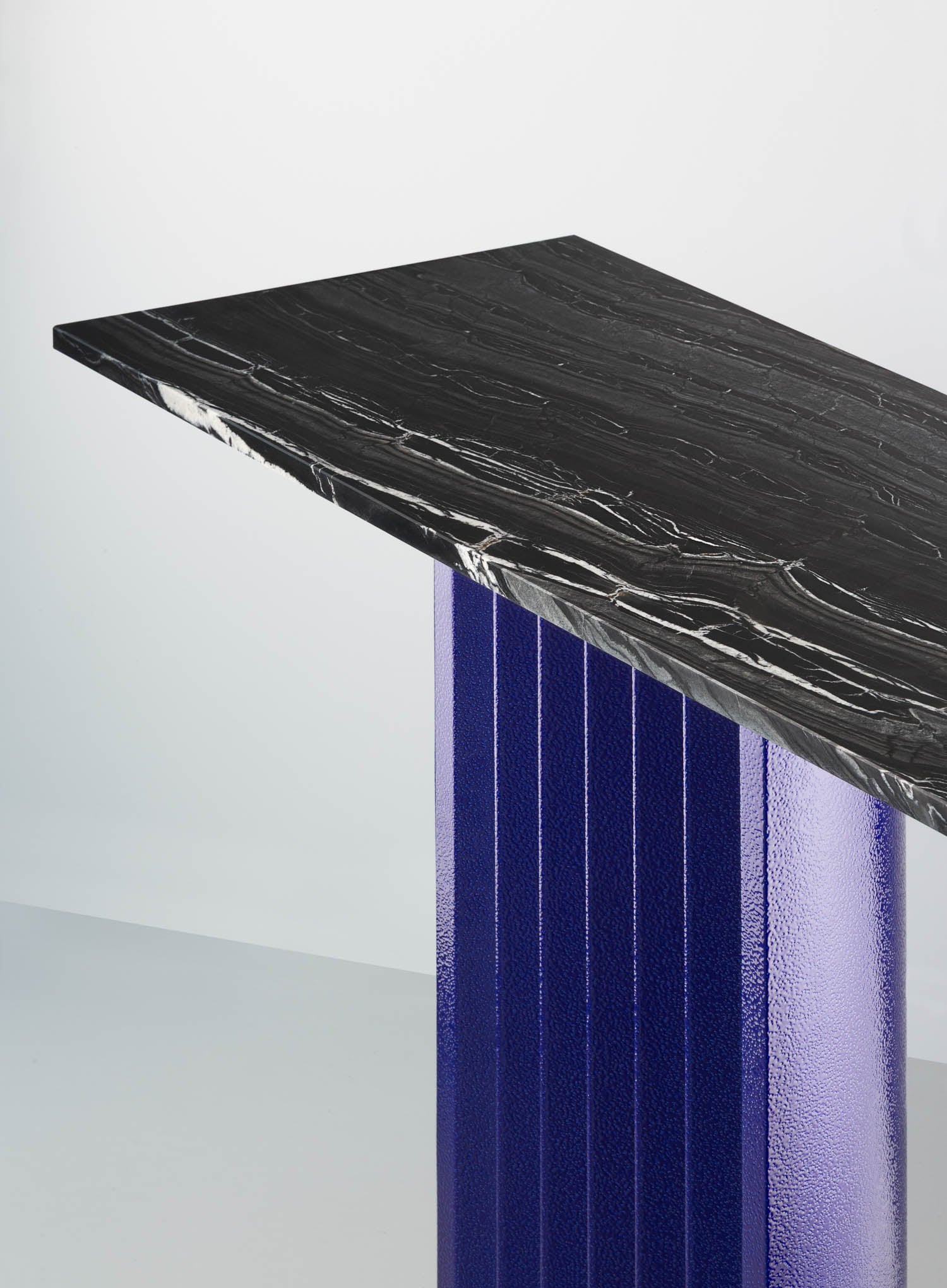
ID: Your mirrors are about fragmentation, and so are the coffee tables. Could you talk about your approach to function in industrial design?
VM: Function is always there, but I like when it disappears behind emotion. A mirror can reflect, but also distort. I don’t separate use and sensation. I often say that my work is a kind of sculptural design. I like industry and I always make sure that my projects are intelligently reproducible, by taking care of the technics, materials.
ID: Besides bold red and bright yellow, cobalt blue had a strong presence in the show. Could you talk about your journey with this color?
VM: I’ve always loved cobalt blue—it’s timeless, strong, and somehow universal. What I enjoy most is playing across very different materials from Murano glass to industrial paint. It’s the same blue, but with totally different depth and definition. I do the same with the lime green, confronting the same tones of colors on very different finishes, connecting, for example, a Brazilian blue Macauba granite to a dark blue paint finish.
ID: “Colorscape” blends existing work with new pieces. What does it mean for you to survey your trajectory and re-contextualize it?
VM: It’s like looking at my own DNA and seeing how materials and forms have evolved. Bringing old and new pieces together creates dialogue across time.
ID: What did you discover about your practice when revisiting previous works?
VM: That my obsession with geometry was already there, but now it’s freer. I am maybe less afraid to make a mistake.

ID: There’s a clash of natural and industrial materials, such as marble, metal, glass. What possibilities do you see in these overlaps?
VM: I love confronting opposite materials and finishes, in terms of nobility, especially. For example, confronting a very special powder coating finish with a marble is my favorite. I think they complete each other. Maybe it’s a bit provocative.
ID: You also advanced powder coating to obtain glaze-like finishes. What do you think about this non-hierarchical approach to materials?
VM: I love treating industrial materials like noble ones. Powder coating can look like enamel or glass—it’s all about pushing technique to poetry.
read more
DesignWire
Designers And Manufacturers On The Move: September 2026 Edition
Interior Design‘s latest On the Move includes must-know industry promotions and hires, like Perkins&Will’s strategic move to expand its design capabilities.
DesignWire
10 Questions With… Artist and Designer Conie Vallese
From sculpture and ceramics to glass, textiles, and furniture, Conie Vallese embraces a multidisciplinary practice shaped by curiosity and creativity.