
10 Questions With… Zein Daouk
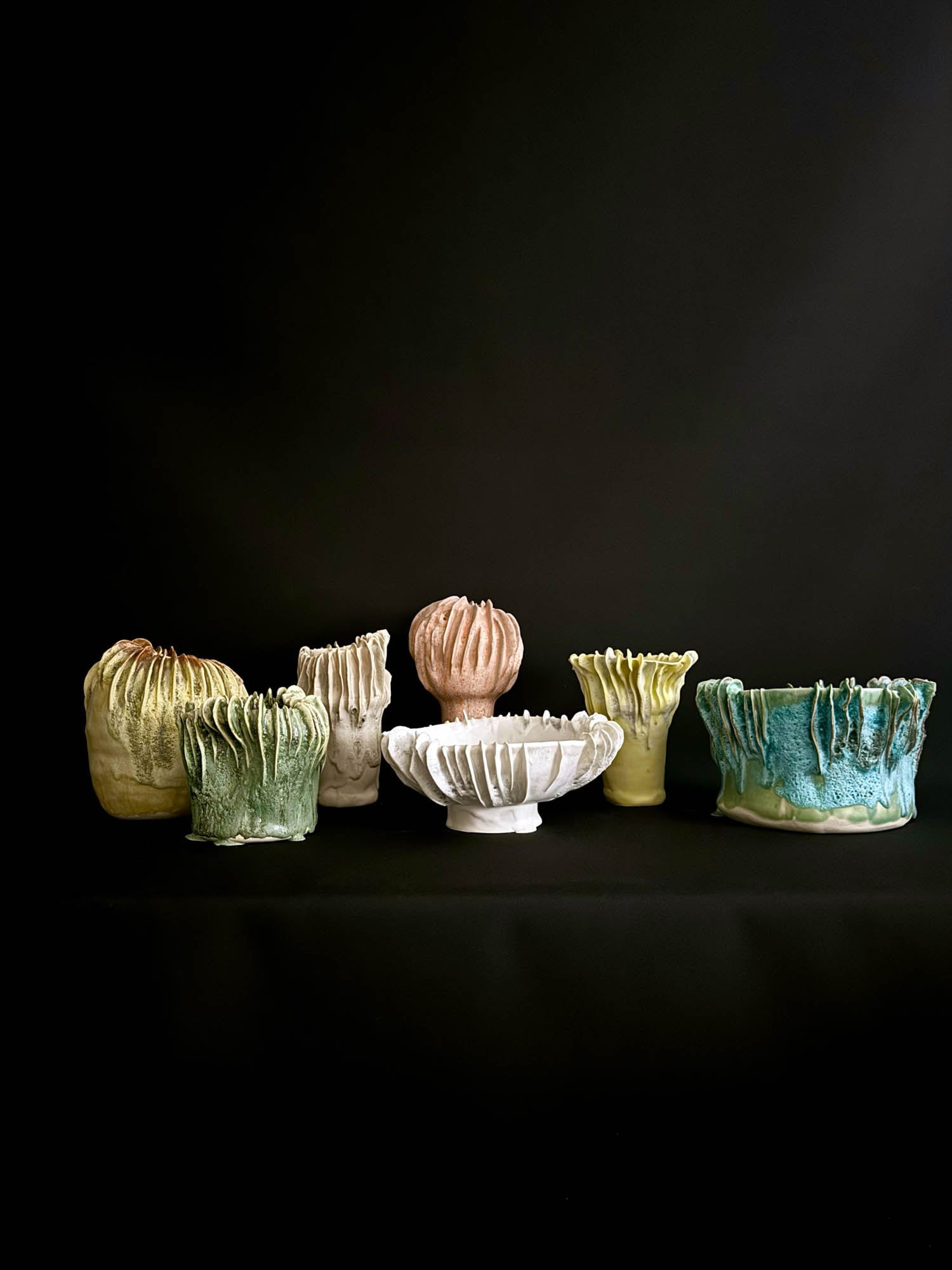
Known for her nature-inspired pieces that straddle functional and sculptural design, Lebanese architect-turned-ceramist Zein Daouk’s pieces are playful, organic and soulful. What started as a cathartic hobby in 1999 has grown into a fully-fledged career in ceramics, paying homage to the humble beauty and quiet coexistence of fungi, fueled by an architectural understanding of form and structure.
Her ethos is tied to the four elements; water used to soften and shape earth, air that dries the pieces and commits their form, and then fire that completes the works, giving them life. In 2020, she decided to devote herself to her ceramics, and has since been exhibited worldwide, at galleries in Beirut, New York and Philadelphia, as well as fairs like The Salon NYC, Design Miami, Design Miami Paris and London’s Collect.
Here, Daouk walks Interior Design through her contemplative creative process, her ongoing bodies on work, and her recent participation at We Design Beirut in October 2025, where she created a site-specific installation.
Zein Daouk Crafts Pieces Paying Homage To Fungi
Interior Design: How did you first get into ceramics?
Zein Daouk: I was always attracted to the act of making, of bringing an idea from my brain into reality. I don’t think I ever remember a moment when my thoughts and my hands were not in deep conversation. I am somehow fluent in the language between mind and hands. Ceramics is both my center and my freedom; it allowed me to shift the balance from doing to being.
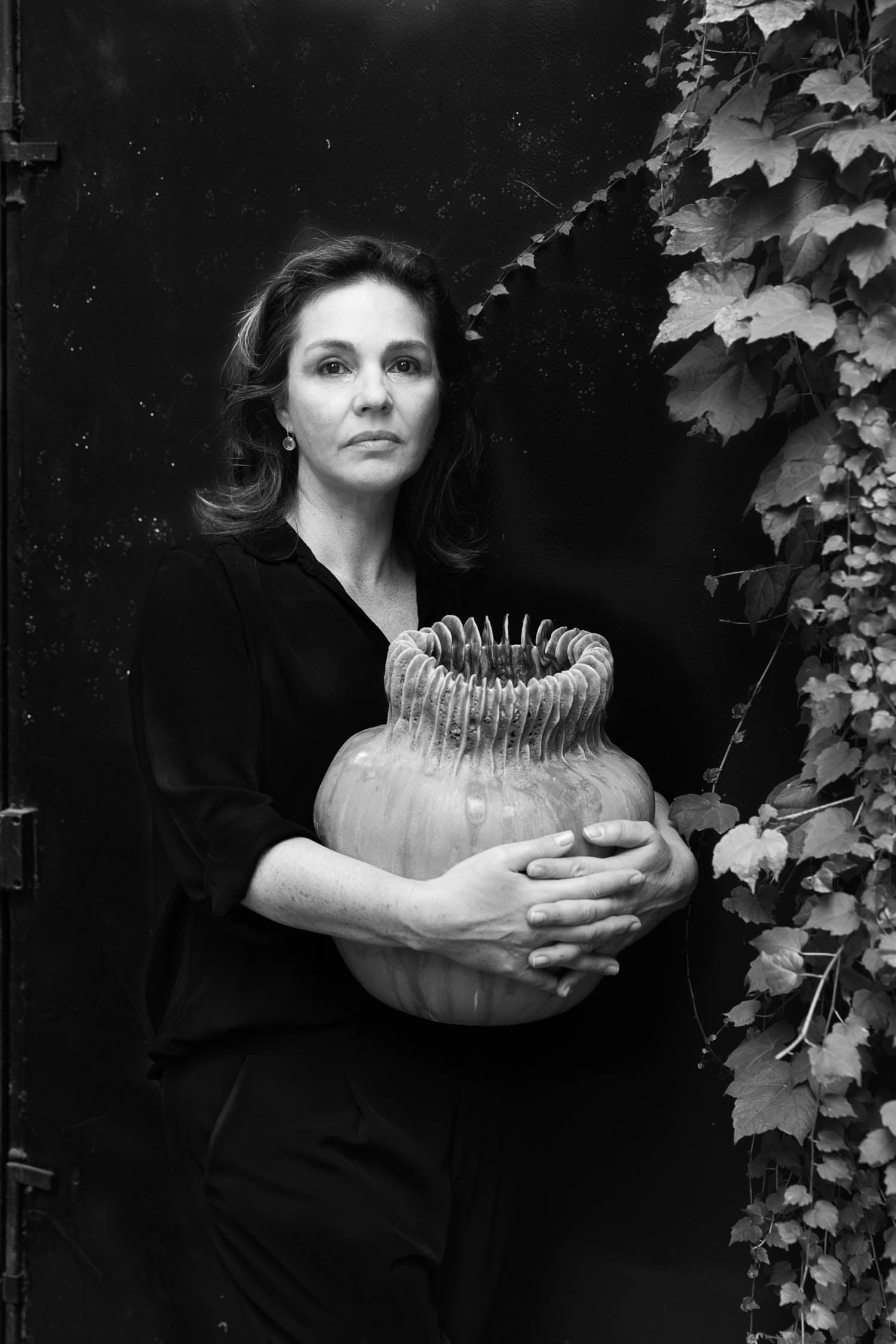
I started taking classes in 1999 and never stopped. It became my sacred time that was just for me, to pause and to reset. I was always playing with bits of clay or play dough, making little things.
ID: Why, after 20 years, did you decide to pursue ceramics professionally?
ZD: I believe in how things converge at the right time. I believe in the power of being open to opportunity and the energies in the universe that guide us. In 2019, there was the revolution [political protests that lasted months], the 2020 Beirut Port explosion and the Covid Pandemic… all terribly disastrous things that somehow pointed to this path. I felt that something needed to be said, and I needed to say it and share it with the world.
For me there was no transition, only one journey. Most importantly, I approached this path as an architect. Even the pieces themselves draw from architectural elements embedded in my psyche—imagine the fungi gills are abstract visions of building buttresses. I am an architect first and foremost. It is not a profession; it is a way of life. Today, I am an architect that tells stories in clay. Architecture is the sine qua non ethos that guides me always, and in everything.
ID: Tell me about your creative process. How do you create?
ZD: I studied the ABCs of clay until I was able to speak in sentences, and eventually in paragraphs and chapters. My process is always intentional and I always have a sketch or a model. However, I respect the material and always leave room for what the earth has to say. Architecture, balance, structure, light, function, color, how the user will interact with the piece, what story does it tell—all these parameters guide me consistently.
ID: Your firing and glazing process is very experimental. How do you go about this?
ZD: My work begins with the four primary elements of nature: Water stretches shapes into the Earth, Air commits them to form, and Fire becomes the founding act that brings them to life. My work resides in contemporary ceramics while rooting itself in expressionism with its emotive color palette. The exterior of each vessel is covered in layer upon layer of gradient hues of matte colors with accents. The interior in contrast, is finished with paired shades of gloss glazes that flow outwardly to awaken the final piece. Every step in this creative process brings on new parameters that push me onto a new path. I glaze in multiple layers, and I fire multiple times. I keep going until the glaze comes to life. It is always exciting to open the kiln, and I’m always praying to the kiln gods. There is always a test soldier to show me something new, and I study, practice and innovate.


ID: Who are some creatives who inspire you?
ZD: I am a relentless researcher. I study the works of my peers and my predecessors from every angle. Samar Mougharbel and Nathalie Khayyat and many of my potter friends generously shared knowledge and excitement, and studying the works of Lucie Rie, Dorothy Salhab, Valentine Schlegel, Akiko Hirai, Kentaro Kawabata to name a few, always creates exciting new synapses in my brain.
ID: Your work is often inspired by fungi and nature. Why does this interest you?
ZD: I was enthralled with the world of fungi, the magic, the mystery, the history, the kindness, the variety… It is a world where symbiosis, synergy and collaboration are central to the existence of Fungi. I needed to tell their story because our world was only becoming more polarized and more divided. We have not evolved as a species, only technology has. We still do the same things only faster and more aggressively. I felt I should point that out, and maybe through repeating it, that pendulum may, in some way, even if minutely, shift. Just because we don’t understand the language of nature doesn’t mean it is unintelligent or that it didn’t communicate; it only spoke of our inability to understand it.
Four books that really influenced me a lot were Fantastic Fungi by Paul Stamets, The Web of Meaning by Jeremy Lent, Entangled Life by Merlin Sheldrake, and The Hidden Life Of Trees by Peter Wohlleben. The photography of Stephen Axford is also a huge inspiration for my fungi.

ID: Tell me about The Third Kingdom, your earliest series of fungi ceramics.
ZD: When I started working on The Third Kingdom, I saw snippets of my personality in each genus I created. The Third Kingdom is a world that I built inspired by these quiet beings that were the first life on earth and spawned the biosphere as we know it. I created a realm, an order of beings made up of 10 species. Each has a scientific name according to form, color and size, and each has a personality. I use Latin names because classification and taxonomy are always in Latin. I chose their colors to be soft and full of depth, as they speak of hope and rebirth and most of all, of working together. Each one has its own personality in a way: a Coprinus is cerebral, a Calvatia nurturing, a Polyporus is curious with a multitude of heads that sprout in different directions.
ID: How does your recent lighting series combine function and form?
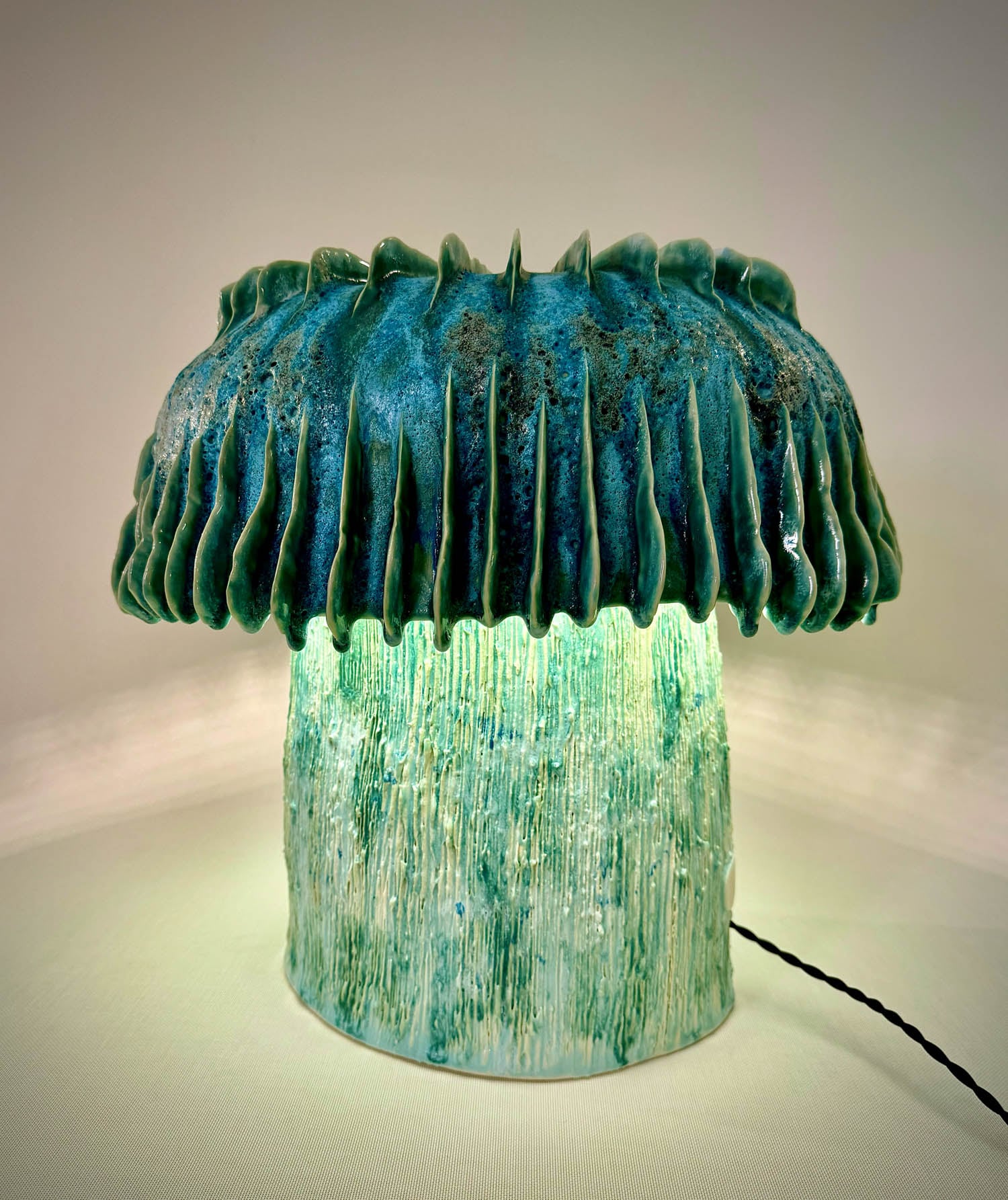
ZD: The Shining Shiitake is a conversation between materiality and functionality. It is a magical narrative that links object and purpose. I knew I was creating a new species of functional sculptures that also bring the energy from nature into our living spaces. Light fascinates me. As an architect, I’ve delved deeply into how something as intangible as light can completely alter the experience of a space, profoundly affecting us both physically and emotionally. In my practice, I strive to give the immateriality of light a sculptural physical form, a sort of vessel that emanates light. To me these are not just functional fixtures, they are sculptural illuminations.
I love how these pieces live in dualities. In daylight, they stand as vibrant sculptures, revealing a play of colors and textures. As night falls, they shift into glowing sentinels, casting an amber light that bathes their surroundings in a glimmering warmth. This dialogue between purpose and art, between function and form, lies at the heart of my work. Each piece becomes a functional sculpture—an invitation to explore the magic of light and landscape.

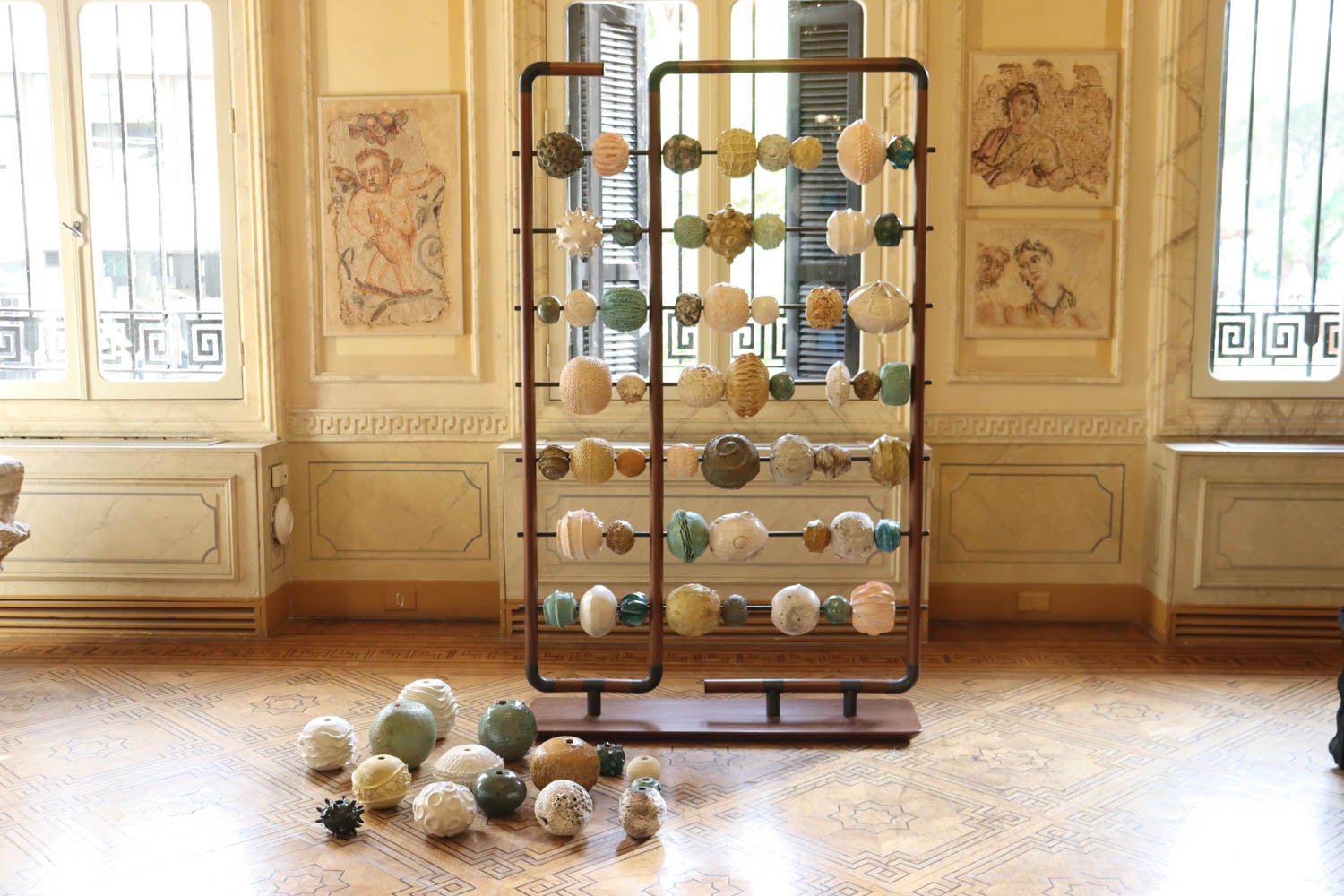
ID: Your latest piece Abacus Quadrumanus was created for We Design Beirut in collaboration with Hala Matta. What was it about?
ZD: We wanted to highlight what can emerge through unity and imagination. The ceramic wall partition stands as a sculptural manifestation of collaboration, symbolism, and cultural memory. Born from the creative synergy between Hala Matta of Namika Atelier and myself, it embodies an ethos rooted in cooperation, shared narratives, and symbiotic relationships; both human and material.
It’s composed of strung ceramic beads—some created in my glazed-style or some in Hala’s signature Raku firing, or a mix of both—to make a partition that blurs the boundaries between art, design, and craft. Together, these forms create a contemporary mashrabiya and a reinterpretation of our architectural heritage that traditionally filtered light and air, now filtering memory, meaning, and possibility. The number seven echoes through this work, referencing Beirut’s mythic cycles of destruction and rebirth. Like an abacus, the partition counts the passage of time, not in numbers, but in hopes, intentions, and the tactile traces of human hands. As a tool for reckoning and rebuilding, it frames a countdown toward a better tomorrow.
ID: What’s next for you?
ZD: There are continually new materials to explore. I am currently investigating casting works in bronze; there are certainly new stories to tell that bring on new shifts in the path. I’ve recently been reading Brian Klaas’ book Fluke: Chance, Chaos, and Why Everything We Do Matters and I found it liberating to realize that, as he wisely says: “We control nothing, but influence everything, nothing matters and everything matters.” So, my journey continues, I am open and trying to let go of control. I will have to wait and see how I influence the shifts in the path, and where they will lead me. I do however believe with certainty that the only constant is change, and change revels in the magic of possibility.

read more
DesignWire
Designers And Manufacturers On The Move: September 2026 Edition
Interior Design‘s latest On the Move includes must-know industry promotions and hires, like Perkins&Will’s strategic move to expand its design capabilities.
DesignWire
10 Questions With… Artist and Designer Conie Vallese
From sculpture and ceramics to glass, textiles, and furniture, Conie Vallese embraces a multidisciplinary practice shaped by curiosity and creativity.