
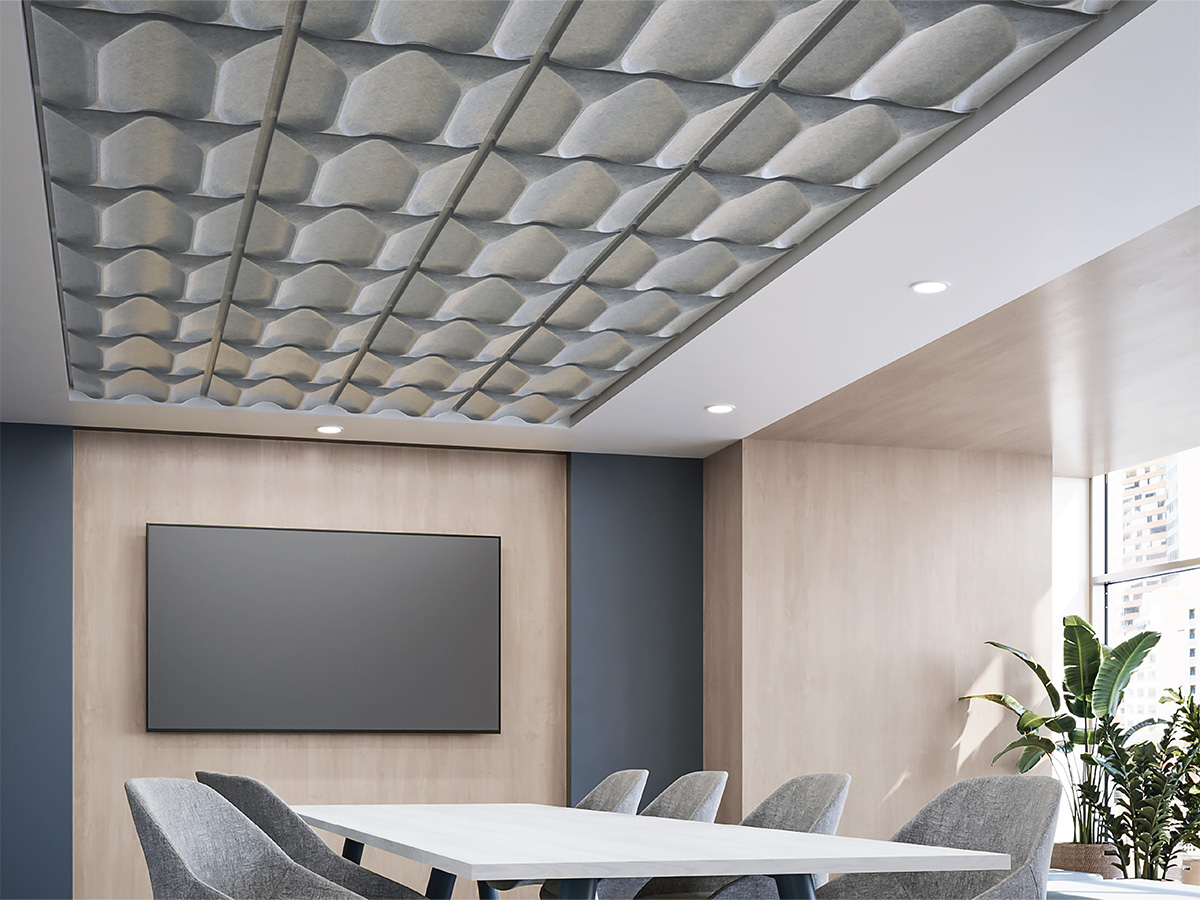
Biophilic Design Shapes Qwel’s New Ceiling Tile Collection
Ceiling tiles become rhythmic, sculptural surfaces in Qwel’s Biophilic Collection, where natural references drive three-dimensional profiles. Drawing on terrain shaped gradually over time, the collection registers pattern and depth overhead through measured repetition.
Manufactured in the United States in a standard 2-by-2-foot format from PET fiber, the tiles are designed for durability and washability over time. The profiles provide acoustic absorption with a Noise Reduction Coefficient of 0.75 and meet Class A flame and smoke ratings, while the fully recyclable construction supports flexible installation and long-term maintenance through removability and cleaning.

Sound absorption is central to a broader wellness-driven approach across Qwel’s products that considers how ongoing noise shapes focus and comfort in interior environments. “Our company is built around the idea of creating positive impact, and we do that through a quality, accessible product that is extremely functional as well as stylish,” says Cory Marvel, Qwel’s business development manager. “Expanding into biophilic design allows us to incorporate organic visuals with the preexisting acoustic control.”
Forms Shaped by Natural Reference
Two profiles, Dune and Terra, give shape to the Biophilic Collection. Dune draws from wind-shaped landscapes, translating gradual shifts in elevation into a repeating ceiling condition. Read from below, its elliptical plan gives way to a sculpted profile marked by gentle variation, with measured repetition shaping the ceiling surface as light and shadow move across it overhead.

Terra takes inspiration from terraced landforms and Zen gardens, with a geometry that reads as free-flowing and contemplative, grounded in a language drawn from the natural environment. The resulting cadence reflects principles associated with Japandi design, including restraint, material clarity, and functionality.
A System Built on Shape Psychology
The Biophilic Collection extends Qwel’s ceiling systems through an expressive visual language informed by shape psychology. Within the broader offerings, sound absorption and form are developed together as core design considerations, with ceiling surfaces treated as active elements of the interior that shape how space is read and occupied over time.

Alongside the Biophilic profiles, Qwel’s Affordance Collection applies this thinking through geometry. Developed to respond to varied modes of use across contemporary interiors, the collection introduces clearly defined profiles that help organize space and communicate intent overhead. Square, circular, linear, and angled forms correspond to specific types of spatial use, allowing form to guide spatial organization through the ceiling plane.
The Biophilic Collection engages the same thinking through a different source of reference. Shared material construction and acoustic performance allow the two collections to be used independently or together, supporting interiors where organic and geometric forms guide spatial emphasis without changing system requirements.