
Classic Motifs Meet New Materials in Arte’s Spring 2026 Collections
What moves through storied fashion houses and haute couture ateliers has a way of arriving, eventually, well beyond the runway. Frederik Decoopman, Design Manager at the Belgian wallcovering brand Arte, was studying the season’s collections when he saw it: Dior, Louis Vuitton, Dries Van Noten, each pulling centuries-old document patterns from the archive and pressing them into leather, tracing them in embroidery, running them through metallic. “These fashion shows caught my eye,” he says. “This was the start of the new launch.”

Arte's Spring 2026 collections, spanning seven in total, are where that observation landed. Each draws from a different chapter of decorative history: the Early Renaissance, 19th-century French interiors, ancient Egypt, the tapestry traditions of medieval Europe. Four collections in particular work those sources through materials more familiar to the fitting room than the wall: caprine leather and cross-stitch embroidery, sculptural velvet relief and hand-stitched suede.
Craft and Surface
Allures begins with 19th-century French decorative arts and the savoir vivre that shaped them, its sources rendered in brushed suede, velvet jacquard, and hand-embroidered cotton. Éclosion unfolds as a botanical scene, its surface worked with French knots, while Reliure takes its cue from bookbinding, its panels stitched and laced together. Galon references the trim of antique upholstery, Cabochon the decorative nails used in French furniture, and Étamine introduces an open, woven ground that anchors the collection. The path to each design, Decoopman says, is rarely the same. “Sometimes it starts from a design, and all the rest is built around it. Sometimes it starts from structures, and we think about the right designs to add.”

Corium pursues the same instinct through a single material. Built from caprine leather, it unfolds across five steps and three production studios, the surface cut, stitched, and assembled before embroidery is applied. The collection takes its name from the Latin word for leather, its references moving between architecture, dress, and ornament. Palazzo pulls from the monumental gates of Florence's cathedral, Cassone from coffered ceilings and ceremonial collars, while Gambison traces the stitched structure of padded armor. Finishes shift between satin and lightly sanded nubuck, giving each design a different surface while the material stays constant.
History on the Wall
Memphis takes its name from the ancient Egyptian capital and its five designs from the landscape and architecture that surrounded it. Where Corium and Allures work close to the surface, Memphis builds outward, its velvet-like textile molded into sculptural relief, each pattern given physical depth. Decoopman is precise about what drives that process. “Our 3D collections are always about the top, fabric layer,” he says. “Now we try to make all our designs by hand, so this gives an extra dimension to the design after molding.” Sakkara borrows from the stepped pyramids of the nearby necropolis, while Siwa traces the texture of desert palm trunks. Ibis turns to the verdant riverbanks of the Nile. Abydos draws on temple structures, its pattern defined by shifting geometry, and Amarna on the layered layout of the ancient city.

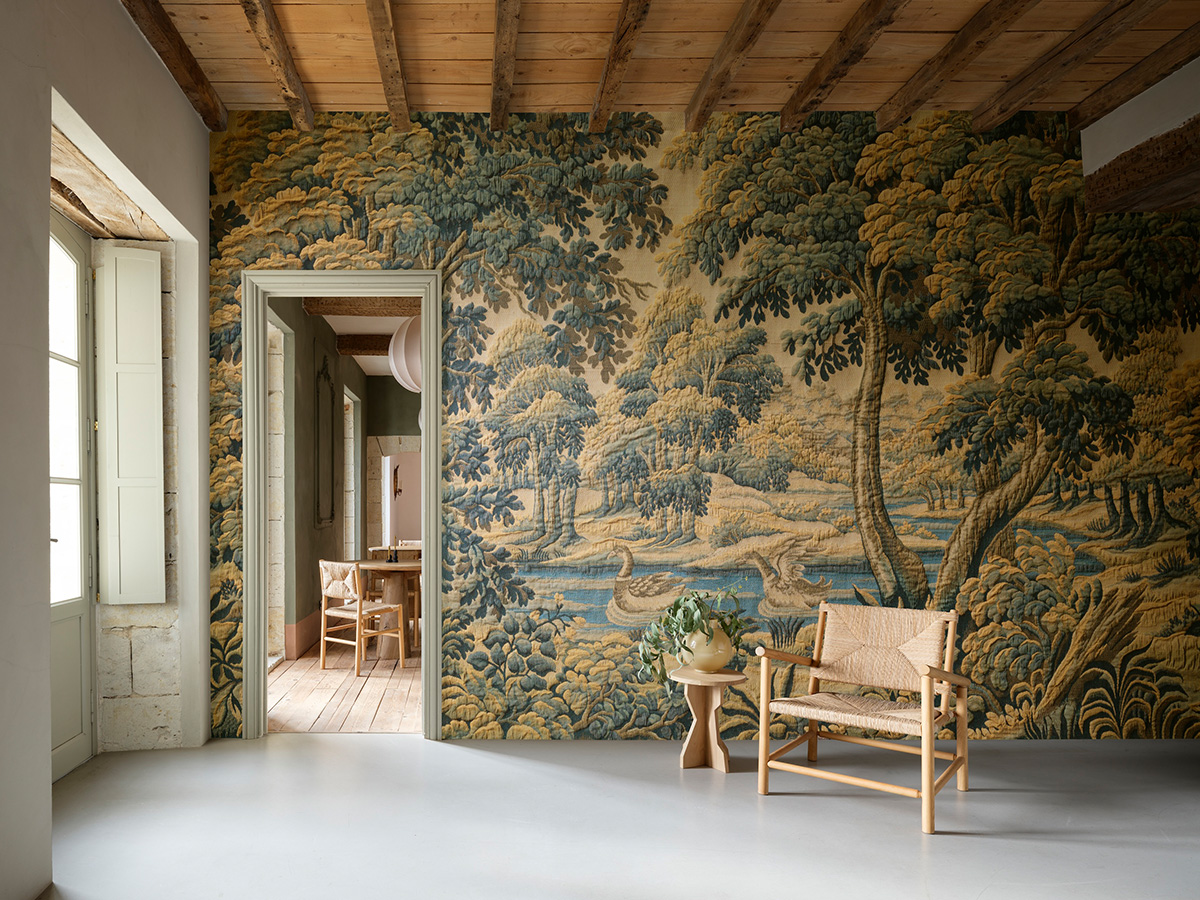
Les Tapisseries takes the longest historical view of the season. An extension of Arte’s Décors and Panoramiques collection, it looks to the hand-woven tapestries that hung in European castles and manor houses from the 14th to the 18th century. Each of the collection’s ten designs is sourced from a specific historic work. Bucolique is based on a 17th-century tapestry depicting two swans, while Floraison references an 18th-century Aubusson original. Récolte des Fleurs translates an antique Beauvais tapestry, with other designs extending into pastoral scenes, botanical studies, and ornamental compositions drawn from across the same period. The designs are printed or embroidered on textile, the source material held close enough to the surface to remain legible.

Three further collections complete the Spring 2026 season: Indienne, a vinyl collection evoking the texture and breathability of linen; Zephyr, which works natural sisal, suede, and metallic foil into fluid, wind-inspired forms; and Luxor, whose geometric compositions draw from the Art Deco era and its Egyptian influences. All seven reach into an archive built up over years of sourcing trips and supplier relationships across the world. For Decoopman, it has become “a playground.” The results shift accordingly. “Every season we try to surprise everybody with something new,” he says.