
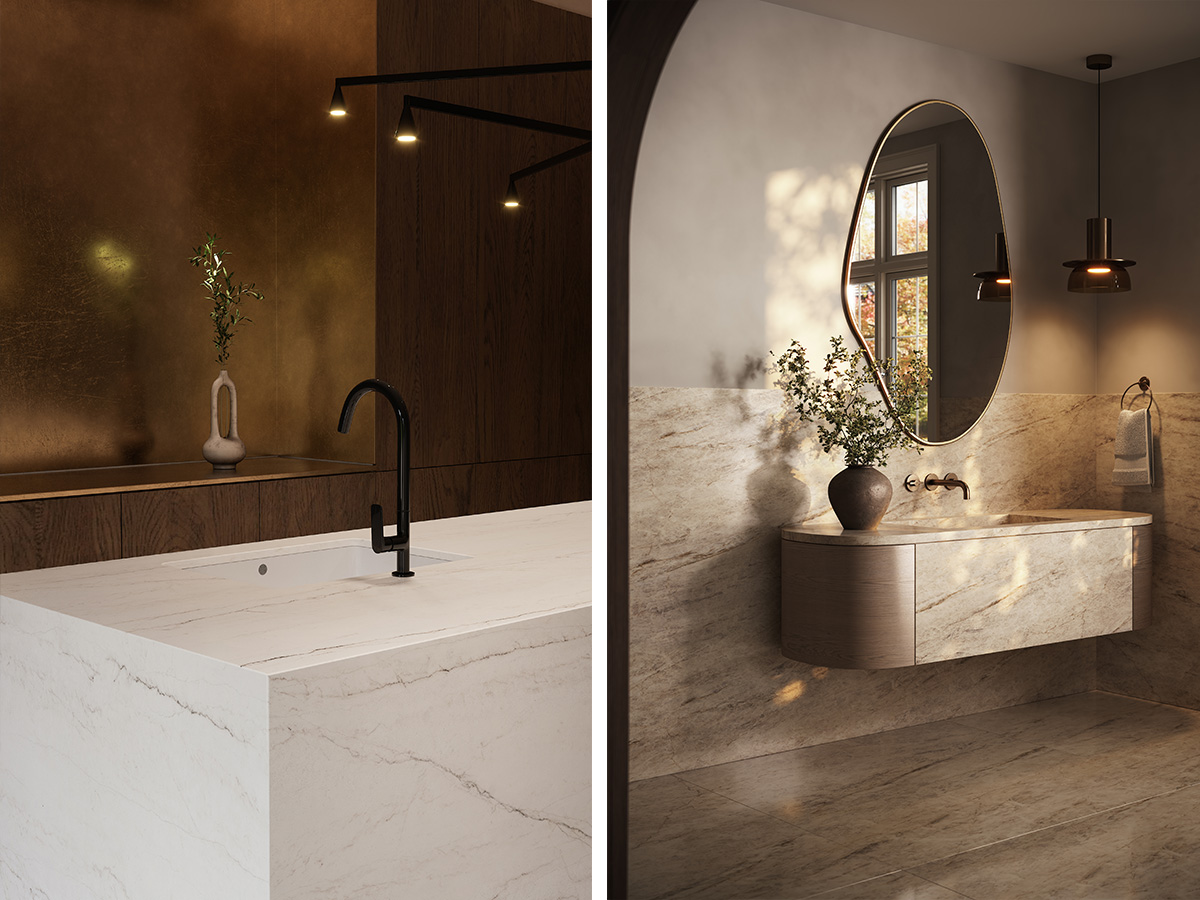
Cosentino Develops Éclos for Continuous Surface Applications
The edge of a slab is where a material’s ambitions are tested. Veining that carries across a face, the sense of depth and movement, has to hold through every cut, miter, and exposed thickness a fabricator makes. Éclos®, a new mineral surface launched globally by Cosentino in October 2025, was built around that requirement.
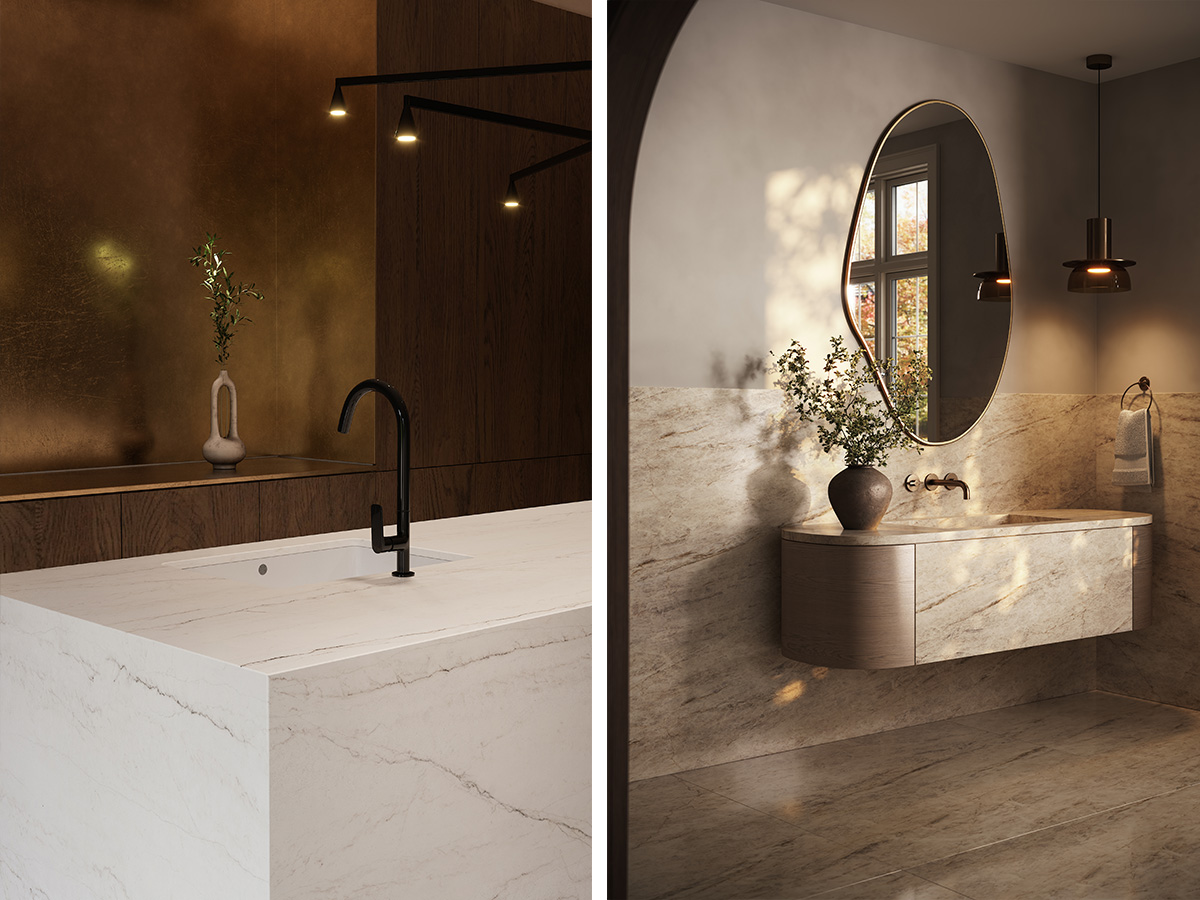
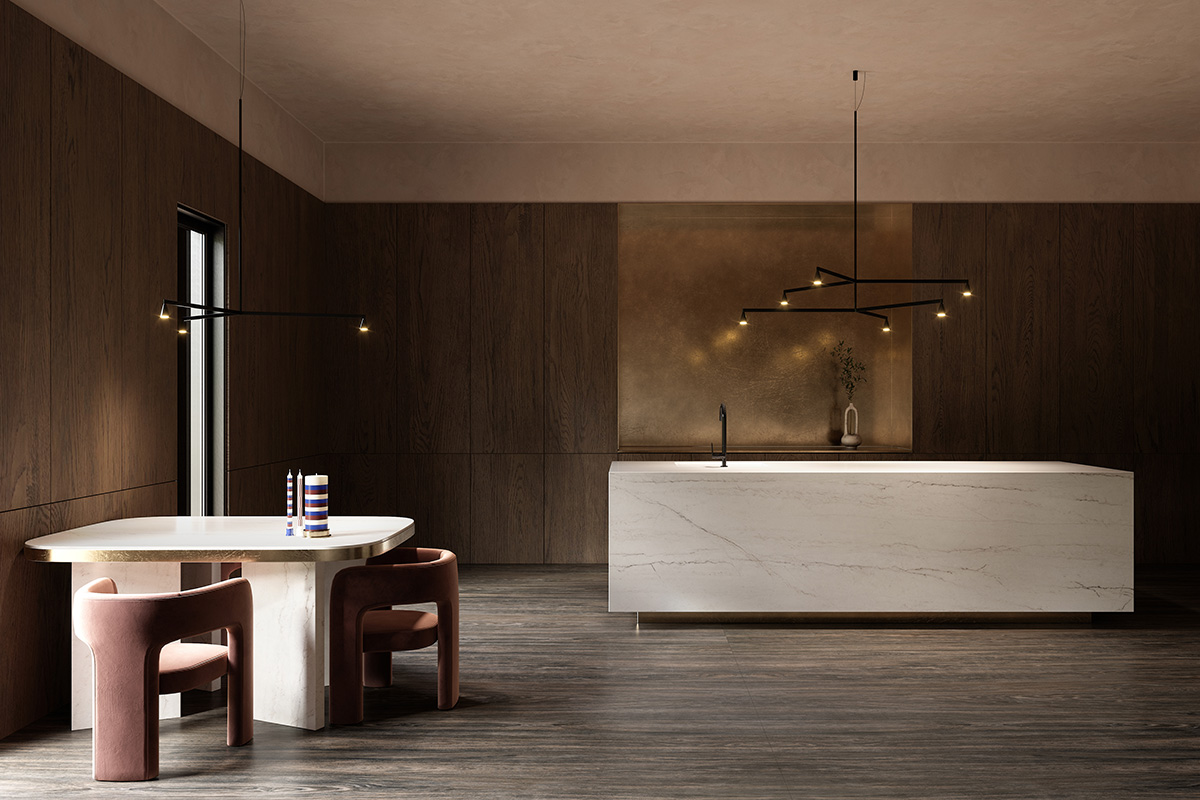
The technology behind it, called INLAYR®, uses advanced robotics and layered decoration techniques to integrate three-dimensional design with veining and pattern that extend to the edges. Fabricated details like waterfall islands, wrapped cabinetry, and integrated wall features read as coherent at the seam as at the center, the design continuous through cuts and cross-sections as much as across the face.
A Process Years in the Making
Éclos® took shape over an extended period of cross-disciplinary research at Cosentino. Fifty specialized researchers contributed across departments, logging more than 28,000 hours of development and 1,500 hours of testing between the company's R&D and product teams. Patty Dominguez, VP of Business Development at Cosentino Americas, points to manufacturing as the axis around which the hardest work turned. “One of the most significant breakthroughs came in manufacturing, particularly in developing the technology that allows veining to exist throughout the material,” she says. “Achieving that balance between design and reliable fabrication performance was critical, and it required years of testing and refinement.”
The physical properties that came out of this process go beyond appearance. Éclos® offers heat resistance up to 428°F, including direct contact with cookware, and its formulation gives the material greater flexibility, ductility, and impact resistance, making it more manageable for fabricators to handle and install. The surface also carries a natural touch and feel, a tactile quality the company developed in parallel with its visual properties.
Composition as Commitment
The material's construction also marks a shift in how Cosentino approached what goes into a surface. Éclos® carries a crystalline silica-free formulation, a development with direct implications for fabricator safety, and all colorways incorporate a minimum of 50 percent recycled content. Several reach close to 90 percent. Dominguez describes the two goals as having developed in tandem. “The team worked to align both goals to create a next-generation surface that reflects environmental responsibility and industry safety standards without compromising design,” she says.
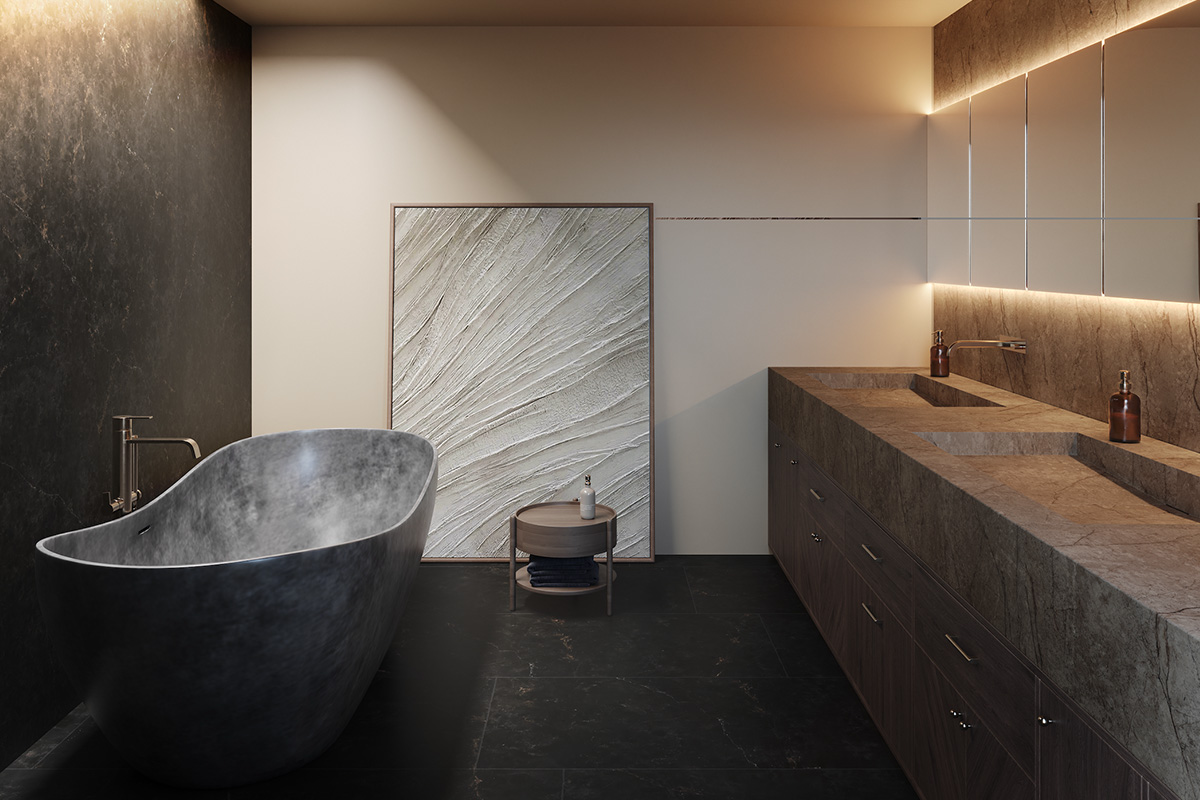
This focus on recycled content tracks with a broader direction at Cosentino, where sustainability has been a through-line across product generations. Éclos® pushes that percentage further than previous offerings in the portfolio, with the new line advancing a commitment to circular materials that has shaped the company's development priorities over time.
Within a Longer Arc
Cosentino has introduced category-defining surfaces before. Silestone® arrived in 1990 and reframed what quartz surfaces could be; Dekton®, launched in 2013, brought ultracompact technology to interior and exterior architectural applications. More recently, Hybriq® technology advanced Silestone® further, combining natural raw materials with recycled content in a single formulation. Éclos® enters that lineage as what the company is calling an entirely new category: Inlayered Mineral Surface. “Each milestone has responded to evolving market needs, and Éclos® embodies the growing demand for materials that function as durable, sustainable, and design-forward,” says Dominguez.
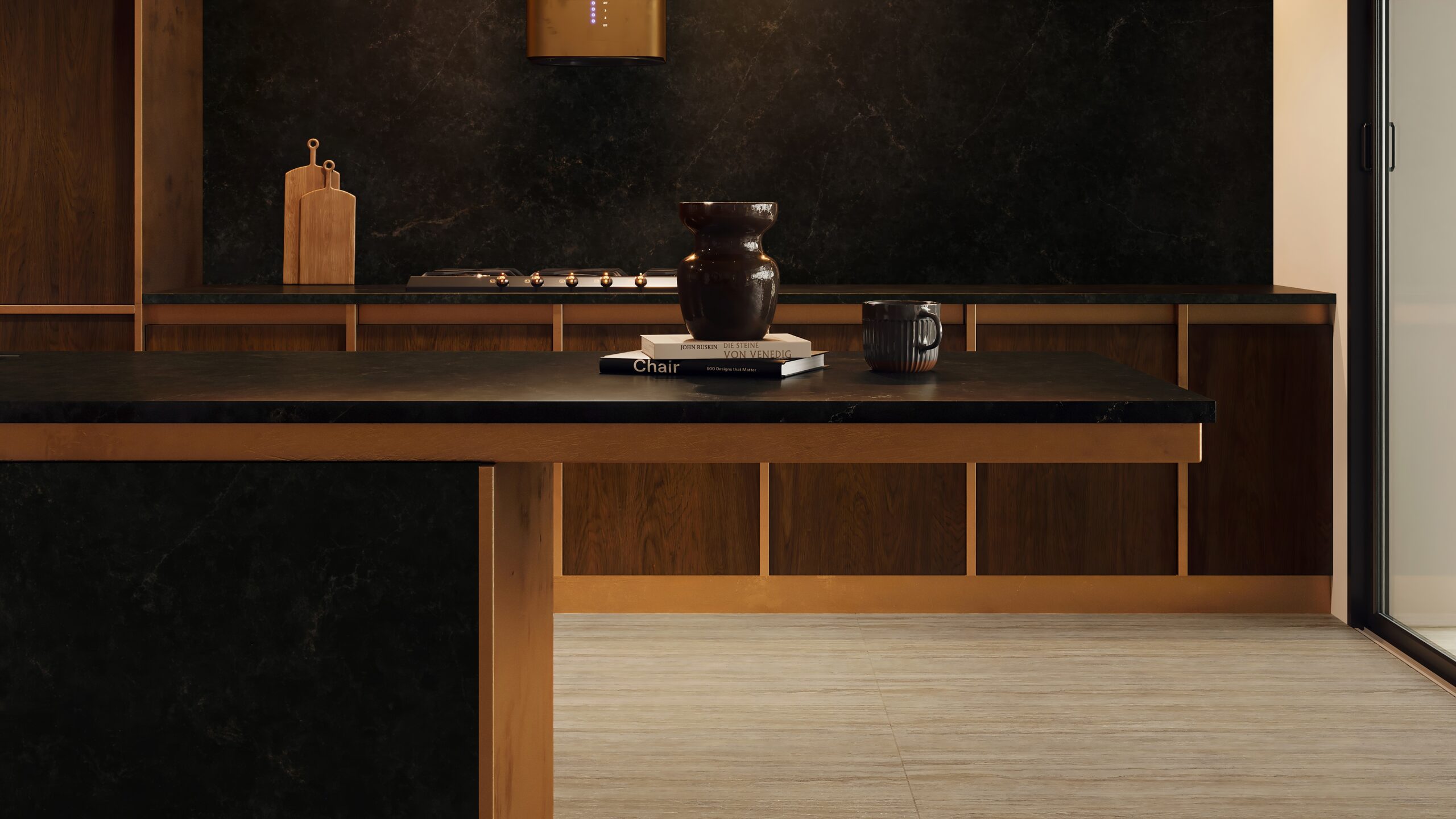
For Cosentino, Éclos® points toward where material development is heading more broadly. Dominguez sees the priorities sharpening around a few concrete demands. “Innovation is increasingly focused on creating materials that are visually authentic, technically advanced, and aligned with environmental and safety standards,” she says. Large-format applications, surfaces that move continuously across vertical and horizontal planes, and design with dimensional character are already shaping what the industry will ask of manufacturers next.