
Design Thinking Takes Shape in the Haworth Brand Gallery
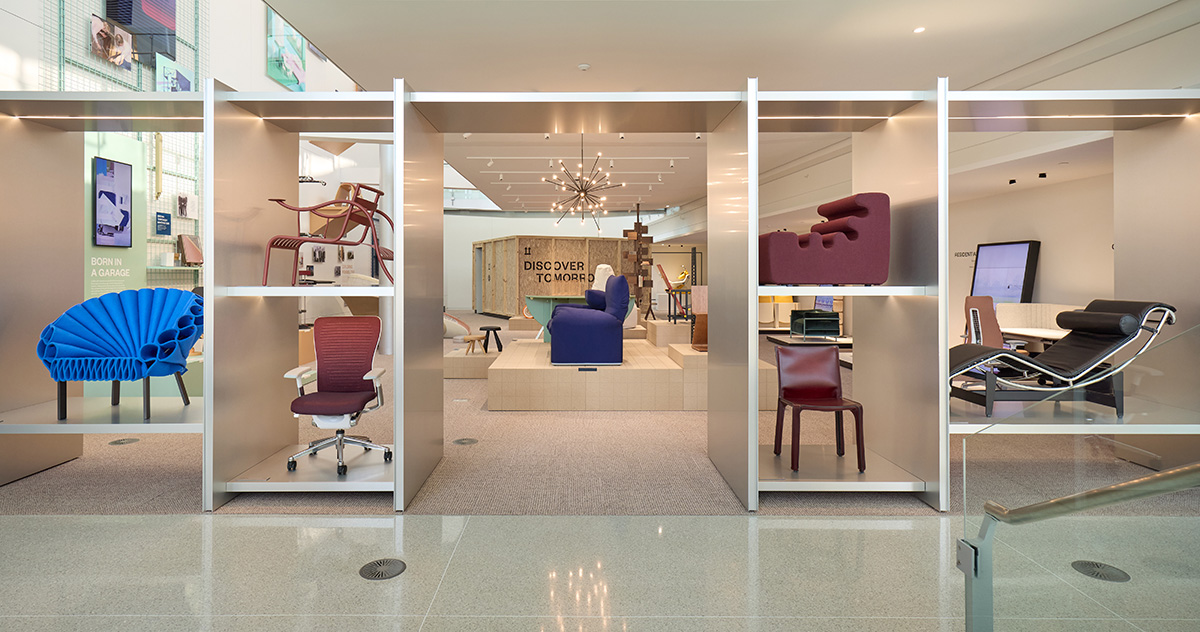
A structured entry frame, flanked by iconic silhouettes in seating, cues the transition into the Haworth Brand Gallery. Just beyond, digital displays rise like vertical panels, warm wood podiums hold form-driven furnishings, and signature designs from across decades begin to appear. The museum-like setting moves deliberately through past and present via material, craft, and typology, with each piece contributing to a sensorial experience of how ideas at Haworth have taken shape.
A Museum of the Present
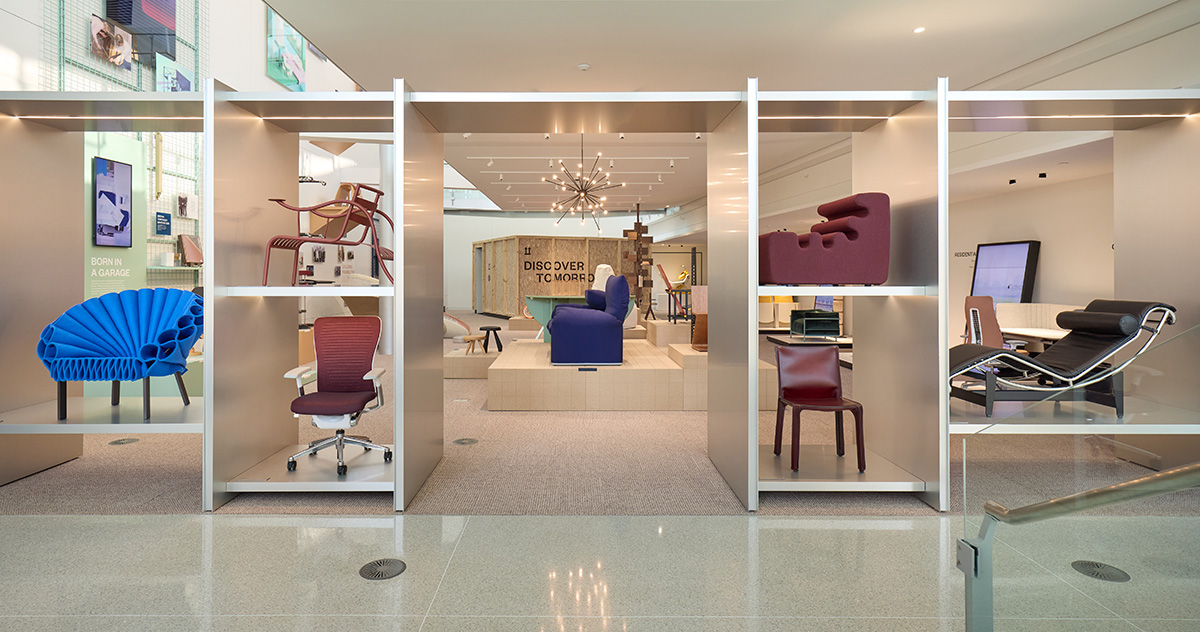
Set inside the company’s headquarters in Holland, Michigan, the Haworth Brand Gallery was conceived to articulate the company’s design evolution, cross-industry reach, and future-facing vision, all through physical space. The gallery unfolds across five areas: an opening threshold, a display of Haworth Group’s global portfolio, a wall of core brand pillars, a central podium exhibit of curated products, and a multisensory installation.
Every element in the gallery contributes to a layered narrative. “We wanted to create a physical experience to show the vast array of products from Haworth Group,” says Kurt Vanderschuur, Brand Strategy and Marketing Director. “That would be difficult to do in a traditional showroom. This experience goes a step further with a space to feature iconic pieces paired with video and audio channels that show who Haworth Group is today.”
A Spatial Narrative in Five Parts
The gallery opens with a portrait of Haworth Group’s scope, introduced through six-foot digital displays that represent the company’s reach across sectors. The breadth is expansive and designed to be felt. “It spans commercial, residential, hospitality, and retail projects, as well as cultural venues such as theatres and airports, and even extends to transportation design,” says Designer and Architect Patricia Urquiola. “This experience is both physical and digital, curated to immerse visitors in the breadth of Haworth’s work over the years.”

These displays are surrounded by products that represent a portfolio built for a wide range of environments, from cruise ships and civic venues to residential interiors and workplaces. Their presence signals the collective output of designers, craftspeople, and partner brands across the group. As Haworth President and CEO Franco Bianchi explains, “Haworth Group designs at the intersection of people and spaces, no matter who the people are and no matter what these spaces are. Today, we are honored to participate in the design and manufacturing of work, automotive, theatre, restaurant, home and yacht interiors with crafted product solutions designed in collaboration with the best designers in the world.”

The rhythm shifts at the east wall, where Haworth’s three pillars—entrepreneurial, design-forward, and multicultural—frame the company’s values and approach. Artifacts in this area include early products like G.W. Haworth’s study carrel, a 1970s pre-wired panel system, and a timeline of logo evolution, collectively offering a reflection of the company’s foundation in craft, foresight, and long-term thinking. “We looked for iconic pieces and famous design icons that are the most unique,” explains Adam Clark, Senior Marketing Design Manager. “We also looked for iconic products by category. It was important that we reflected every category and go beyond the office.”
Design as Ongoing Experiment
The Design Forward section continues this narrative with a focus on experimentation and ergonomics. Prototypes such as the Sit-to-Stand chair and Drift Workstation illustrate how Haworth Design Studio has long explored movement, posture, and emerging modes of work. Developed in the 1990s, Drift used vertical and horizontal space to support memory and workflow, while Flo—a companion piece shaped like a surfboard—was designed for visibility of work-in-progress. Artifacts here show how the company translated behavioral insight into design.

Toward the back of the space, Discover Tomorrow houses video projections featuring four voices central to Haworth’s past and present: Franco Bianchi, Patricia Urquiola, Matthew Haworth, and Dick Haworth. Each reflects on the company’s values and direction. “The Brand Gallery is meant to create an experience and tell stories across the variety of brands that are part of the Haworth Group,” says Bianchi. “It’s also a physical manifestation of our company and the maker foundation of Haworth—our people.”

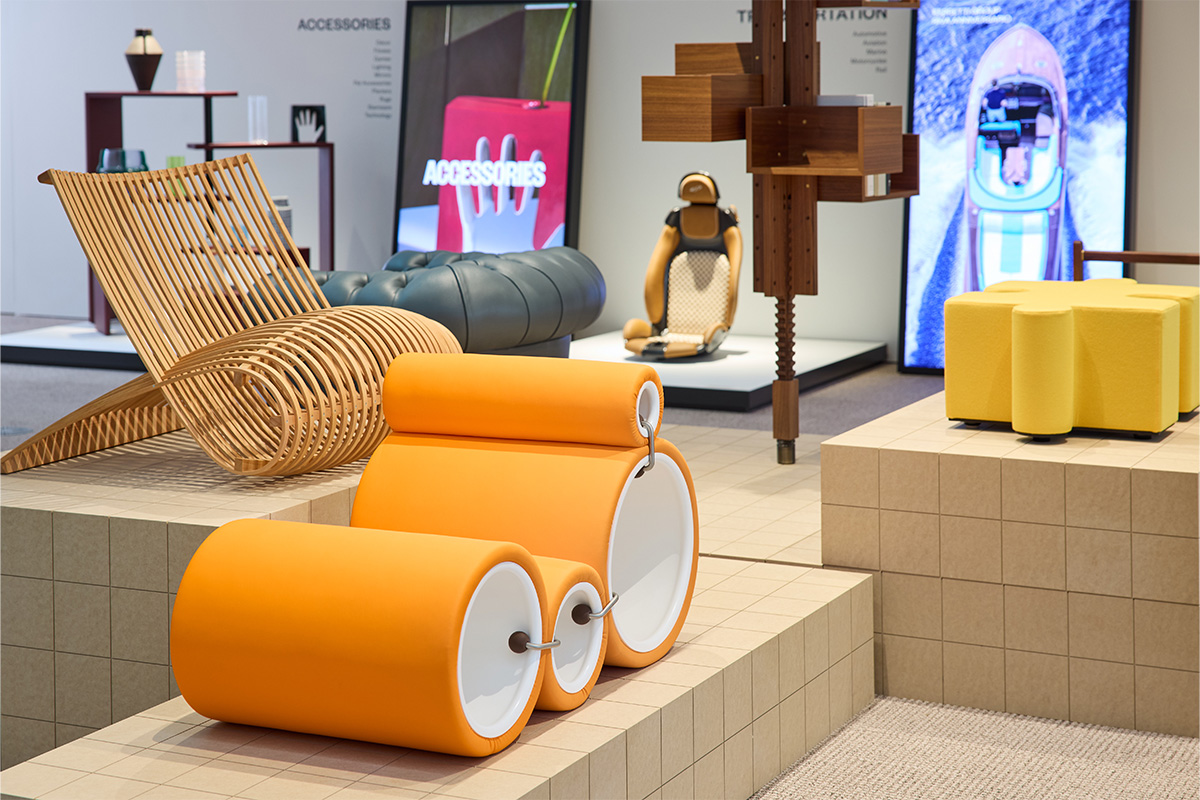
The Multicultural section reinforces Haworth’s global footprint and design diversity through materials, methods, and manufacturing stories. A knit-to-fit lounge chair made from recycled PET bottles sits alongside hand-modeled clay prototypes, custom upholstery techniques, and a world map tracing Haworth Group’s reach across continents. The Center Podium Exhibit runs down the spine of the gallery, presenting a curated collection of iconic designs from across the group. Each piece is labeled with its designer and date of origin—Gerrit Rietveld’s Zig Zag, Charlotte Perriand’s Tabouret Berger, and the 2024 production debut of Galaxy, a 1949 light by Charles and Ray Eames. Together, these artifacts invite close looking and offer moments of recognition, invention, and legacy.
The Haworth Brand Gallery distills decades of design thinking into an immersive experience where process, partnerships, and material sensibility come into view.