
Framery Looks to Data to Inform the Future of Office Design
For today’s flexible workforce, yesterday’s one-and-done approach to office architecture, where designers deliver fixed, finished spaces that resist evolution, falls flat. “Hybrid work is now the standard, and it fundamentally changes office design,” declares Framery’s Head of Smart Office Solutions, Arto Vahvanen, an alum of Microsoft and Nokia who brings decades of expertise and innovation to bear on the subject. “Designing a workspace for a fully in-office team with only in-person meetings is relatively straightforward. The complexity skyrockets when you factor in hybrid attendance and hybrid meetings. At its core, this is a design challenge.”

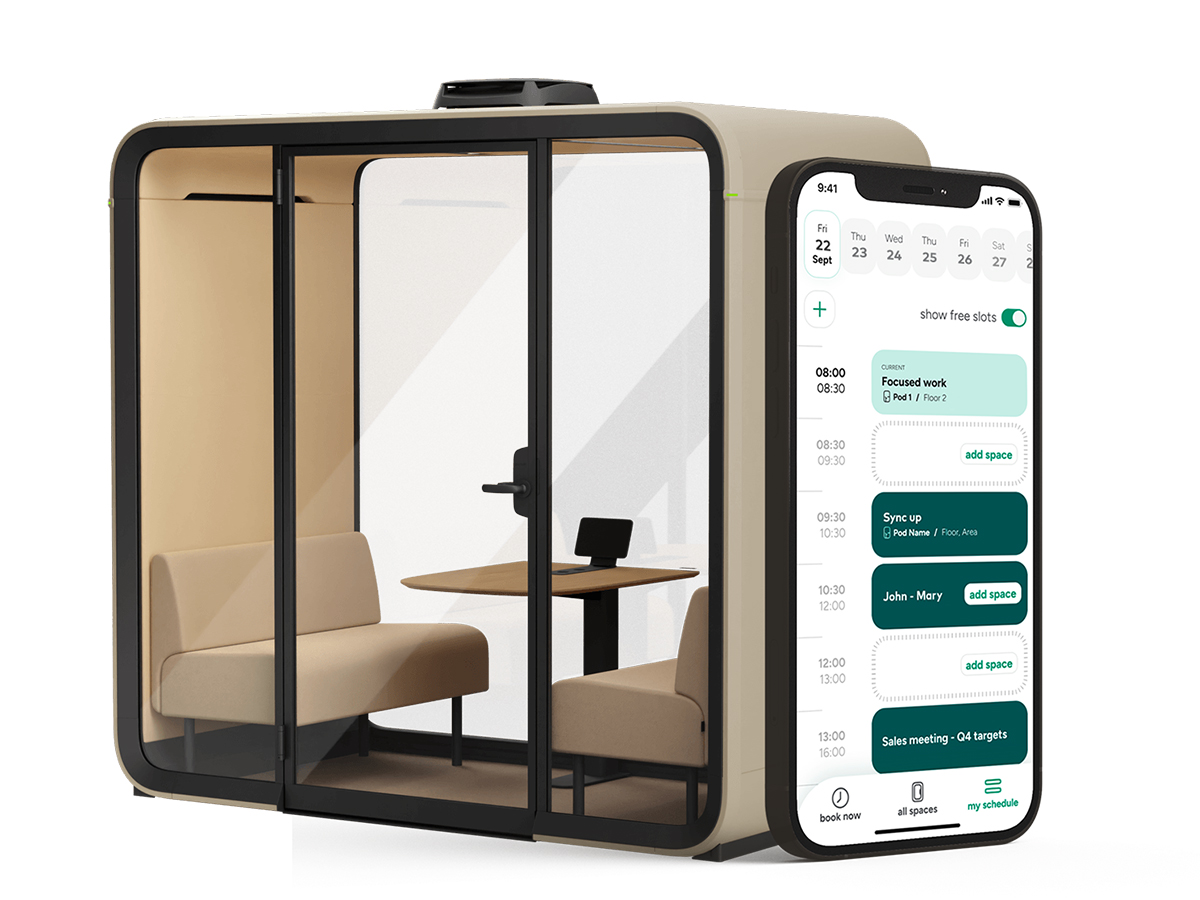
Enter Framery—the industry pioneer that 15 years ago debuted modular soundproof pods as the premier solution for private calls and heads-down work in chatter-laden open plans—with a new mandate: to leverage cutting-edge workplace technology such as millimeter wave (the same radar sensors utilized in autonomous driving) to transform how offices iterate over time. Usage statistics are the crucial first step in understanding how to shape a workplace to the needs of staffers. Framery’s solution to capturing this data ingeniously overlays the digital on the physical, with sensors in the company’s one- to six-person smart pods—and elsewhere in the workplace—monitoring and delivering real-time anonymized data on occupancy numbers, session lengths and frequency, peak usage times, and trends over time. This granular data from the pods and meeting rooms is funneled through 4G connection to Framery Connect, a system that acts as the centralized brain of the office, providing facilities managers and designers with valuable decision-making insights that assist with the continual optimization of the workplace based on accurate metrics rather than hypotheses. Successful case studies abound, with companies like CBRE and H&M leveraging the occupancy data from Framery smart pods to become leaders in office design. Framery Connect’s usage data helped Inderes, for instance, repurpose an underused area as a fully functional meeting room, obviating the need to invest in building one.

Research suggests 40 percent of workers spend 30 minutes per day looking for a vacant space to engage in undisturbed work, so having quick access to the right space through one system—with pods, rooms, displays, and bookings all working together without extra tools or confusion—significantly reduces time wasted. But if a truly “smart” office is akin to a responsive organism that through intelligent technology can mold the workplace into a more productive and human-centric form, crucially “the ‘brain’ must run seamlessly in the background, avoiding technology for its own sake,” Vahvanen explains. “The primary purpose is to address the largest employee pain points with zero friction,” he adds. “For instance: automatic walk-in reservations and ventilation that automatically adjusts to the number of people in a pod. Furthermore, when our analytics are deployed correctly, they eliminate waste, such as oversized conference rooms, and ensure needed space is always supplied instantly, without the user even noticing.”

It's no small feat to ease the lived experience of work in this way, but as RTO evolves, with no future norm in sight, the key value of Framery’s suite of digital offerings lies in its ability to give clients the data points needed to tweak their spaces ad infinitum, narrowing the disconnect between how workplaces are designed and how they are used until the gap simply ceases to exist. In short: the office, perfected.