
Layered Veining and Relief Define XTONE’s Latest Porcelain Collections
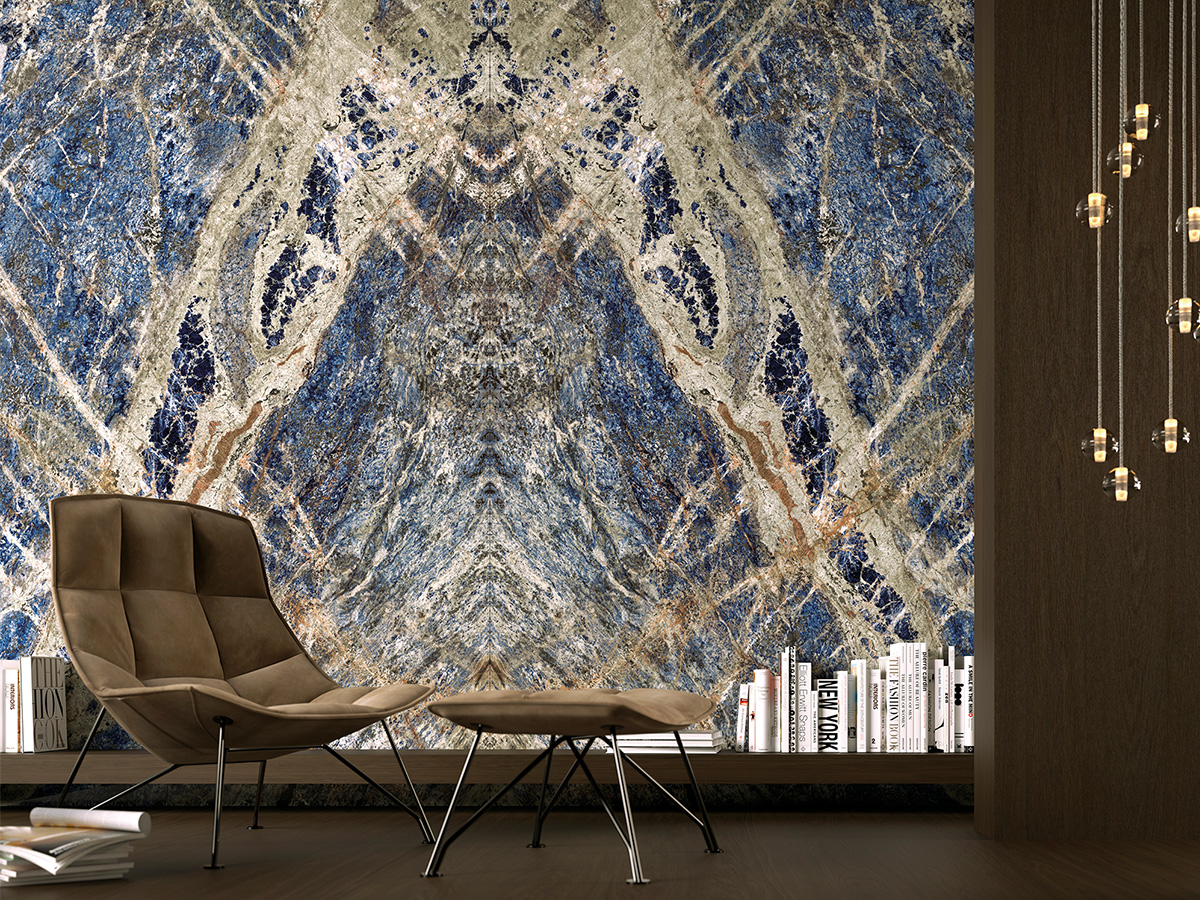
A deep blue field runs with gold, white, and copper veining, crystalline particles suspended across it so the surface shifts with the viewing angle. Andes Blue is one of six recently launched collections from XTONE, the Porcelanosa Group brand specializing in large-format porcelain. Its shimmer comes from Comet, a proprietary technology that sets luminous particles of varying intensity into selected areas of the design. Placed along particular elements of the pattern, they heighten the mineral character and lend the surface depth and movement. The collection arrives in a polished finish that deepens the veining and sharpens the contrast between the blue ground and the metallic tones crossing it.

The rest of the range interprets marble, travertine, and limestone across five more registers, each pairing a different reading with the technology that produces it. Camouflage unfolds fluid veining across the slab, a composition alternating softer areas with more expressive ones, recalling geological layers formed over time. Two technologies are at work. Core incorporates color and particles throughout the body of the material, creating greater visual continuity between the surface and its core. The result is a more integrated appearance at exposed edges, cutouts, and other fabricated areas—an important consideration for highly detailed architectural applications. Eclipse lends the face a physical dimension, applying decorative grit selectively to build concave and convex relief, so depth, shadow, and tactile realism shift with light and viewing position.
Where Camouflage reaches for contrast, Ceppo Carabelas settles into warmth, interpreting travertine and limestone in beige tones carrying gentle veining and a granular texture. Mallorca Caliza turns lighter still, its pale, open tones recreating the understated character of Mediterranean stone. Both rely on Core for full-body continuity, and both are offered in a Texture finish that adds subtle relief.

Negresco and Vendome are shaped by Lumen, which raises decorative relief in chosen areas so texture follows specific graphic elements, emphasizing veins and natural irregularities. Recent XTONE applications also use the technology to highlight passages through polishing, letting them respond differently to light. Negresco takes after a coppery black marble quarried in Morocco, its dark ground crossed by fine ivory and gold veins. Vendome sets delicate golden nuance against a luminous base, with veining that flows naturally across the slab.

Every collection arrives in two formats, the largest measuring 160 by 320 centimeters and a second at 160 by 160 centimeters, a size suited to flooring and bathroom furniture. Both are produced in six-millimeter and twelve-millimeter thicknesses. The thinner gauge carries four designs with infinite continuity along the long side, letting an expanse run without an obvious repeat, while the thicker one is cut for bookmatch symmetry.
Its two thicknesses also allow XTONE to respond to different architectural requirements. At 6 mm, the material provides a lightweight solution for expansive floor and wall applications, from feature walls and shower surrounds to furniture cladding and other vertical surfaces. At 12 mm, XTONE lends itself to applications requiring a more substantial fabricated surface, including kitchen countertops, bathroom vanities, reception desks, tables and custom-designed elements. Beyond interiors, the material can also be incorporated into exterior façade solutions. Together, these applications give designers the opportunity to extend a single material vocabulary across multiple scales—from the building envelope and interior surfaces to furniture and bespoke architectural details.

Beneath the decoration, the fired porcelain has low porosity, keeping liquids from being absorbed and odors from collecting. The material is waterproof and antibacterial, resistant to temperature, scratches, stains, and abrasion, and tolerant of heavy impact and cutting tools.

Production at the plant follows a circular model in which heat drawn off the oven goes back to the drying process, water passes through a treatment facility before returning to industrial use, and 4,475 solar panels supply the site through energy self-consumption. Clay waste, raw and fired alike, along with the industrial wastewater generated during manufacturing, reenters ceramic tile production either internally or through external spray dryers, under a full-recovery program the company calls REGAIN. Bag filters capture emissions through textile membranes permeable to gases that retain dust particles.
