
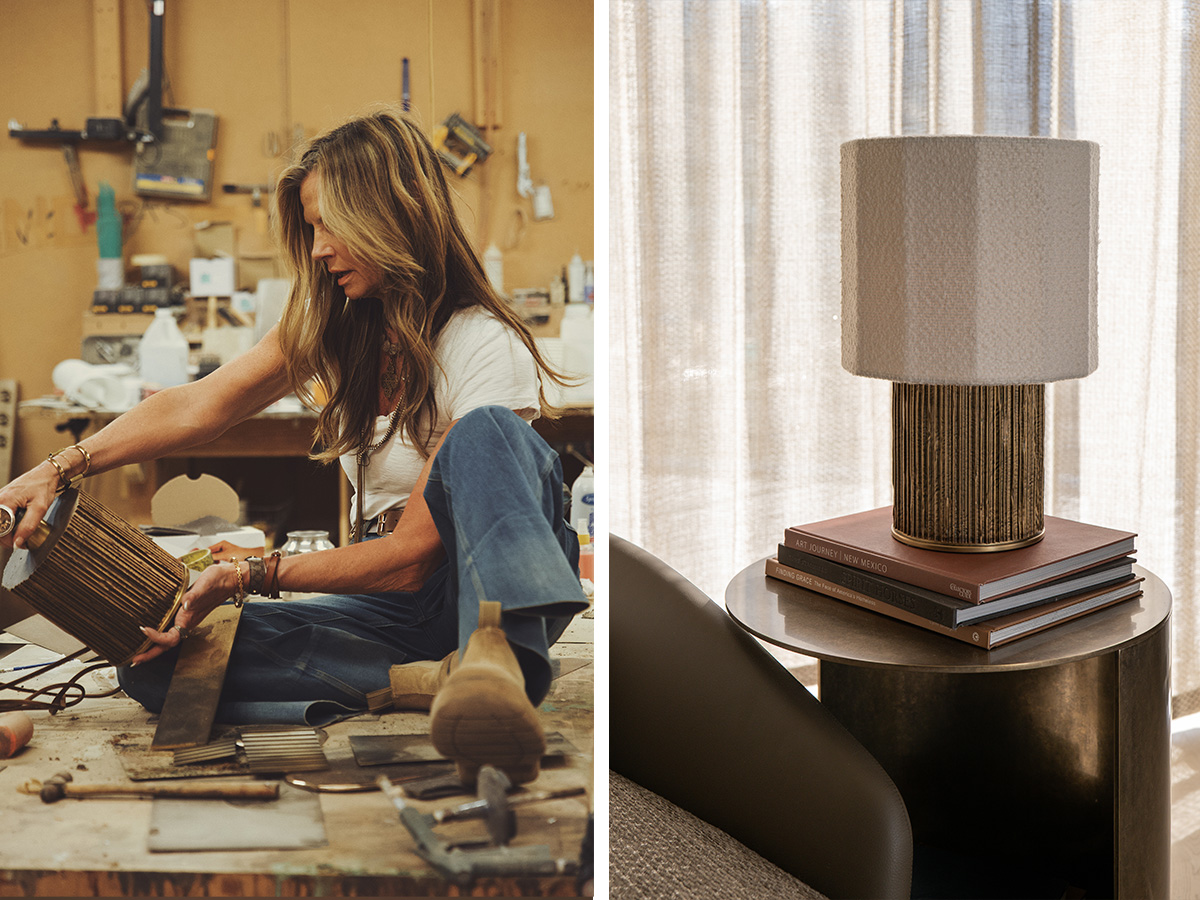
Sculptural Forms Define Anne-Marie Barton’s Visual Comfort Lighting Line
Before there was a collection, there was a single casting. At a workshop she frequents near her home in Salt Lake City, interior designer Anne-Marie Barton had been experimenting with metal when one piece emerged scored, pitted, and irregular, its surface recalling fossilized tree bark. “I am always looking for evidence of the maker's hand, something that feels worked, touched, pushed, heated, imperfect in the right way,” Barton says. Her find gave tangible form to those ideas. “It was bronze, but not polished into silence. It had movement. It had weight.”
The casting was one discovery in a much longer pursuit. For years, Barton's studio had been producing its own fixtures alongside rugs, sculpture, furnishings, and plumbing fittings. When Visual Comfort & Co. encountered the work firsthand, including a faucet prototype cast in bruised bronze, the partnership all but proposed itself. “They asked, ‘Why aren't you designing our lighting?’ and something in me knew the answer was yes,” she recalls. In the three weeks before their first meeting in Houston, she developed 78 concepts.

Guiding those concepts was a vision already fully formed. “I wanted the collection to feel like jewelry for the home: molten cuff bracelets, a suede necklace, fragments of the body reimagined into fixtures,” she says. Five families of sculptural lighting emerged: Fumar, Dune, Armise, Austera, and Remi, rendered in natural patinas, hand-cast brass, wood, leather, stone, and glass.
Studies in Material
Fumar, a series spanning portables and hardwired designs, grew directly from that workshop experiment. It comes in Ridged Carbon, Tombac, and Graphite, each surface individually detailed and sealed so its character holds for decades. Drawing on her architectural background, Barton set a dado gap between the base and body of the cylinder table lamps and paired the rugged metal with crisp alabaster forms and a custom shade in soft bouclé. The finish speaks the same language as the fireplace surrounds and wall treatments she designs, and it reflects a conviction that runs through all of her work. “Texture is not only something you touch,” she says. “It is something you read from across the room.” She traces Fumar's staying power to where it started. “It began as a piece of bronze with a voice, and it became a fixture that holds that voice.”

Elsewhere the collection reaches for softer references. Dune, a belted light of hand-formed Murano-style glass strung on suede straps, began with an object Barton admires for its everyday utility. “A leather belt is intimate. It has memory. It wraps, holds, softens, supports,” she says. “It is practical, but it also carries sensuality.” Shaped using historic Murano techniques, the glass carries a fine effervescence across its surface, like the first pour of champagne, while waxed cotton stitching and a blunt edge lend the straps, offered in Bone, Ash, and Russet, a relaxed confidence. Mounted as swags or vertical suspensions, individually or in series, the piece was seeded by a second object from Barton's own wardrobe, a choker of asymmetric ocean pearls she describes as “just moody enough to glow.”

A Shared Vocabulary
The remaining families extend those instincts across scale. Armise, offered as a chandelier, pendant, and sconce, takes its cue from a gold cuff bracelet, its curved frame securing a luminous expanse of alabaster or opalescent fiberglass. Austera, a wall fixture in hand-applied Mottled Brass, Mottled Pewter, or Matte Carbon, projects an angular profile with a softly lit channel of stone at its center. And Remi, a linear pendant that also translates to the wall, conceals its source beneath a gently domed shade, its dual-rod suspension set off center on the canopy and its patinated metal grounded by dry walnut detailing.

Across all five, Barton returns to a single standard, one she sums up as material honesty: metals that record the hand, leathers and woods that age in place. “The pieces share a belief that authenticity is felt before it is intellectually understood,” she says. It is the quality that gives the line its coherence, and that lets each object hold its own as sculpture. “The collection is not united by one shape,” Barton adds. “It is united by touch, shadow, patina, and warmth.”