
Ready To Go: A Design-Forward Take on Ford’s Dearborn HQ
The first thing to know about Ford Motor Company’s new world headquarters in Dearborn, Michigan, is that it is immense. The four-story building measures a whopping 2.1 million square feet, making it larger than many skyscrapers, and the footprint covers 14 acres. So perhaps what’s most striking is that the interior feels…comfortable. “I think people will be surprised how intimate it seems,” begins Craig Dykers, founding partner of Snøhetta, the project’s design architect, “because it’s made up of many small spaces.” Maintaining that human scale throughout the vast structure was a key goal and challenge.
The previous headquarters was built in 1956, and functions were scattered across the campus. Research and development groups had been siloed since the days of the Model T: The brake engineers might be in one building, the motor engineers in another. “Employees often drove to one another for meetings. A mock-up of a car would have to travel for 30 minutes to be viewed by an executive in the correct lighting,” marvels architect Jennifer Kolstad, global design and brand director at Ford Motor Company and Ford Land, the real-estate arm of FMC, overseeing all commercial, testing, and manufacturing properties, including design, construction, and facility management. This time around, FMC had to bring teams together without losing specialist focus, take the old production line into the 21st century, and create a welcoming environment that promotes innovation.
Snøhetta + Arcadis Take The Ford HQ For A Spin
It was a job requiring multiple partners. Ford initially hired Snøhetta in 2017 for the master plan of its 700-acre campus, which consolidates operations, increases density, and improves transit and pedestrian connections. The firm’s scope later expanded to include the world headquarters at the campus’s heart, which will house approximately 4,000 employees but is open to anyone across the company. For the interiors and furniture selection, Snøhetta collaborated with Arcadis and Kolstad’s team. Together, they reimagined how Ford would work for the next 100 years.
Dykers and his colleagues first got up to speed on the automotive industry, learning how a car gets designed, prototyped, and viewed. They had to figure out how to bring everyone from executives to fabricators under one roof—and move vehicles within it. “We saw it as an urban plan, because the magnitude was more like designing a small city,” he recalls. About half the building is devoted to research and development, including design studios, paint labs, metal shops, and a showroom. The rest resembles a standard office, albeit one with 300 meeting rooms and a 160,000-square-foot food and amenities hall.
Behold A New Era At Ford World Headquarters
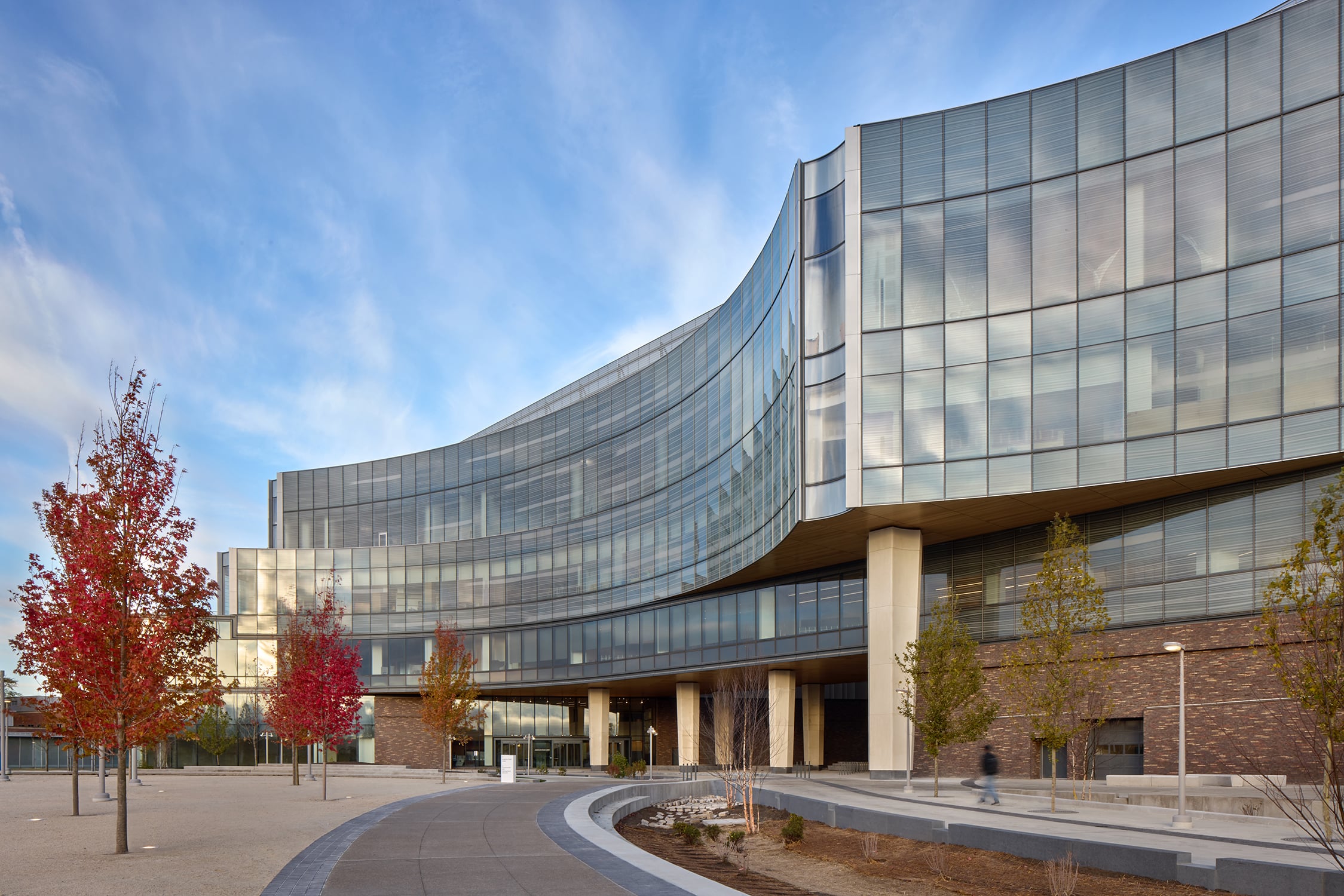
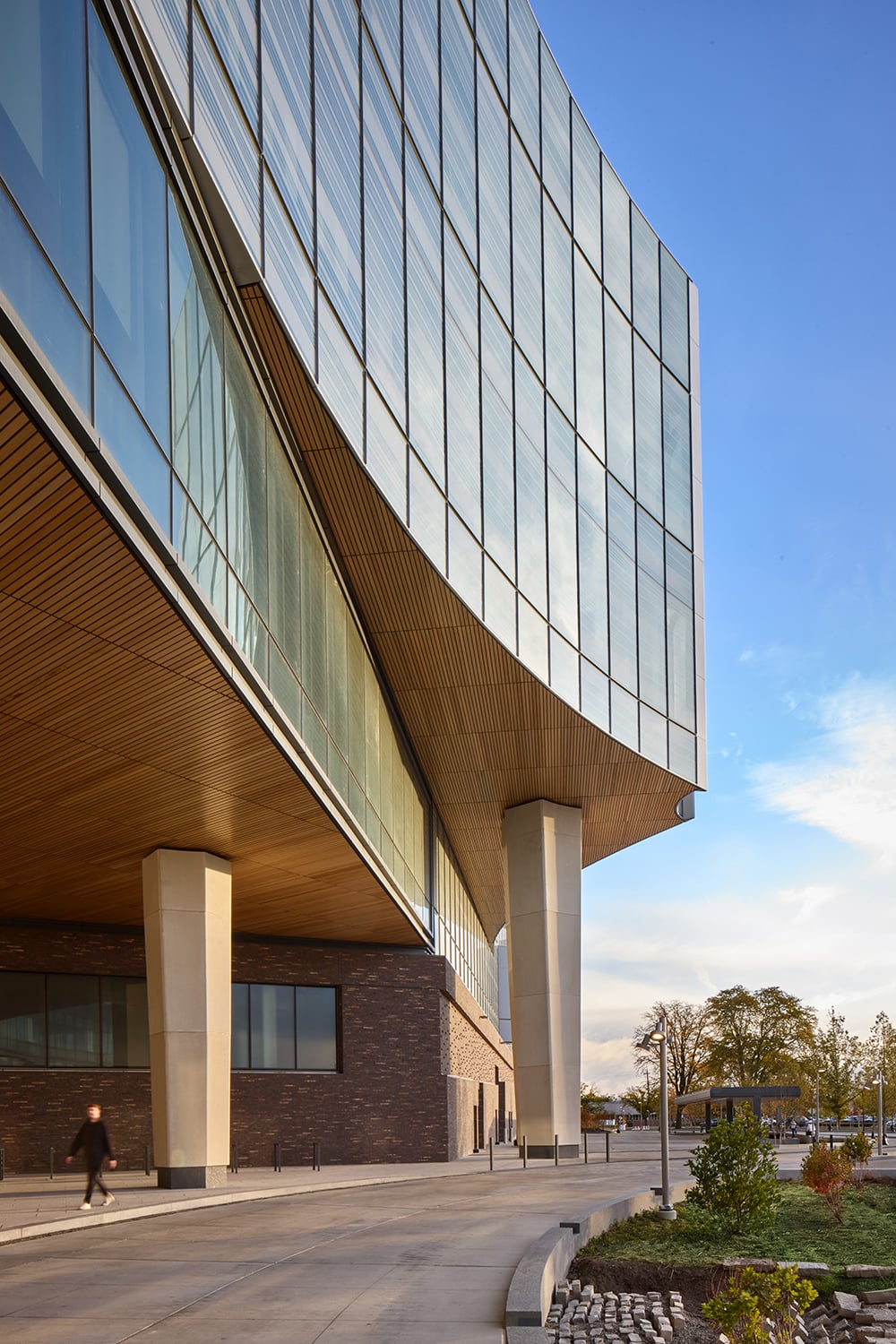
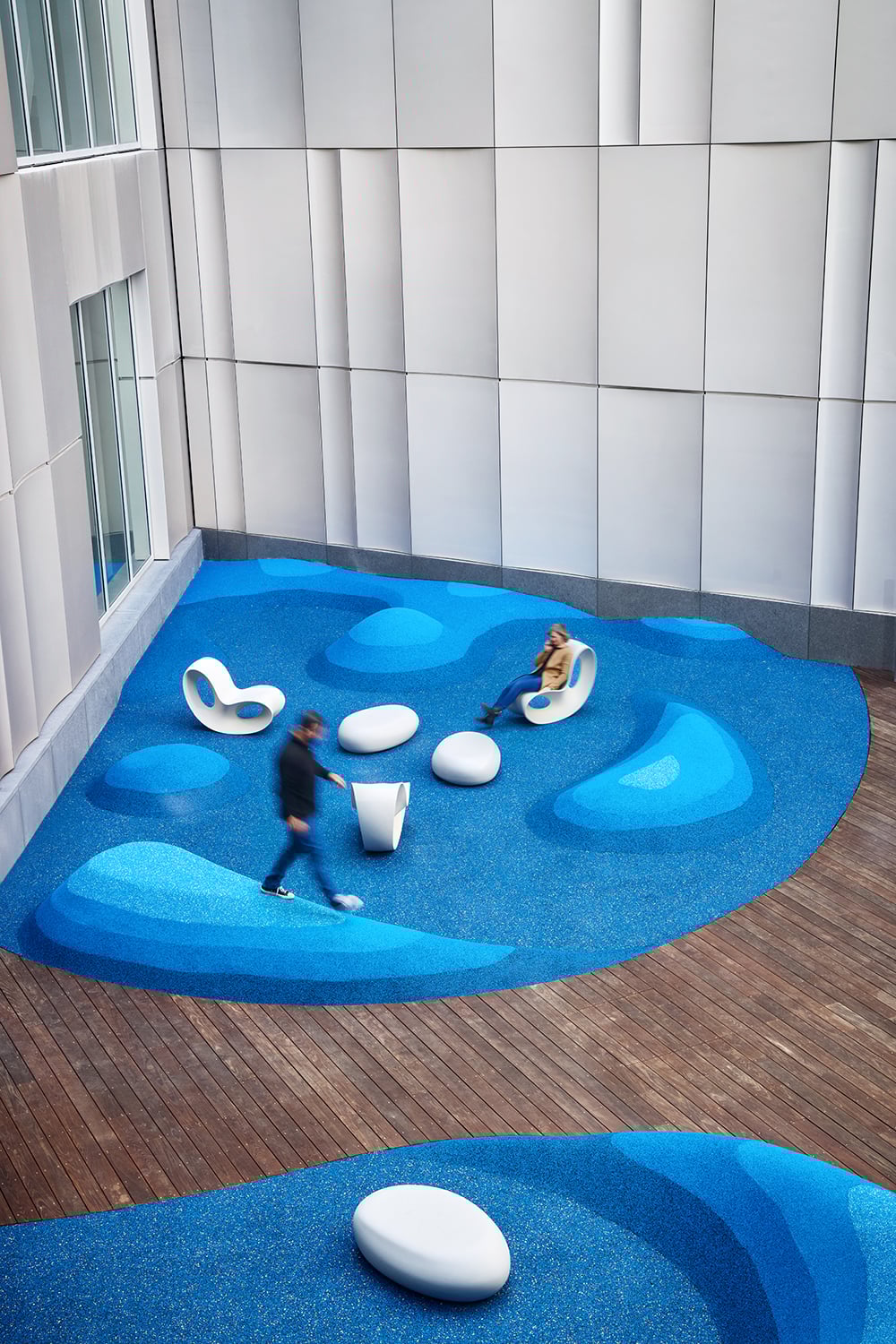
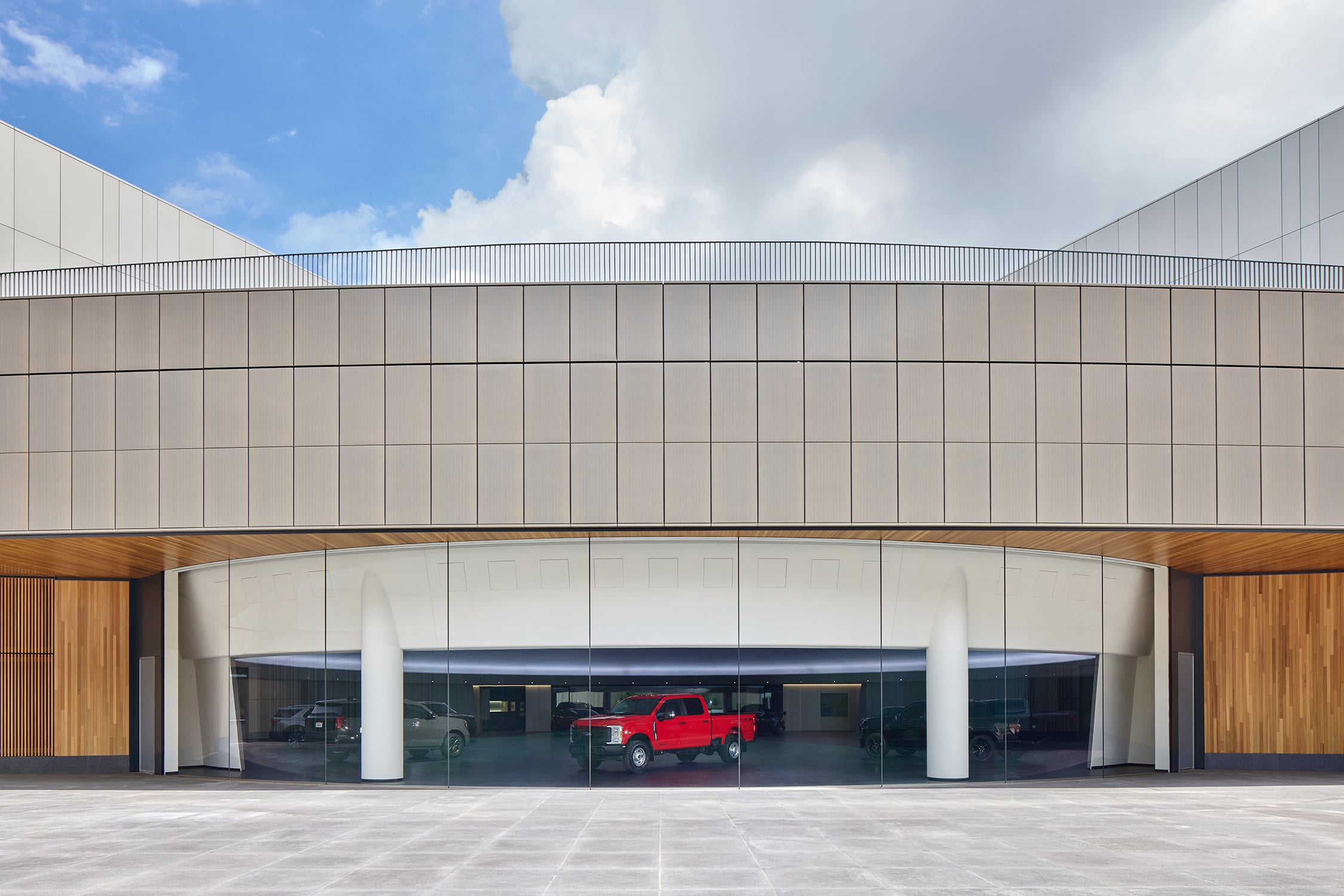
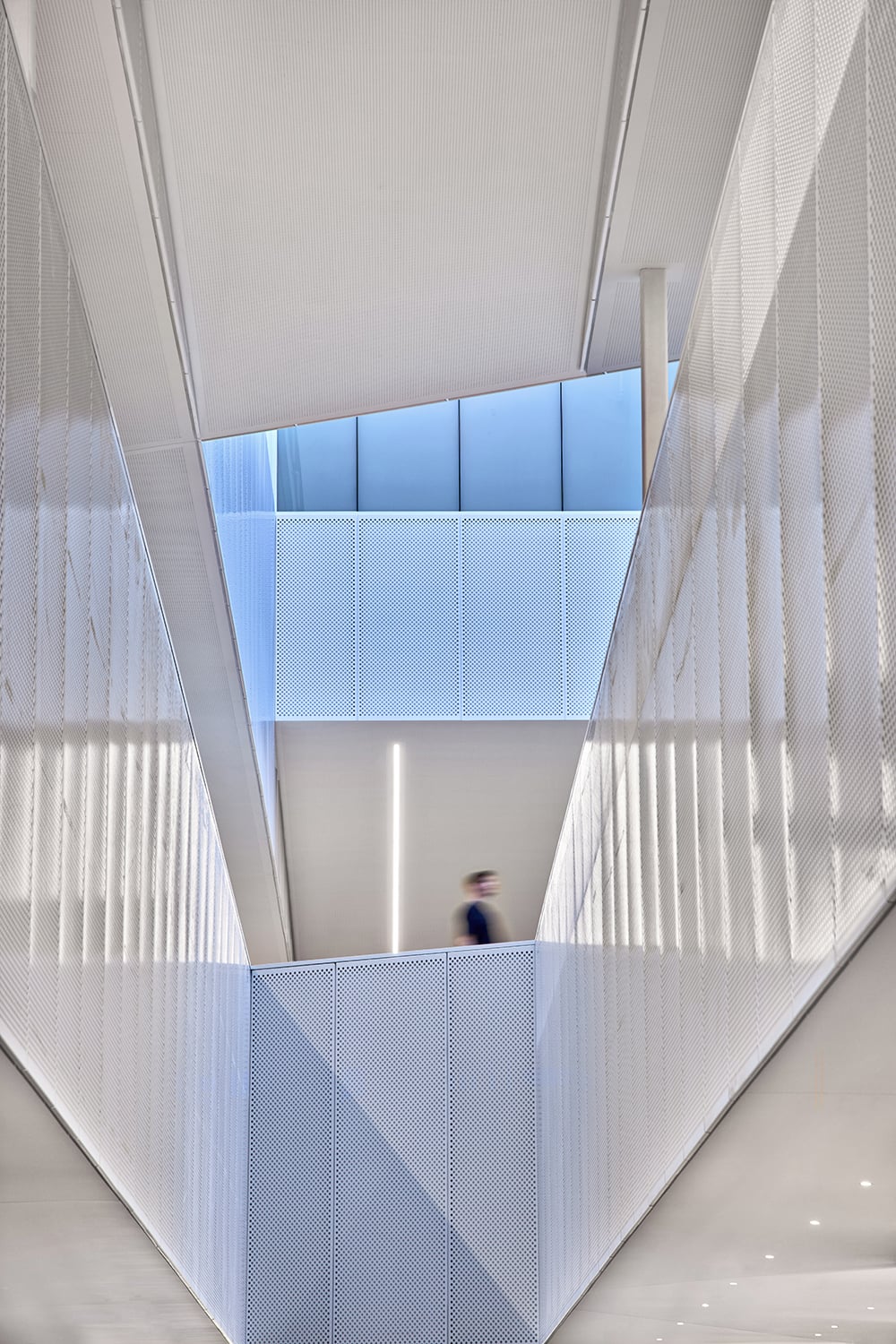
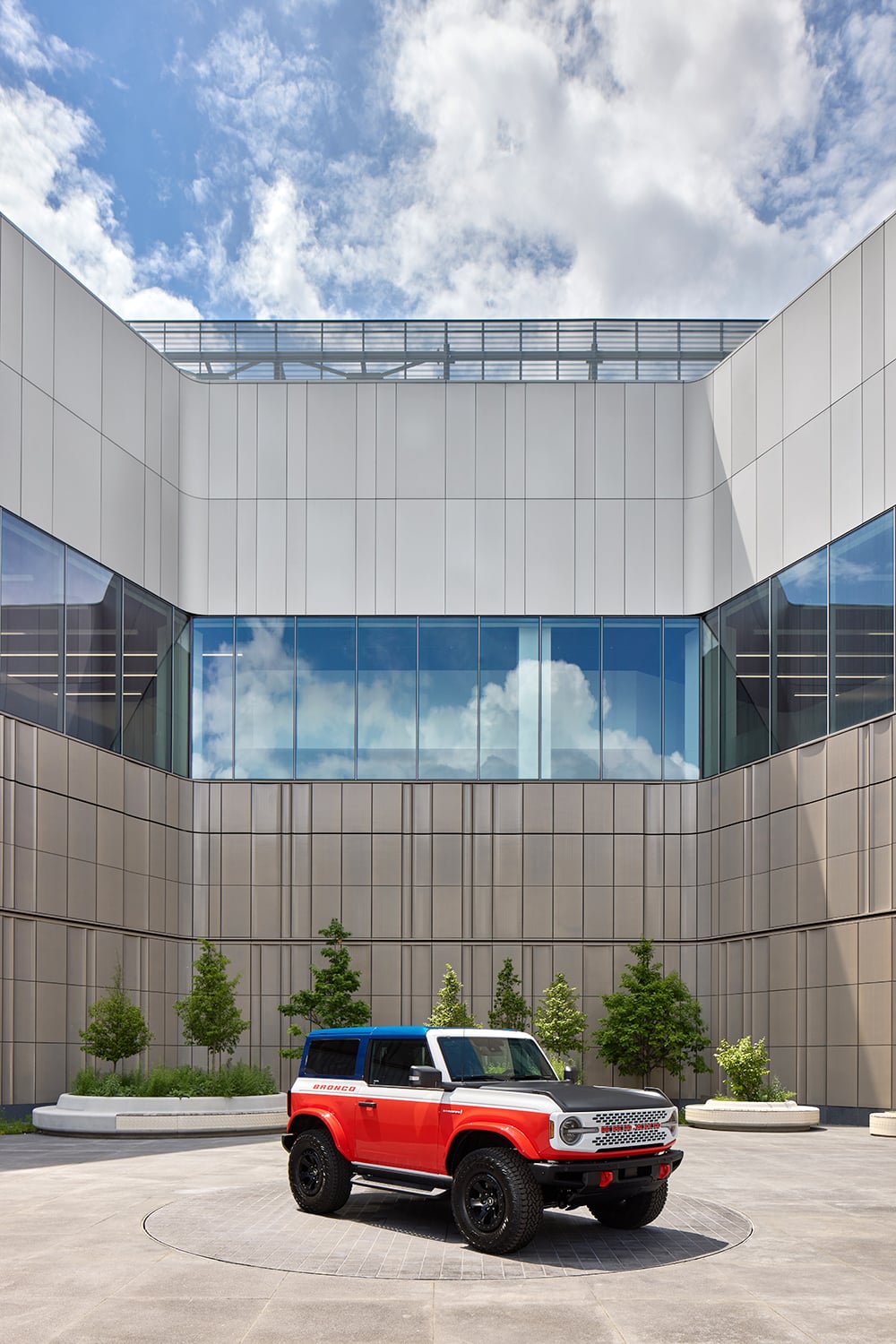
Snøhetta had to balance dueling priorities: natural light for employees and security for products in development. The firm conceived a glass facade broken into layers so it’s more approachable from the street, with swooping curves that express a sense of movement. A frit pattern, derived from vector fields of how air flows over automobiles, provides solar shading. Inside, each of the four levels is slightly different and composed of several linear floor plates with courtyards in between. Skylit atriums further brighten areas deep inside.
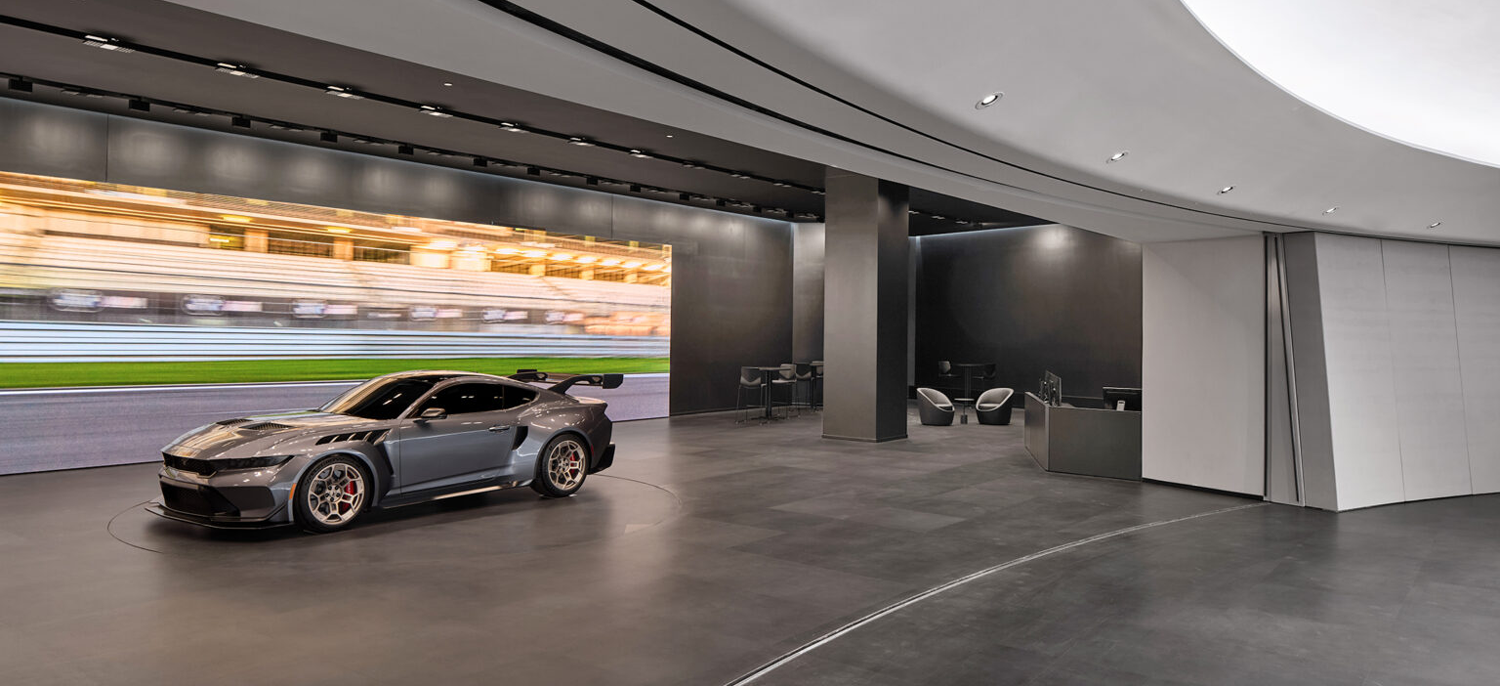
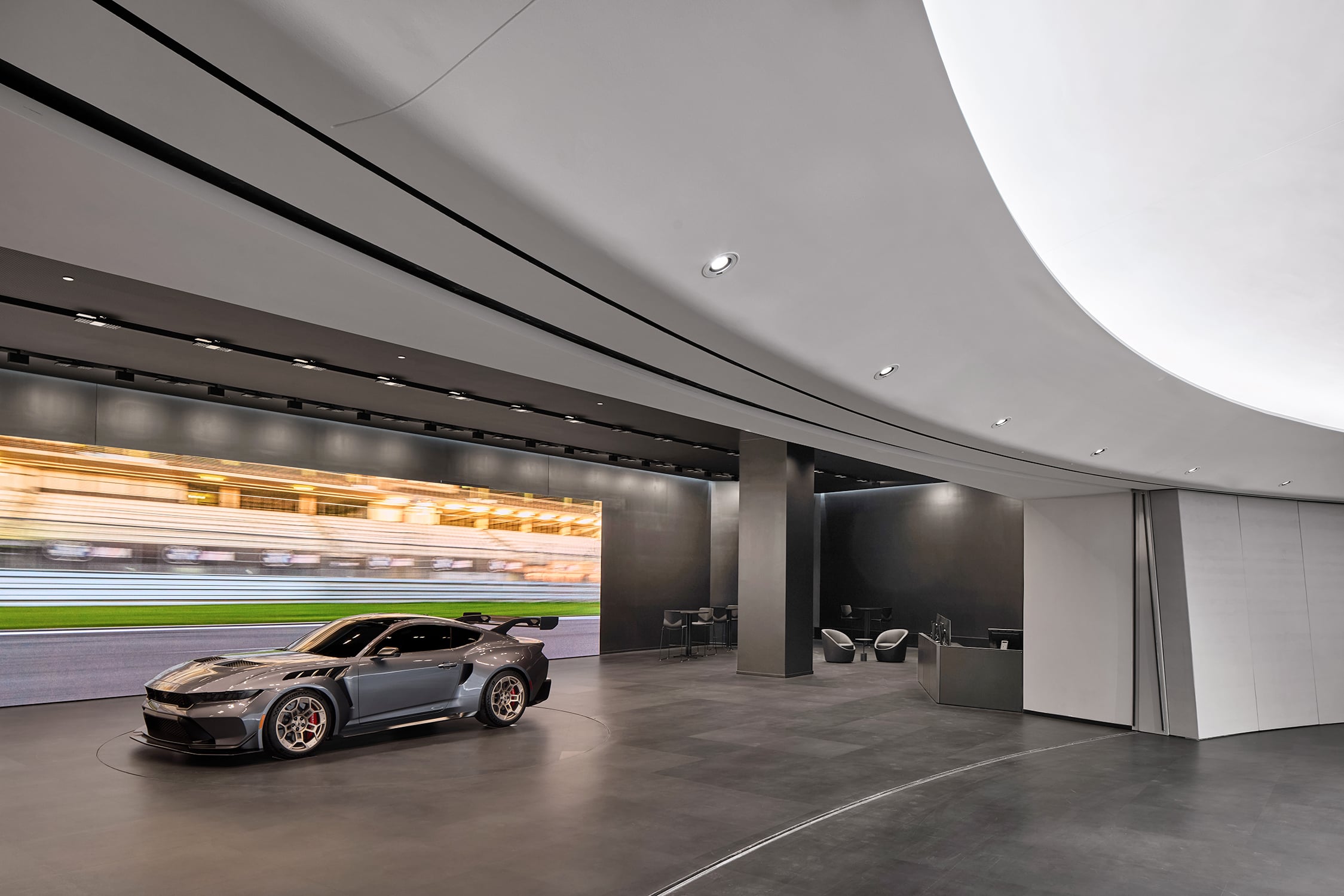
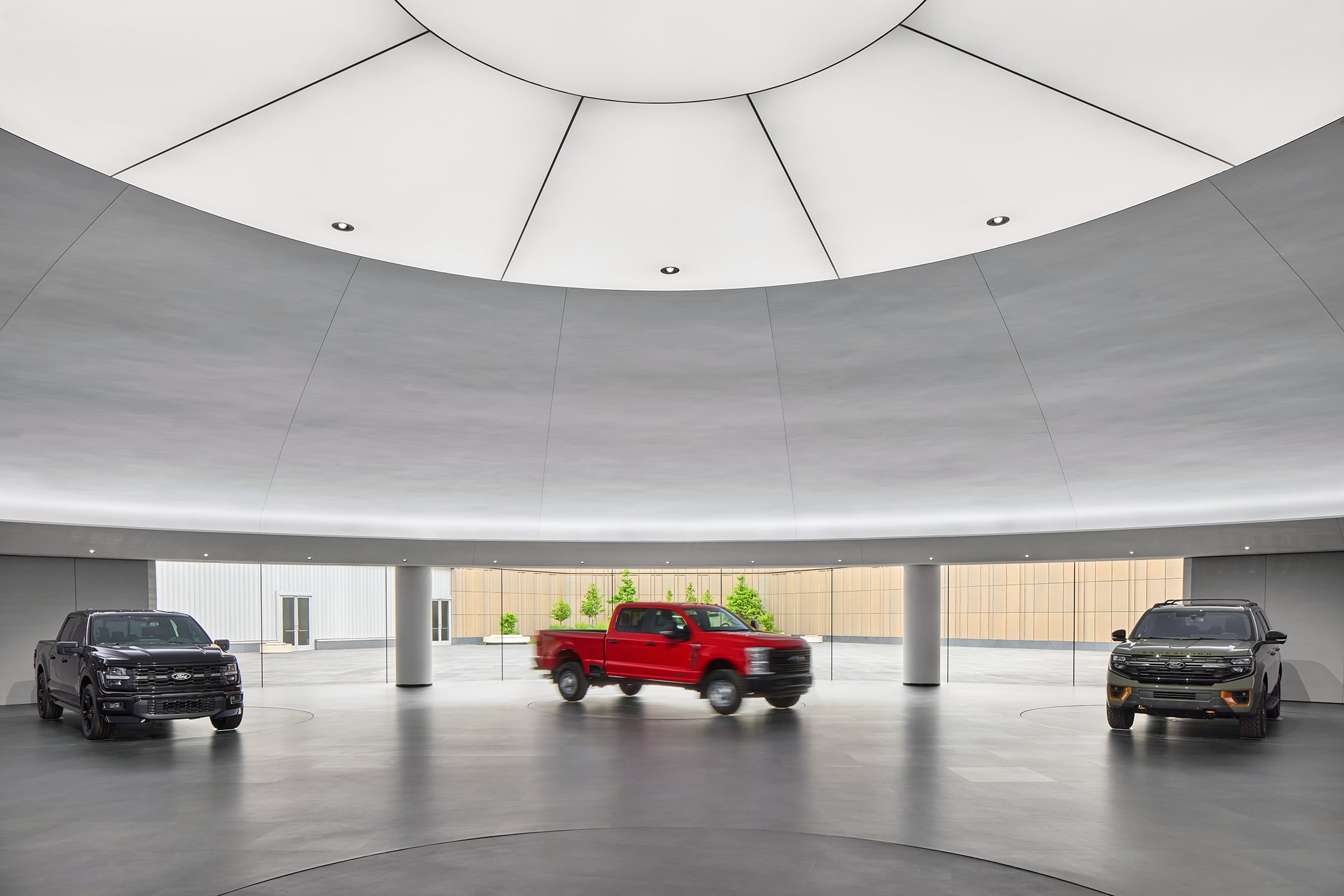
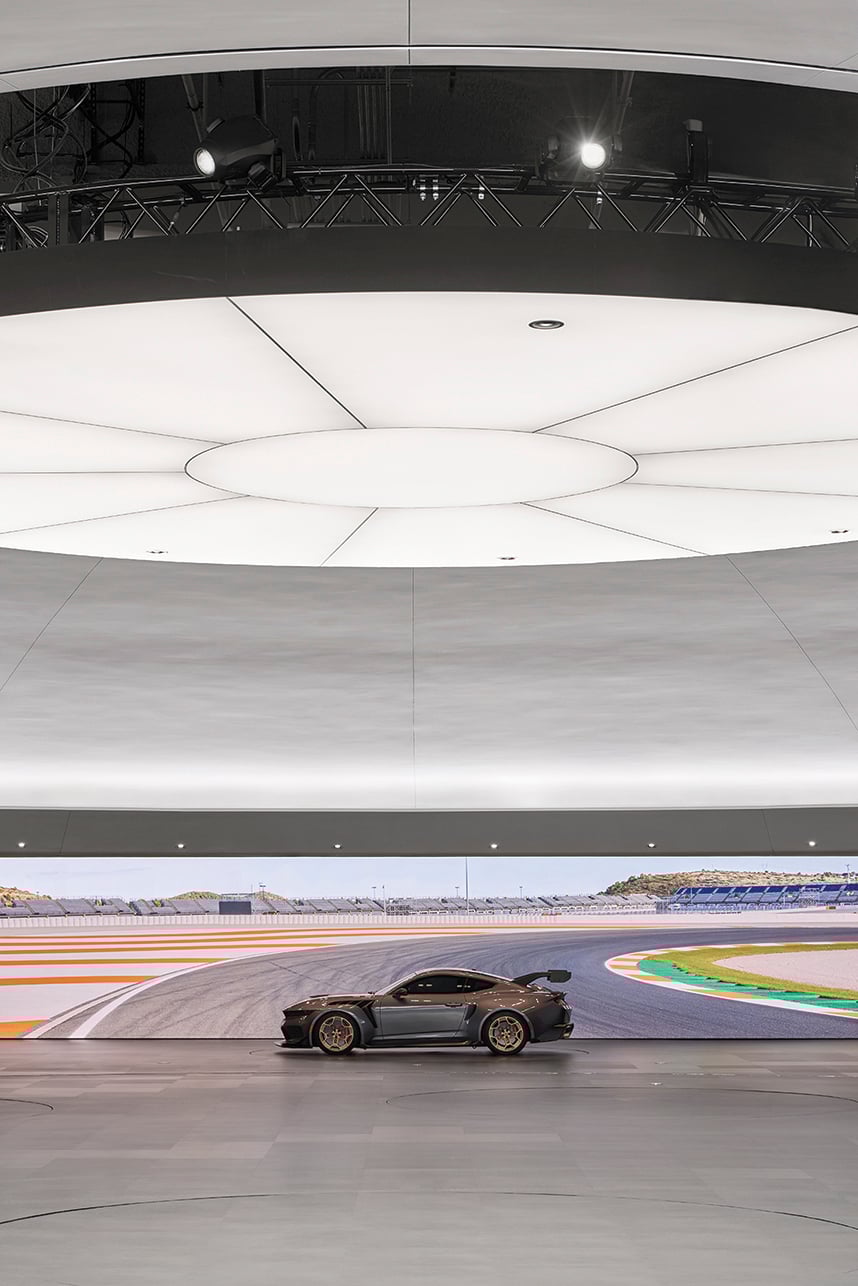
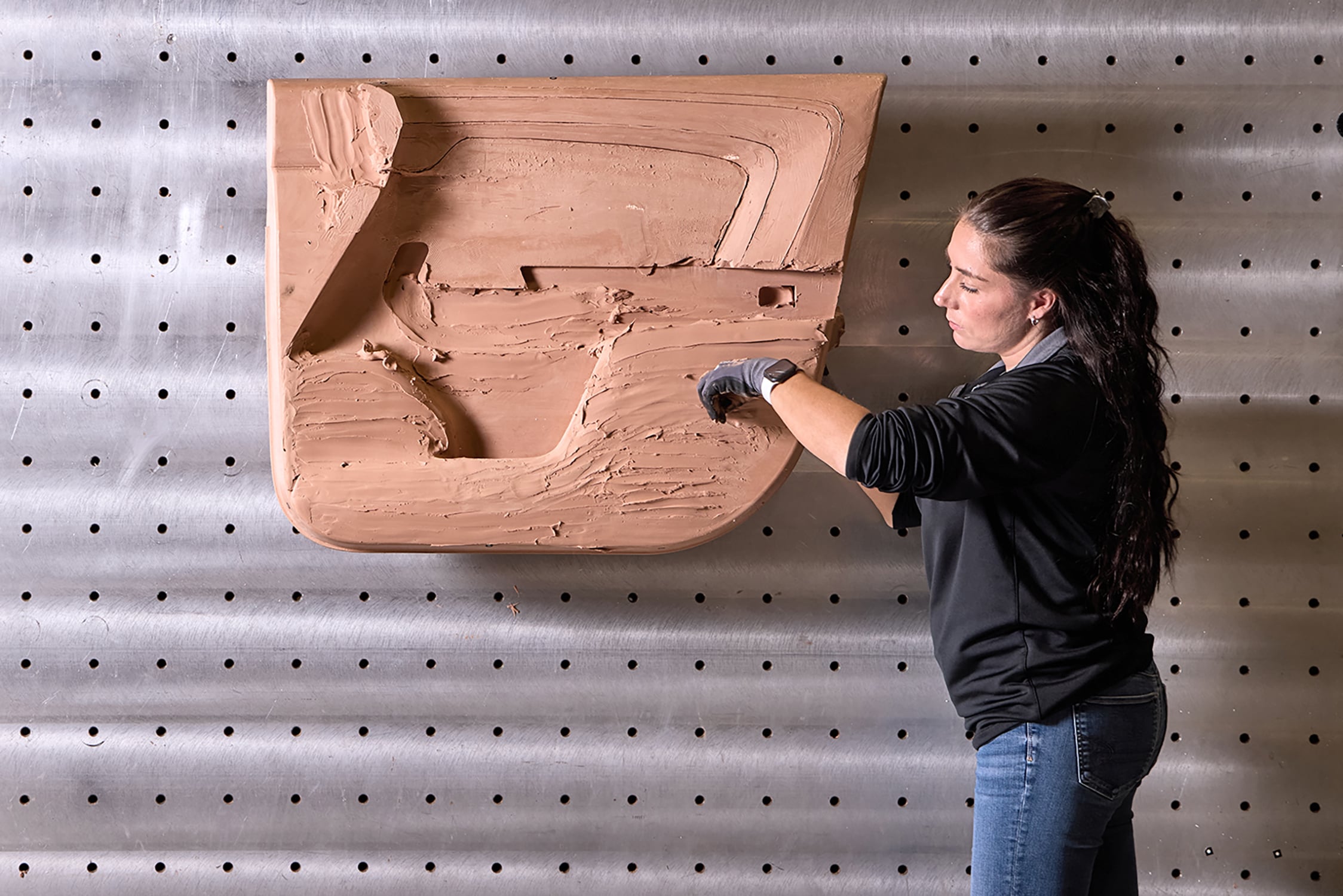
Even with so much glass, many spaces are obscured from public view. The building is organized around the need for visual privacy, with a secure vertical stack of controlled areas. The six design studios are on the top floor, so the average employee can’t peer in, and have windows facing an internal courtyard to thwart snooping drones. Prototypes travel up and down on freight elevators. A designer can sculpt a clay model in a studio and move it directly to the milling shop to construct a hard body. Eventually the concept vehicle goes to an indoor/outdoor showroom on the ground floor, where executives view it on one of 13 precisely lit turntables.
Driving The Future of Automobile Design
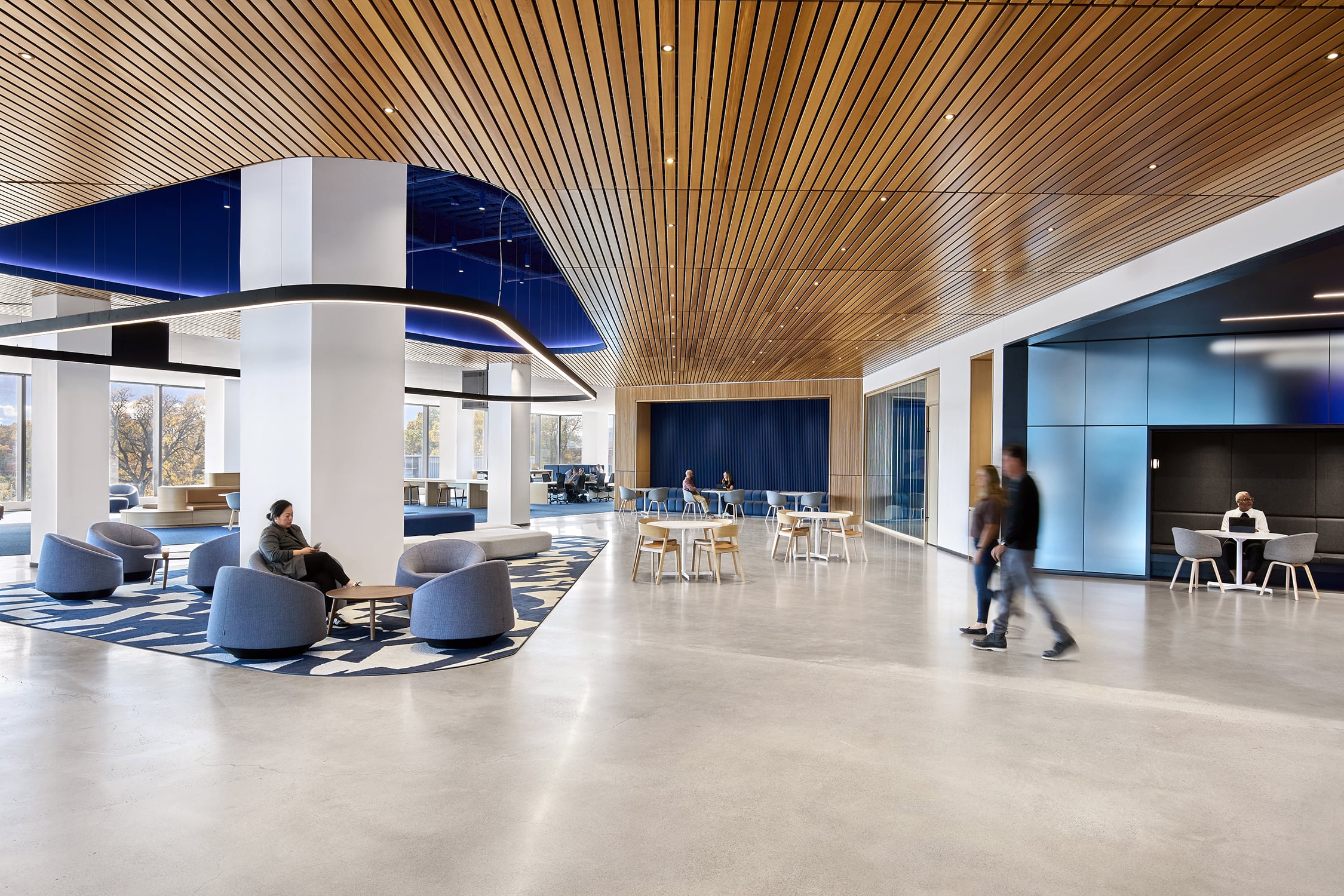
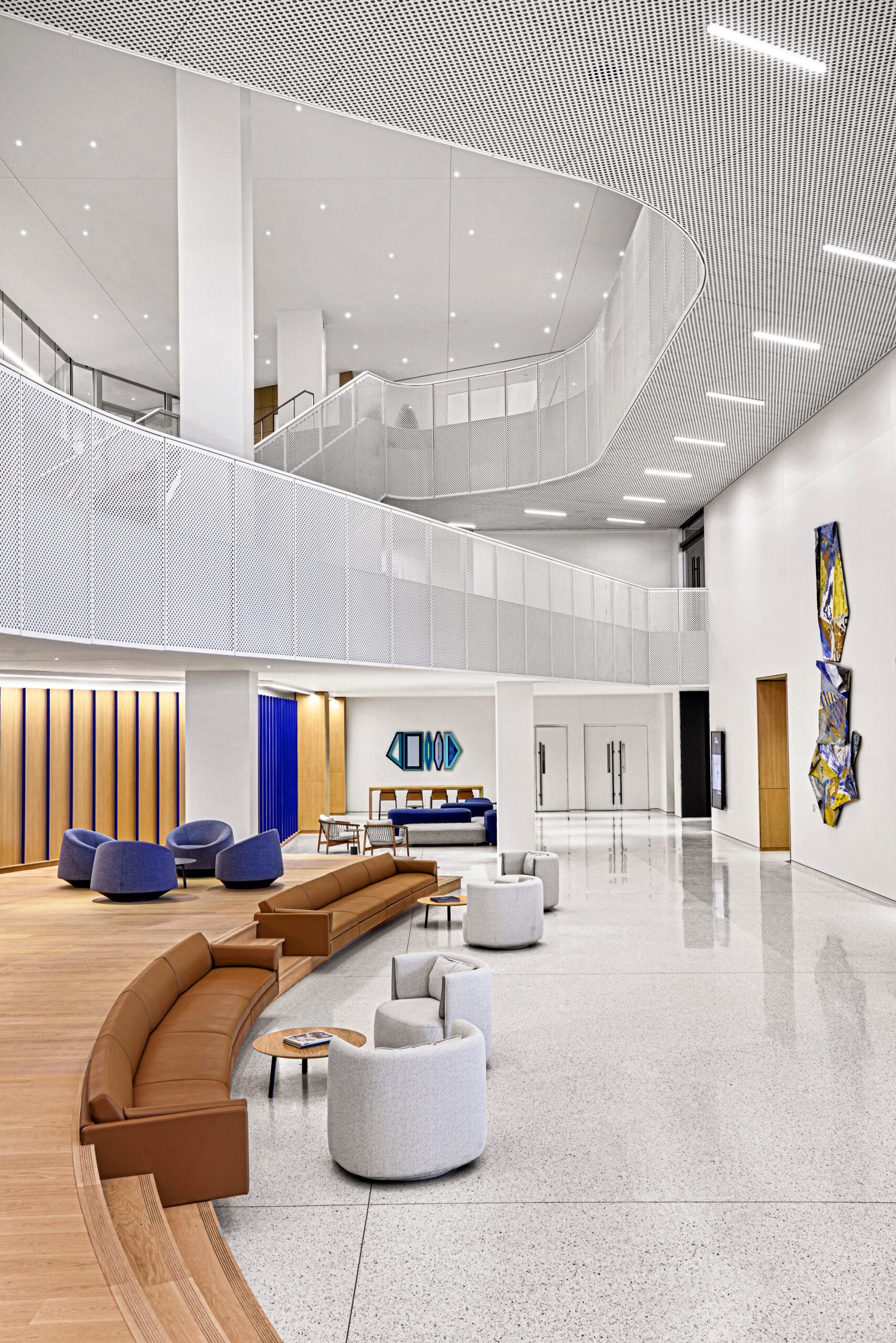
While the engineering and design spaces drove the floor plan, they make up only part of the building. The rest is workplace, which has completely different requirements. Dykers compares it to designing a ballet-opera theater, a Snøhetta specialty. “The opera wants a narrow stage with loud acoustics, and the ballet wants a wide stage with quiet acoustics,” he says. “We have to find a balance between groups that inherently don’t agree.” The three design teams limited the scale of the studios so their floor plates wouldn’t dwarf the offices below and organized the layout into neighborhoods of workstations and meeting rooms. Amenities, including the food hall and a library, line a central corridor on the second floor.
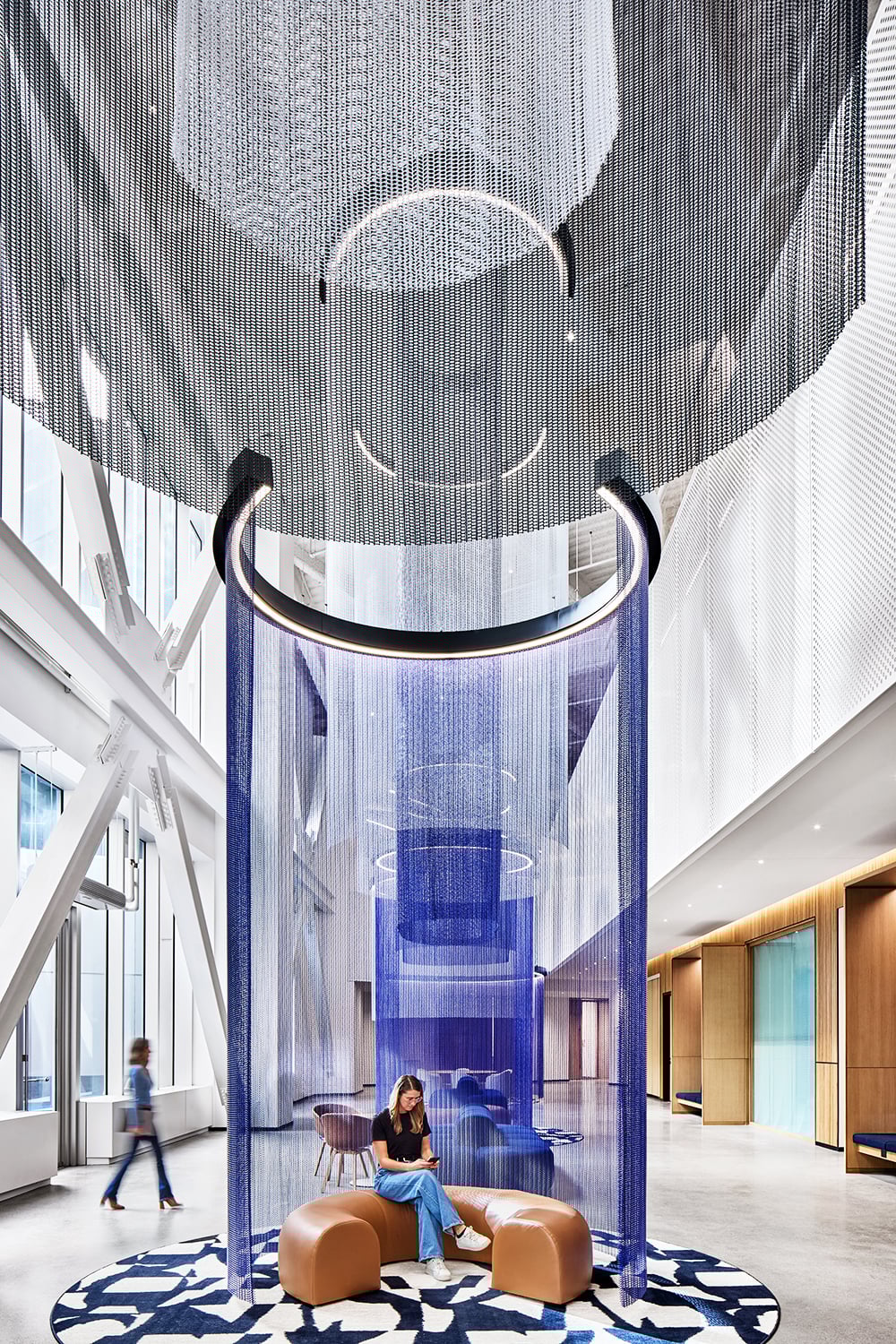
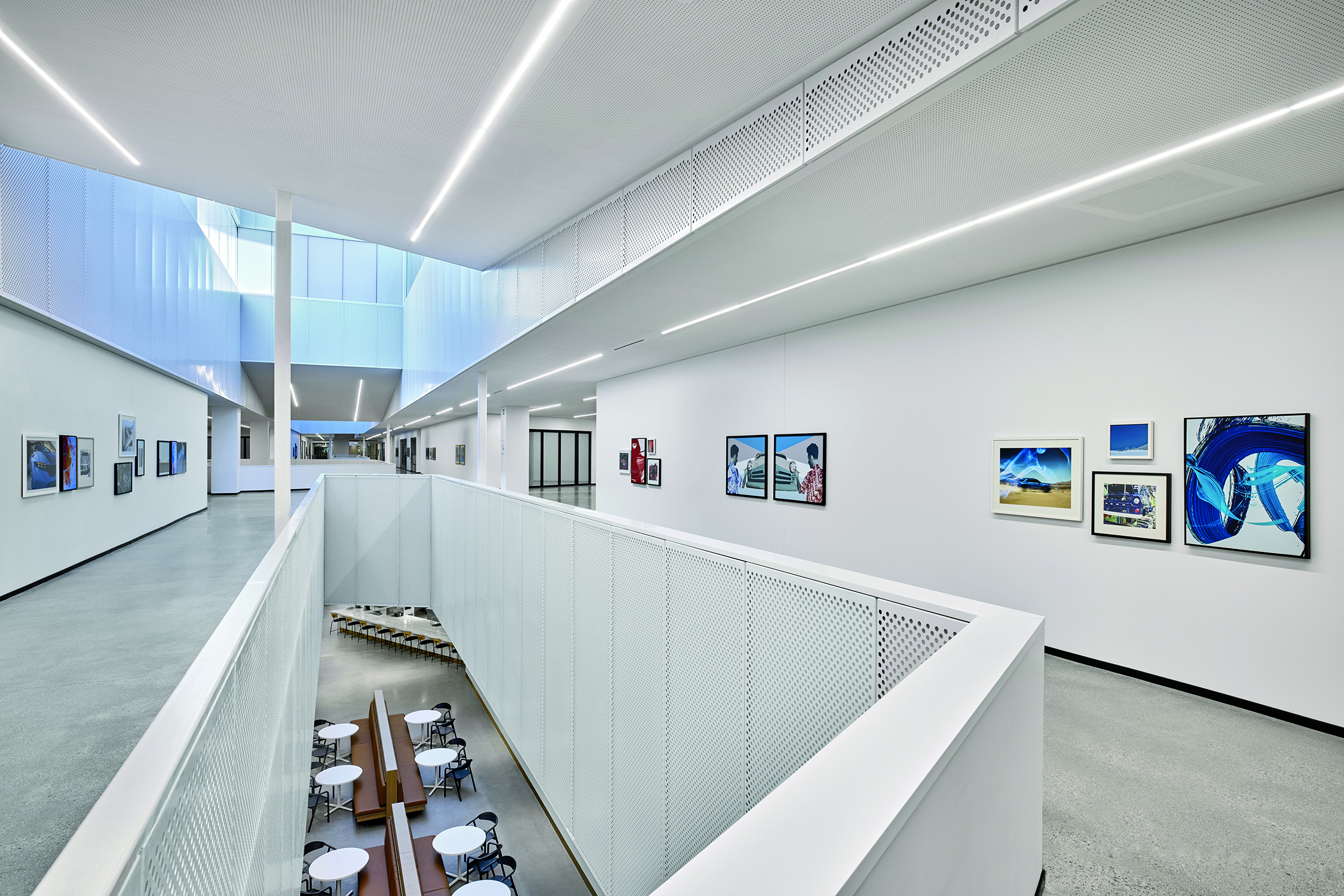
“We had to create bite-size pieces within the larger footprint,” explains Joe Pettipas, principal and global director, interiors, at Arcadis, which led much of the space planning and was the project’s architect of record. The interior could feel overwhelming, with an average slab-to-slab height of 22 feet. “We brought it down with a vertical datum line at 11 feet, a scale that’s familiar and comfortable for humans,” Pettipas continues. Pendant fixtures, wall panels, doors, and storefronts max out at that height. Alcoves and enclosures also help make spaces digestible. In some double-height areas like corridors, for instance, custom wire-mesh curtains, in Ford’s signature twilight blue, move on a rail with integrated lighting; they can be pulled shut to form a semiprivate nook.
Cars, Art, And Craft Collide At This HQ

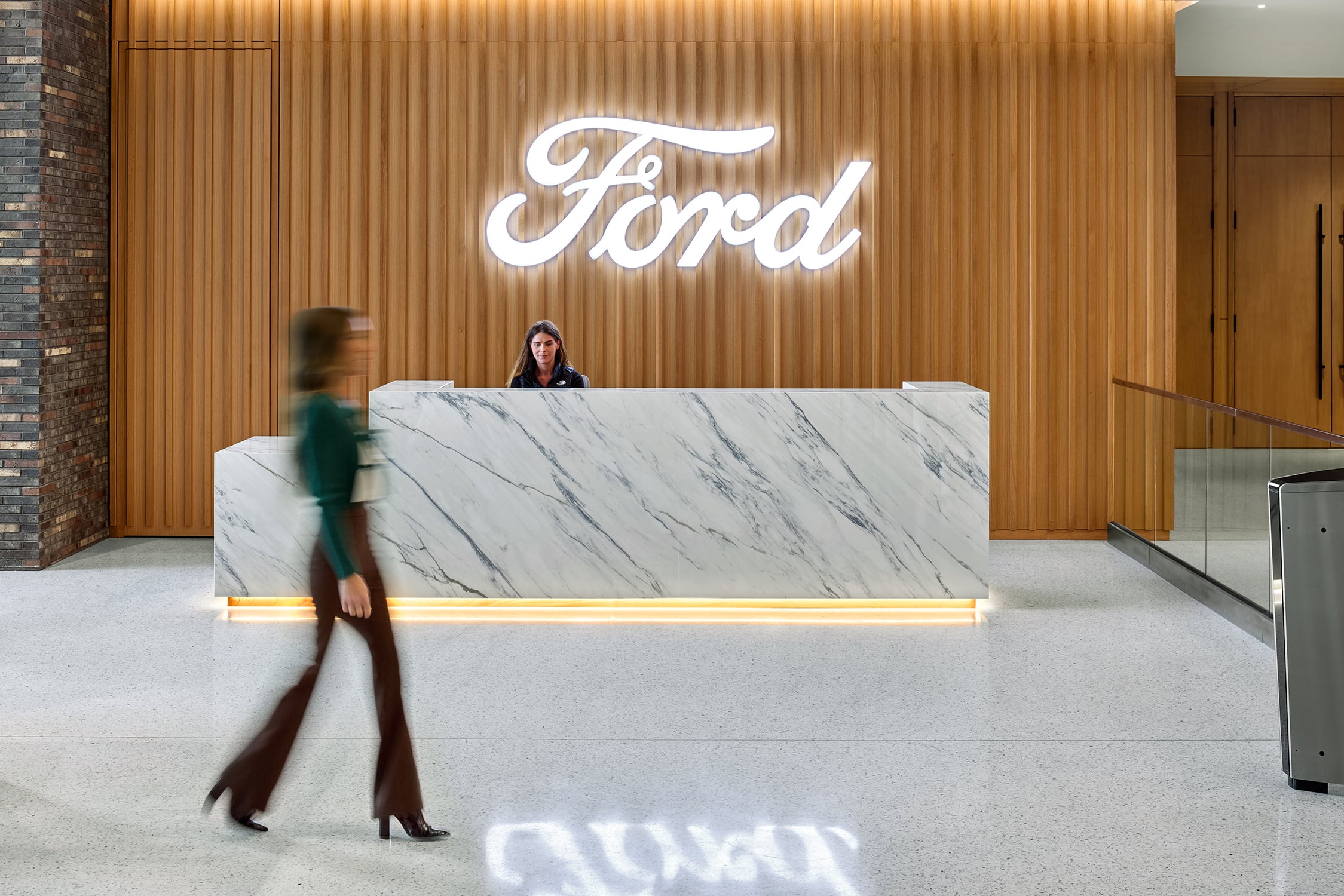
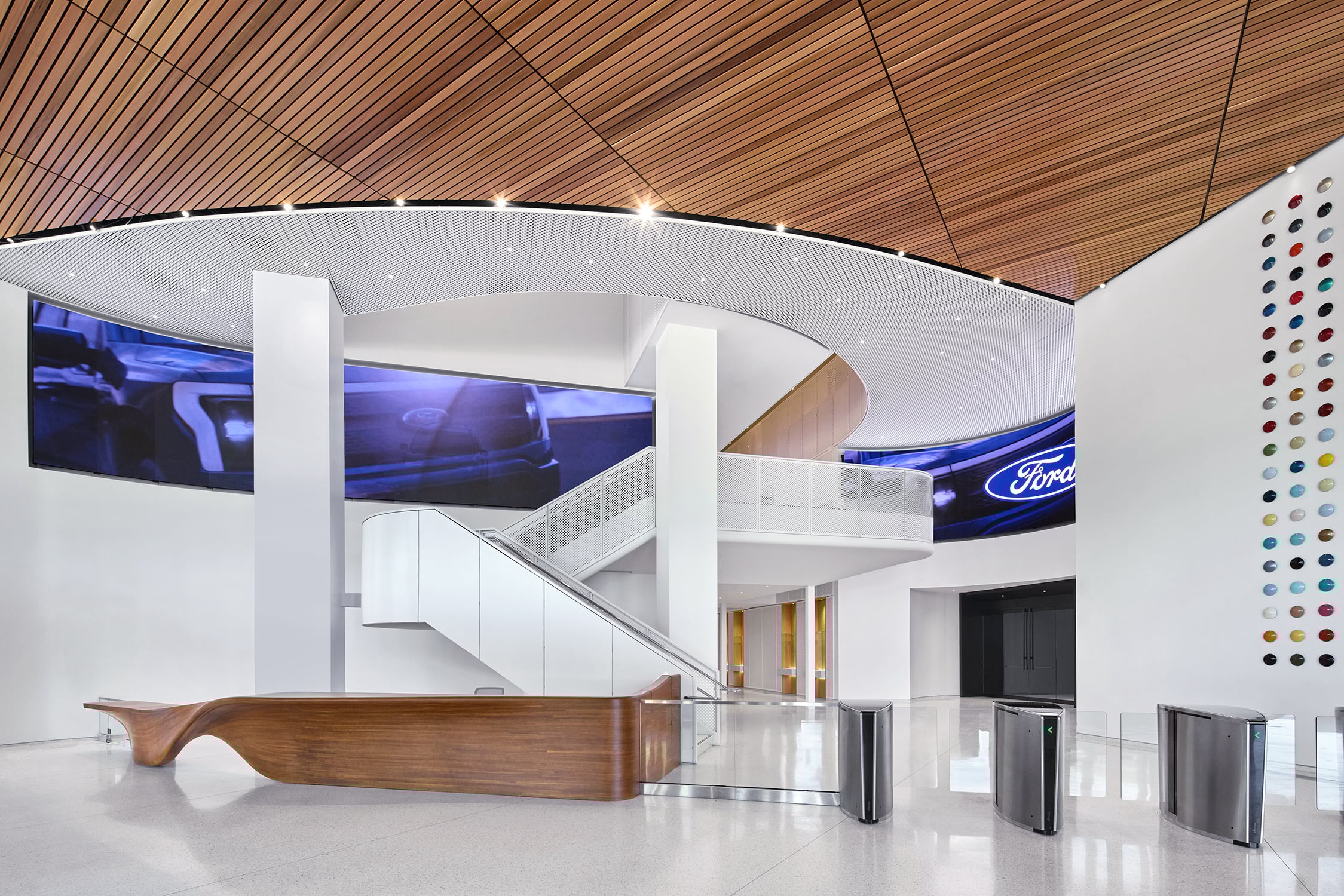
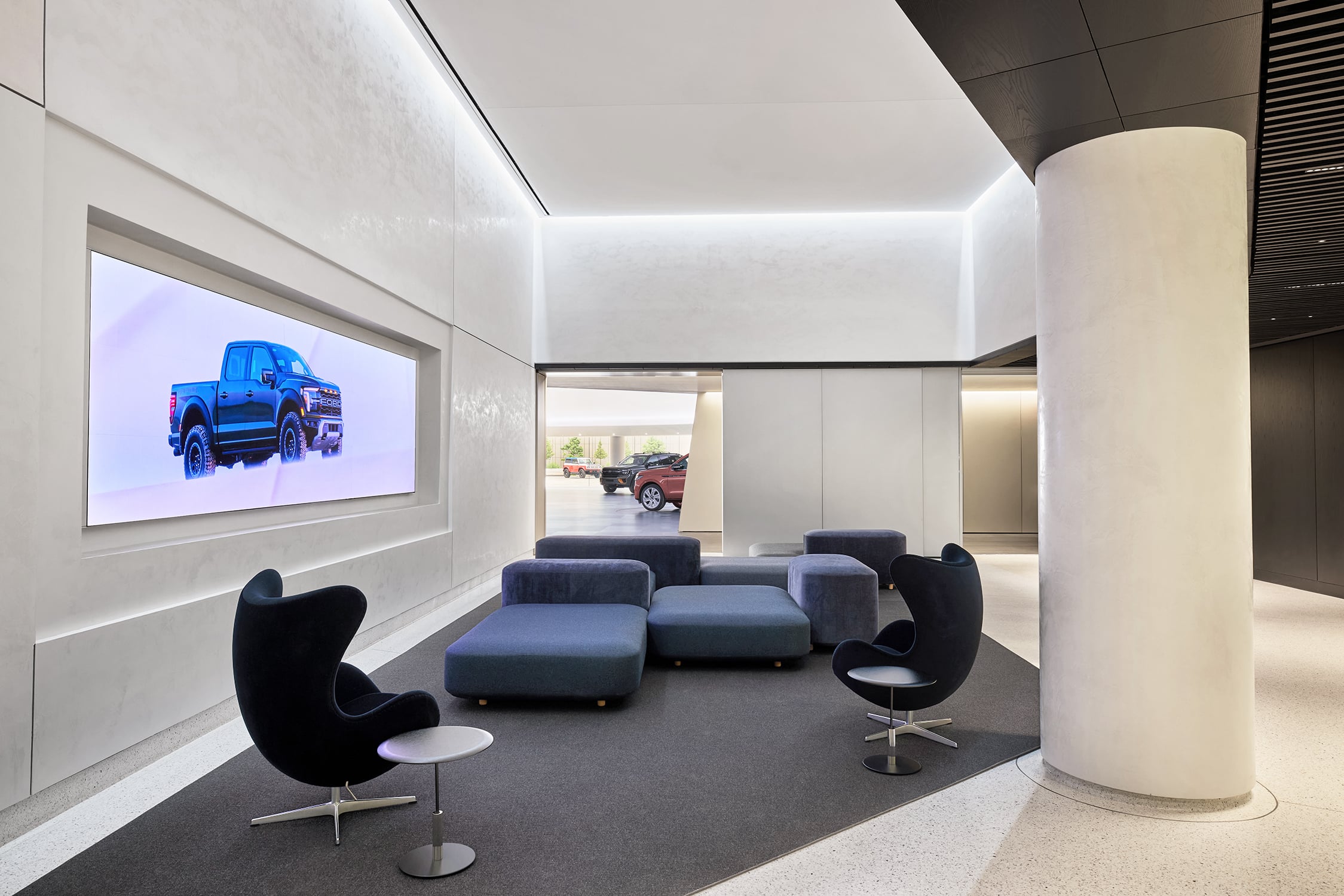
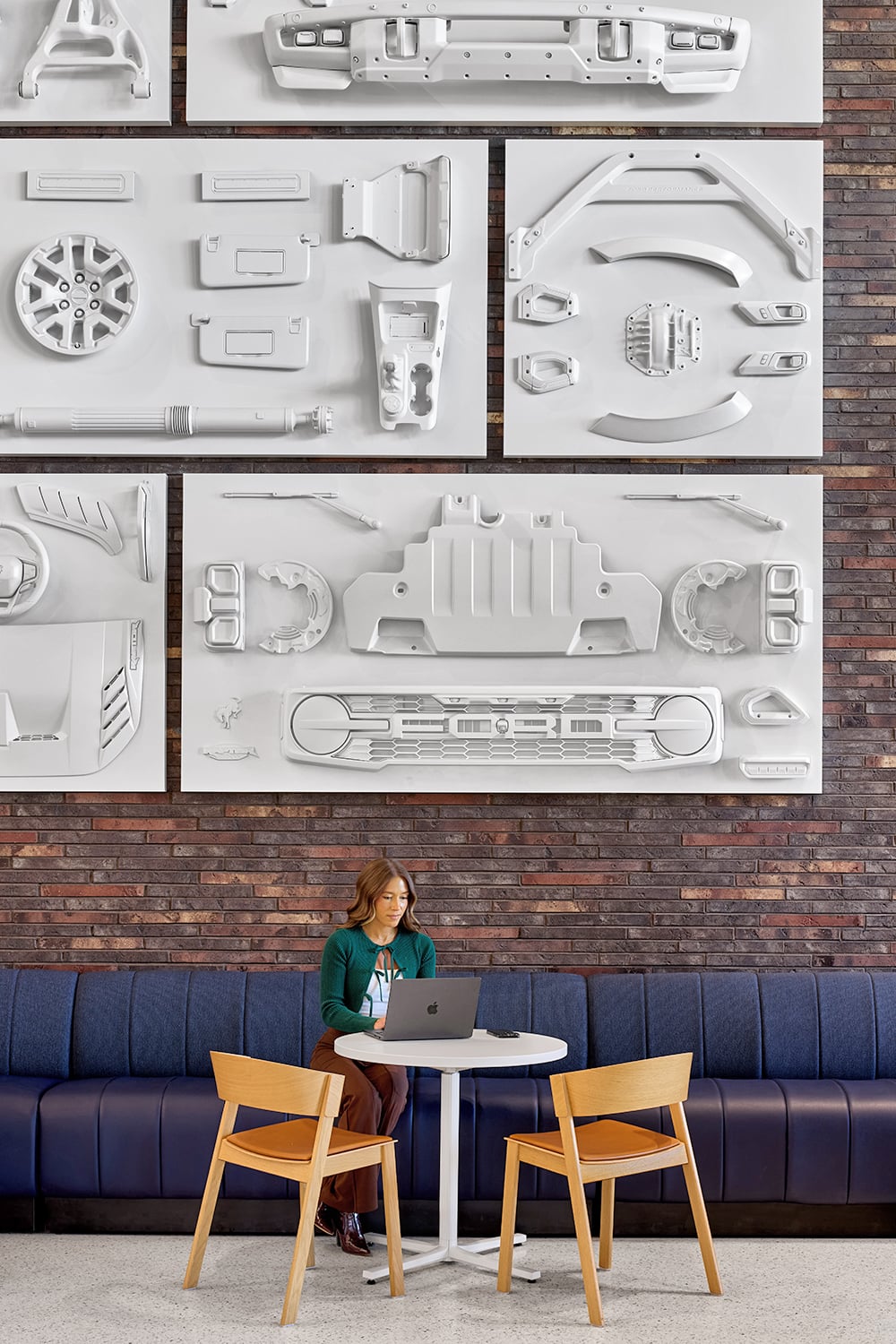
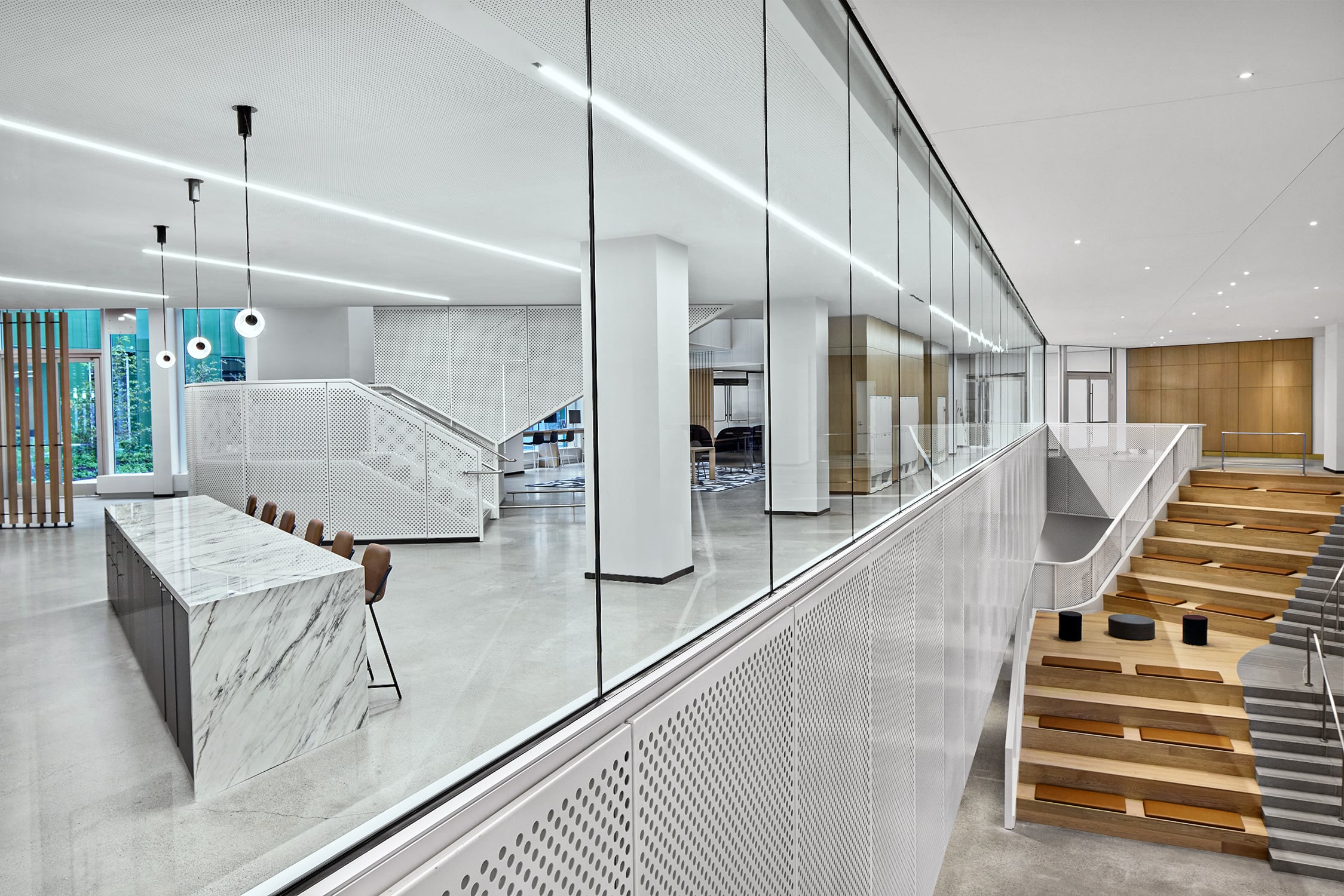
The curtains’ sophisticated yet industrial quality reflects the site’s overall aesthetic, which uses a minimal palette of raw, timeless materials suited to both office and engineering zones. Perforated metal in a creamy white powder coat shows up as a balustrade and wall cladding, while flooring is poured terrazzo in lobbies and polished or pigmented concrete elsewhere. Wood brings warmth throughout, from white-oak tambour panels to Western red cedar slat ceilings, as do swaths of brick and Venetian plaster. “These are museum-quality finishes meant to last,” Kolstad concludes. They ensure that, like Ford’s previous facilities, the headquarters can power the company for a century or more.
Inside Ford’s Reimagined Dearborn Headquarters

Automotive Heritage Meets Contemporary Design

PROJECT TEAM
PROJECT TEAM
ARCADIS: NUNO MOREIRA; MICHAEL MACHNIC; DONNA JOHNSTON; KEVIN PORTER; ALEXANDRA SAMOUK; ERIN MCDERMOTT; VICTORIA ERWIN; SSHIVAM TRIVEDI; CAMERON ELDER. FORD LAND: SEAN CORRIVEAU; DONALD ZVOCH; KRISTY HAAG; ANTHONY DELAROSA; ALEX BULLO; RACHAEL SMITH; ELIZABETH UMERLEY; SANDRA RUTKA; HEATHER MURPHY; ANUJA RAJA; ZACH FUNK. SNØHETTA: MICHELLE DELK; NATHAN MCRAE; SAM BRISSETTE; JOHN NEWMAN; JEFF CHEUNG; ALEX CORNELIUS; JOSH DANNENBERG; LILLIE LIU; NICK KOSTER. FARMBOY FINE ARTS; SPECIAL PROJECTS: ART CONSULTANTS. ENTRO: GRAPHICS AND BRANDING. ARUP: LIGHTING, ACOUSTICAL ENGINEER. GHAFARI: MEP. PETER BASSO ASSOCIATES: EXTERIOR LIGHTING. BEAUBOIS GROUP: MILLWORK. EVENTSCAPE: CUSTOM ARCHITECTURAL FABRICATOR. JIFFY SIGNAGE: SIGNAGE. BARTON MALOW: GENERAL CONTRACTOR.
PRODUCT SOURCES
PRODUCT SOURCES
FROM FRONT BERNHARDT DESIGN: CHAIRS (SHOWROOM). MOHAWK GROUP: FLOOR TILE. ARMSTRONG: CUSTOM WALL PANELS, COVE CEILING PANELS. GANAS: CUSTOM RECEPTION DESKS (LOBBIES). COSENTINO: DESK SOLID SURFACING (EMPLOYEE LOBBY). HERMAN MILLER: CHAIR (DESIGN STUDIO). ARKTURA: PERFORATED METAL PANEL CEILING (PUBLIC LOBBY). FRITZ HANSEN: CHAIRS (SHOWROOM LOBBY). MAHARAM: RUG. STUDIO ÄIX: VENETIAN PLASTER WALLS. ASWA ACOUSTIC: PLASTER CEILING. VICCARBE: BENCHES (SHOWROOM LOBBY, EMPLOYEE LOBBY). TACCHINI: SWIVEL CHAIRS (TECH LOUNGE). BUZZISPACE: BENCH (HALL). BANKER: CUSTOM MESH CURTAIN. MUUTO: CHAIRS (EMPLOYEE LOBBY LOUNGE). NATIONAL: MODULAR BENCHES. M.A.D. FURNITURE DESIGN: STOOLS (EMPLOYEE LOBBY, WORKSPACE). ANDREU WORLD: TABLE (EMPLOYEE LOBBY). SIXINCH: TABLES (COURTYARD). MAGIS: CHAIRS. MADERA: STAIR ENGINEERED WOOD (WORKSPACE). BLUDOT: OTTOMANS. THROUGHOUT ASI ARCHITECTURAL: SLAT CEILINGS. SHAW: CUSTOM RUGS. SURFACING SOLUTIONS: TAMBOUR PANELS. FALKBUILT DETROIT: DEMOUNTABLE PARTITION SYSTEMS. INTERSTATE BRICK: BRICK. SYNERGI: CUSTOM PERFORATED METAL GUARDRAILS, PANELING. HARMON; INTERPANE GLAZING: CUSTOM CURTAIN WALL. SEDAK: CUSTOM CURVED GLASS. ADVANCED ARCHITECTURAL STONE: CUSTOM EXTERIOR COLUMN COVERS. MICHIELUTTI BROS.: CUSTOM TERRAZZO. SHERWIN-WILLIAMS COMPANY: PAINT.
read more

Projects
Art Nouveau And The Vienna Secession Reinterpreted
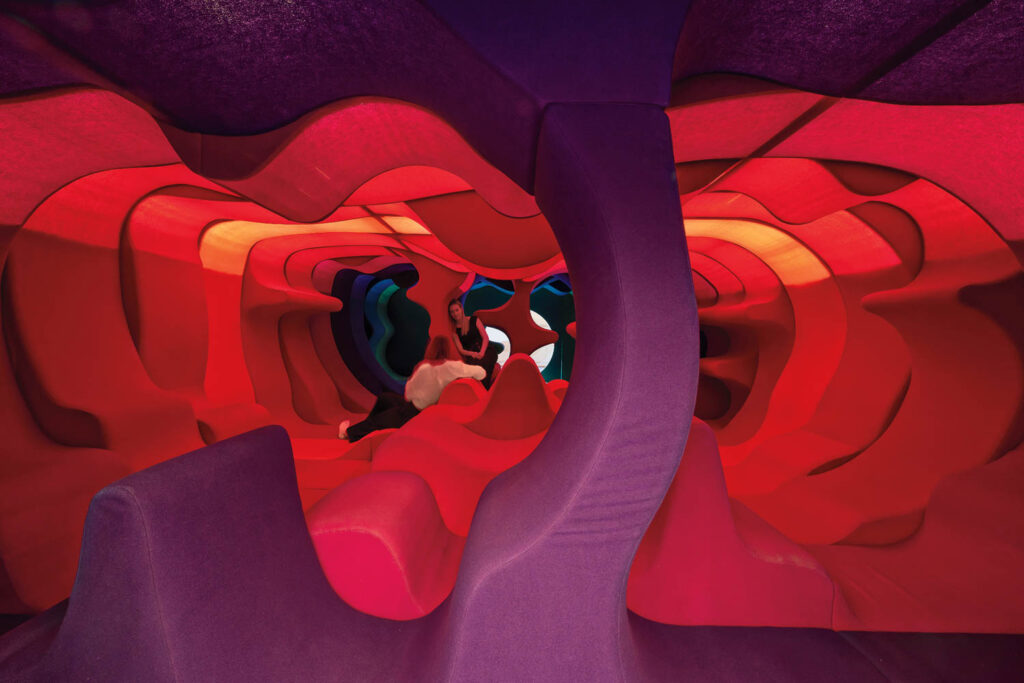
In a Vienna apartment, Yana Molodykh channels the spirit of the Vienna Secession through sweeping curves, bespoke details, and artful touches.
Projects
5 Must-See Exhibitions Revisit Icons Who Bridged Art And Design
Recent exhibitions from Milan to New York to Porto, Portugal, honor influential 20th-century creatives whose output merged art and design to spark broader cultural shifts.