
From Industrial Warehouses To Biotech Hub: The Transformation Of Kilroy Oyster Point
Not long ago, Oyster Point in South San Franscisco, California, was an overlooked industrial swath of concrete warehouses, its main attractions being an old marina and a fishing pier on San Franscisco Bay. But in 2018, Kilroy Realty began redeveloping the 50-acre site as Kilroy Oyster Point, a biotech and life-sciences hub, with six ground-up office and lab buildings opening in two stages, plus a spruced-up waterfront trail. For phase two, Kilroy tapped Rapt Studio for a suite of amenities that would attract blue-chip tenants: two building lobbies, fitness and conference centers, and a food hall, totaling 48,400 square feet. But the brief went beyond the spaces themselves. “The client was passionate about revitalizing the whole property, not just the building footprints,” Rapt creative director and head of design innovation August Petersen begins. “The question was, How do you shape the experience of inhabiting the campus?”
Interested in learning more about Interior Design’s 2026 Giants of Design? Check out our reports for Top 100 Giants, Rising Giants, Hospitality Giants, Healthcare Giants, and Sustainability Giants.
Petersen and Rapt CEO and CCO David Galullo, an Interior Design Hall of Fame member, had to create a sense of place for what could otherwise be a generic office park. That’s something of a specialty for Rapt, which ranks number 92 among Interior Design’s 100 Giants; its ethos is to use design to foster feelings of belonging and community. The studio started by devising a narrative rooted in the rugged coastal landscape that would unite the various areas into a cohesive whole.
“We hoped to meaningfully link the interior and exterior public spaces,” Galullo says. The team was essentially planning the campus quad, the land between the lab buildings, which are by California architecture firm DGA. They had to situate two freestanding structures, the food hall and the conference center, and make them stand out amid the labs’ canyon of glass. “Fluidity was a prevalent theme for Kilroy. Since the surrounding buildings are square, everything between them should be organic and flow together,” Petersen adds.
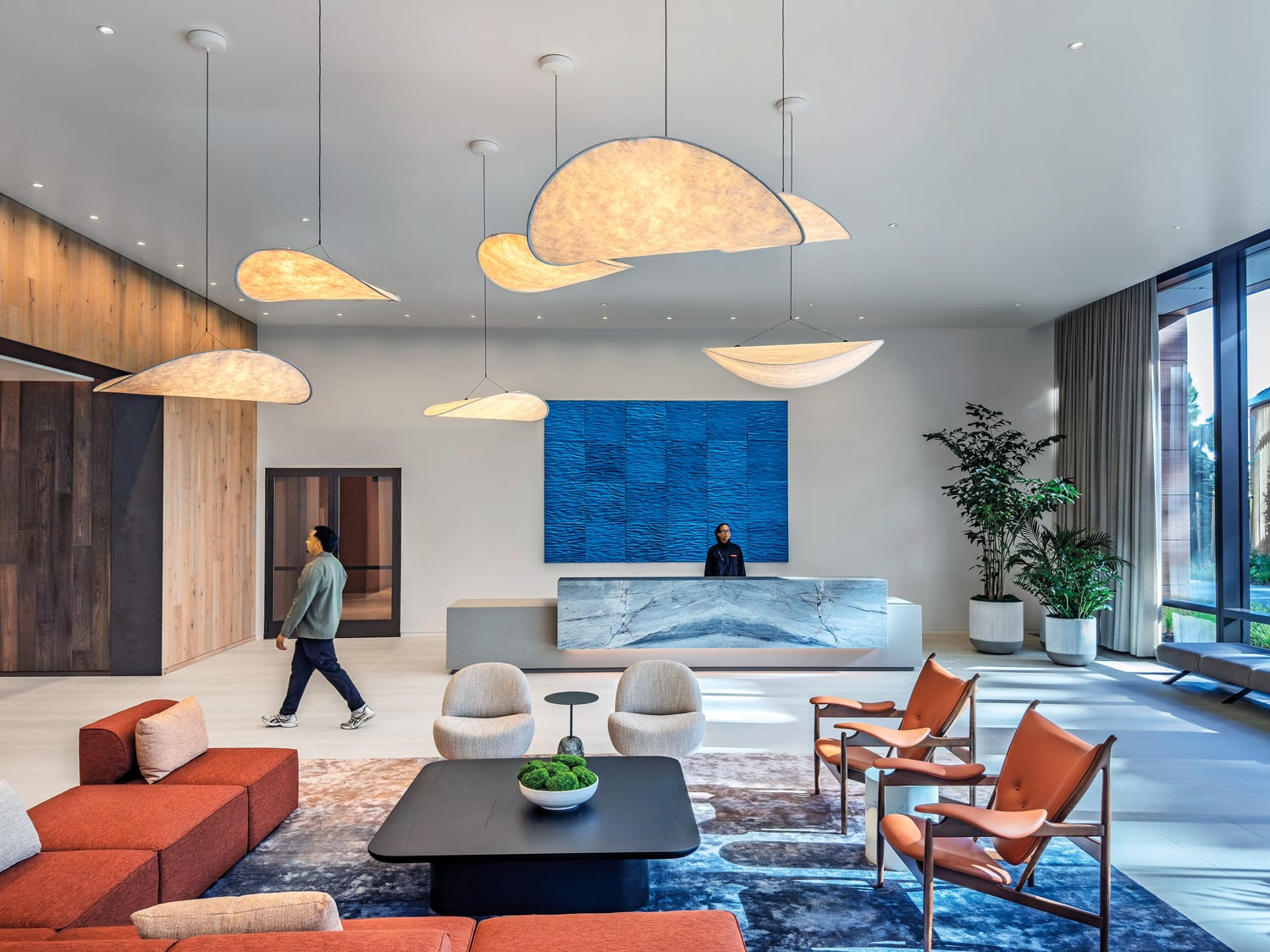
In one of two reception lobbies by Rapt, Tense pendant fixtures by New Works float above Finn Juhl’s Chieftain chairs, backdropped by a desk clad in Ijen Blue quartzite and an Alex Weinstein work in fiberglass, automotive paint, and aluminum. 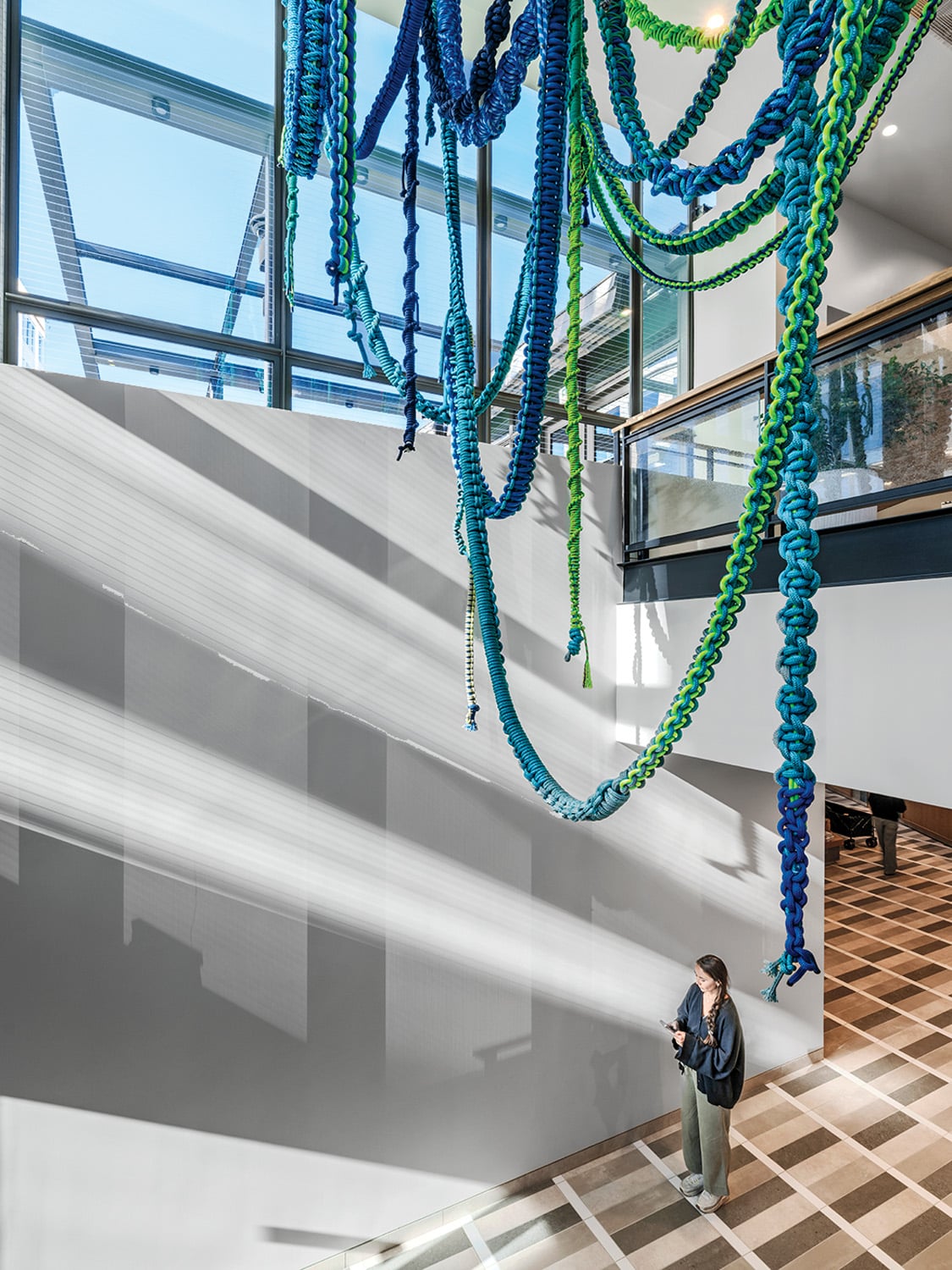
Pacific Eel Grass, an installation of yachting rope by macramé artist Jim Olarte, hangs above an entrance to the Farewinds food hall. 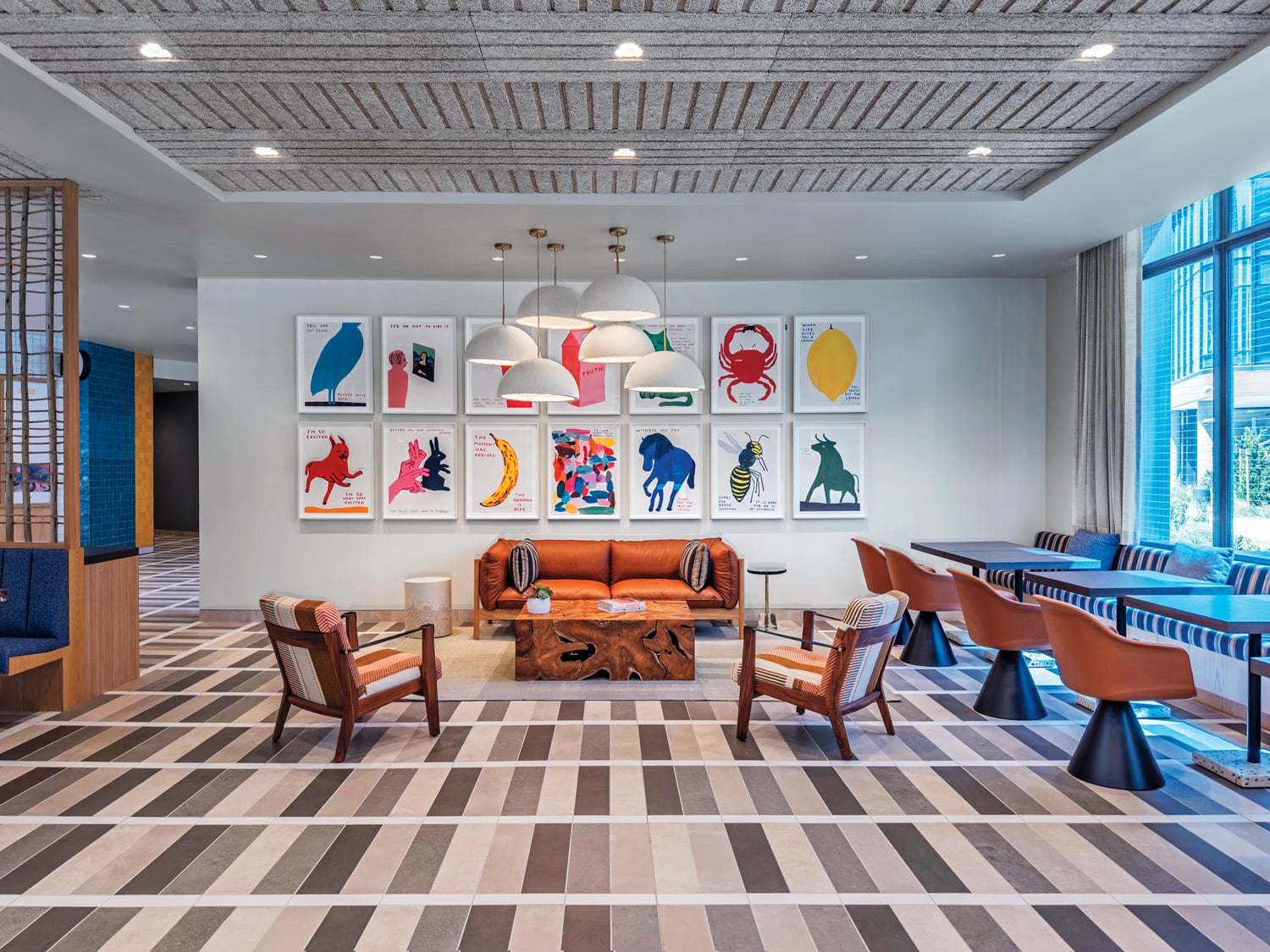
Gathered beneath Danielle Trofe’s mycelium MushLume pendants in a Farewinds lounge are Capo lounge chairs by Neri & Hu, Andreas Engesvik and Daniel Rybakken’s Arbour sofa, Mario Ferrarini’s Lyz chairs, and custom porcelain floor tile. 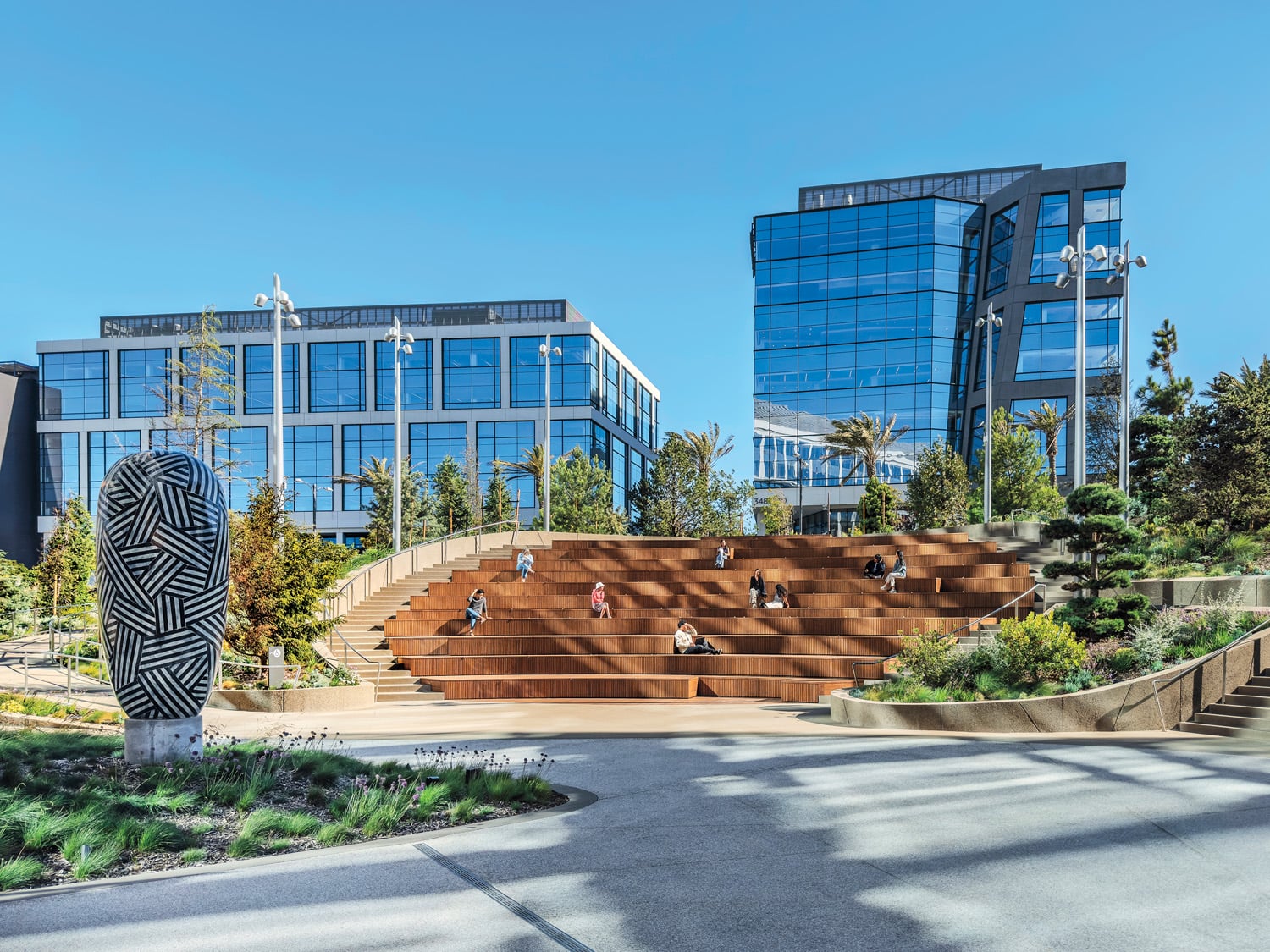
Overlooked by the site’s second Kaneko sculpture, an amphitheater with fused-bamboo decking near the food hall is by James Corner Field Operations and the glass lab buildings around it are by DGA.
Leaning into the location, Rapt conceived architecture and interiors that draw on the ecology and geology of Northern California. The food hall, dubbed Farewinds, became the focus, making it the nexus for everyone on campus, housing serveries, a grab-and-go market, lounges, and a private dining room. But first its massing had to be wrestled with. Petersen and Rapt explored shed roofs and coral shapes before landing on a rock-inspired, concrete-clad structure, its double-height window walls like jagged faces on a geode. A triangular atrium is at its heart, filled with lush vegetation that helps blur the line between indoors and out. The ground floor hosts food stalls and dining areas; upstairs is a mezzanine with a terrace and bar. Natural light streams in from multiple angles.
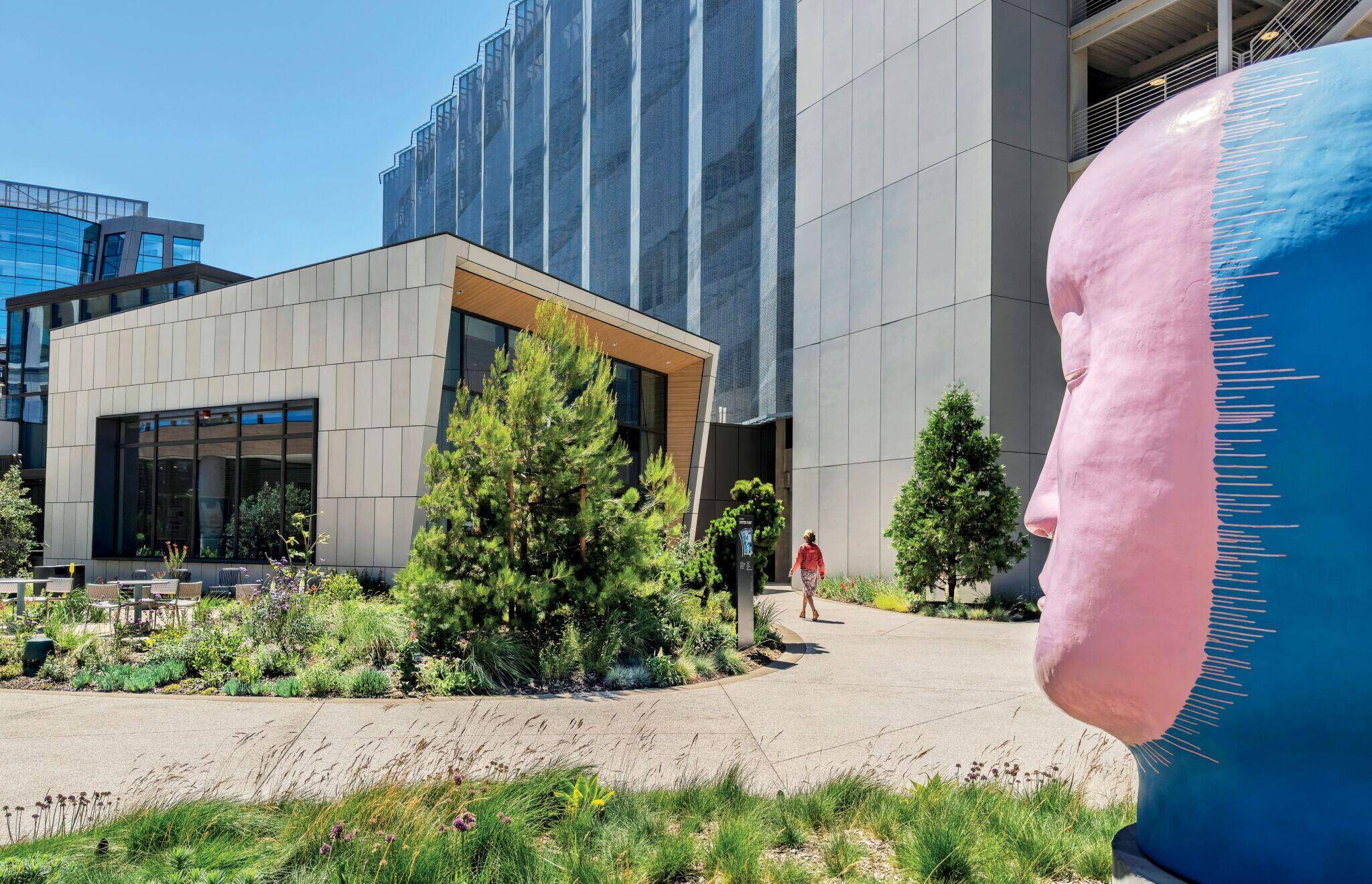
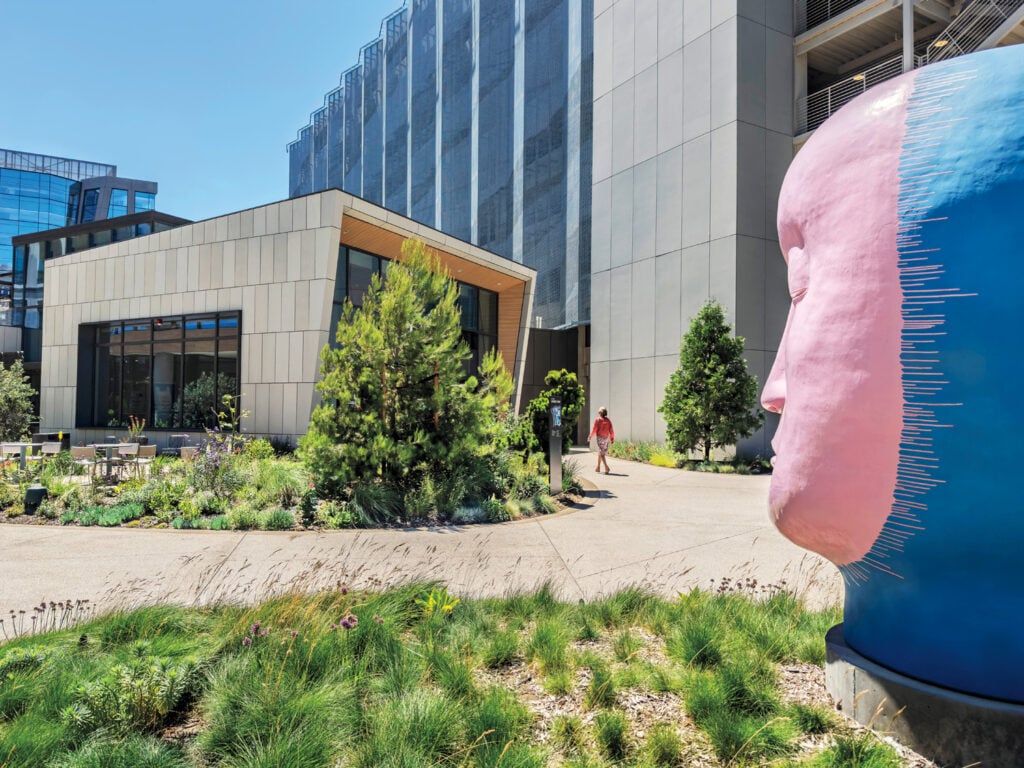
On the south side, the food hall overlooks a circular amphitheater with fused bamboo decking. Built into a hill, it’s also by DGA and the site’s landscape architect, Field Operations, and functions as a town square for events or casual use. To the north, the hall opens onto a plaza beside the conference center, a low, wood-clad volume shaped a bit like an oyster. Concrete paths shimmer with seashell aggregate, and each intersection is anchored by giant ceramic head sculptures by Japanese-American artist Jun Kaneko—the first inkling that art by the established and the emerging, local and international, figures prominently in helping to distinguish Kilroy Oyster Point.
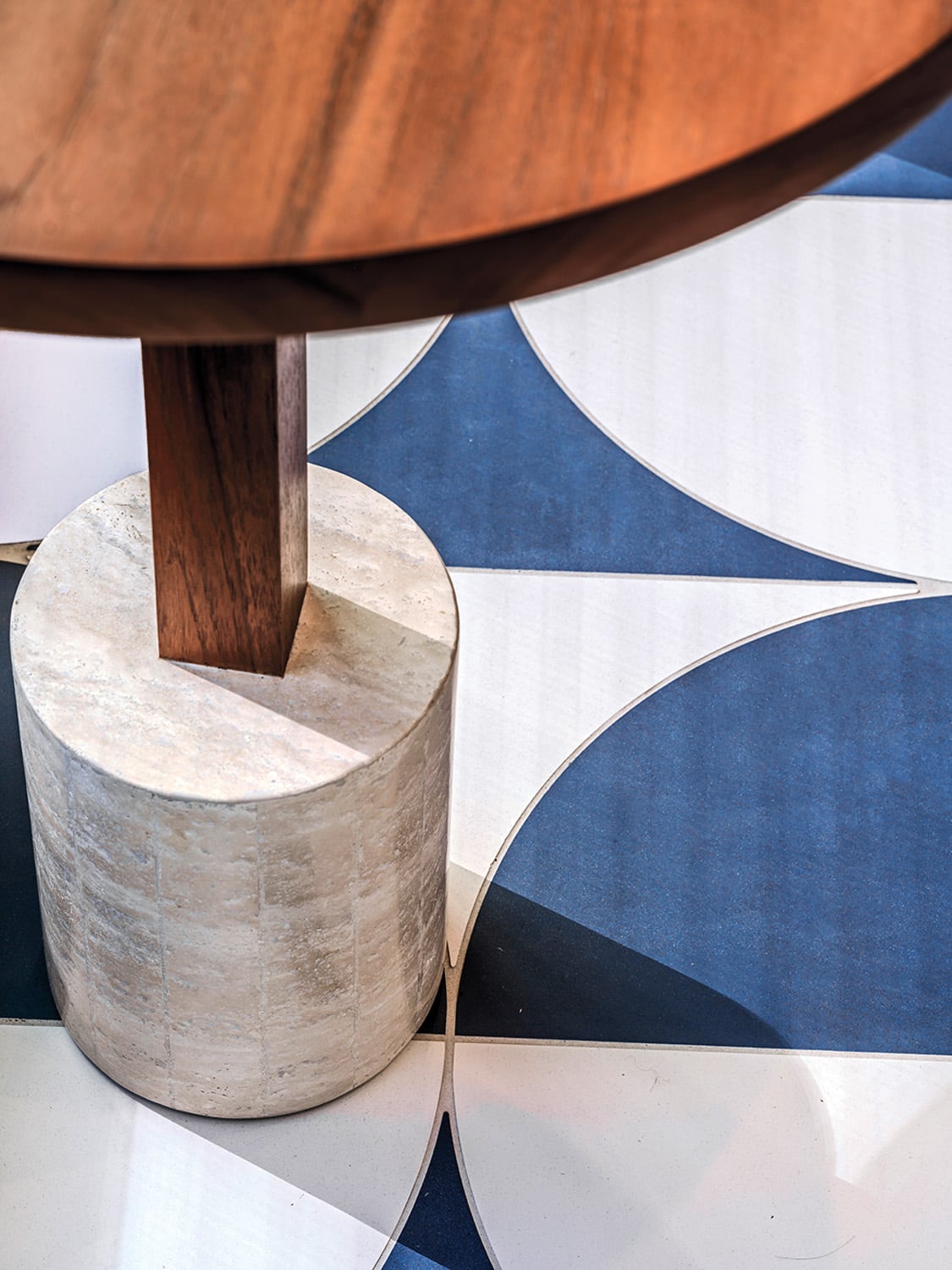
A Fort Standard Column table on ceramic floor tile in the grab-and-go market. 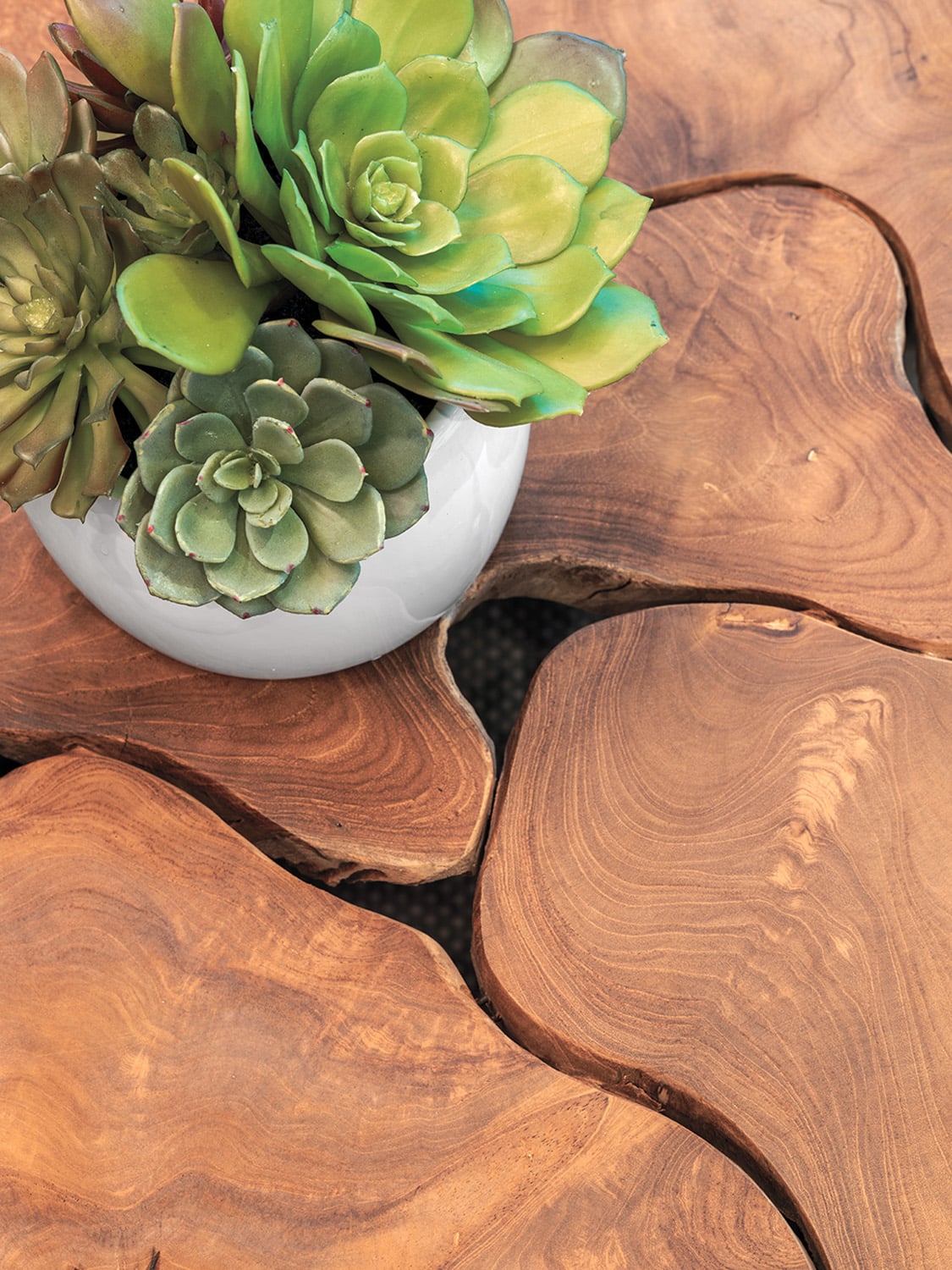
The lounge’s teak coffee table. 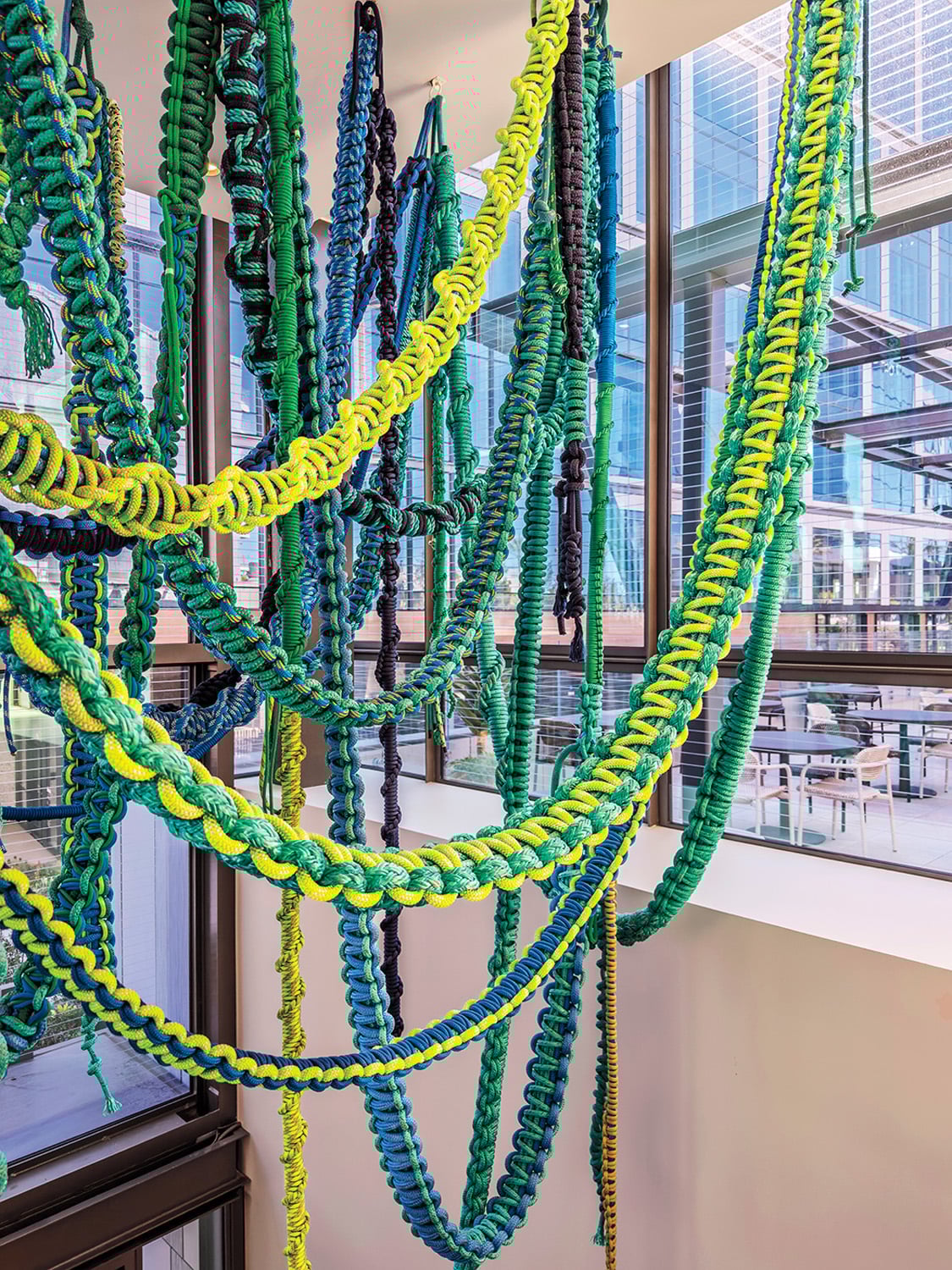
Olarte’s 1,000 linear feet of rope. 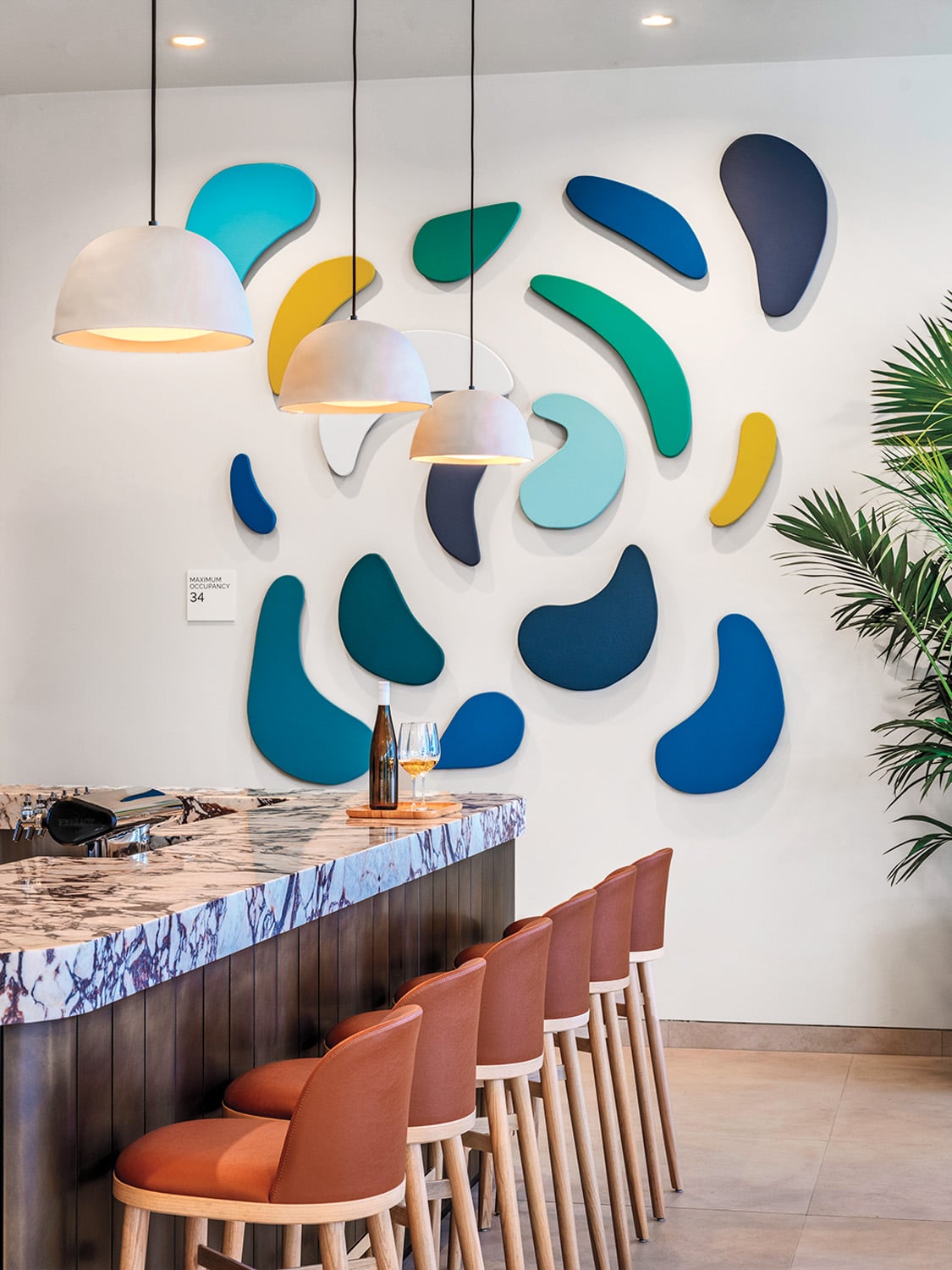
Glory Day McSharry’s acrylic on wood panel assemblage and In Common With’s Dome pendants at the Farewinds bar. 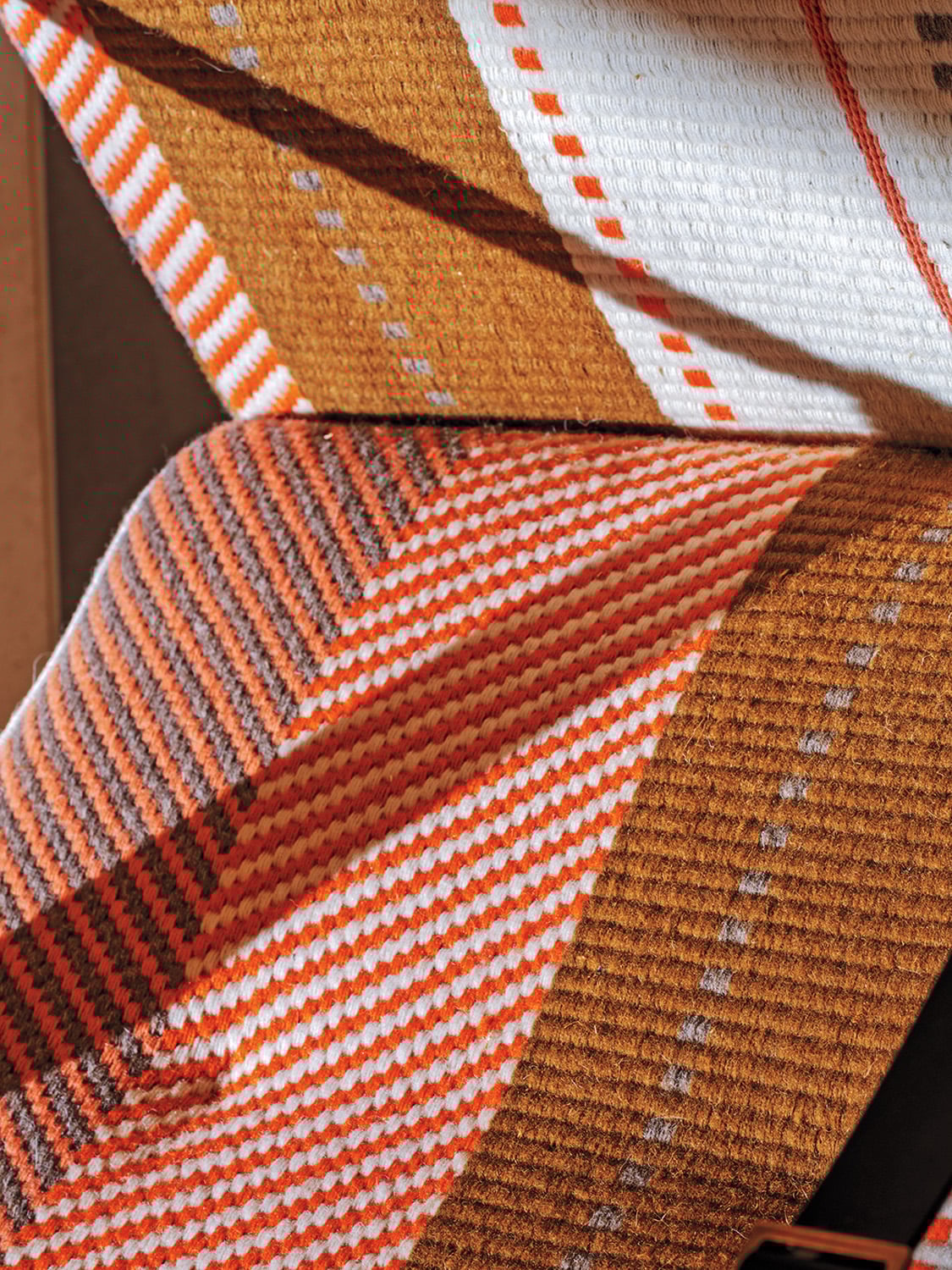
Traditional Portuguese blanket fabric on the lounge’s Capo chair. 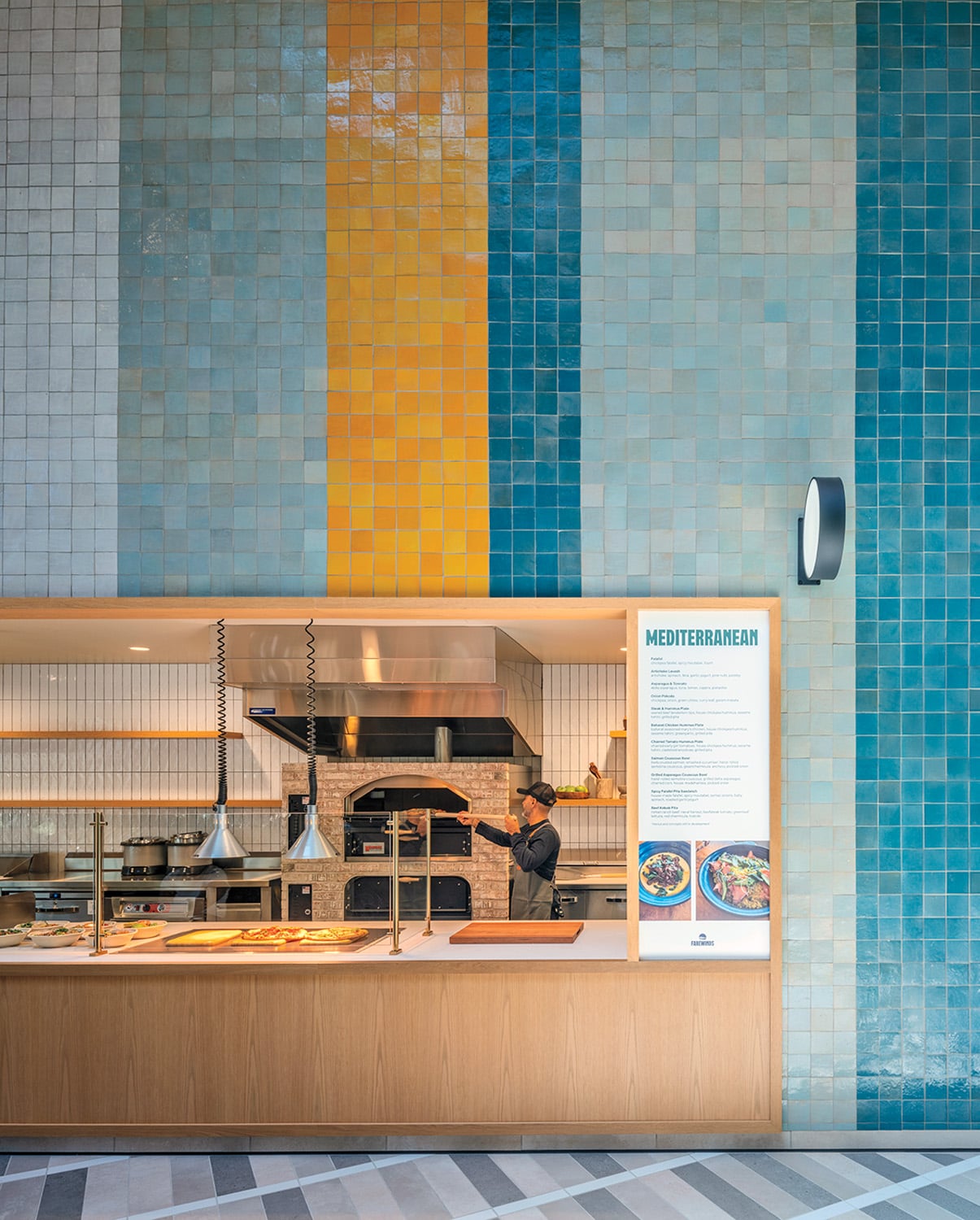
The atrium’s Zellige wall tile. 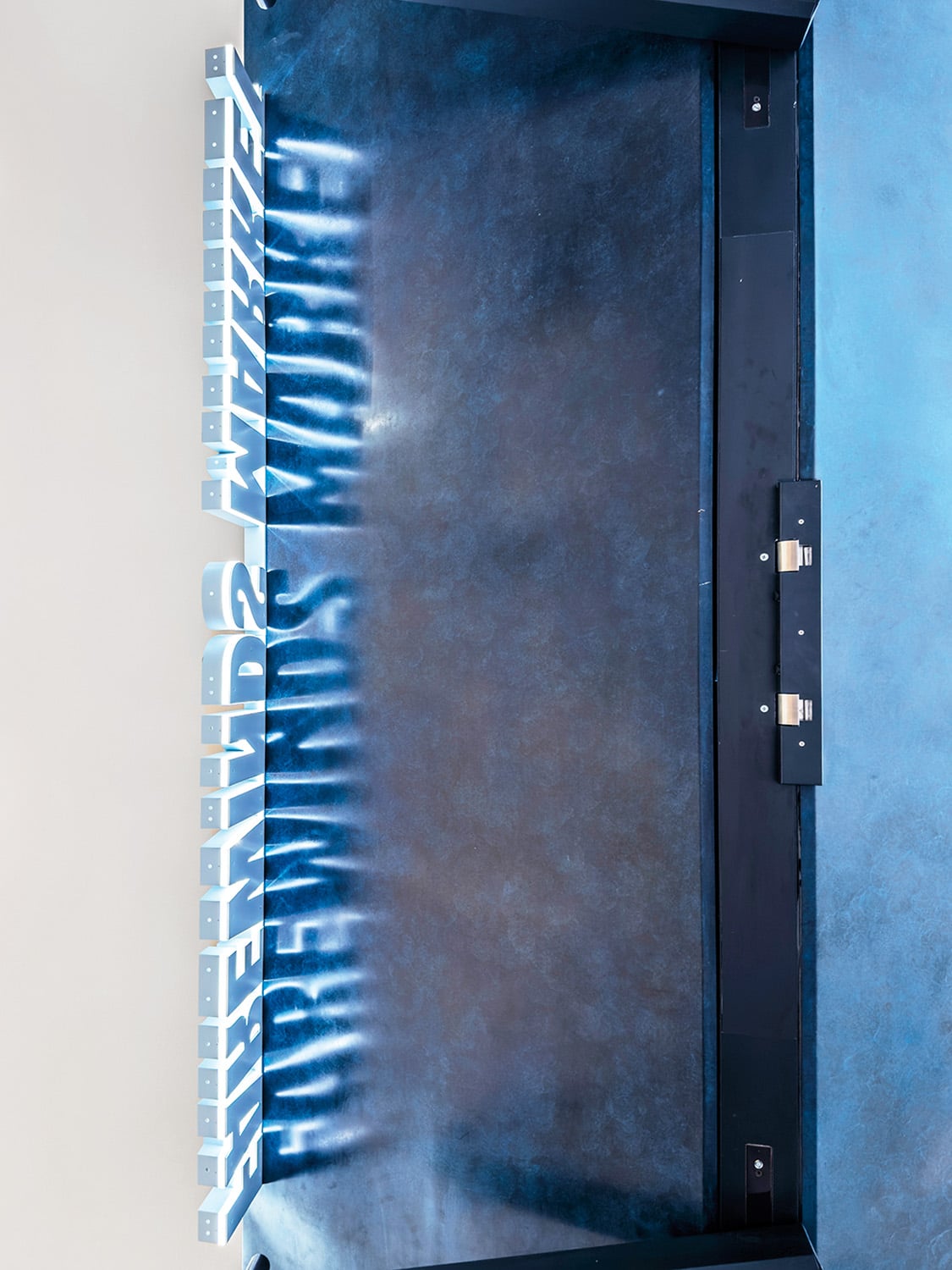
Bronze signage for the market. 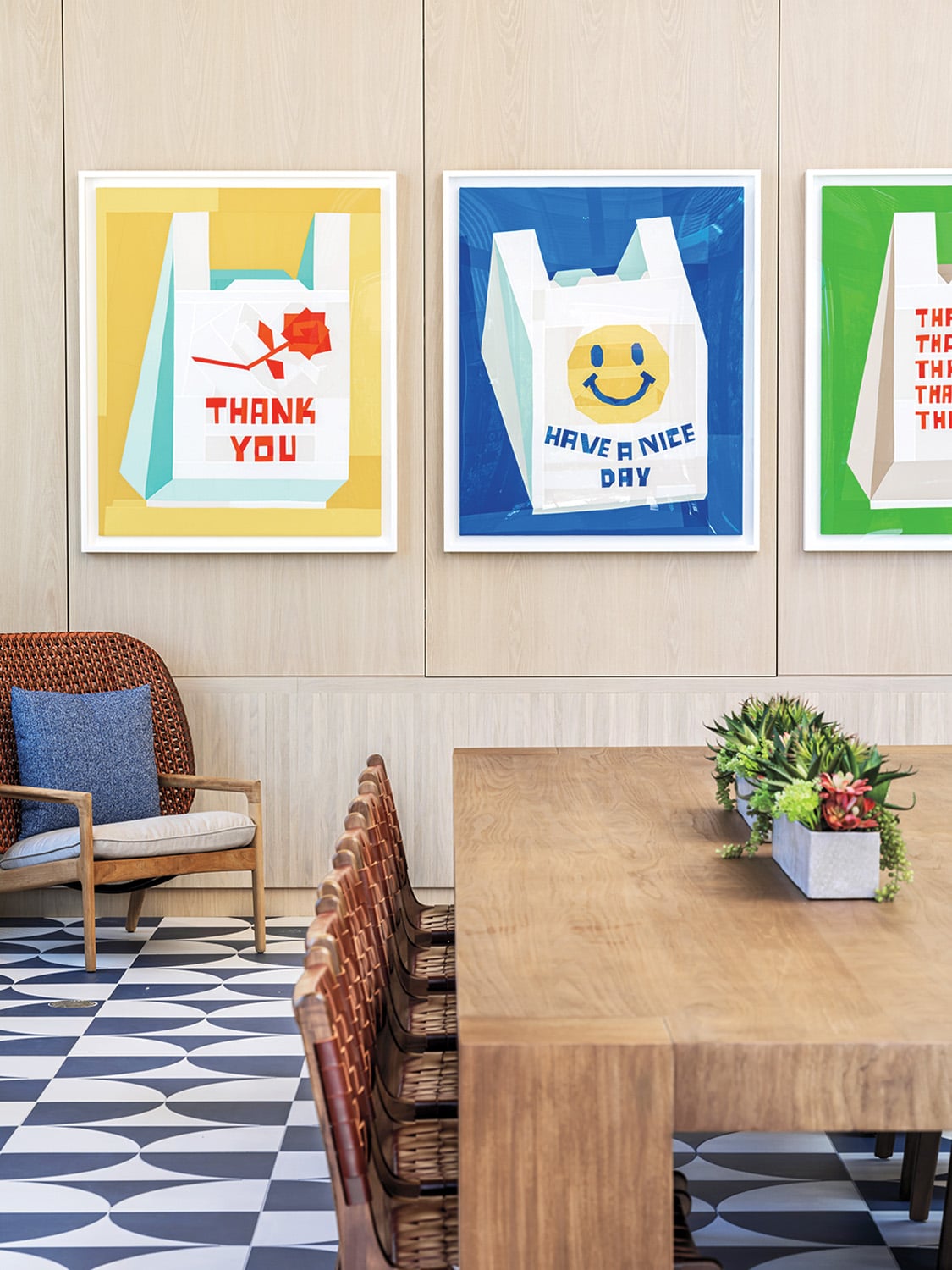
Jeffrey Sincich’s quilted mixed-media works and a custom teak communal table in the coffee bar. 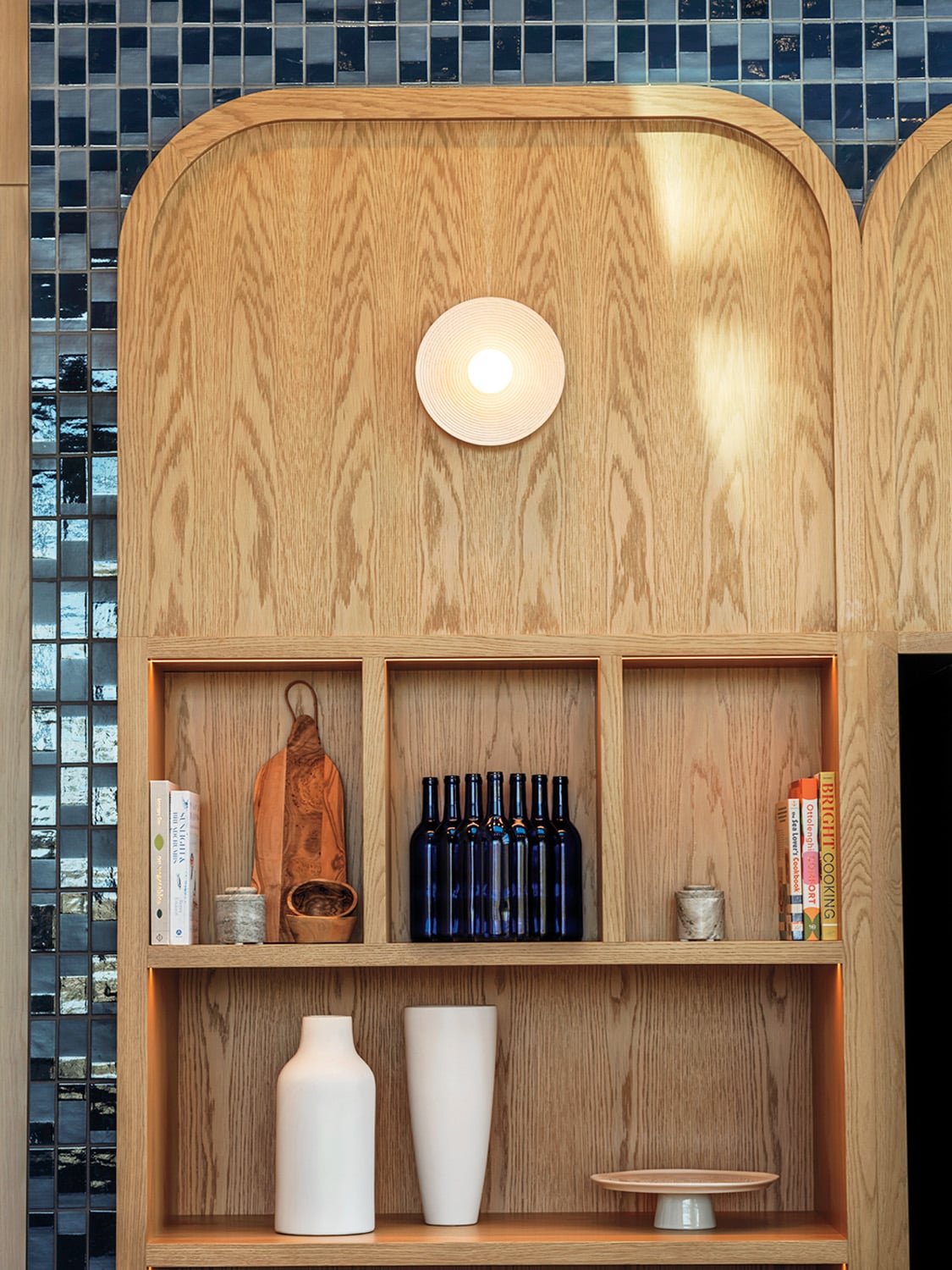
Ceramic tile, custom oak-veneer cabinetry, and Allied Maker’s Concentric sconce in the market.
That’s apparent inside Farewinds, where Rapt conceived refined, layered spaces that feel approachable and residential—an antidote to the sterile labs. Cool tones of blue and gray, driftwood screens, and a double-height installation of teal and green yachting rope by California macramé artist Jim Olarte bring a whiff of the sea. “The palette has a gritty, weathered quality, with materials that feel as if they’ve been dredged out of the bay,” Petersen explains. On an atrium wall, handmade zellige tile form blocks of color like nautical stripes, a pattern mirrored in the porcelain-stoneware flooring.
A mix of furnishings invites people to linger all day. There are roomy booths, a communal teak table in the market, and a dining lounge with Neri & Hu armchairs upholstered in handwoven Portuguese blankets. The private dining room, with its long oak table, amber-glass pendant fixtures by Italian studio Chiaramonte Marin, and cobalt-detailed artwork by Mexican-descent painter Abel Macias is open to all when not reserved for events.
The crafted, comfortable aesthetic continues throughout the amenity spaces. In one of the two reception lobbies, a blue quartzite desk faces a seating area with leather Finn Juhl armchairs and New Works pendants, their soft Tyvek diffusers resembling floating potato chips. On the conference center’s patio, shielded by a cantilevered ceiling and vertical wood-look slats, Ramón Esteve all-weather aluminum sectionals and Sebastian Herkner club chairs furnish a sophisticated lounge. Even the gym gets cloudlike Benjamin Hubert pendants and a tufted circular sofa by Thomas Bernstrand and Stefan Borselius.
Some of the most interesting elements, Petersen says, are natural light and shadow. While conducting solar studies, he and Galullo paid close attention to how rooms orient around the windows and the interplay between the architecture and the sun. At the conference center, for instance, the vertical patio slats cast shifting shadows throughout the day. Lengthening silhouettes slice across the floor and imbue the space with character. Like Rapt’s entire concept, the result is a subtle evocation of the dramatic setting.
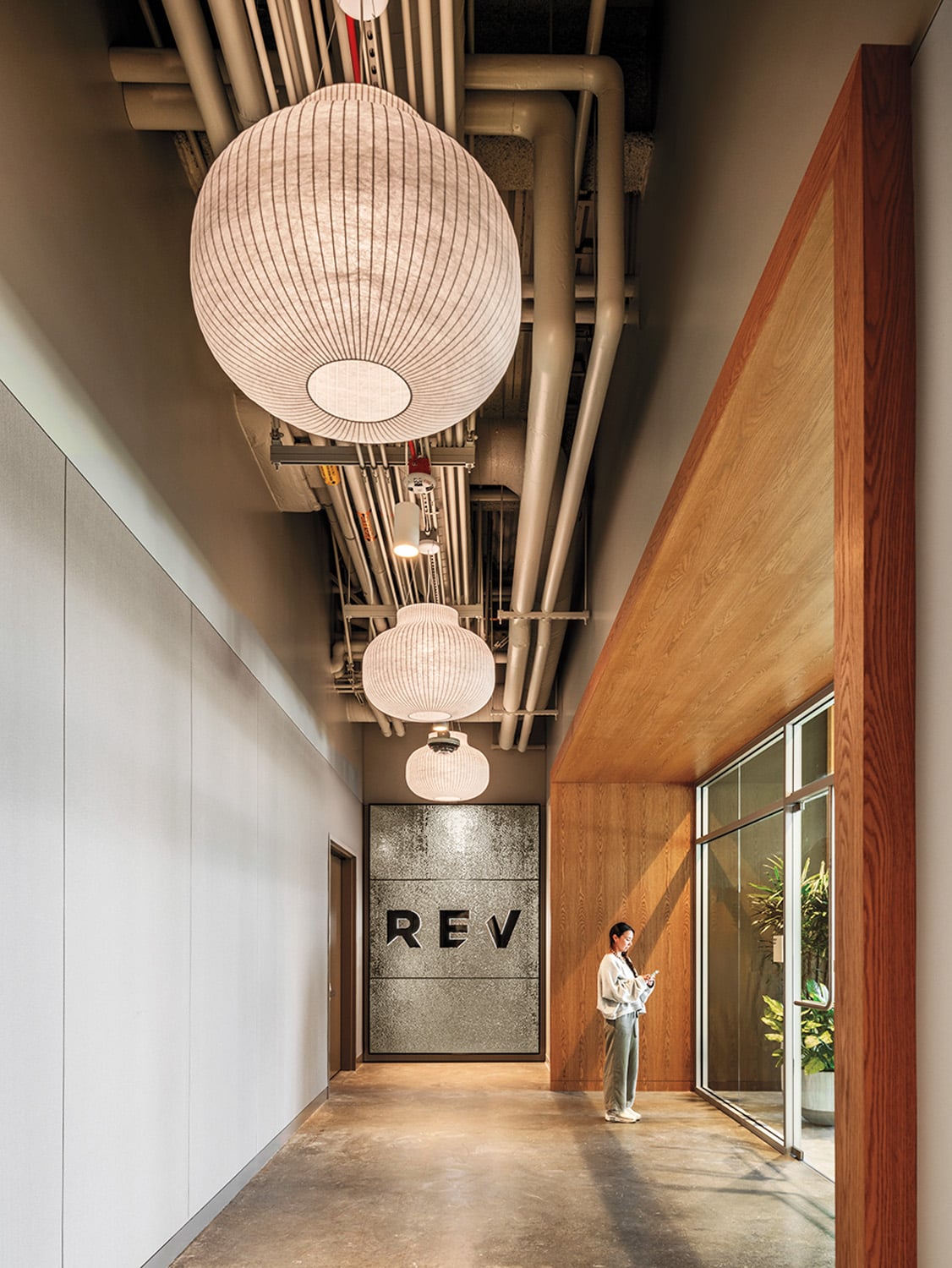
Textured stainless-steel paneling and Benjamin Hubert’s Strand pendants lead to the gym. 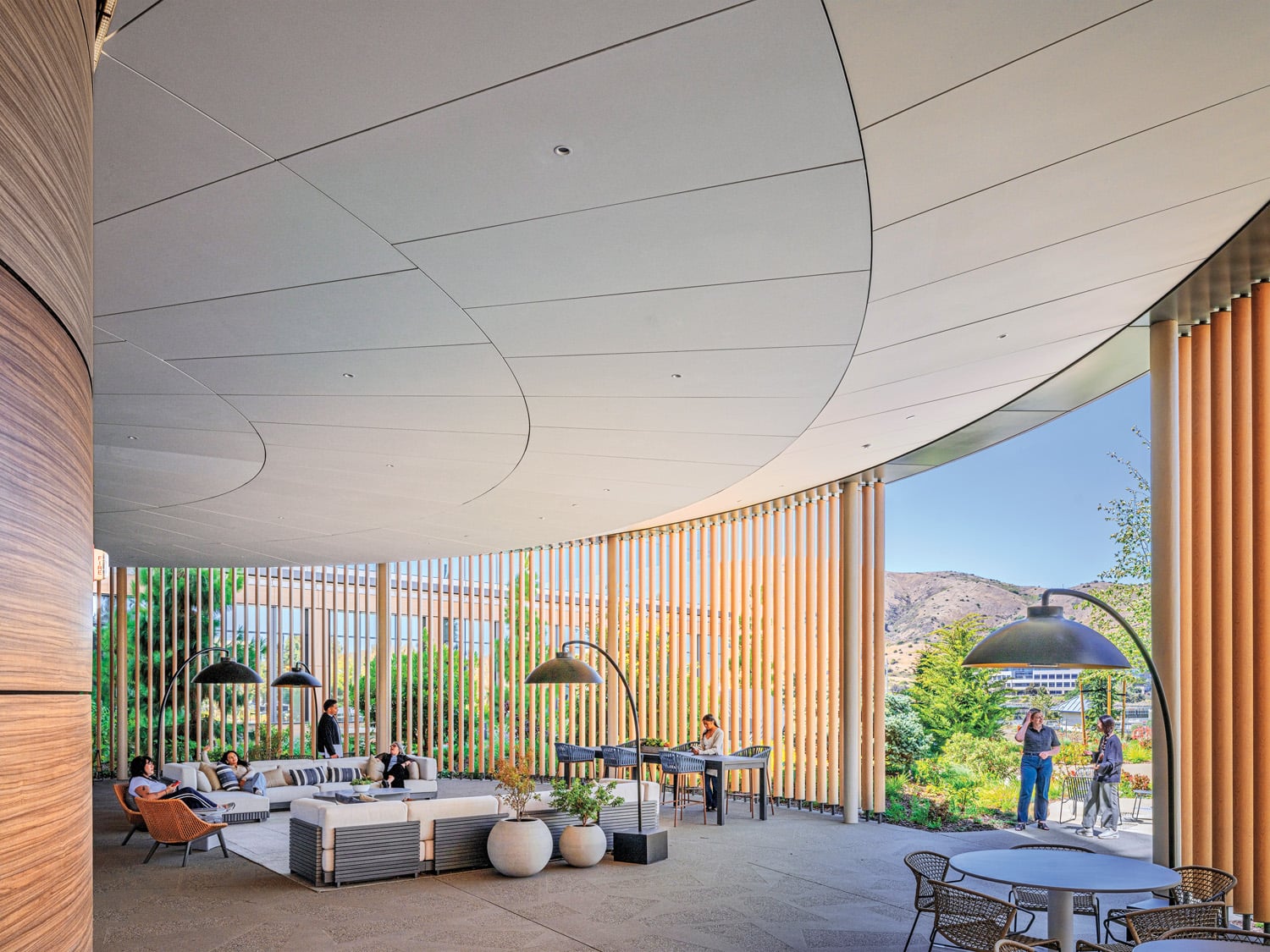
Wood-look aluminum slats screen the conference center patio, furnished with dome heat lamps and Caicos sectionals by Ramón Esteve. 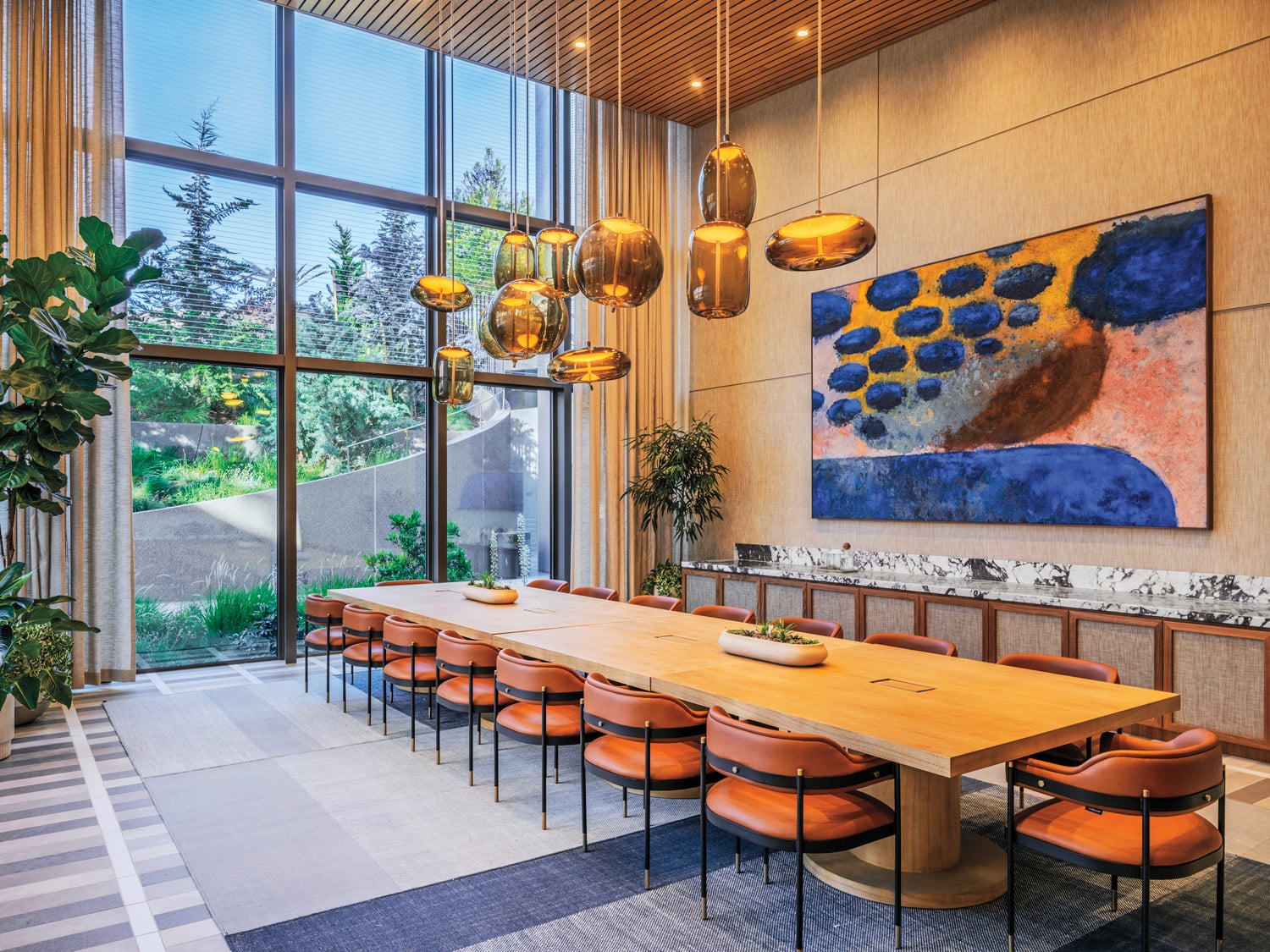
In Farewinds’s private dining room, Chiaramonte Marin’s Knot pendants join a custom 15-foot-long oak table and an Abel Macias painting. 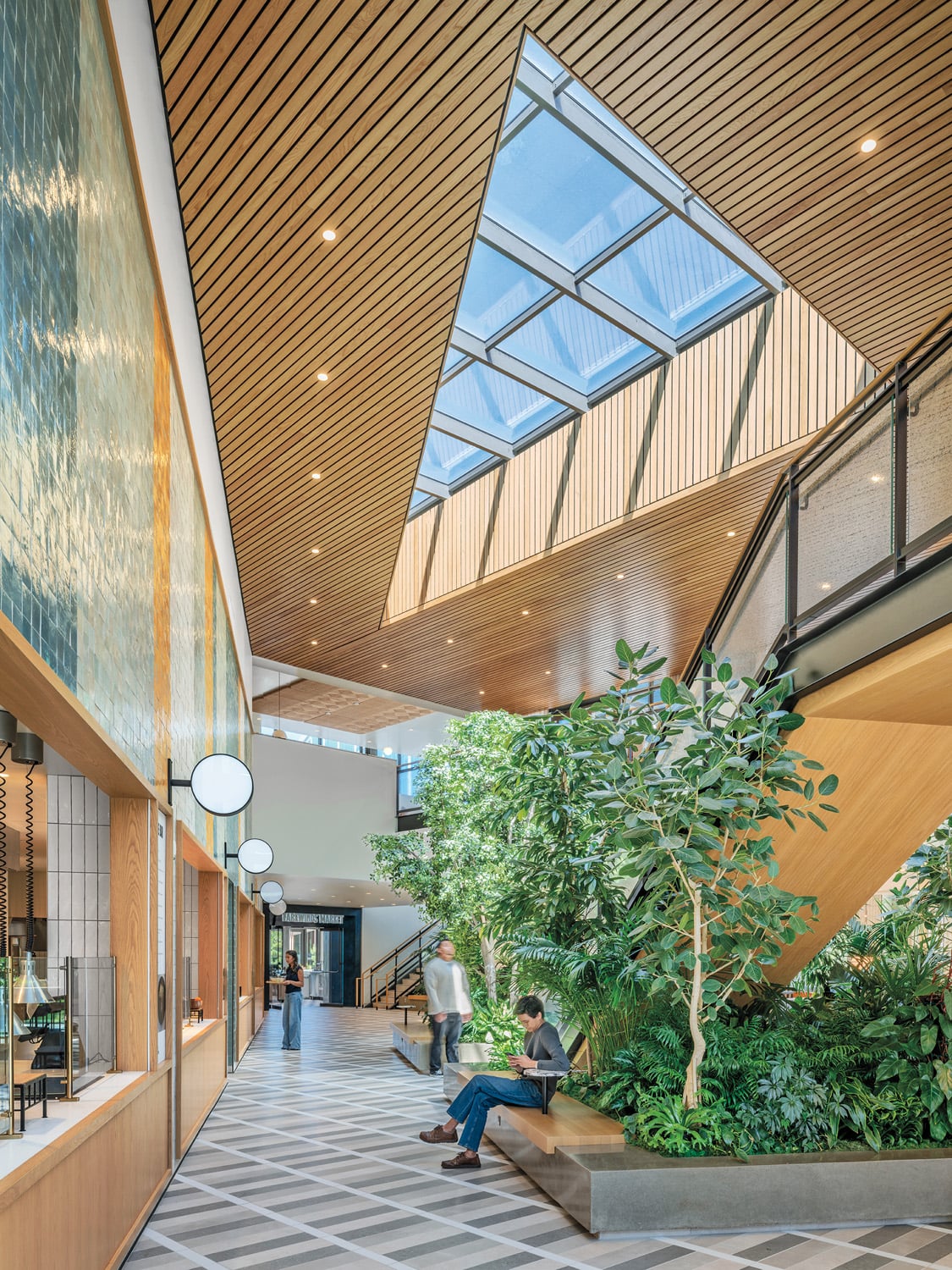
Zellige tile line a wall of serving stations in the Farewinds atrium, crowned by an acoustic wood-slat ceiling.
PROJECT TEAM
JULIA KOMARCZYK; MARIA HOLDER; LINN KAGAY; JANELL LEUNG: RAPT STUDIO. DGA: CAMPUS ARCHITECT. FIELD OPERATIONS: LANDSCAPE ARCHITECT. WEIDNERCA: CUSTOM SIGNAGE. DPA FINE: ART CONSULTANT. HATHAWAY DINWIDDIE CONSTRUCTION COMPANY: GENERAL CONTRACTOR.
PRODUCT SOURCES
FROM FRONT NEW WORKS: PENDANT FIXTURES (RECEPTION). HOUSE OF FINN JUHL: ARMCHAIRS. SACCAL DESIGN HOUSE: WHITE CHAIRS. AUDO COPENHAGEN: SECTIONAL. ALARWOOL: CUSTOM RUG. CAESARSTONE: DESK SOLID SURFACING. PORCELANOSA: CUSTOM FLOOR TILE (FOOD HALL, PRIVATE DINING). DANIELLE TROFE DESIGN: PENDANT FIXTURES (LOUNGE). THROUGH THE FUTURE PERFECT: LOUNGE CHAIR. HAY: SOFA. BAUX: CEILING TILE. POTOCCO: DINING CHAIRS (LOUNGE, PATIO). CLÉ TILE: WALL TILE (ATRIUM). 9WOOD: SLAT CEILING. MOSA: FLOOR TILE (MARKET, COFFEE BAR). FORT STANDARD: TABLE (MARKET). FRANCE & SON: TEAK TABLE (LOUNGE). IN COMMON WITH: PENDANT FIXTURES (BAR). STELLAR WORKS: STOOLS. DDS TILE: WALL TILE (MARKET). ALLIED MAKER: SCONCE. GLOSTER FURNITURE: LOUNGE CHAIR (COFFEE BAR). INDUSTRY WEST: DINING CHAIRS. UNALOME INTERIOR: CUSTOM TABLES (COFFEE BAR, PRIVATE DINING). HEATSAIL: HEAT LAMPS (PATIO). RH: SECTIONALS. KETTAL: DINING TABLES, STOOLS. DEDON: LOUNGE CHAIRS. TRESPA: EXTERIOR SLAT SYSTEM. MUUTO: PENDANT FIXTURES (GYM). GTEX STAINLESS: PANELING. TURF DESIGN: BAFFLE SYSTEM. VIBIA: PENDANT FIXTURES. BROKIS: PENDANT FIXTURES (PRIVATE DINING). LASKASAS: CHAIRS. NANIMARQUINA: RUG. MAHARAM: CURTAIN FABRIC. THROUGHOUT BENJAMIN MOORE & CO.: PAINT.
read more
Projects
Inside A Colorful Health Choice Pharmacy In Coney Island
Sergio Mannino Studio reimagines a Coney Island pharmacy as a flexible, design-forward wellness hub.
Projects
A Victorian Worker’s Cottage In New Light
Anna-Carin has carefully uncovered the character of a century-old Victorian Cottage, layering timeless materials, collected pieces and quiet interventions.
Projects
KPMG’s U.S. Headquarters: HOK Brings Manhattan’s Energy To The Workplace
For the U.S. headquarters of global accounting and consulting firm KPMG in New York, HOK channels the energy and individuality of Manhattan’s eclectic neighborhoods.