
10 Questions With… Douglas Harsevoort and Juan Sala of Sala Hars
Douglas Harsevoort and Juan Sala met in Cambridge, Massachusetts, while they were studying architecture at Harvard University. Their joint master’s thesis led to an early client, which led to forming a firm they named Sala Hars. After a few years of exploration and refinement, their company found its foothold and clients began investing in their vision.
Today, Harsevoort and Sala lead a small studio team with several projects underway. The partners have completed projects in the United States, Mexico, and France. They’ve worked across typology, including craft restaurants, retail environments, a medical clinic, and more.
Interior Design spoke with Harsevoort and Sala about their early projects, their use of spatial tension and lighting, the relationship between the historic and the contemporary in their work, and the ways they strive to slow down in order to be free from the “information overload of the 21st century.”
Sala Hars Strikes a Chord Between Historic and Contemporary
Interior Design: How did your firm get started?
Sala Hars Cofounders: While doing our joint thesis at Harvard, a hospitality group reached out to us with the idea of creating a restaurant. This gave us the determination to [start Sala Hars]. While that restaurant project didn’t see the light of day, it did bring the first paycheck to the office.
The funds from the unbuilt project allowed us to live modestly for a couple of years. We found (and still find) it very important to study our references down to their details, to really understand them in an intimate way. In this kind of Frankenstein patching together of various motifs, we were able to eventually find our own language.
We took a couple of small built commissions on the side, a few museographies, and a sushi restaurant. We spent years creating buildings in our minds, documenting them, and putting them on paper, until we patiently earned the vote of confidence from a few clients who really helped us craft our voice and began believing in our work.
ID: You’ve worked across typology, including residences and mixed-use spaces. How does that change your work?
SH: At the outset of our practice, we found it very important to test our ideology across scales and across typologies. This was important to find if our conception of architecture would break down either at the smallest scale and program to the largest zoomed out scale. Within these differing scales, we think that it is interesting to flip the conventions of emotion in each space: to make a museum gallery somehow feel cozy and full of warmth, opposing the sterility of the white cube; in a house, to somehow feel certain spaces as monumental, using optical gestures of geometry, to make spaces feel larger than they actually are.
ID: You’re based in Mexico City, but you’ve worked around the globe. How do you approach differences within countries while staying true to your perspective?
SH: We have currently completed several projects in the United States, Mexico, and France, and are hoping to begin projects in Colombia and England soon. Countries aside, context for us is fundamental. That can be the immediate adjacent context of the site, the broader context of a city, the cultural context of a country, and—even in more abstract projects like museography—the conceptual and historical context of a museum or collection.
Our approach remains similar, full of iterations, research, feasibility checks, and working closely with the local team of collaborators and consultants, but the result varies drastically depending on all those factors. By maintaining a deep commitment to work, which is indisputably a product of our time, yet anchored in the vast library of historical discourse, we try for each project to be distinctively Sala Hars but not predictably Sala Hars.
ID: How does Sala Hars consider the relationship between contemporary and historic elements?
SH: The past is precious to us as a frame of reference, a mindset, a gateway into how people were thinking of things, in order to see how similar or different it is to contemporary culture and ideas. We like the analogy [Jorge Luis] Borges uses: Put two mirrors together to create a labyrinth. In this one image and idea, we can hold the past up to face the present, and begin to let the reflections, refractions, inflections, blind spots, and glaring resemblances come to light. Objects of the past then become this reflecting pool for us to challenge against contemporary ideas and somehow, as Ed Ruscha said, make new history.
ID: You recently completed three Paris restaurants: Sushi Shunei, Sushi Yoshinaga, and Sushi Hanada. How did you connect with the clients for these projects?
SH: The clients for these projects found us as a very young studio, when we had just started after finishing our degrees at Harvard. They were interested in our approach to history and formal lineage; they wanted to find a way to marry the deep tradition of Japanese Omakase and a contemporary feel of space and form. We started with Shunei, and the result, both in terms of the architecture and the success of the chef, led then to Yoshinaga and now Hanada. Alongside the clients, [we developed] a language for these projects, all coherent, but all uniquely distinct from one another.
ID: What is the through thread for these spaces—and what sets them apart?
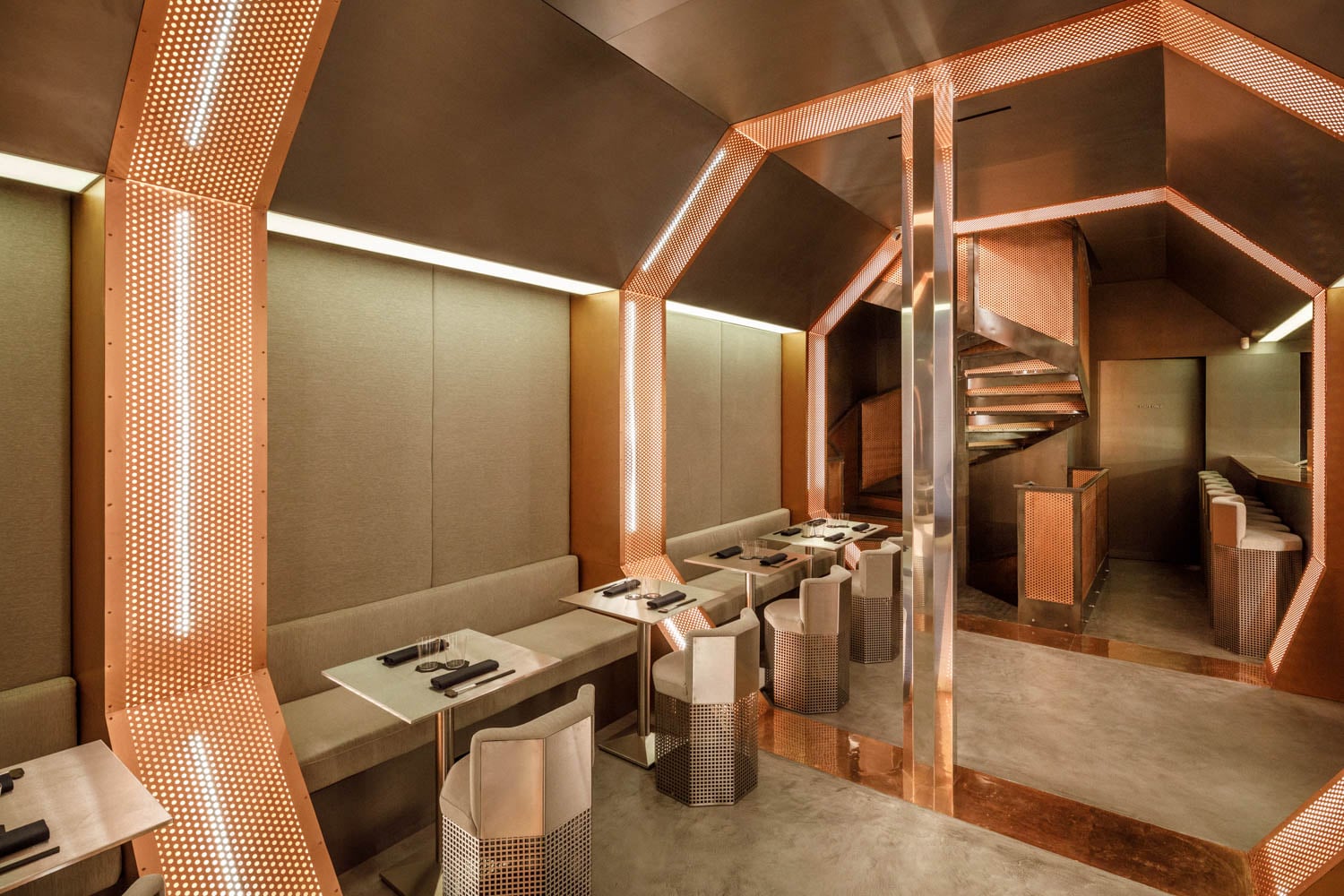
SH: A key element in many of our projects is light and shadow, either natural or artificial. It determines the mood and the atmosphere of the space. The way it engages materials, geometry, and inhabitants ties everything together.
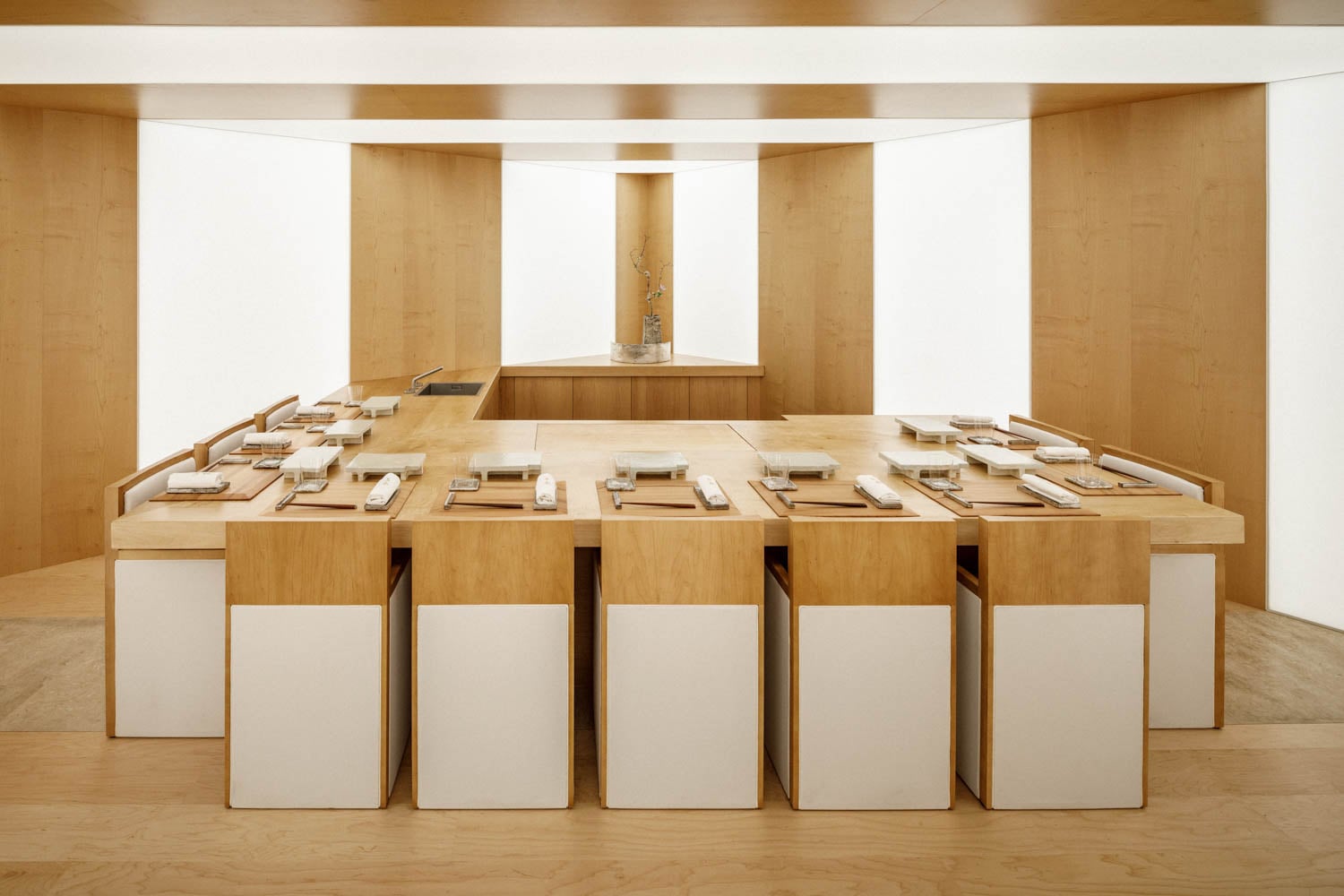
In Shunei, the goal of the lighting was to accentuate the coffering, to make a narrow hall feel more grandiose. It gives an even wash at the center, on the counter, and a gradient to the sides, becoming ever slightly more dim on the wooden walls.
In Yoshinaga, by contrast, the walls also have light panels that continue to the ceiling. The idea here was to give as uniform and non-directional a light source as possible, to almost give the pieces of sushi this levitating quality on the plate, this kind of impossible floating you get in [Paul] Cezanne’s still life paintings.
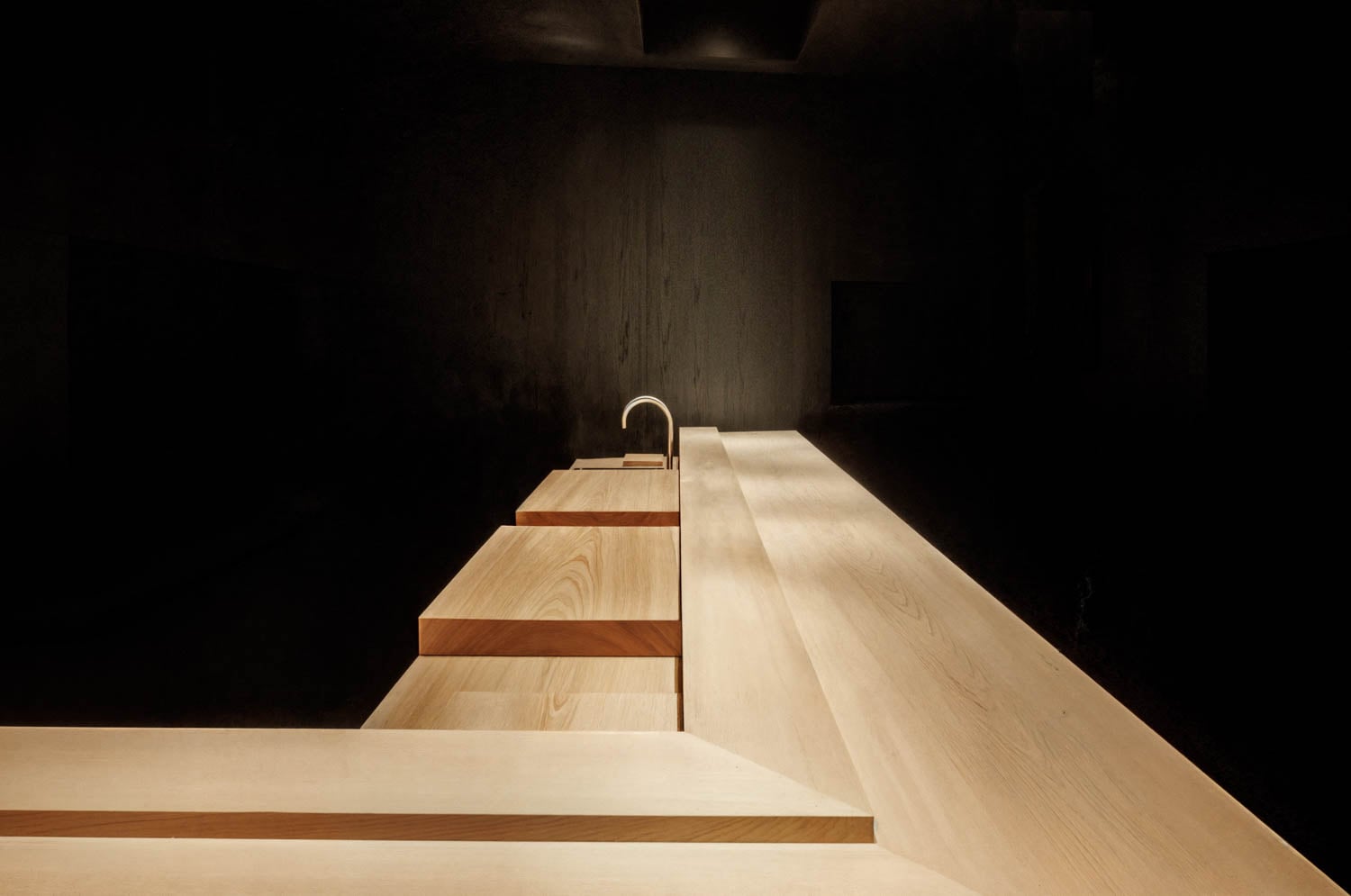
For Hanada, by contrast, the idea was to bring a sense of tension and drama, to focus all the light on the hinoki counter and make it the object of attention in the space that otherwise recedes to black inked wooden walls. Here we see it more as a chiaroscuro painting, where light is profoundly concentrated on certain points, and the rest fades to darkness. In this, the guests become silhouettes that blend into the architecture. The light is then able to highlight these spatial tensions between compression, rotation, and excavation.

ID: Tell us about your other project in Paris, Zoī Vendōme, which is a medical facility.
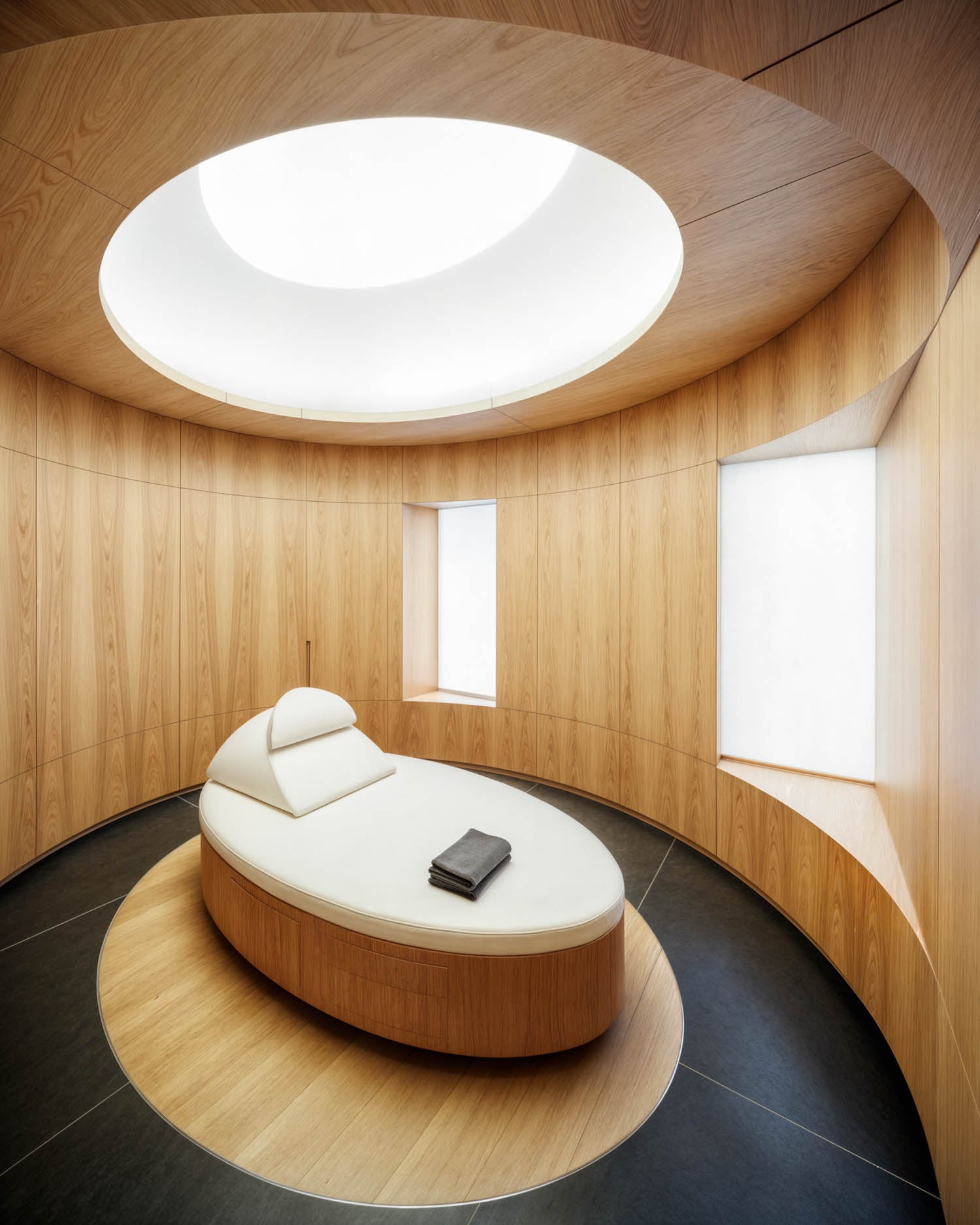
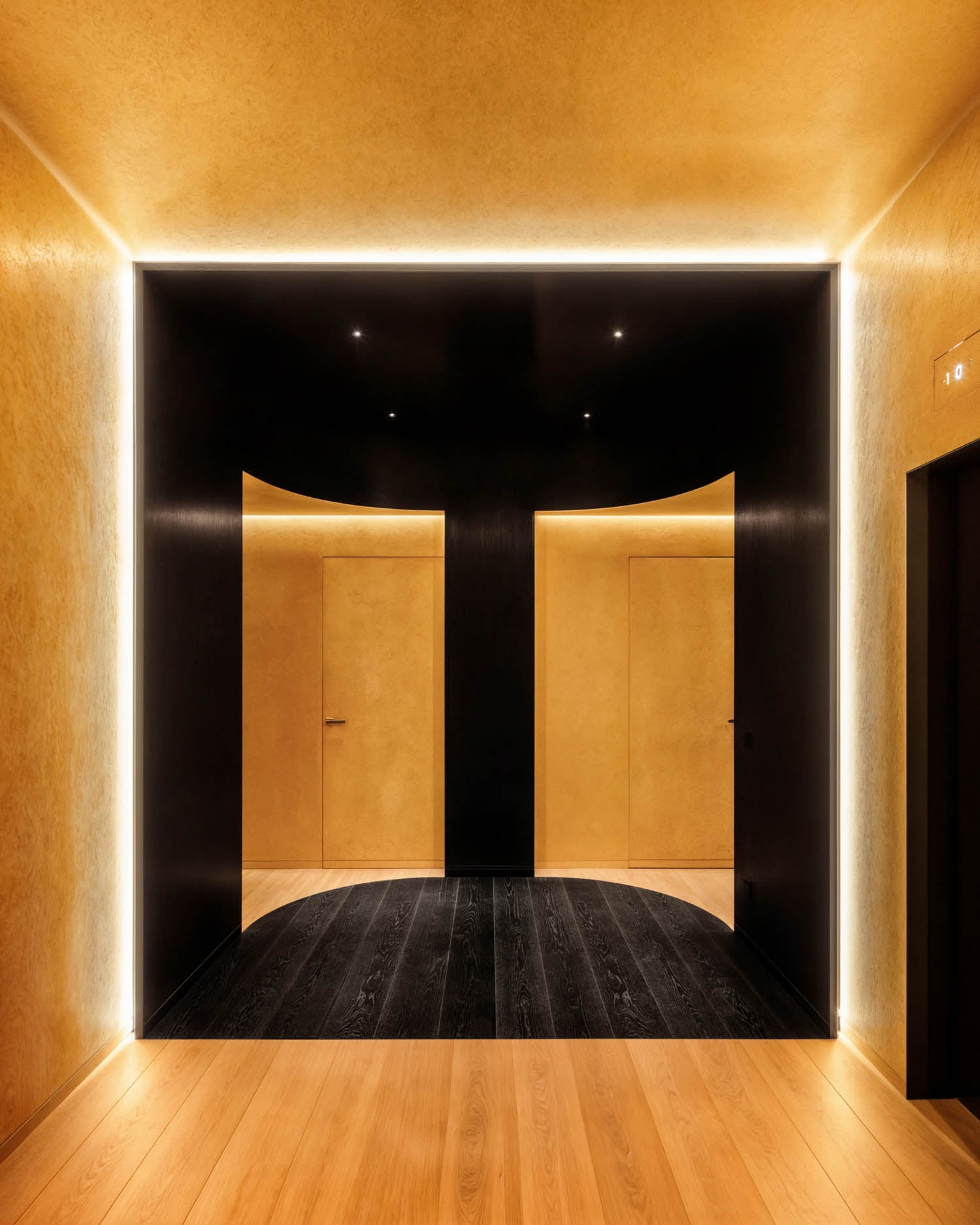
SH: The omakase restaurants were informative in creating certain moments of drama and moments of serenity, which definitely carried over into the work of Zoī Vendōme. For us, what differs is the mise en scene of the entire journey. In Zoī, the goal was to create a journey that would vary in atmosphere but retain a consistency in materiality or lighting or formal gestures throughout. These formal gestures are always keeping the human body in mind and its centripetal relationship to the various spaces.
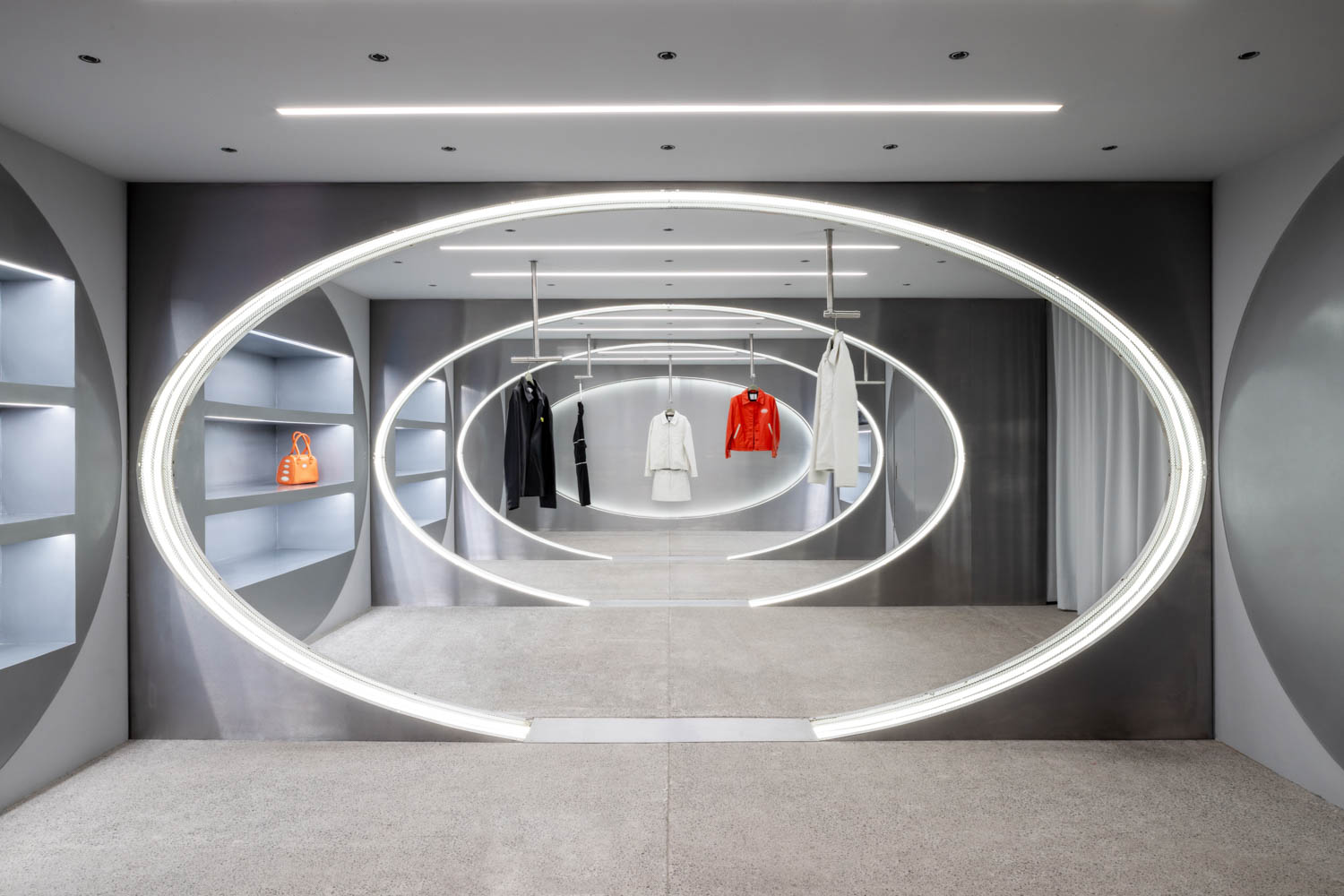
ID: What about the fashion brand Tiempos’s flagship store in Mexico City?
SH: In Tiempos, the lighting performs first and foremost the role of highlighting the clothing. It was important for us to have several different conditions, from overhead diffusers to recessed shelf lighting, and then add to it the drama of the elliptical portal lighting. Each of these can be dimmed and programmed to be off or at different levels, as this space also functions as a place for events and fashion shows. Flexibility in the varying lighting conditions was essential.
ID: Your studio’s narrative poses the question, “In a time where everything is moving so rapidly, how do we create a moment of pause?” How does that work in practice?
SH: Finding that slow and deliberate approach for us looks like finding time to sketch and draw ideas, reading as much as possible to find influence in past ideas, giving ourselves the space to write, and giving our team the space to create and allow the process to be incrementally iterative. Working out an idea to a level where the large concept plays out in the details. This means a slower approach because it means taking the time to really think about these things—even when a client or a contractor is not asking you to—to take it upon ourselves to care about the concept at all scales of resolution.
ID: What are you working on? What’s your dream project?
SH: Currently, we are completing a mass timber, prefabricated apartment building with a contextual brick facade in Madison, Wisconsin; an apartment renovation in a prominent 20th-century building in Mexico City; a house in Puerto Escondido, Mexico; and a high-fashion flagship store at Place Vendôme in Paris.
The dream project for us is truly the one in which we are able to honor the place in which we are working, the culture in which we are operating, and make the hidden visible through the power of architecture, extracting all the potential and layers a project can have.
read more
DesignWire
10 Questions With… Sculptor Aminata Mboup
Aminata Mboup discusses her practice, inspirations, fluidity between disciplines, as well as her unique approach to materials.
DesignWire
10 Highlights From Amman Design Week
Amman Design Week 2026 gathers a host of regional designers and architects under the theme ‘Accumulations.’