
10 Questions With… Christoph Hefti
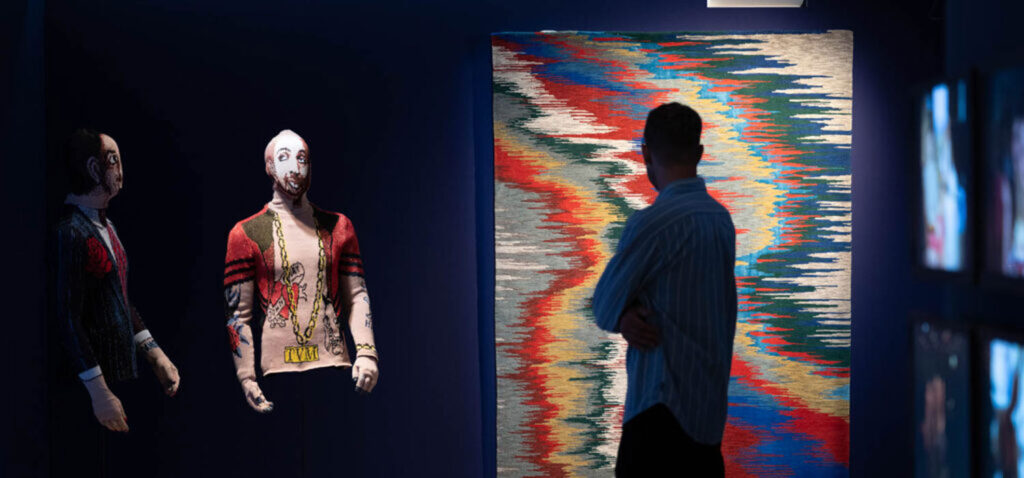
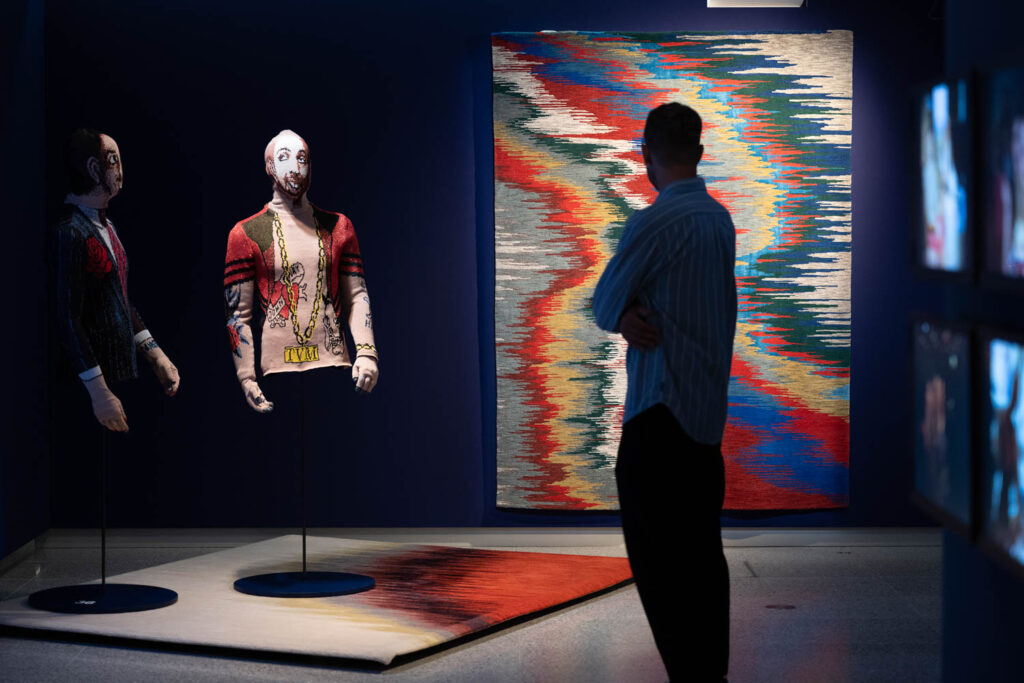
Nearly four decades after studying textile design at Zurich’s School of Design, Swiss designer Christoph Hefti has returned to the same site for his first comprehensive solo exhibition at the Museum für Gestaltung Zürich. On view through January 3, 2027, “Christoph Hefti—The Missing Cat and Other Textile Stories” brings together hand-knotted rugs and printed textiles with ceramics, furniture, costumes, and performance-based work, revealing a practice that has rarely remained within the boundaries of a single discipline.
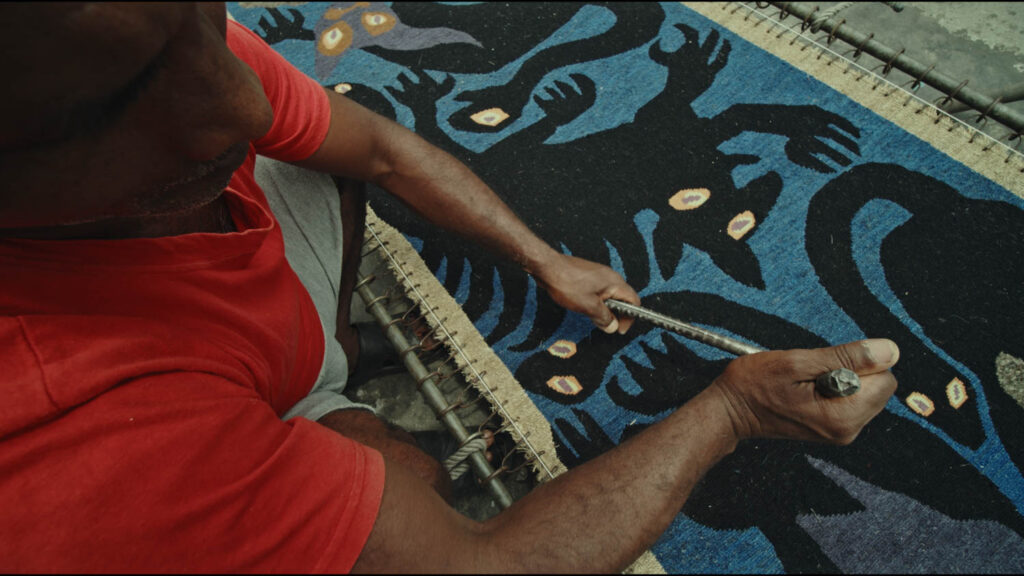
Before rugs became central to his work, Hefti built his career in fashion textiles, first with Jean Paul Gaultier, then for 13 years at Dries Van Noten, and later as an independent designer for houses including Balenciaga and Lanvin. Today, his carpets are hand-knotted in Nepal, where annual visits, direct exchanges with makers, and encounters with available materials and yarns have become integral to his design process.
Across mediums, Hefti’s visual language remains unmistakable: vivid color, deliberate irregularity, and a recurring cast of masks, eyes, insects, animals, and enigmatic figures. Interior Design spoke with him about moving from fashion to rugs, designing through collaboration and imperfection, and why, despite the fluid boundaries of his practice, he still firmly considers himself a designer.
In Conversation With Christoph Hefti
Interior Design: After a career that has taken you from Zurich to Paris, Amsterdam, Antwerp, Brussels, London, and Kathmandu, what does it mean to return and present this body of work here?
Christoph Hefti: It was the first time I really stopped working and looked back. When I studied here, I didn’t necessarily think I would become a textile designer. I simply loved art school. But at the time, fine art wasn’t an option; you could study textile or graphic design, photography, or jewelry. Looking back, I realized that if fine art had been offered, I probably would have chosen it. Maybe that explains why people sometimes struggle to define my work as either art or design. For me, those boundaries were never very clear to begin with.
ID: Before the rugs, ceramics, and installations, you designed textiles for fashion houses including Dries Van Noten and Jean Paul Gaultier. What did fashion teach you about pattern and color that you still carry with you?
CH: Fashion gave me a certain fearlessness with color. You can be daring because people wear something, combine it with something else, take it off, and then the next season comes. I carried that attitude into carpets. People would tell me, “A rug has to last forever, so perhaps the colors should be quieter.” I never really understood that. Why shouldn’t you spend the rest of your life with something colorful?
Scale was another big change. In fashion, a pattern can only become as large as the body. Suddenly, with carpets, I could think much bigger. That was incredibly liberating.
ID: A fashion print may last a season, while a rug might live with someone for decades. How does that sense of permanence affect the way you design?
CH: Sometimes it makes me cautious—and then I try to counter that with fearlessness. I don’t want longevity to mean that everything has to be toned down. If the answer to designing something that lasts is to make everything beige, I’m not very interested. I would rather treat longevity as another challenge.
ID: Your rugs are hand-knotted in Nepal, and you now arrive with sketches rather than finished designs. How has working directly with makers changed your process?
CH: In the beginning, I went to Nepal with finished designs because I thought I had to arrive perfectly prepared. Then I discovered the warehouses where they keep leftover yarns. I would see combinations I would never have imagined in my studio in Europe: different browns piled together, undyed hemp yarn, unexpected textures. Suddenly, I wanted to change the carpet I had come to make.
Over time, I became confident enough to arrive with sketches and more open ideas. Now I draw there, look through the yarns, talk directly with the makers, and ask what a material can do or whether different techniques can be combined. The carpet is still very precisely designed in the end, but Nepal has become part of the design process itself.
That closeness to the people making the work was also one of the things that drew me away from fashion and toward carpets.
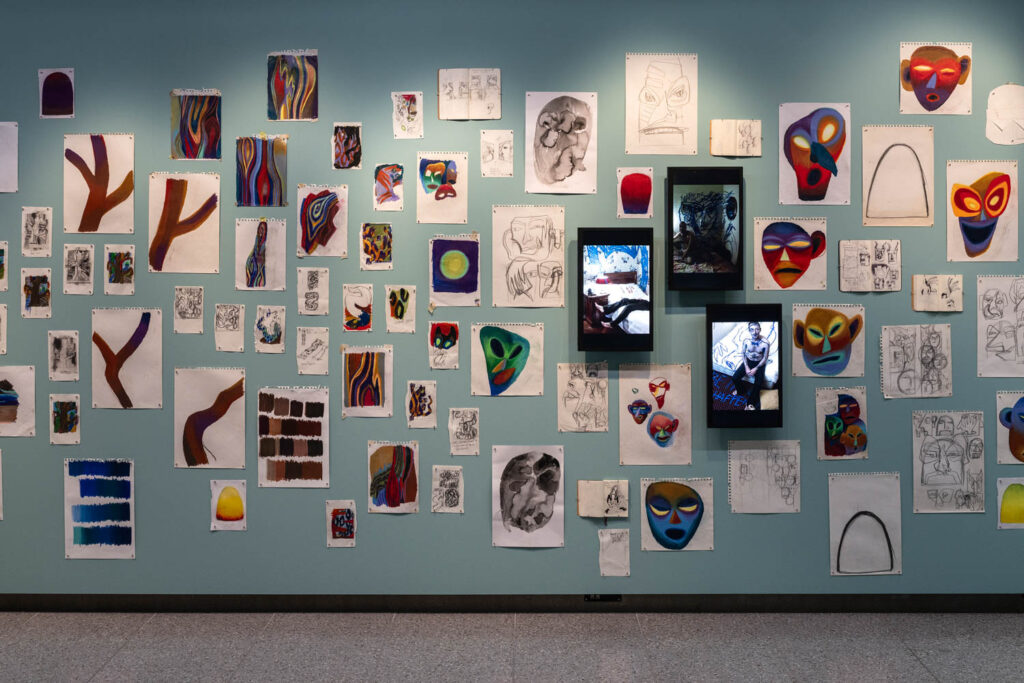
ID: Eyes, masks, insects, faces, and strange creatures keep appearing in your work. You’ve described drawing from an “internal library.” What is stored there?
CH: Probably everything I have seen, imagined, and experienced. I draw constantly, and I almost never research a motif before drawing it. If I want an insect, for example, I think: Somewhere inside me I know what an insect looks like. Then I draw my version of it. Sometimes something comes out looking folkloric or very ’80s or slightly cheesy, and then I decide whether to push that further or take it somewhere else.
I think that library started very early. I was quite a sickly child and spent a lot of time at home drawing and listening to fairy tales on cassette. I would draw what I heard. Maybe that was good training—learning to make an image from something that existed only in my head. I’ve basically kept doing that my whole life.
ID: So, why the cat—and what exactly is missing in The Missing Cat?
CH: I wanted the exhibition to have a title that suggested something that wasn’t there—an extra layer rather than simply calling it a textile exhibition. At first, I wanted to call it “In the House of the Missing Cats.”
There is also something about “missing” that is very connected to how I work. Before I finish a carpet, I always ask: Is something still missing? And very often I realize that whatever is missing from one design becomes the starting point for the next. There is this empty space between finishing and beginning.
Then I became fascinated by cats, although I’m actually not a cat person. They’re independent, wild, mysterious, beautiful, and you never completely understand them. I realized that’s a little how I would like my carpets to exist in the world. You can live with one for the rest of your life without necessarily understanding why this motif is next to that one. You can simply enjoy not knowing.
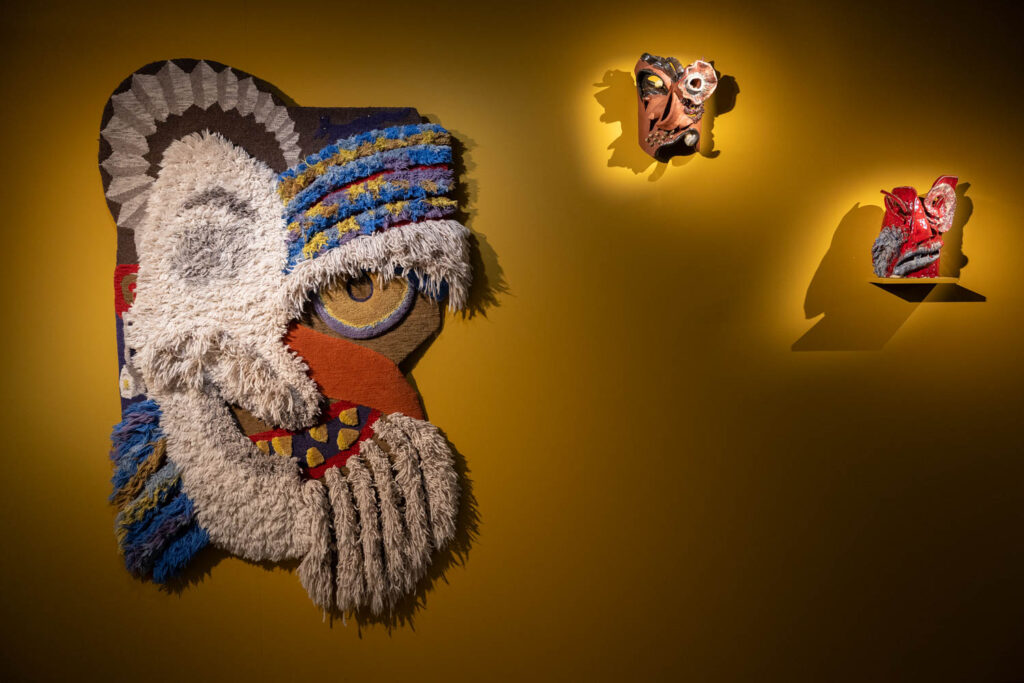
ID: What can imperfection do that precision can’t?
CH: Imperfection brings something closer to us. I want to feel that a carpet has been made by hand and that making it wasn’t completely effortless. I design things quite precisely, but within that I like to create uncertainty—mixing yarns, dip-dyeing something, allowing a color to behave in a way I can’t entirely predict. I still want a beautiful carpet, but I don’t want to control every millimeter. The irregularity gives it an existence of its own.
ID: Your work often sits between art and design, yet you still call yourself a designer. Why is that distinction important to you?
CH: I don’t really mind what people call me. What bores me a little is the idea that as soon as something is colorful, wild, or illustrative, people say, “Oh, but that’s art.” My carpets are made to be used, whether someone puts them on the floor or on the wall, and my ceramics are lamps. I like things to have a role and a function.
So yes, I consider myself a designer. Design is such a broad world, from the very minimal to something completely different, and I want to be part of that diversity. I don’t want the work to be pushed into the art category simply because it looks different. In a way, I want to show that this is possible within design too.
ID: When an idea arrives, do you know what form it should take?
CH: It’s very fluid. I usually have one main thing. For many years that was fashion, and for roughly the past decade it has been carpets. The other things often grow out of that. I might be working on a carpet and think it would be nice to have a lamp with it, and that leads me into ceramics. Or I see a wall and immediately want to do something with it.
At the moment, fabrics, curtains, walls, wallpaper, carpets, and ceramics feel very connected. Maybe that comes from fashion, because there you work in collections: the large motif, the small motif, something colorful, something quieter. I can start with one thing and then it branches into others. Sometimes an idea leads me somewhere; sometimes it’s a commission. One thing tends to lead to the next.
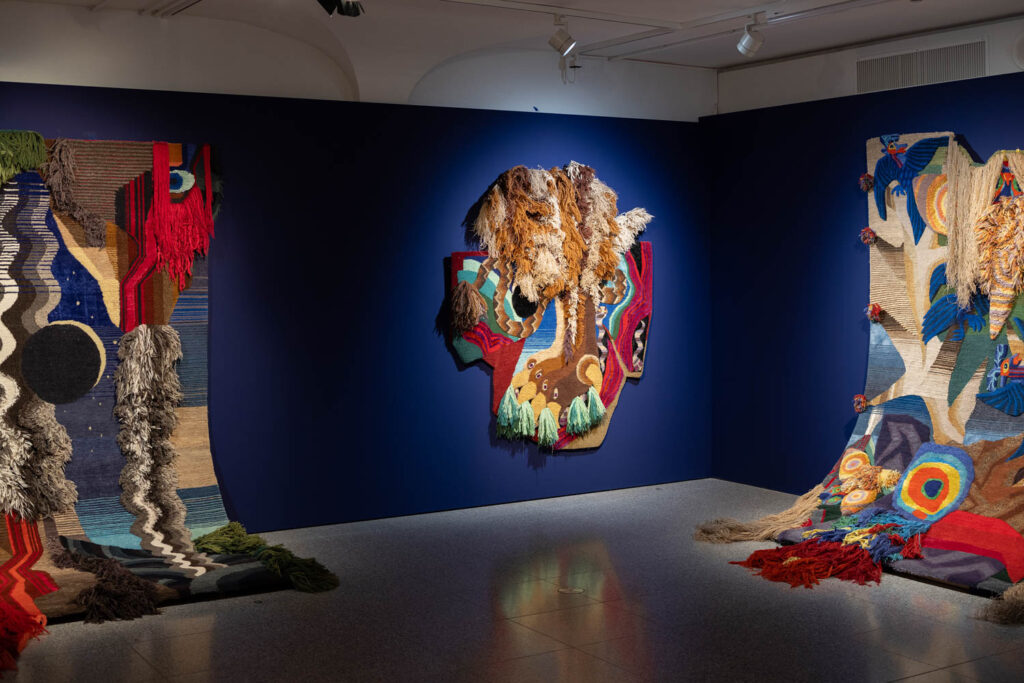
ID: Has making this exhibition changed what you want to do next?
CH: It made me realize that I’m increasingly interested in creating a whole picture. Before, I thought of making a carpet and sending it out into the world to see where it would end up. Now I’m more interested in bringing things together: the carpet with the walls, the ceramics, the furniture, the room.
I would love to work on a hotel lobby, a restaurant, or especially a bar. Or an entire house—even just one room where somebody says: “This is our house, but we want this to be a Hefti room.” I would find that very exciting.
At the same time, working on the exhibition was a little scary because I wondered whether looking back and analyzing everything might somehow kill the thing that keeps me designing. Then I made the Missing Cat carpet, which is the final work in the exhibition, and I realized I could continue. I can walk out of the exhibition, see that carpet, and go straight back to my sketchbook.
read more

DesignWire
Designers And Manufacturers On The Move: November 2026 Edition
Take in must-know industry promotions and hires, like new principals at Workshop/APD and a key acquisition in the acoustics space.

DesignWire
Designers And Manufacturers Convene In Sonoma For Hospitality Giants
Hospitality Giants brought leading designers and manufacturers to Sonoma’s wine country for design tours, culinary experiences, and creative workshops.