
10 Questions With… FUTUREFORMS
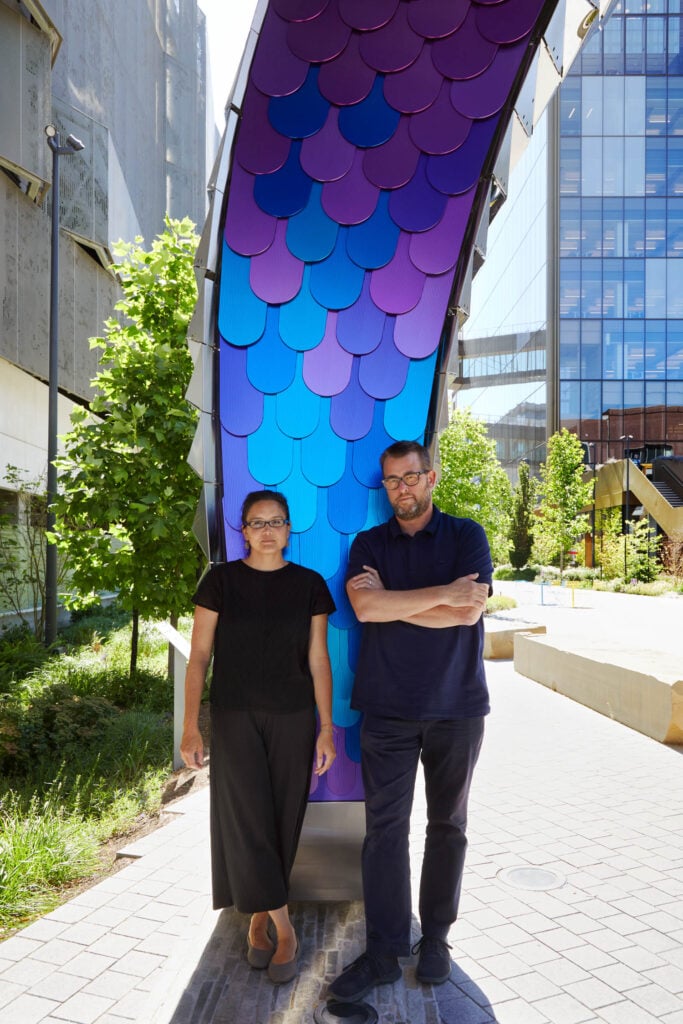
The Bay Area-based art and design studio FUTUREFORMS broadcasts its philosophy in its name. The husband-and-wife founders, Jason Kelly Johnson and Nataly Gattegno, have become known for their large-scale public artworks that, through their innovative use of materials and technology, sometimes look like something dropped from an alien spaceship. “The ‘Future’ in our name reflects our forward-looking mindset and the digital tools that allow us to prototype and visualize worlds not yet realized,” they say. “The ‘Form’ represents our commitment to the underlying craft behind the structure, material, and making.”
Johnson and Gattegno met at the school of architecture at Princeton University, where they studied under professors such as Elizabeth Diller, Peter Eiseman, and Jesse Reiser, and they themselves continue to teach in the field. For them, the transition to public art was an extension of their training in matters of siting, infrastructure, construction, and urban design. In that way their creations are not just individual works, but part of the urban fabric. And they are deeply responsive to and embedded in their site, from the fog and salty air of San Francisco to tropical Florida with its powerful storms. Their bold designs are rendered in durable, sturdy materials like stainless steel to ensure they can stand the test of time.
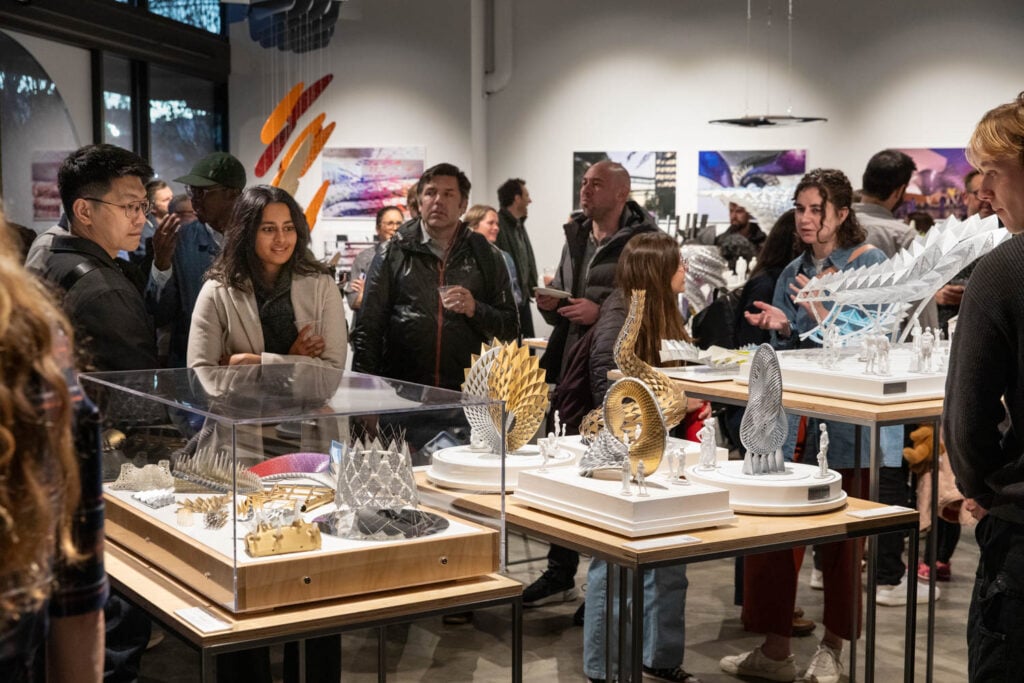
They describe their new traveling exhibition “METAXIS” as a studio visit; a curated selection of models, mockups, tests, and drawings that gives visitors a look into the often unseen parts of the design process. It recently closed a stint at the California College of the Arts Campus Gallery and it’s now bound for an upcoming east coast location. METAXIS (its name derived from the Greek word metaxi, meaning an in-between condition) is about neither final works nor unbuilt ideas, but the fluid middle state where their monumental visions slowly become reality. It describes how the studio works across mediums and translates from the digital to the material, combining the best of technology and craftsmanship.
We spoke to FUTUREFORMS about METAXIS, their design philosophy, and how architecture and art-making intertwine in their work.
In Conversation With FUTUREFORMS Cofounders
Interior Design: What do your collaborations across disciplines, like with engineers and landscape architects, look like? When do they get involved in the design process?
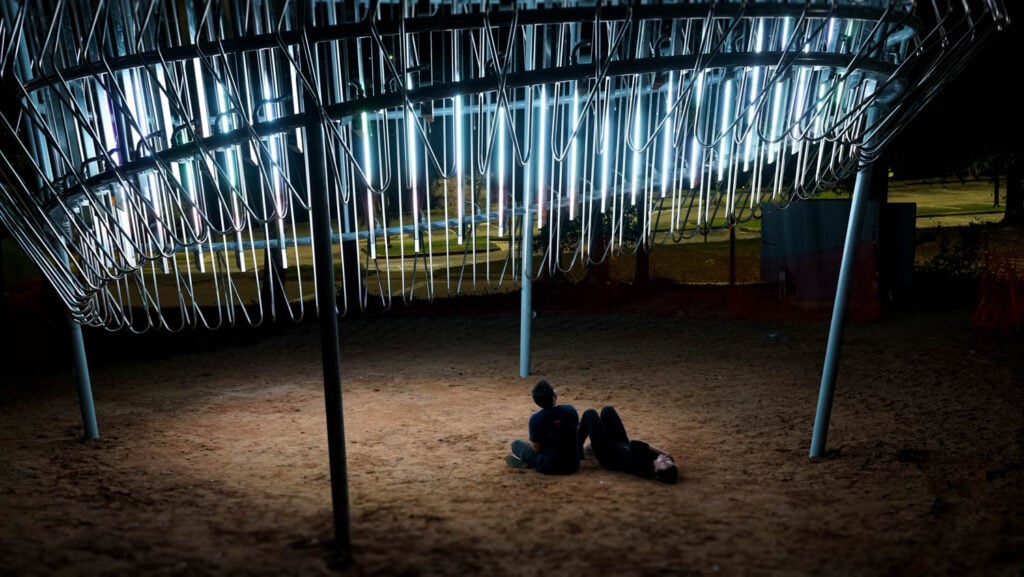
Jason Kelly Johnson and Nataly Gattegno: We place a strong emphasis on early collaborations with the full design team—particularly structural engineers, landscape architects, and urban designers—so that our work is embedded within the larger project framework from the outset. Being at the table early allows us to engage with the broader design vision and contribute ideas that build upon conceptual, spatial, and urban strategies rather than operate independently of them. In our most successful projects we have worked in close dialogue with landscape and building architects, integrating our interventions into site systems, circulation, and phasing, and ideally becoming part of the project’s overall construction sequence. Our work on the sculptural Levitt Pavilion with the landscape architecture firm CMG on St. James Park in San Jose, is a great example of this.
Typically, structural engineers are a key creative partner from the very beginning—often engaged while we are still pursuing a project. We are currently collaborating with a number of engineers of different scales of projects, including with ARUP and MKA on some of our larger projects like the Levitt Pavilion, Orbital, and Stretto. For medium-scale projects like “Constellations,” in Pensacola, Florida, and an upcoming pavilion in Scottsdale, Arizona, we have had a very fruitful collaboration with ENDRESTUDIO, led by structural engineer and architect Paul Endres. Together, we develop concepts where structure is not an afterthought, but a generative driver of form. This collaboration allows us to fully integrate structural logic into the design itself: faceted skins that perform structurally, expressive ribs that carry loads, or internal frameworks that reveal themselves through particular viewpoints.
ID: Your works are largely site-specific. How do you learn about a site when you are thinking about creating an artwork for it? What kind of research do you do?
JKJ and NG: We approach every project with the belief that a site is not just a location, but a layered record of material, ecological, and social histories. Our process begins by uncovering what has shaped a place over time—its past landscapes, the materials drawn from it, the communities that have inhabited or passed through it, and the cultural practices embedded within it. We look at these histories through multiple lenses, from native ecologies and patterns of extraction or cultivation, to the lived experiences and narratives that continue to define the site today. These overlapping histories provide a rich framework that informs the direction and meaning of the work.
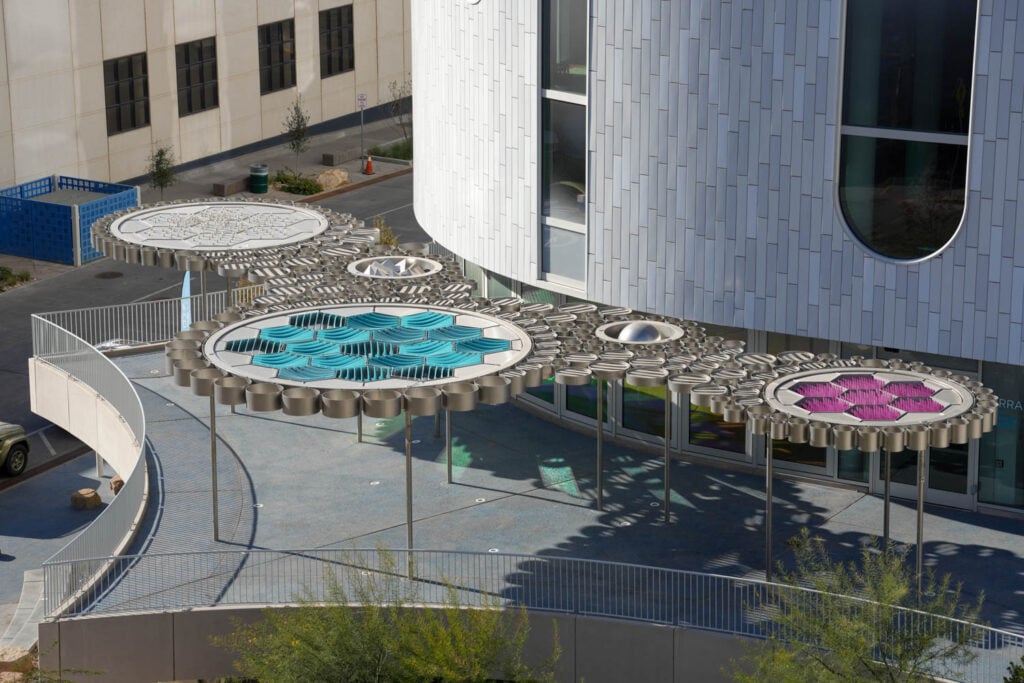
Equally important is understanding how a site is used in the present—how people move through it, gather, pause, and interact across the rhythms of the day and the cycles of the seasons. We study patterns of circulation, moments of convergence, and temporal shifts in light, climate, and occupation, allowing these dynamics to shape the spatial and formal logic of the project. From this, we begin to identify latent patterns—whether drawn from environmental systems, cultural artifacts, or collective behaviors—that can be translated into form. A wide-open field might suggest an engagement with the sky and atmospheric conditions; a performing arts district might reveal choreographies of movement; a historically significant site might point to material traditions or craft practices. Our projects such as “Weatherscape” in El Paso, sited on the outdoor terrace of a children’s museum designed by Snohetta, become an interpretation of these intersecting forces, grounding the work in the specific material and social life of its context.
On a more personal level, our two daughters—now 8 and 13—have also shaped this perspective in very meaningful ways. Raised in San Francisco, their curiosity, openness, and unfiltered ways of seeing the world continually challenge us to rethink assumptions and embrace play, wonder, and experimentation. Experiencing public space through their eyes—how they move, gather, pause, and imagine—has deepened our sensitivity to the social and experiential dimensions of our work, reinforcing the importance of creating spaces that invite discovery, inclusivity, and shared engagement across generations.
ID: What are the similarities and differences between designing for a building or a monumental artwork?
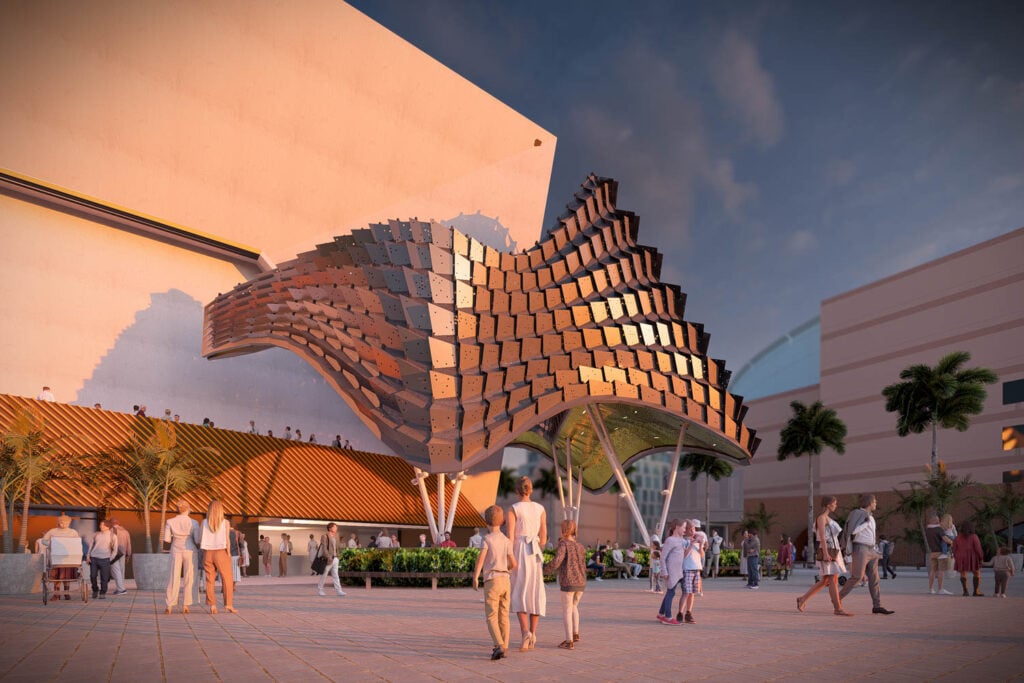
JKJ and NG: At larger scales, our work often carries the same technical complexity, permitting requirements, and multidisciplinary coordination as a building. It involves close collaboration with architects, engineers, and contractors, and must meet rigorous standards for safety, fabrication, and installation. Where our approach begins to diverge is in how the work is conceived within its context—whether as a singular, monumental object or as something more deeply integrated into an architectural or urban system. A good example of this is “Stretto” at OCVIBE in Anaheim, where the sculpture is over 60’ tall, and wraps around and overlaps with a new concert hall by POPULOUS. For this scale of project we have collaborated with a highly experienced team of engineers, fabricators and construction professionals including Matt Construction, who are well known for their work on the Broad Museum by Diller, Scofidio + Renfro, and the Academy Museum of Motion Pictures museum by Renzo Piano, both in Los Angeles.
Rather than treating public art as an isolated icon, we are often interested in work that is embedded within a site—interwoven with a building, a landscape, or the flows of a place itself. In these cases, the artwork participates in shaping space, movement, and experience, operating less as an object placed in a site and more as a spatial system that is inseparable from it. At the same time, the conventions of art practice allow for a different kind of authorship: we maintain a high degree of design control from concept through fabrication and installation. This means we are not only designing, but also detailing, prototyping, and in some cases directly producing key components—bridging the gap between idea and realization in a way that differs from the typical architect-contractor relationship in building projects.
ID: Can you talk about the process of turning something from a model into a full-scale object? How often do design elements have to change to accommodate what’s possible given time/physics/funding constraints?
JKJ and NG: Translating a project from a model to a full-scale object is less a linear progression and more an iterative negotiation between intent and reality. Early models—often quickly constructed in basswood, paper, or acrylic—allow us to explore geometry, proportion, and spatial effect with a high degree of freedom, but they inevitably abstract away the forces, tolerances, and constraints that emerge at full scale. 3D printed models, if they are printed out of a single material with variable thicknesses, can also begin to inform us how a concept might perform from a structural perspective. As we move into engineered assemblies, the concepts are re-evaluated against gravity, wind, fabrication limits, budgets, and installation logistics. Elements that feel effortless at a small scale—thin edges, tight radii, seamless transitions—often require rethinking when they must perform structurally, be fabricated efficiently, and endure over time.
As a result, change is not the exception but the mechanism of the process. Design elements are continually adjusted in our parametric models—sometimes subtly, sometimes fundamentally—to align with physics, cost, and constructibility, but ideally without losing the conceptual clarity of the original idea. Close collaboration with structural engineers, fabricators, and contractors becomes essential in this phase, as their input helps transform abstract form into buildable systems. The goal is not to compromise the design, but to evolve it—allowing the realities of material and scale to sharpen and deepen the work rather than diminish it.
ID: This exhibition had to do with process as much as it did with final products. What is it like sharing aspects of the design process the public would not usually see?
JKJ and NG: Much of what shapes our work remains invisible to the public, who typically encounter only the finished piece. Yet the design and fabrication process—iterative, hands-on, and often unpredictable—is central to how the work is conceived and realized. In our recent gallery exhibition “METAXIS”, we are interested in opening a window into that process by effectively staging a “studio visit”: bringing forward models, mockups, tests, drawings, and fragments that reveal how ideas evolve over time. The challenge is in how much to show and how to frame it – offering enough to communicate the rigor, experimentation, messiness and collaboration behind the work, while still preserving a sense of discovery and not over-explaining the outcome.
Rather than presenting a polished narrative, the exhibition embraces the partial and the in-progress. It foregrounds the back-and-forth between digital modeling and physical prototyping, the false starts, and the material experiments that rarely make it into public view. By curating these artifacts and moments, the gallery becomes a space where process is legible but not fully resolved—inviting visitors to engage with the work as something unfolding, rather than fixed. In doing so, it offers a glimpse into the studio’s inner workings while maintaining the mystery and openness that allow the final work to resonate on its own terms.
ID: You work with modern technologies like digital fabrication and 3D printing alongside handcrafting. How do the analog and digital work alongside or in tension with each other?
JKJ and NG: We don’t see the analog and digital as opposing modes so much as materials to be stitched together into a single workflow. Digital tools—parametric modeling, simulation, robotic fabrication, 3D printing—allow us to explore complex geometries, test performance, and coordinate systems with precision. At the same time, handcraft remains essential: it’s where we test tolerances, feel material behavior, and introduce judgment, intuition, and variation that can’t be fully scripted. The work moves back and forth between these realms, with each informing and correcting the other.
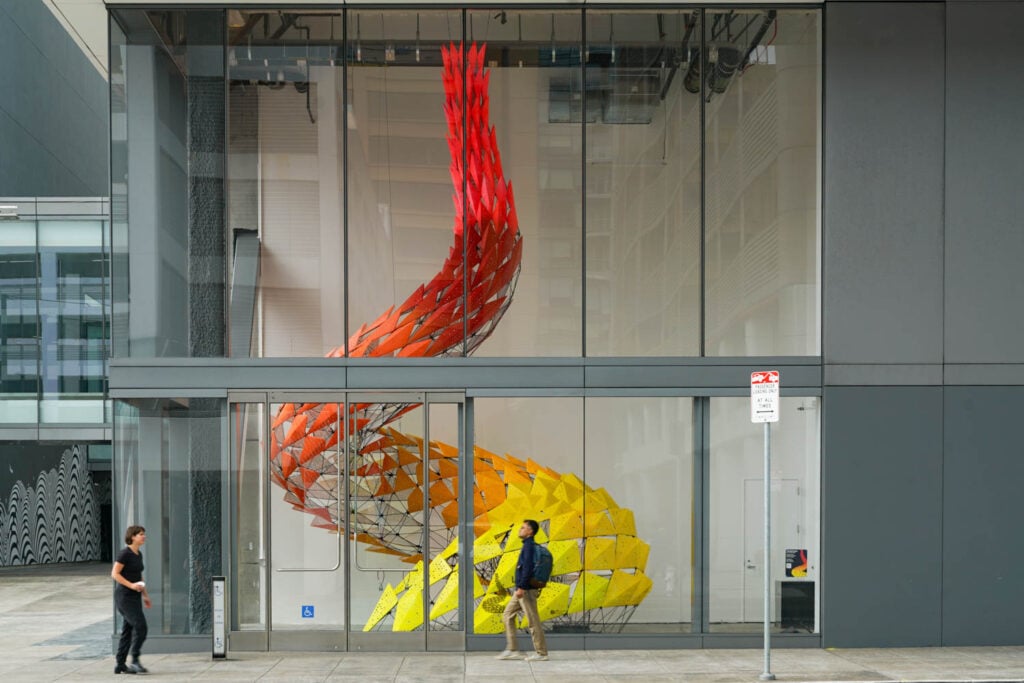
What emerges are what we think of as synthetic assemblies—structures that combine high-tech precision with low-tech intelligence. Our recent installation, “Leviathan”, at the Moscone Center in San Francisco, is a great example of what we call “digital craft”. A digitally generated form might be rationalized into repeatable parts, but then tuned through physical prototyping and hands-on assembly. Conversely, a craft-based technique might be scanned, modeled, and amplified through computational processes. There is a productive tension between the two: the digital pushes toward complexity and control, while the analog grounds the work in material reality and human touch. The goal is not to resolve that tension, but to leverage it—creating work that is at once technologically advanced and materially direct.
ID: How did you curate the works featured in this exhibition?
JKJ and NG: The exhibition is conceived as a curated cross-section of projects—primarily realized or in construction—that both opens our process to the public and reflects back on the trajectory of the studio. By organizing ten years of work in this way, it makes the ideas, methods, and iterations that typically remain behind the scenes legible, offering insight into how projects evolve from concept to built form. At the same time, it is not simply retrospective; it acts as a kind of internal roadmap, clarifying the directions we want to continue pursuing.
Across the work, certain themes and typologies come into focus—canopies, pavilions, installations and furniture; faceted and tubular systems; geometries drawn from natural phenomena and mathematical logics. By presenting these projects together, the exhibition reveals both continuity and progression, helping audiences understand the underlying threads of the work while also helping us articulate where those threads might lead next.
We also routinely build full-scale mockups of our work prior to final fabrication. We were able to present several of these in our most recent exhibition, including a full-scale prototype for “Celestia”, an upcoming suspended sculpture for a museum in Pittsburgh, Pennsylvania.
ID: Did you see any themes or throughlines when you were compiling 10 years worth of projects? What about ways in which your work has evolved?
JKJ and NG: We titled the exhibition METAXIS, from the Greek metaxi, meaning “between,” as a way to describe not only the nature of the work, but also the evolution of our practice. As we assembled the projects, it became clear that our trajectory has shifted, from a more academically-oriented studio rooted in speculation and disciplinary exploration, to one deeply engaged in the public realm. In that transition, our work has come to occupy a space between art and architecture, between conceptual inquiry and built reality, and between individual expression and collective experience.
METAXIS frames this condition as an active, generative space. It explores what happens in between ideas, objects, and scales—between the building and the city, the studio and the site, the speculative and the constructed. Rather than a fixed position, it reflects a dynamic state of practice: an ongoing oscillation where different modes of thinking and making intersect. In this way, the exhibition not only describes where the work sits, but also how it has evolved—charting a movement from academic exploration toward a more public, civic, and materially grounded form of engagement.
ID: What do you hope visitors seeing your works will get from the experience?
JKJ and NG: We hope visitors leave the exhibition with a deeper appreciation for the richness and range of our creative practice—recognizing it not as a fixed methodology, but as an open framework for experimentation and discovery. By revealing both the outcomes and the processes behind them, the show invites people to see how ideas evolve through collaboration, iteration, and the interplay of different skills across our studio team.
At the same time, we hope it sparks a broader curiosity: to look more closely, to spend more time with the details, and to begin to uncover the underlying logics—whether natural, material, or social—that inform the work. In that sense, the exhibition is as much about how we make, as what we make, highlighting a practice that is collaborative, adaptable, and continually exploring new ways of thinking, designing, and building.
ID: What do you see, or hope, for the future of public art or public space in general? How does this also influence your approach to public art master planning?
JKJ and NG: We see public art as an essential contributor to the social and cultural life of cities—an active participant in shaping how urban spaces are experienced, shared, and understood. Within the democratic framework of public space, art introduces another voice into the collective conversation, enriching the layers of meaning that define a place. It has the capacity to make cities more engaging and memorable to inhabit—inviting curiosity, sparking interaction, and offering moments of delight, reflection, or connection within the everyday.
In this sense, public art does more than occupy space; it helps produce it. It creates settings for encounters—places to gather, to pause, to exchange ideas, and to see one another. Especially in a time of increasing polarization, these shared experiences become vital. By activating the urban realm and fostering dialogue, public art contributes to a more vibrant, inclusive, and culturally resonant city.
Our work in arts master planning in cities like Chattanooga, Denver and Anaheim has further shaped this perspective, allowing us to think beyond individual projects and consider how a network of artworks can operate across a site, district, or city. Through this lens, public art becomes both strategic and cumulative—engaging patterns of movement, program, and identity over time. It encourages us to think at multiple scales simultaneously, aligning singular interventions with broader urban and cultural frameworks, and reinforcing the role of art as an integral component of the public realm rather than an afterthought.
read more
DesignWire
Behnaz Farahi Approaches Design With Eyes Wide Open
At the MIT Media Lab, Behnaz Farahi explores the intersection of design, art, materials, and technology to create environments that surprise and invite reflection.
DesignWire
10 Questions With… Multidisciplinary Artist Oksana Levchenya
Oksana Levchenya reflects on how her work transforms traditional Ukrainian weaving into a contemporary language of form and meaning.