
Behnaz Farahi Approaches Design With Eyes Wide Open
At the MIT Media Lab, Behnaz Farahi explores the intersection of design, art, materials, and technology to create environments that surprise and invite reflection
After earning a master’s degree at California’s USC School of Architecture, Behnaz Farahi knew that she didn’t want to follow a conventional career path, so she completed a PhD in the university’s cinematic arts department. It was a horizon-expanding time for the Iranian native, who found herself collaborating with the school of engineering on a NASA-funded project while also being exposed to queer and feminist theory, performance art, and the work of scholars like Amelia Jones. “These experiences helped me frame technology,” she recalls, “not just as a tool but as a medium for questioning power, identity, and social norms.”
Several of Farahi’s early projects integrated wearable architecture with technology to explore movement, human interaction, and such social issues as othering and female objectification. In 2024, the self-described “critical maker” joined the MIT Media Lab, the academic research laboratory within the Massachusetts Institute of Technology School of Architecture and Planning, as an assistant professor in media arts and sciences, where she directs the Critical Matter research group. She is also one of three inaugural holders of a Morningside Academy for Design Professorship, with a mandate to catalyze design across multiple disciplines and departments at the institute. Her numerous honors include a Cooper Hewitt Smithsonian Design Museum Digital Design Award and a World Technology Award. Her work has been included in the permanent collection of the Museum of Science and Industry in Chicago as well as exhibited internationally, and she has been a featured speaker at Interior Design’s Giants of Design conference.
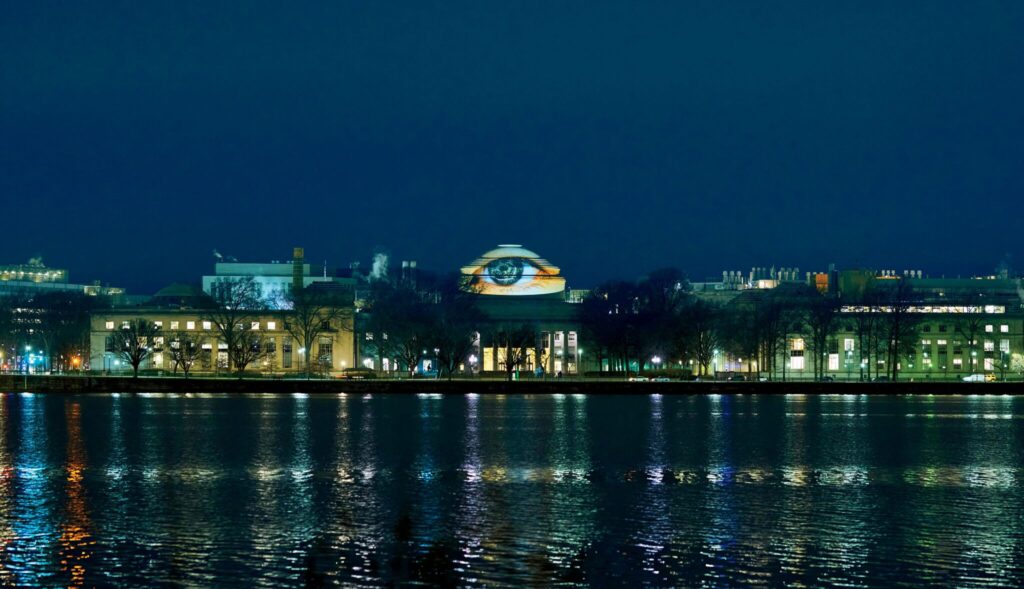
Last year Farahi produced Gaze to the Stars, a multimedia, site-specific performance-art installation, in which participants sat in a futuristic pod and answered AI prompts about their innermost feelings. Computer-vision tools tracked their eye movements, then projected the meta data–embedded images onto MIT’s Great Dome, transforming the landmark into a giant eye in the sky that was at once startling, beautiful, and thought-provoking. We recently spoke to her about her career so far and her plans for the future.

In Conversation With Behnaz Farahi
Interior Design: Did being born and raised in Tehran influence your work?
Behnaz Farahi: Growing up under a repressive regime shaped my awareness of the body, visibility, and control from an early age, especially as a woman. Working in industrial, often male-dominated spaces was especially transformative. Engaging directly with machines and materials gave me a sense of agency and confidence. I realized that I wanted to challenge existing boundaries, both socially and disciplinarily. At some point, I had a very clear dream of leaving and pursuing a different life. That journey was not just geographical but also deeply personal—I began to discover my own voice and identity.
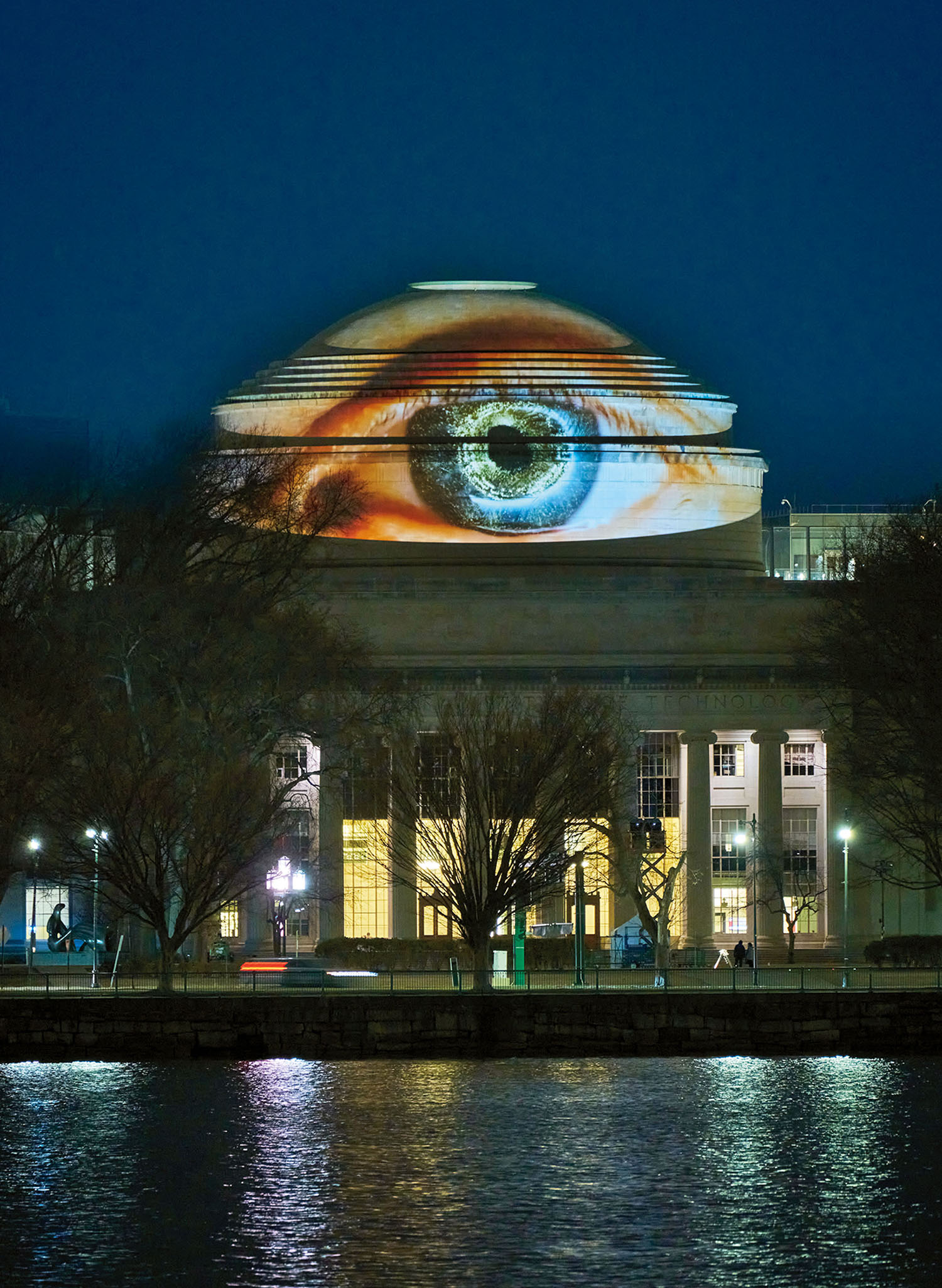
MIT’s Great Dome, a historically protected structure, its surface transformed into a storytelling vessel by Gaze to the Stars, Farahi’s 2025 projection installation. Photography by Chenyue “ Xdd44” Dai. 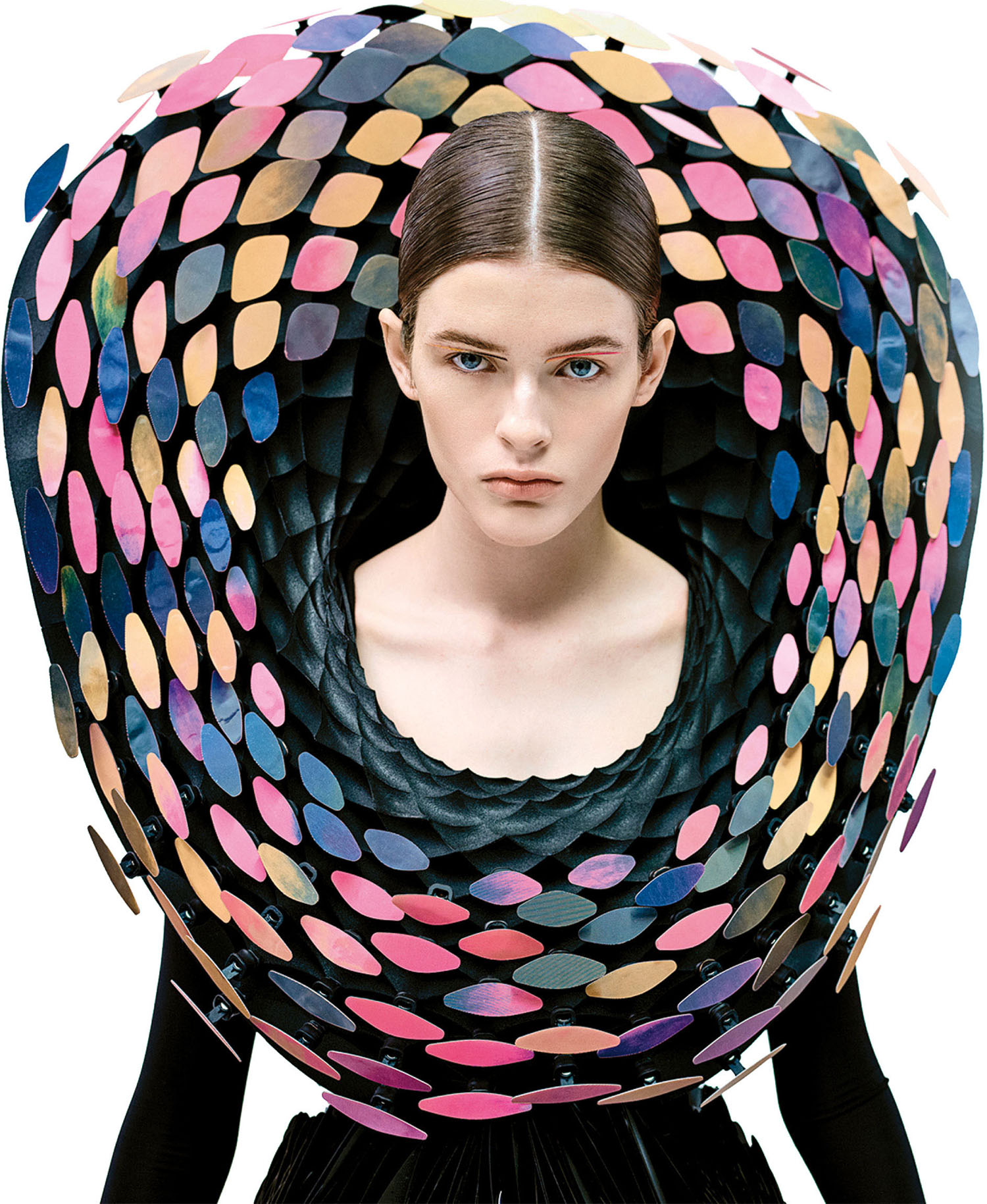
Iridescence, 2019, her 3D-printed interactive collar that responds to onlookers’ movements and facial expressions, part of the “Wired to Wear” project commissioned by the Museum of Science and Industry in Chicago. Photography by Kristina Varaksina. 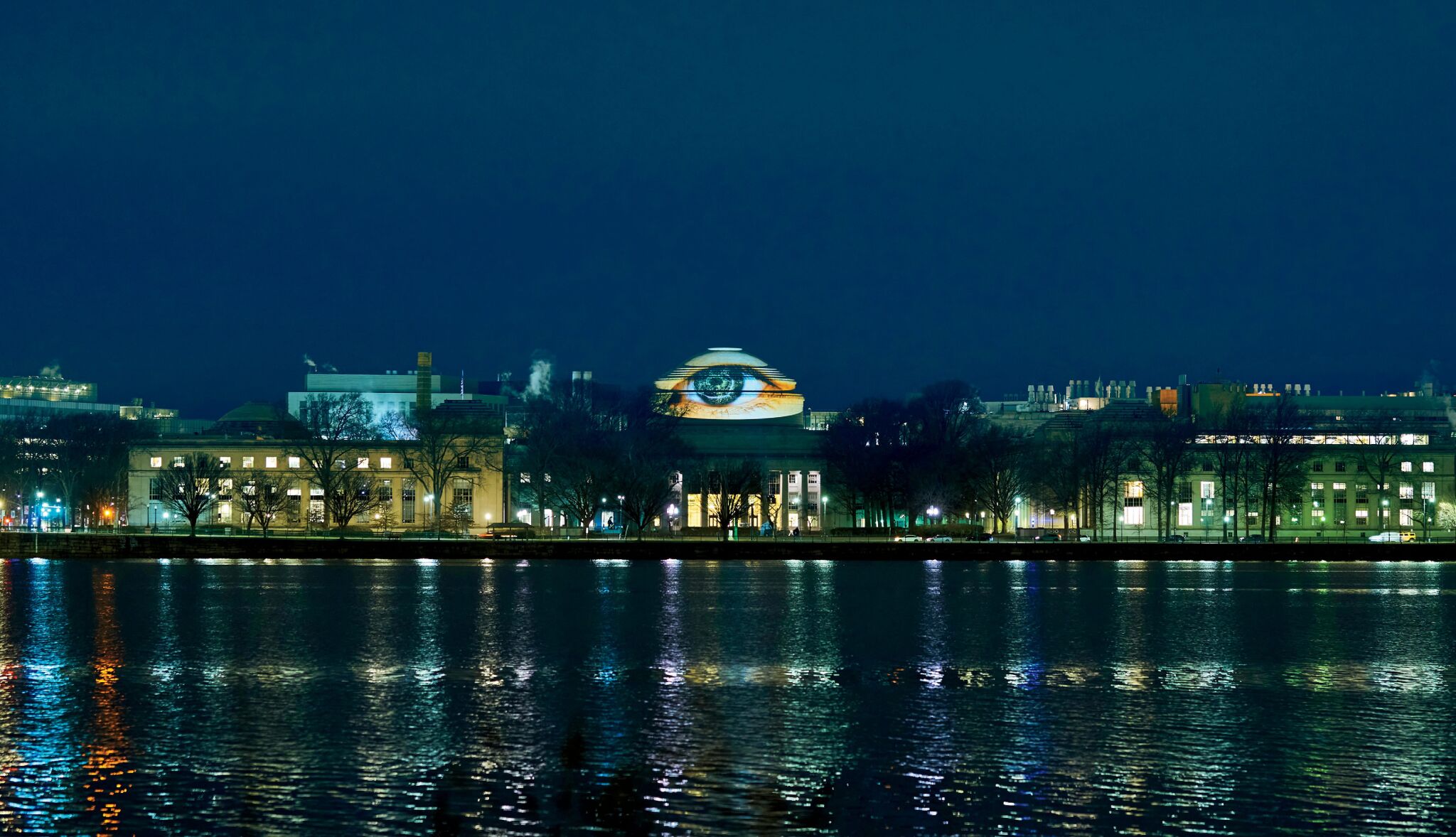
For Gaze to the Stars, a specially designed pod recording participants’ eyes as they respond to AI prompts. 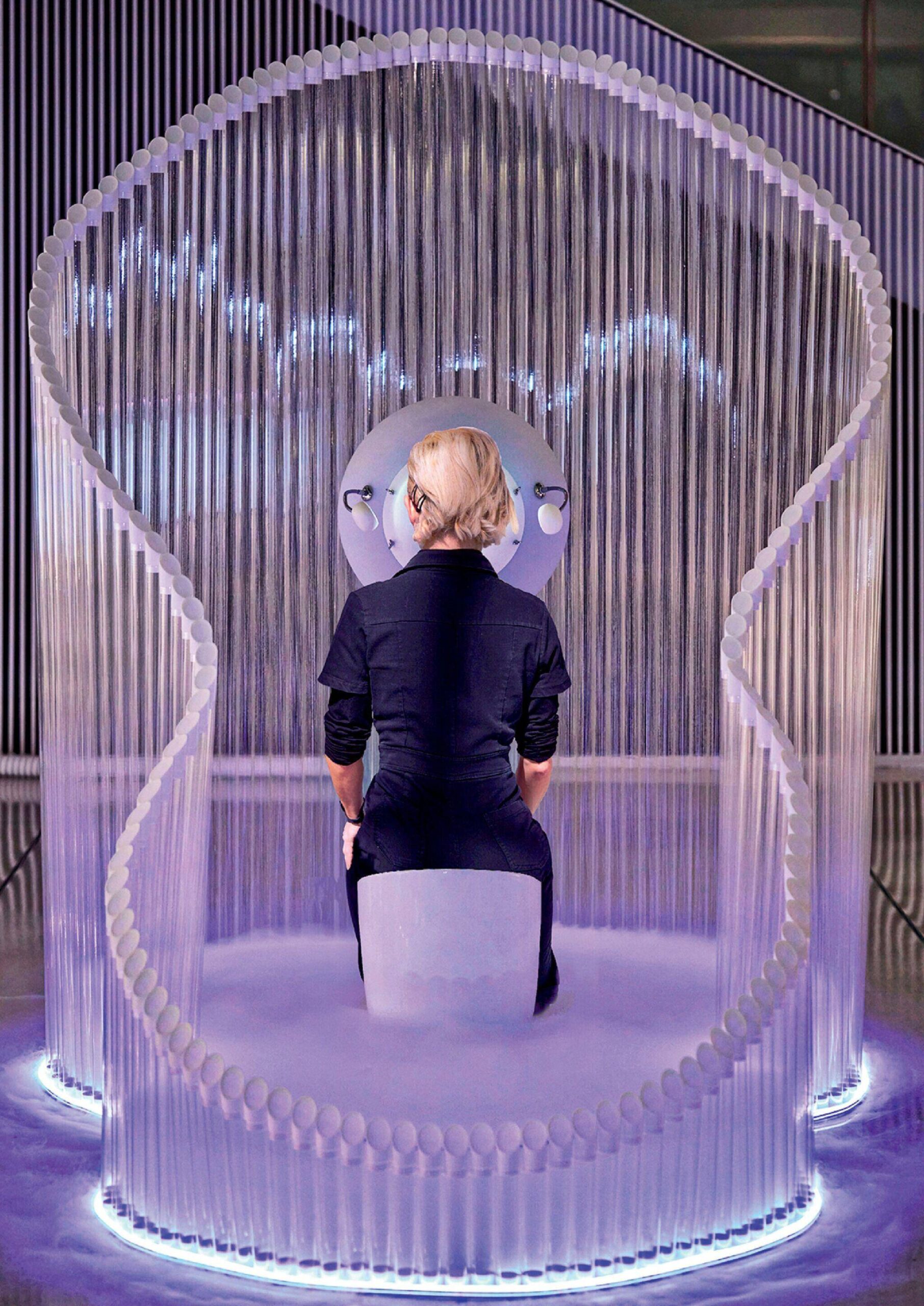
From across the Charles River, the projected images surveying the night sky. Photography by Chenyue “Xdd44” Dai; Jimmy Day.
ID: Photo-projection as a form of social commentary is having a moment. What did you want people to perceive in Gaze to the Stars?
BF: A shared humanity. MIT is often seen as a place where people look toward the future, innovation, and progress. We wanted to gently shift that gaze inward and outward at the same time, toward the lived experiences of the community. We were also inspired by MIT’s long tradition of site-specific “hacks”—one of the most memorable involved a police car mysteriously placed on top of the Great Dome—so we reimagined the dome as a platform for collective emotional storytelling, something that explores the tension between intimate personal affect and shared collective empathy, turning private emotion into a civic act.
ID: What are you doing for an encore?
BF: Something called Affective City. If Gaze to the Stars captured stories in one stationary pod in conversation with AI, Affective City brings the process back down to the scale of the body and everyday life to the city. We’re exploring wearable systems that can move through the city and collect stories in situ, gathering emotional experiences as they unfold across different neighborhoods and communities. Instead of a single site, the entire city becomes a kind of living, emotive map.
ID: Your work reminds me of multimedia performance-art by Laurie Anderson and Krzysztof Wodiczko.
BF: I’m really honored by that comparison. I’ve long admired Anderson; her ability to blend technology, storytelling, and performance in such a poetic and critical way has been very influential to me. And Wodiczko has actually been a mentor, someone I’ve been fortunate to know over the years. His approach to projection as a form of public intervention, and his commitment to giving voice to marginalized experiences, has deeply shaped how I think about art in public space.
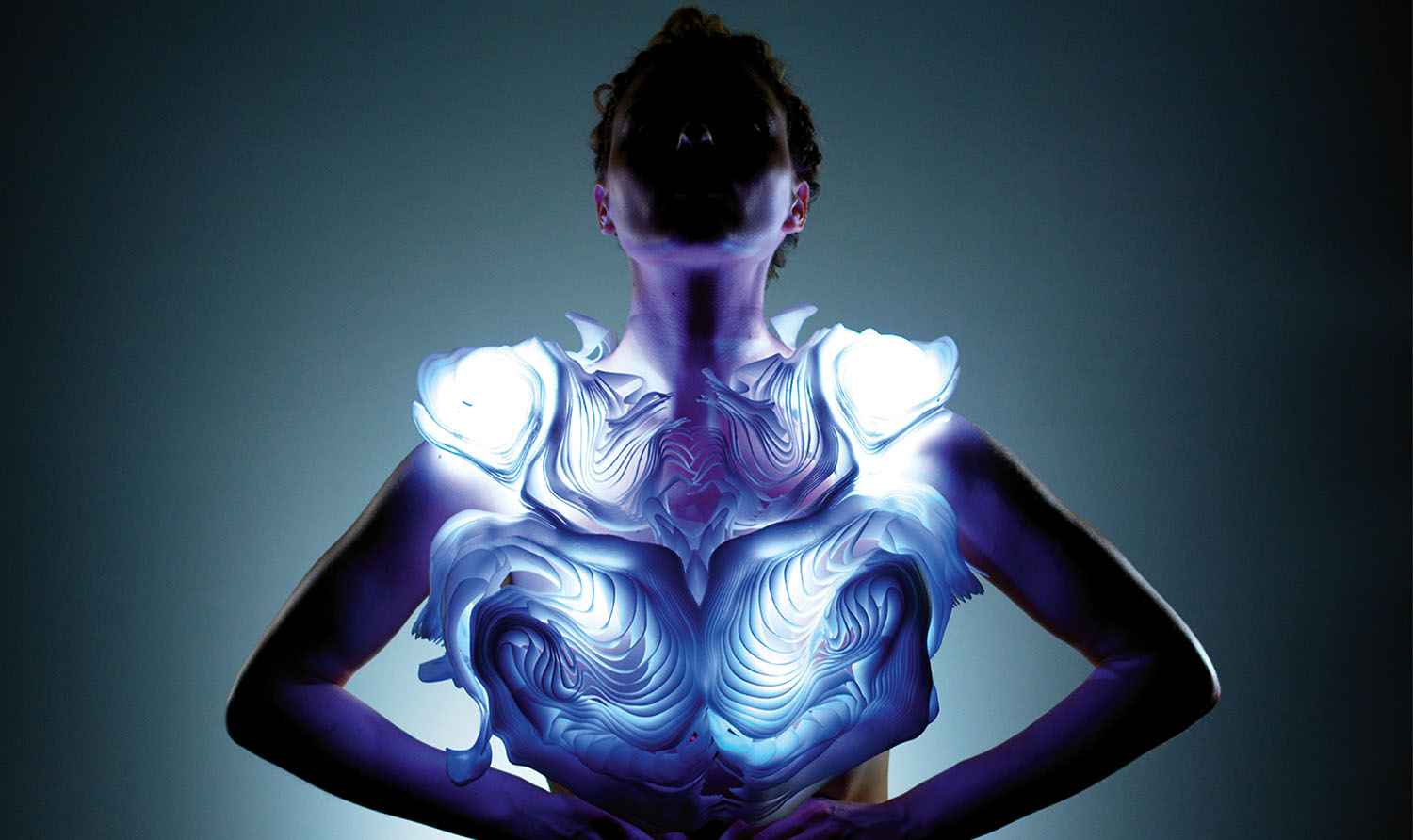
Bodyscape, 2017, a 3D-printed garment that tracks the wearer’s shoulder movements through gyroscopically controlled LED illumination. Photography by Kyle Smithers. 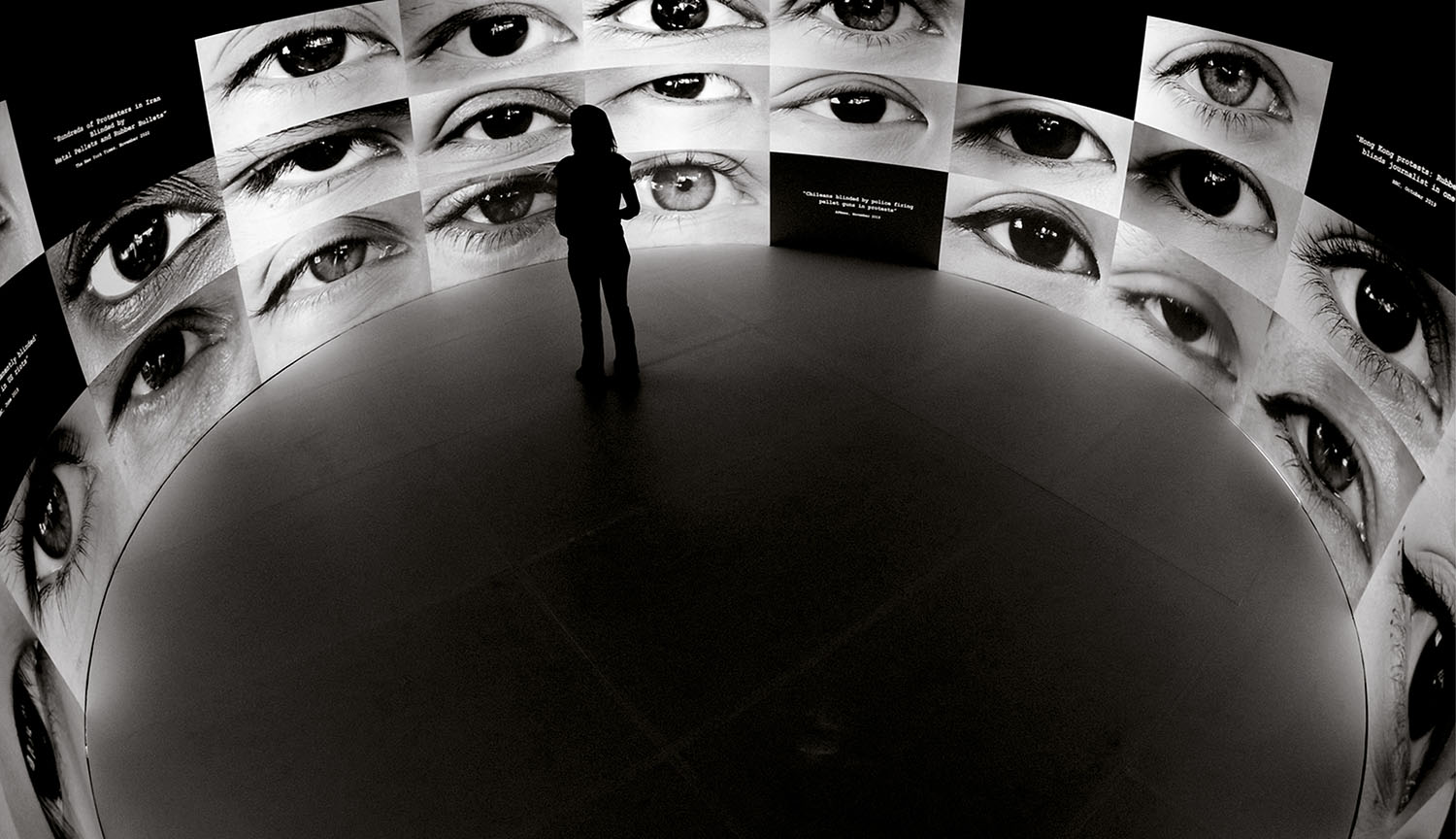
In Blindness, 2023, close-up recordings of protesters’ eyes injured by authorities’ violence, their own words appearing across the ocular surface while reaction-diffusion patterns ripple and digitally generated black tears fall. Photography by Gregory Crosby. 
Breathing Wall II, 2014, a soft, fabric-clad surface that swells and contracts in response to hand gestures, its contours captured and returned as projected lines of light. Photography by Laura Cechanowicz. 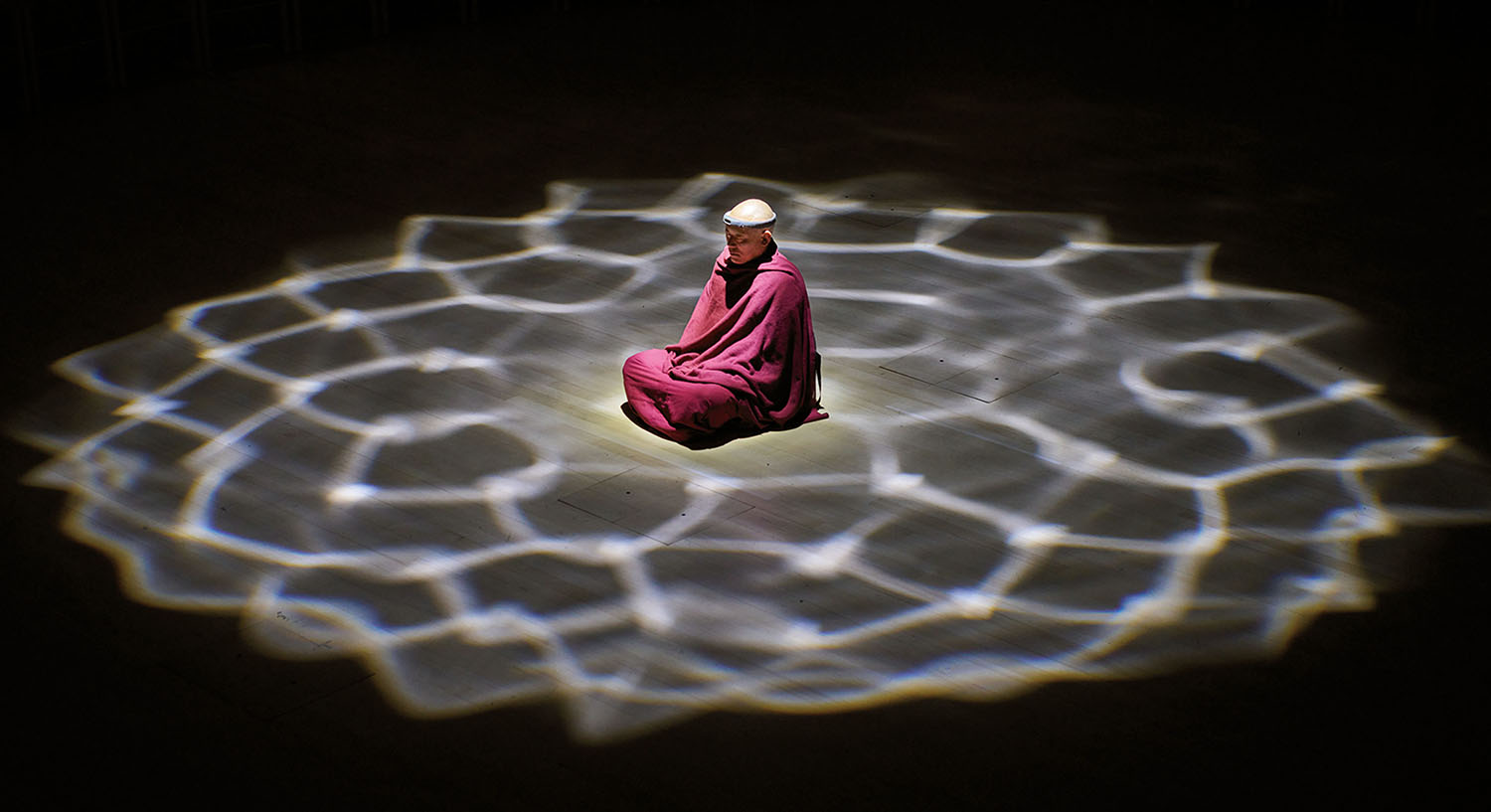
Brain waves of a meditating monk translated into water-pattern reflections in Resonance, 2025. Photography by Yuxiang Cheng.
ID: Tell us about Resonance, an “immersive contemplative installation” you presented at MIT’s new SANAA-designed music hall earlier this year.
BF: The work translates the brain waves of a meditating Buddhist monk into dynamic water patterns, casting reflections throughout the space. As neural rhythms animate the liquid surface, thought becomes movement, rendering invisible states of attention and awareness perceptible through light and vibration. A traditionally solitary contemplative practice is transformed into a shared spatial experience. The installation occupied the building’s vertical expanse, suspended from a 40-foot-high ceiling. The architectural volume, acoustics, and reflective surfaces became active components, transforming the hall itself into a responsive field of light, water, and shared resonance.
ID: What is a typical day at the lab?
BF: Right now, we have about 11 researchers who work in small, interconnected teams on various projects organized across three areas: social, psychological, and material. There’s a rhythm to it—teams come together, share what they’ve been exploring, what they’ve discovered, and new questions that are emerging, then they disperse to follow those questions into new directions.
ID: What kinds of questions?
BF: In the material domain, for example, we focus on novel fabrication processes and circular material systems. We’re rethinking waste as a resource, and exploring the properties and meanings embedded in materials. Take human hair, something that carries a biological record and deep cultural significance and goes to waste daily. It can be transformed into keratin, opening up new possibilities for reuse. We extend this thinking to other overlooked materials—biological waste, algae, ocean plastics—materials that exist at the margins. We’re constantly asking, “What if?” Not just in a technical sense but also in a social and cultural one. What if materials could carry stories? What if environments could respond to emotion? What if design could foster new ways of relating to our bodies, to each other, and to the world around us? A typical day is less about routine and more about moving between making, questioning, and imagining together.
read more
DesignWire
Designers And Manufacturers On The Move: September 2026 Edition
Interior Design‘s latest On the Move includes must-know industry promotions and hires, like Perkins&Will’s strategic move to expand its design capabilities.
DesignWire
10 Questions With… Artist and Designer Conie Vallese
From sculpture and ceramics to glass, textiles, and furniture, Conie Vallese embraces a multidisciplinary practice shaped by curiosity and creativity.