
10 Questions With… Glenn Adamson
Glenn Adamson is among the most prominent curators and scholars of the 21st century. Based in New York and London, the former director of the Museum of Arts and Design and head of research at the Victoria and Albert Museum (V&A) is now an independent and ever-present figure in international design.
Adamson has challenged notions of aesthetic history with exhibitions like his epochal 2011 exhibition Postmodernism: Style and Subversion 1970 to 1990 at the V&A, and even the history of craft itself with the landmark show Objects: USA 2020 at New York’s R & Company gallery in 2021. He’s currently the artistic director for the Design Doha biennial, curator at large for the Vitra Design Museum, and the curator of the Clark Institute’s fascinating exhibition of outdoor sculpture, Ground/work 2025, which sites work by Yō Akiyama, Laura Ellen Bacon, Aboubakar Fofana, Hugh Hayden, Milena Naef, and Javier Senosiain around the Williamstown, Massachusetts, institution’s ever-changing outdoor acreage.
In the midst of all this, Adamson sat down for a wide-ranging video conversation with Interior Design, in which he talks about the role of a curator in this charged moment, the point and pitfalls of the design fair model, and commissioning outdoor sculpture just to let it decompose.
Glenn Adamson Delves Into The Global Design Landscape
Interior Design: Let’s start at the beginning. When did you first understand that an object was made with intention, and has meaning because of that?
Glenn Adamson: I was fortunate to have a grandfather who was a both a prominent aircraft engineer and also a hobbyist wood carver. He would let me watch him work as he was cutting through all these different timbers and making images of boards, which was quite extraordinary to experience as a child. Then, in college, I had the experience of handling some medieval Chinese ceramics. That was really the mind-blower for me. At first, I thought I would be a ceramic historian. And then it broadened out from there into understanding objects in relation to human skill and connection. It’s a continual process of trying to live up to your love of the object.
ID: How did the occupation of a curator and researcher make itself known to you?
GA: My first job after graduate school was at the Chipstone Foundation in Milwaukee. I was curating shows at a rapid flip and learned the trade of being a curator—it was only by doing it that I really understood. And then, I had the chance to go to the V&A and spend eight years in the research department. That’s where I curated a show about post-modernism, which was a much larger project than I was able to do in Milwaukee. The challenge in a large scale project is holding on to your own ignorance of the topic. When I talk to students, I’ll suggest that when they first start working on a project, they should write down everything they know on the subject and put in a drawer. They should check on it occasionally. Because, at best, that’s where their audience is going to be coming from. When you’re in a long-term research project, you kind of lose touch with what it’s like to not know about it, and that can make it very difficult to communicate clearly to the audience.

ID: Let’s talk about that postmodernism show—what did you seek to accomplish in terms of our understanding of it?
GA: In 2011, postmodernism was virtually a dirty word. As I tried to understand it in the show, with my co-curator Jane Pavitt, it’s an absolutely critical stage of the Radical Design trajectory, coming ultimately from the Art Nouveau movement through the Bauhaus and then through Italian Radical Design. Before that exhibition, I think it was understood basically as term of the 1980s culture wars: on the one hand meaning cultural relativism and on the other, the architectural debates of Charles Jencks. People lined up on both sides of it, and then a certain kind of exhaustion set in around the argument. People really wanted to move on, such that when we went to Frank Gehry, for example, and asked them to participate in the exhibition, they would basically say, well, we love the V&A but postmodernism, no thank you.
Now, I think the most useful way to understand it is as an embrace of plurality in distinction to what was understood to be a restrictive, principled ideal coming from modernism. Modernism pretended to be a clear window on the world, and postmodernism was like a broken mirror reflecting you back to yourself—multiple, fragmentary, confusing, somewhat arbitrary. It requires you to look at yourself in all your parts. It has this kind of criticality built into it, which is why I think we’re still living through its consequences.
ID: Which brings us to the idea of progress and your latest book, A Century of Tomorrows, which was published last December. How does a history of thinking about the future help us cope with the immense, and intentional, uncertainty of our time?
GA: There’s a sense of information overload. There’s climate change. There’s the crisis of authorship that Roland Barthes and others wrote about. And maybe most importantly, the future seems to be captured by corporate interests and state interests in a way that is new. The future has become a contested battleground. One way of thinking about the book is to show that hope, optimism, forward-planning, and serious thinking about the future is the best way to cope with uncertainty. We’re seeing a conscious attempt to foreclose the possibility of liberated and progressive futures, and it’s surprising that it’s meeting so little resistance. Looking back over the history of futurology, what strikes me is that there are so many positive role models—whether it’s Buckminster Fuller or Catherine Bauer—who have a lot to say to us in a moment like this.
ID: And what about us today? Is the responsibility on us as designers, architects, craftspeople, curators, journalists to resist?
GA: It’s the responsibility of the designer and the architect, and that makes them distinct from the craftsperson. One great way of understanding design is that it’s politics in material form. The Covid moment is basically asymmetrical power relations inscribed in urban and other environments, and how they would be contested and shaken loose by, say, outdoor dining—space that had been claimed for people to park was reclaimed for people to eat. Who benefited and lost in that kind of deal?
Craft is a motive force that can be used to achieve a lot of different ends, like a kinetic capability. I wouldn’t say the craftsperson has more or less responsibility than any human being does. But I wouldn’t look to a craftperson as an arbiter of social organization through objects and buildings, whereas that’s what we look to designers and architects to do. Being a curator is a second-order phenomenon. I’m curating a retrospective for Hella Jongerius which will open next March at the Vitra Design Museum. For that, I’m basically expressing a belief in another person’s material politics. I’m trying to shape and communicate her story as best I can, but it’s not my material politics. It’s very important to maintain that conceptual distinction. That semi-detached position is helpful both to the designer or artist and to the viewer.
ID: Curators and institutions around the country, and also the world, are facing intense pressure in terms of political opposition. How are you negotiating that?
GA: I haven’t had that pressure exerted on a project of mine yet, but it could happen, certainly. I have had more experience working on projects where there’s a corporate interest in place. When I was a museum director, I was obviously contending with the reality of fundraising, and I’ve had lots of encounters with those kinds of external stakeholders who have their own expectations. You’re navigating a highly complex situation where you have different forces in play, some of which you might approve of and some of which you may not. Ultimately, you’re trying to hold the interest of the artist or designer and the public in mind. You need to do that in a way that’s realistic and pragmatic, at least to some degree. That’s the approach I would take in a politicized environment as well. I think we should try to suss out exactly how progressive the institution could be in that moment and try to hit that target squarely, rather than grandstand on the one side or play it too safe on the other, if you see what I mean.

ID: How did that approach come to fruition curating something like the Design Doha biennial, in Qatar?
GA: That’s another complicated subject. The big point was that it was the first non-commercial, large-scale platform for design in the region. Obviously, you have this background context of Qatar’s political and economic reality, which is something I’m still learning about because I hadn’t worked in the region at all before. There’s a lot to say, beginning with the crucial diplomatic role they’re playing in the Middle East conflict, and the US military base in the country. Their diplomacy is a big part of their national story and character. There’s obviously the fossil fuel economy, the guest worker population—which you might want to compare to how the United States treats its guest workers and immigrants.
What I’ve wanted to do is take this unbelievable opportunity and contribute whatever I could as a non-regional specialist and a non-Arabic speaker, to the creation of this platform. When you have hundreds of designers converging from across this huge part of the world who have been given almost no oxygen by our discipline, to me, it spoke for itself as an urgent necessity and an incredible achievement of which I had small part. And next year, we have an open call that’s gone out for urban design interventions and exhibitions. Qatar really does create a space with its capital for people from across the Arab region, for countries that don’t have those advantages, and we’re just trying to do our best with that opportunity.
ID: What do you think is useful (and not) about the biennial or design fair model right now?
GA: The fair model is not sustainable from an environmental point of view. I think they can improve, but the model will clearly have to shift. Having these gatherings for design, in the form of the fair, seems to be more crucial and productive than what I see in our peer institutions in the art world, partly because there’s such a glut of air fairs which seem to be much more commercially led and much less community led just by virtue of their scale. That’s one thing I would say. But most of all, I worry about climate footprint.

ID: Speaking of the natural world, let’s talk about your show at the Clark in Williamstown, Massachusetts. What’s its origin story?
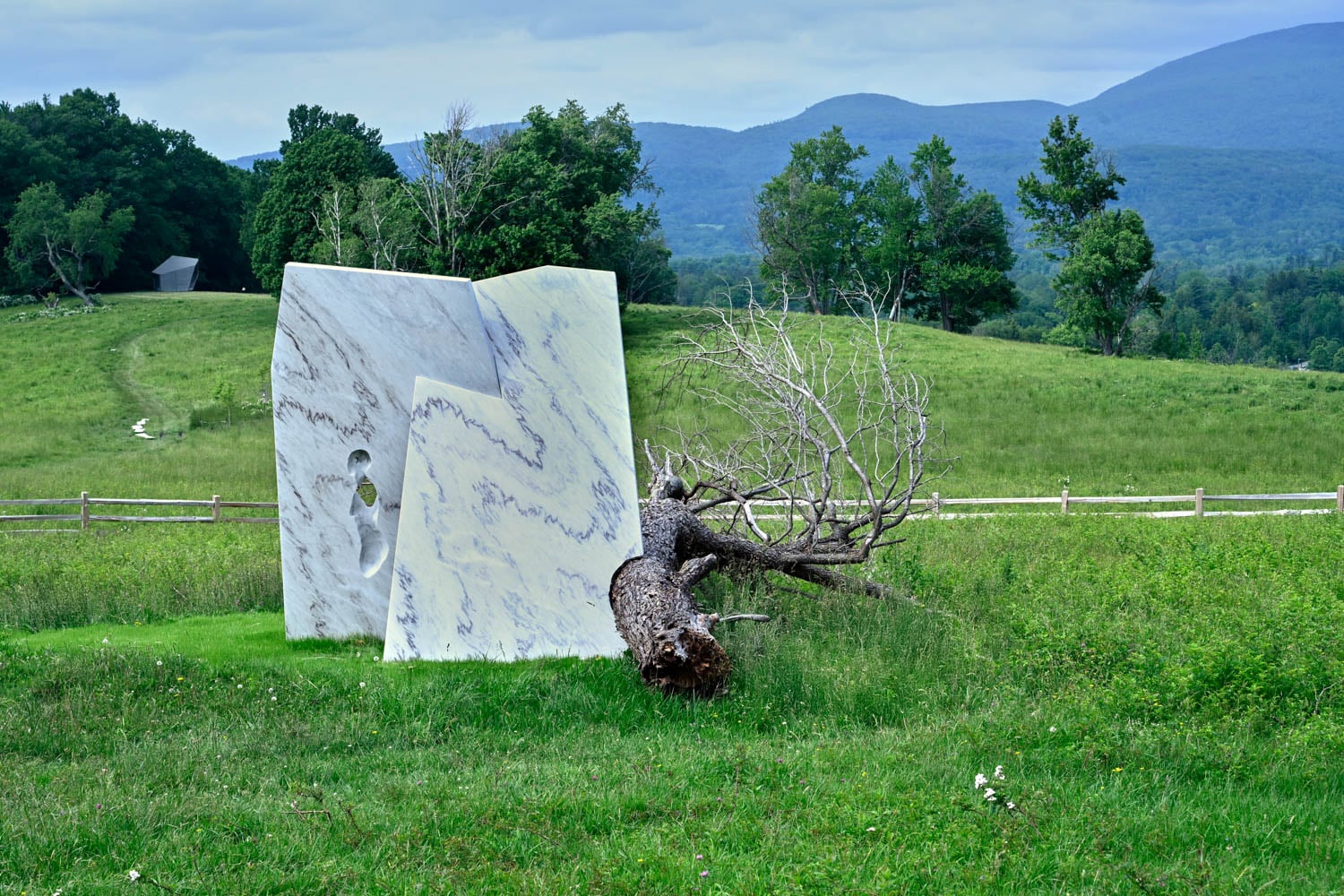
GA: The Clark Institute told me they had this exhibition called Ground/work, which happened during the pandemic lockdown, and it gave people access to art in a way they wouldn’t have had as the galleries were closed. They wanted to do another exhibition like that with the theme of craft. I felt strongly that the first exhibition had been successful and that it had a lot of DNA that we should replicate. And so, we have six commissions, the same as the first, with the same challenges, which were managing the terrain and making sure the work stays intact for twelve months through a Williamstown winter and rain storms and wind.
The idea was to really emphasize the global diversity of craft practices, and even conceptions of craft. We found artists who both exemplified a certain set of values and wisdom associated with craft in different parts of the world, but who were also reinventing and extending that narrative through their work. We wanted each person to be working in a different medium, and then we had the question of gender balance, generational balance, and geographical range—but I was looking for people so strong and inventive in relationship to the invitation that they would transcend the classification that they were presenting. I don’t have any objection to gender balance and ethnic and geographic diversity. That’s a good working premise.
ID: And perhaps an increasingly unusual one. As is another aspect of the show: some of the commissions will stay on the Clark grounds after the exhibition closes, and react to the elements for the foreseeable future, even through their decomposition. Why was this interesting for you?
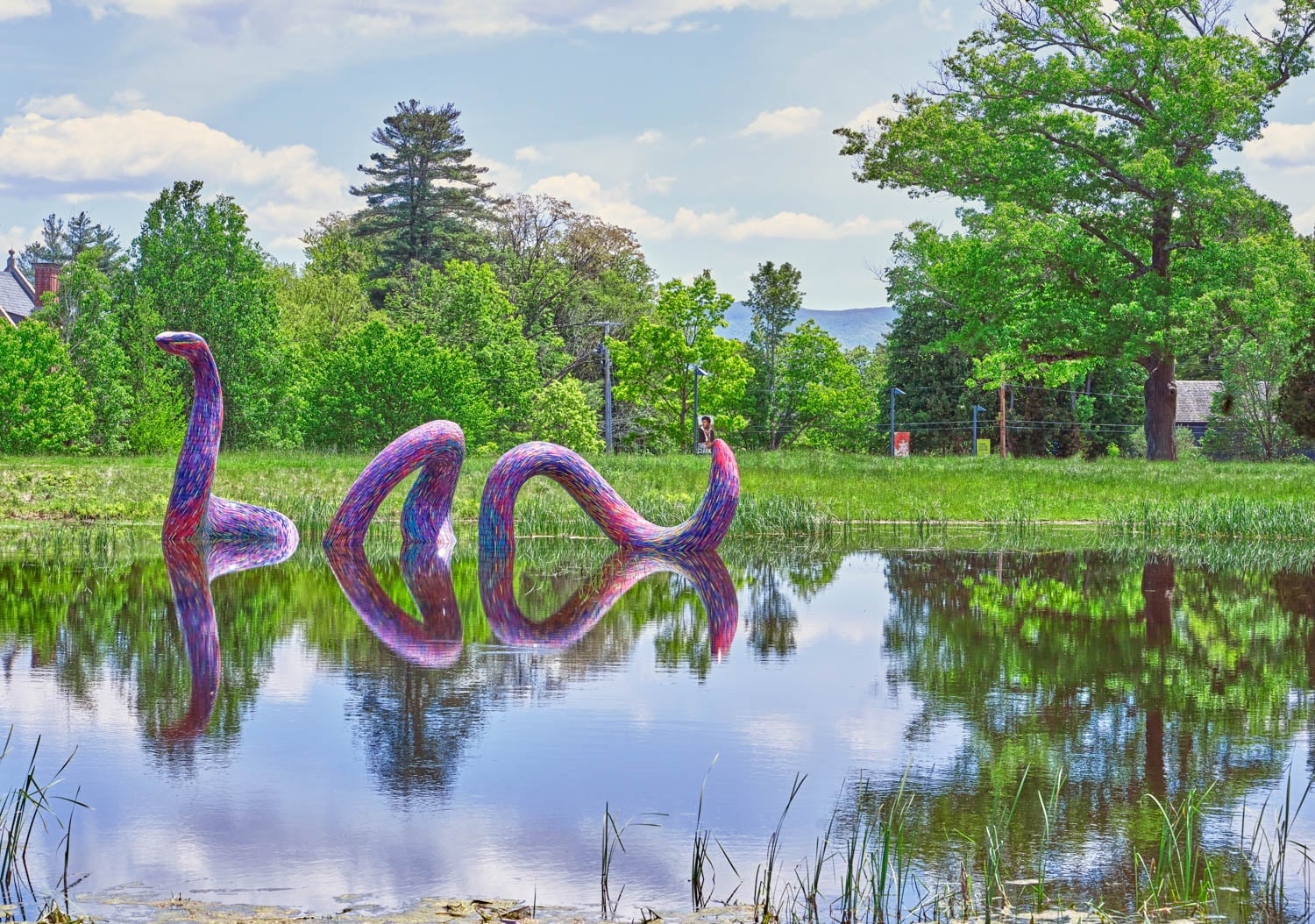
GA: Two will remain on site. Laura Ellen Bacon is always commissioned to do these site-specific works that she makes by her own hands. She has no intention of ever removing them, and so, because they’re made of natural materials and organic and biodegradable, they just disintegrate in the exact spot where they are. Hugh Hayden, for sure, this is the first time he’s ever done this. He’s an artist in great demand, so even as a financial proposition, the idea of a massive sculpture being allowed to just decay and disappear was a big decision. It came from him. It was entirely something he was interested in because of the set up of the show, he wanted to make work in that way. But another piece I’m wondering about is the serpent by Javier Senosiain. I would love it to stay there, but it obviously requires a very specific context of a body of water. The great thing about public art is that it sort of inscribes itself into the history of that place. So even when it’s gone, you still feel that it’s there.
Ground/Work 2025 is on view at the Clark Institute through October 2026.

read more
DesignWire
Designers And Manufacturers On The Move: September 2026 Edition
Interior Design‘s latest On the Move includes must-know industry promotions and hires, like Perkins&Will’s strategic move to expand its design capabilities.
DesignWire
10 Questions With… Artist and Designer Conie Vallese
From sculpture and ceramics to glass, textiles, and furniture, Conie Vallese embraces a multidisciplinary practice shaped by curiosity and creativity.