
10 Questions With… Jorge Diego Etienne
Born in Tampico, Mexico, Jorge Diego Etienne is a force in design, believing that his country needs to progress from a “Made in Mexico” culture to one of “Designed in Mexico”. He works tirelessly to seek out and support designers from all over his home country, and his studio, JDE Design Driven Consultancy, founded in 2012, works in a variety of disciplines—furniture, product, and public areas among them. As the firm’s leader, he devises solutions that have both cultural and social impact. What makes it such a success is that the process is flexible and scaleable, so he is able to work with everyone from large manufacturers to individual craftspersons.
His goal has, from the beginning, been to bring design he experiences around the world back to his home country in meaningful ways. He graduated from Tec de Monterrey in 2009, and immediately began exploring design and learning at schools on multiple continents. His approach goes beyond mere industrial design, incorporating business and manufacturing principals in order to achieve bigger goals for his clients. His aesthetic sense is both practical and strategic—but also has an eye to humanity. “I always try to make products that are life enhancers. You know, that beautiful chair that is going to make your day better. A beautiful table that is going to help you have incredible meals.”
Beyond working on dynamic products, he collaborates with a full spectrum of people, shining a light on young talent and seasoned artisans alike, helping both to find pathways to realize their potential and work effectively within the contemporary design sphere.

Here, Diego Etienne shares with Interior Design his multi-faceted approach to design, podcasting experience, and how he creates playful environments that stimulate the senses.
Jorge Diego Etienne Champions Mexican Creative Talent

Interior Design: Your story weaves in and out of Monterrey, Mexico. Tell me about your background and how you ended up doing what you do?
Jorge Diego Etienne: I came to Monterrey around 20 years ago to study industrial design here at the Tec de Monterrey [Monterrey Institute of Technology and Higher Education]. It’s relevant because eventually I became the national director for the design program of the school. It was a great university, but not a great design school. So I wanted to expand my knowledge with some experience abroad. I did some courses at St. Martin’s in London, Domus Academy in Milan, Parsons in New York, Boisbuchet in France. I started visiting the Milan Furniture Fair, which helped to establish big ambitious goals for me as a designer. Eventually, my experiences led me to an internship in Amsterdam at Feiz Design Studio. So I went from being a student to working on projects for Nokia and Herman Miller. It was the first time I dipped my toe in the international design scene. Then back to Mexico.
ID: And at the same time, you began blogging—and later podcasting. Tell us about that experience.
JDE: I started writing and blogging at what was called Designaholic, which became very popular. It was not about me, but about what I was learning, seeing, and experiencing. I was trying to bring the international design world into Mexico in a very accessible way. Designaholic is now a podcast, and it’s the most popular Spanish-speaking podcast about design in Latin America.

ID: You call your business a design consultancy. Can you explain why you made that choice?
JDE: I like to describe myself as someone who does design, promotes design, and communicates design. After I lived in Amsterdam, returned to Mexico, and was doing projects on my own, I realized that the circumstances were different here, and I couldn’t do design like it is done in New York or in Italy. The scene was different. The industry was different. I needed to stop talking about design and start talking about business, to show people how we could help their brands—through design—to achieve bigger goals.
It wasn’t just about designing a nice chair but working on a full collection that could help their company grow. In Mexico, there wasn’t an established design scene, an established framework for companies to create new design. We are a manufacturing economy. I wanted to bring something more more, so I did a masters at Parsons for strategic design and management. So we make beautiful designs in the end, but the start is always how I can help a business through design.
ID: Can you talk about your own personal approach to design?
JDE: Well, I like to keep ego and style apart. I like to focus on what the project needs, what the brand needs. The values that I abide by are timelessness, creating emotions through design, and being responsible with our choices—understanding that these are things that are going to live in peoples’ lives. I try to be very conscious regarding materials and processes, to create items that are not only feasible in terms of market fit and style, but also price points and manufacturing, which can be a challenge here.
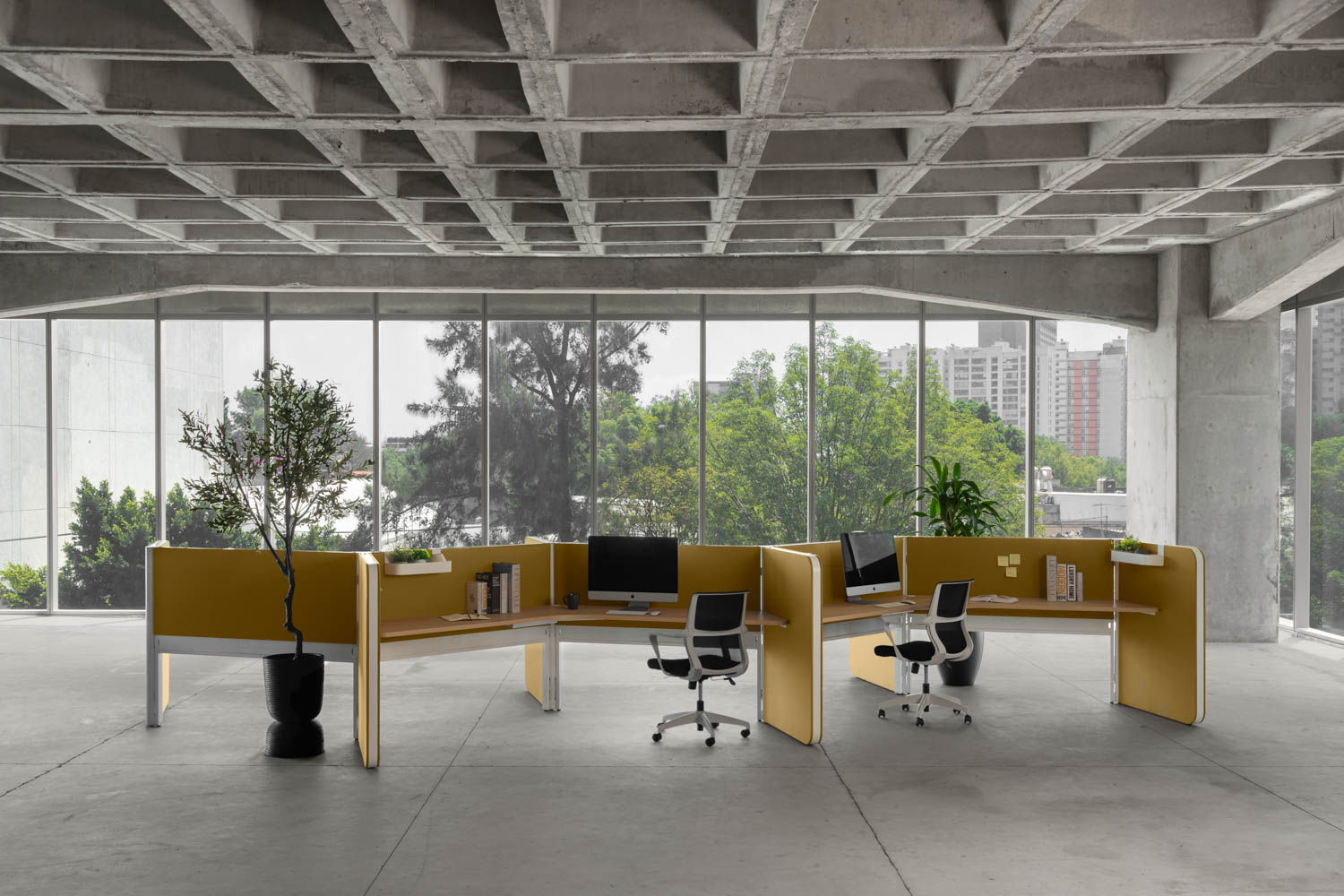
ID: One project you worked on was an office partition system for Línea Italia. There are certainly a lot of systems on the market. What innovation did you bring to the table?
JDE: It’s called Setto and it balances openness and protection, addressing a big challenge in offices—the lack of privacy. Many of the dividers they were selling were designed more than 20 years ago, when there were a lot of cables and the systems were very rigid. Setto is more modular and uses acoustic materials that give you visual and auditory comfort, but without giving up on the ability to collaborate. It uses a variety of cutting-edge technologies to manufacture, and has built-in power and storage, but is always ergonomic and precise. The old system had 60 components, whereas Setto has 12, so it’s more efficient to produce. The pendulum swung from very isolated workspaces to a free, open office—and now it is swinging back. You want an open office, but you need privacy. In the past, the company used to offer only black, gray, and white. So we inserted color, too. We’re trying to push them in a new direction.
ID: On your website there is an interesting set of furniture called René. Can you tell me how it came about?
JDE: Los Patrones is a steel furniture manufacturer here in Monterrey. They collaborate with several designers, and they invited me to develop this collection based on a chair I had already designed, but wanted me to expand it. On my website, you see the outdoor steel version, but the idea behind the design is that you have a frame on which you can have a textile seat, you can have a wooden seat, or you can have a steel seat. It was conceived to adapt to any project, regardless of scale, typology, or setting. It’s very soft, roundish, and stackable. Inspired by the flexibility of sports equipment—like a tennis racket—each piece in the collection evokes a sense of continuous motion. (The welders called it the racket chair.) There is a lounge seat, bench, high chairs, tables, coffee tables, and the original chair.

ID: Have you done any other recent collaborations in the furniture and lighting field?
JDE: There is Grama, done for Cacao, a furniture brand in Puebla. Up until then, Cacao only did steel furniture and they wanted to explore textiles. So they invited us as consultants to expand and to explore new options for their collections. The briefing was create furniture for a reading corner. And this, this chair, our idea was something that can hold you like in, in, in the palm, like, like someone will hold you in the palm of their hand. We did a lot of research into rest, reading and quiet spaces.
You know, it’s a really embracing design—a reading corner at home in the face of the hustle and bustle of everyday life, bringing the stillness of nature indoors. The lounge chair a hard shell and a very soft, big backrest and seat cushion. And it has its own ottoman and a lamp because, again, we were thinking of that reading corner. We did a version in, in leather, but it’s not, not regular leather. It’s cactus leather, made with cactus biomaterial. So I think in, in both designs, you can see this timelessness. We like to create objects that have personality, but don’t shout and can blend into any ambience.
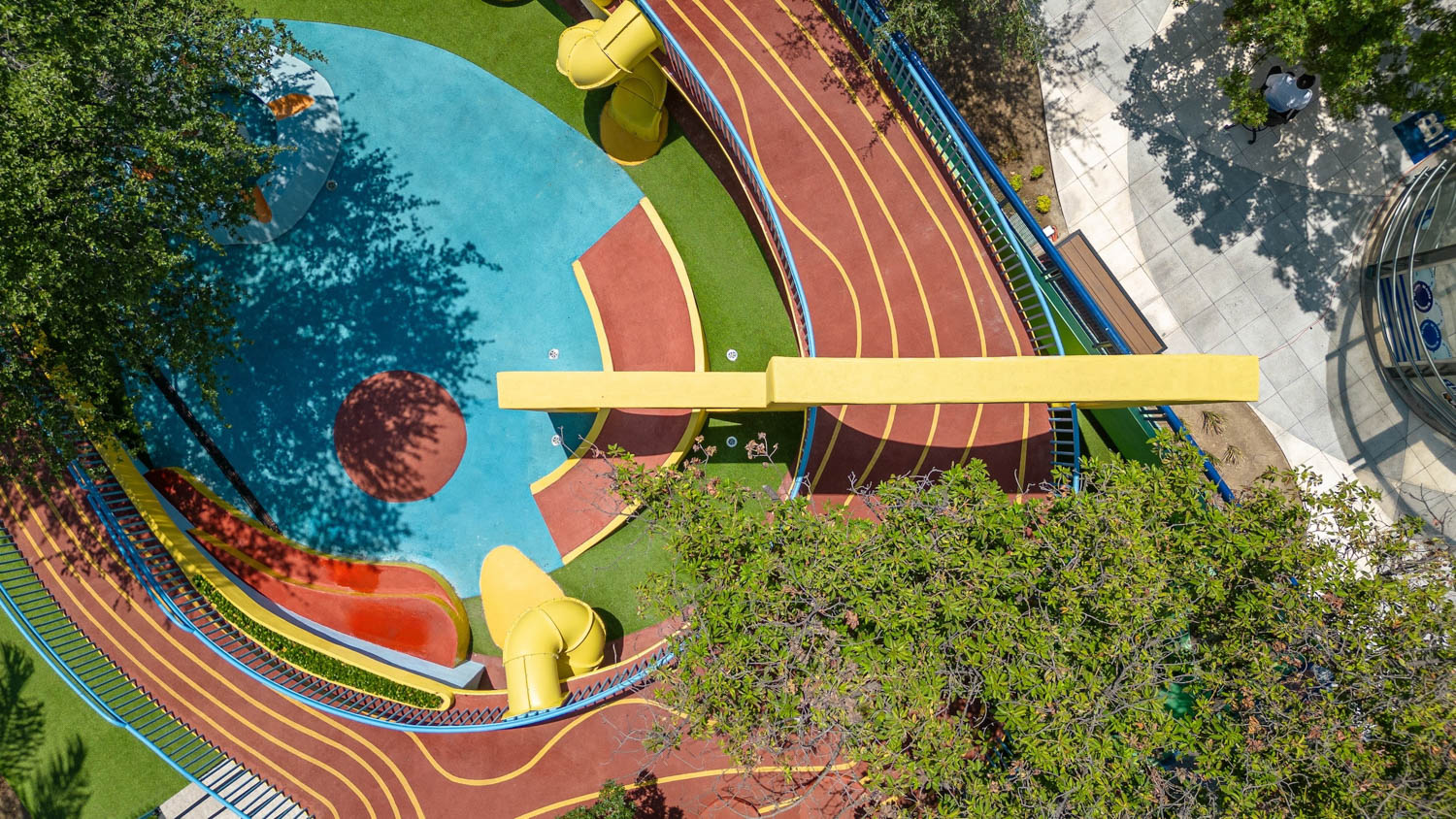
ID: And I read you designed a special playground in San Pedro Garza García. What made it different from the typical swings and slides?
JDE: Play spaces attached to schools and other educational spaces prioritize safety over critical thinking. So they’re safe, but they lack stimuli that’s necessary for children’s development. They neglect the need for reasoning and for adventure. We wanted to change that. So we developed a play space for the preschool area of the Brillamont Institute that encourages critical thinking and curiosity. It still upholds safety, of course, but it uses organic and bold geometric elements that resonate with the freedom found in nature. The long bridges and big arches encourage the kids to explore. In the middle there are towers and tunnels that are playful and create opportunities for unexpected play for the young students.

ID: You are a champion of Mexican design, and work with manufacturers and artisans. How does this process help support craftspeople and the industry as a whole?
JDE: We did a project—along with the book, Galeana, that documents it—in Galeana, a municipality south of Nuevo León, which has one of the world’s few alabaster deposits. It examines regional craft traditions and contemporary design through exhibitions, documentation, and product development. Generations of craftsmen and artisans have extracted and worked with the stone, but the art is facing challenges, everything from a decline in new, younger people learning the craft, and a lack of recognition outside the area. Nobody regards the North of Mexico as a place with craftsmanship and artisanal work. This project relates to time I spent in Japan, learning about traditional craftsmanship.
I collaborated with them to create contemporary design pieces that will take their work into a realm where it has bigger value than what they were doing with their crafts nowadays. The first thing we did was an addition of 10 of each—bowls, flower vases. We also did a piece for the Pope, a chalice for communion, and a monumental chair that started with a single 1/2 tonne stone and took three months to carve by hand. What I was trying to do is showcase the ability of the artisan to produce these pieces with their hands. A month ago we launched the book, in Spanish and English, to showcase the project.
ID: You also organize and participate in design shows that showcase young talent from the area. Can you talk about that?
JDE: This year we had the fifth edition of Emergente in Mexico city, a platform for fostering the talent of emerging designers, highlighting projects for their conceptual and narrative qualities. We showcased 37 projects by 85 designers from 10 cities in Mexico and two from abroad. I was part of the curatorial team with Cecilia León de la Barra, head of ZONA MACO DISEÑO—the largest are and design fair in Latin America—and designer Joel Escalona. Like at Salone Satellite in Milan, these are people who might not have the money to procure a whole booth, or who don’t have enough work to fill up a whole booth. It’s a way for people who are working, producing, and selling to be showcased. Some go on to be big successes! The selection covered a wide range of materials, such as ceramics, stone, metal, wood, and steel—realized in furniture, lighting, household objects, and, for the first time, jewelry. It continues to grow and we are very excited for the next edition in 2026!


read more

DesignWire
Interior Design Hosts Latest re:Source In Palm Springs, California
Explore highlights from Interior Design’s latest re:Source event in Palm Springs, where designers and manufacturers connected over meetings and more.
DesignWire
A New Chapter In British Design: London Design Festival 2026
At London Design Festival 2026, Britain’s emerging creatives showcased an ambitious new design landscape shaped by material experimentation and craftsmanship.