
10 Questions With… Landscape Designer Piet Oudolf
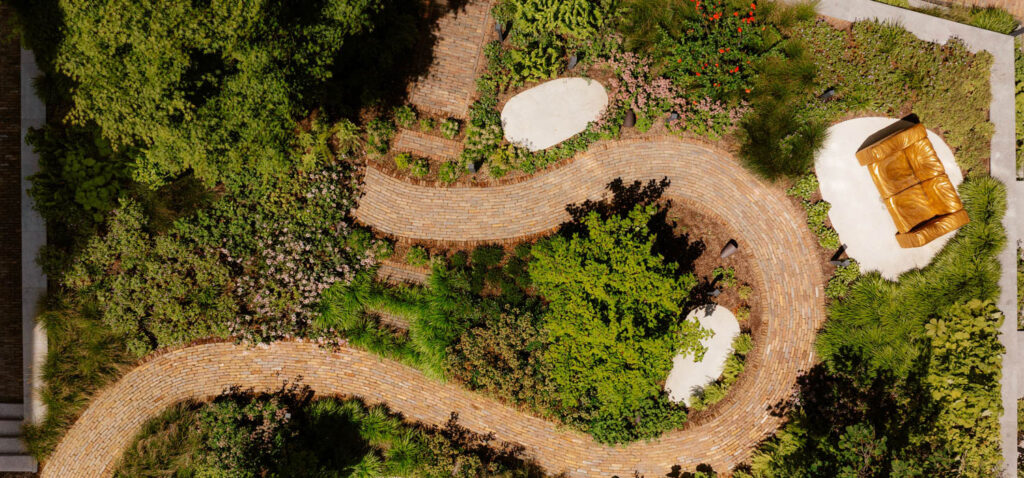
Not unlike New York (albeit New Amsterdam), Amsterdam is a city of compact architectural marvels. From the overlap of serpentine canals and narrow ornate buildings, the city dwellers and tourists craft their own contemporary narratives and invent ways to inhabit an infrastructure of over seven centuries. Among the city’s newest hidden gems is De Tuin, a garden that Piet Oudolf designed for the recently-unveiled Rosewood Amsterdam.
Sitting on the famed Prince’s Canal within the UNESCO-listed Canal District, the Piet Boon-designed property lives in a 360-year old building originally built as an orphanage, followed by housing the Palace of Justice from mid-19th century until the last decade. “History is for me is what they mean by what they make the building for today,” he tells Interior Design and adds about his most recent outing in Amsterdam: “My impact in Rosewood is quiet, not over accelerated. I tried to create something quiet and peaceful.”
From herbaceous perennials to evergreen shrubs, Oudolf’s statement in the heart of the hotel echoes with his love for perennials, the nature’s painterly gestures with subtle yet arresting volumes. Sought-after Dutch designers such as Frederik Molenschot, Saar Scheerlings, and Maarten Baas each has work across the 134-room property, leading the guests to the garden, which also houses Dutch design collective Studio Job’s bronze couch sculpture.

The project is both surprising and innate for Oudolf who has helmed some of the most riveting gardens around the world, including the High Line, Delaware Botanic Gardens, Calder Gardens, and Tokyo Garden. Besides public lands of shared horticultural statements, he has also orchestrated private havens of perennial encounters for private residences in Basel, Nantucket, and Manhattan.
Oudolf today lives on a three-acre farmhouse right outside of Amsterdam. His light-filled office in the middle of the fields sees him work everyday, alone while collaborators all across the globe help him keep his gardens alive. A sketch, or two, rendered by hand always initiates the 81-year old landscape maestro’s process. “I like being in touch with the paper and with things in my mind. This is a different way of thinking than the computer,” he says.
Get To Know Landscape Architect Piet Oudolf
Interior Design: After designing gardens for public parks and art institutions, what can you say about leaving your mark at a hotel like Rosewood, which is of course a semi-private property?
Piet Oudolf: I see it similar to a public park on a very small scale. The difference is people come not primarily for the garden, but for staying there. The big difference is, of course, some people come to a public garden accidentally, either during their walk or on the way to a destination, or some people simply go there on purpose because they like what a garden can be. In terms of a hotel, if you do it right, you give something extra for your guests.
ID: I am curious about the chance element of encountering a garden, similar to a public artwork. Some gardens have access and others don’t, such as the Gramercy Park garden in New York. Do you keep in mind this element of chance when you plan a project?
PO: There is the chance element, yes. A garden can mean so much for so many different people. They are also culturally diverse—you can be visiting a Japanese garden, Persian garden, or a British garden. There are histories, mythologies, and personal stories attached. My way of gardening in the last 20-25 years is more based on a naturalistic idea without being really nature. It just creates something that reminds you of nature, or at least something wild that you recognize from being in nature.

ID: You often collaborate with architects such as Herzog & de Meuron or Piet Boon. How do these overlaps influence your process and approach? Do you exchange visions?
PO: It depends on the project. These dialogues are different if we are working on a public space like the Calder Gardens or a private project which can something be enclosed by apartment buildings, like the 543 Hortus building which Herzog & de Meuron designed and I did the landscaping. What the architect does hopefully makes the garden also beautiful and creates something special altogether.
ID: How do you prioritize your steps and layer them in your process?
PO: I first look at my planting palette that covers most of the seasons. Some of it depends on where I am and how the seasons are felt there. I look at the characters of the plants, the textures, the leaf forms, and often the flowers. Then color comes on top of that. I think about how plants work together when they’re not flowering and then when they flower. I first start with how the plants have textures together.
ID: How about longevity?
PO: It is important to work on a garden that is durable and grows over years together in a beautiful community with, of course, the help of the gardener. There is always something that goes wrong, but the point is to make a garden that lives, not forever, but for over a very long time. The approach should be to create something that stays there for many, many years with the good guidance of the gardener. Then you can, of course, make changes or little additions, but your approach should not be to replace plants every year.


ID: The garden inside the Rosewood is an hour drive away from your home; while your other gardens are all over the world. What are the differences between working with a very familiar terrain as opposed to, let’s say, another continent?
PO: I like to work with climate zones that I am familiar with. There have been some exceptions, such as Hauser and Wirth on Menorca where north of Spain is climate-wise different and I had to learn many different plants and flora. That is also why I try to stay away from California. The important thing is to find people that can assist me in my work.
ID: Your practice is, in many ways, infinite, constantly transforming with the seasons’ changes as well as impacts of climate change, all beyond our control. Architecture, on the other hand, depends on human vision and the end result is not open-ended but resolute.
PO: Many things are beyond my control which is why I try to work on a project where there is a good stewardship, or at least the client has good gardeners. The High Line, for example, has a staff of ten or more gardeners. After 15 years, the garden is not what it was when we started, so there is a process that is going on all the time that you have to keep in mind and discuss with the gardeners and the horticulturists. The process is, in a way, never-ending with a constant configuration of plant growth.

ID: Do you often visit a project site before anything else and you start sketching?
PO: I visit a place several times during construction and I try to understand what people need here. There is also the brief from the client concerning how they want people to walk in their garden and the atmosphere they’d like to see. After several visits, I put together an idea in my head. Then I start putting together a plant list which might be bigger than I will actually use, but at least I have choices to pick from.
ID: Do you pay equal attention to a horizontal view of your garden and a bird’s eye view? I am curious about your idea of geometry and symmetry which are experience differently when touring a garden as opposed to seeing a aerial picture of it.
PO: I think about balance and repetition which both depend based on the scale of the project. The scale of groupings is also important. The balance between grass and flowering plants is important. There is, for example, a style of planting called matrix planting where a few plants are dominant. Gardening is a four dimensional way of design. You have to think what the garden will be like in in a year’s time or in five years. Trees are also very important part of the garden because they are the framework that envelopes the experience. They give volume to a garden.

ID: Let’s finish with sustainability. How do you work around the realities of climate change?
PO: We have to trust plants. Climate change goes quick and slow at the same time. We have to be careful about where the plants we use come from. I try to use plants that are easy and not too complex or demanding of where they are. Perennials are easier, in this case, than gentle flowers, which are usually annuals that come up and die. They require replanting.
read more

DesignWire
Designers And Manufacturers On The Move: September 2026 Edition
Interior Design‘s latest On the Move includes must-know industry promotions and hires, like Perkins&Will’s strategic move to expand its design capabilities.
DesignWire
10 Questions With… Artist and Designer Conie Vallese
From sculpture and ceramics to glass, textiles, and furniture, Conie Vallese embraces a multidisciplinary practice shaped by curiosity and creativity.