
How Ace Group International Curates Hospitality Hot Spots
Ace Group International managing partner Brad Wilson might have a degree from Cornell University’s School of Hotel Administration, but his three decade–plus career in hospitality has been defined by more than a deep understanding of the business-and-numbers side of the industry. Since 1997, when Starwood CEO Barry Sternlicht hired him to help launch W Hotels, Wilson has built a reputation for blending sharp analytic expertise with a visionary grasp of design’s commanding role in the modern hotel experience—an ethos he continues to develop as head of Atelier Ace, the brand’s 50-person in-house creative agency, which regularly partners with outside firms.
Unusually, he prefers collaborating with designers that have no prior hotel experience—a habit established early, when he worked with Rockwell Group on the W New York and Yabu Pushelberg on the W Times Square, the first hospitality commissions for both studios. We spoke with Wilson about that philosophy and how it plays out in Ace’s three newest properties in Sydney, Toronto, and Athens.
Ace Group International Works With Hospitality Newcomers
Interior Design: Along with Ian Schrager’s hotels, the W New York pioneered high-end hospitality design in the city when it opened in 1998. What was that like?

Brad Wilson: We were creating the W brand at the same time we were creating an amazing hotel. Barry focused on engaging interesting new designers and moving them into the hospitality realm, in this case David Rockwell. It was David’s first hotel, and I worked with him on the program, using his vision for it—spalike, tied to nature, organic—to create the overall lifestyle that would be W Hotels. I had the same opportunity with George Yabu and Glenn Pushelberg on the W Times Square—taking a fresh look at hospitality design and aiming to make something new and different but also elegant and sophisticated.
ID: Why have you continued working with hospitality newcomers at Ace?
BW: The Ace DNA weaves through all our properties, but we want to make each hotel unique, very site specific, with a strong individual personality—a one-off experience in one particular location. We’ve found that partnering with upcoming designers allows us to achieve that more than going to firms who’ve already done a hundred hotels, because a lot of times what you get is their hotel.

ID: How does a collaboration between Atelier Ace and an outside firm work?
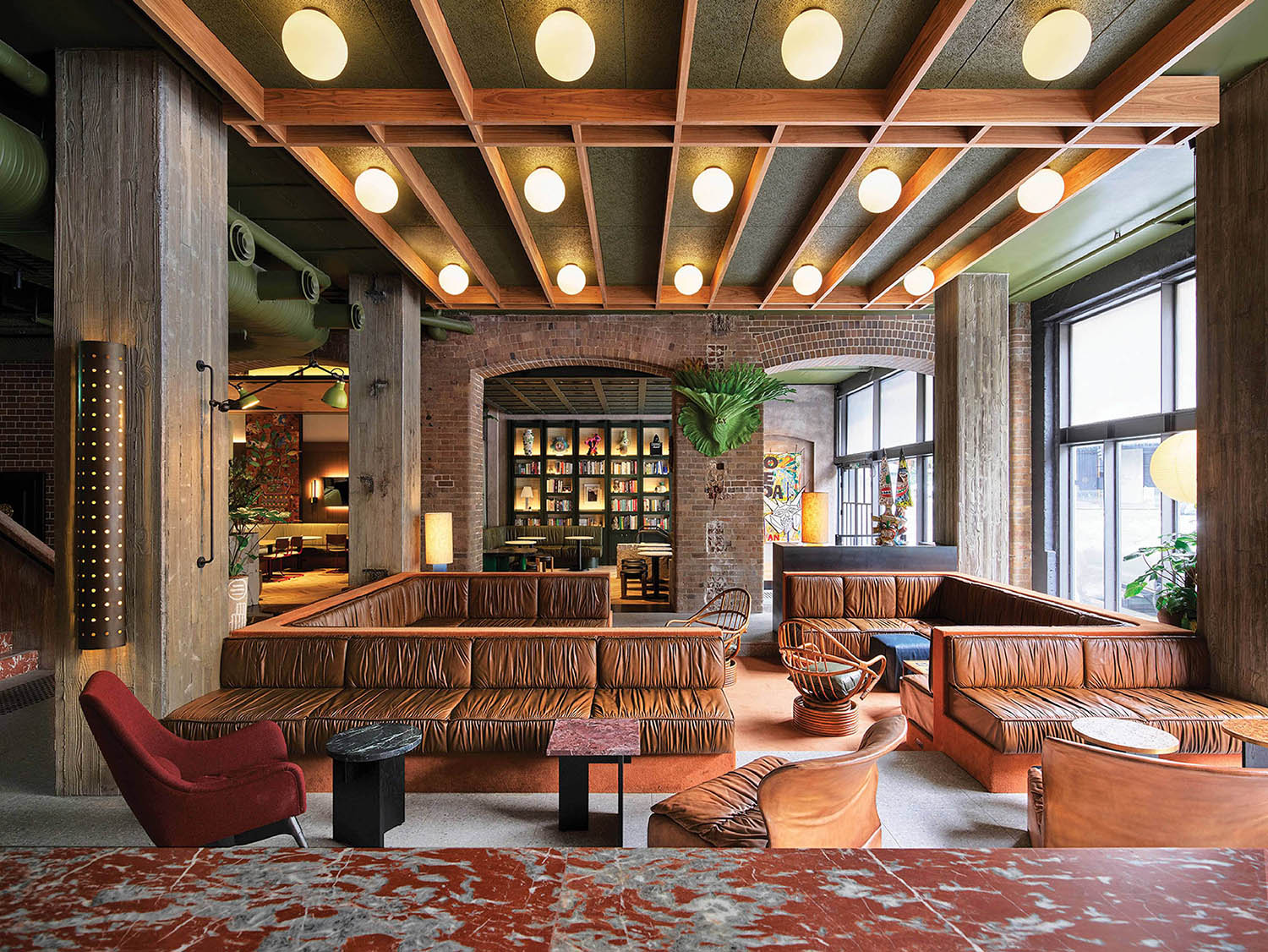
BW: Before we hire a designer for a project, our team—headed by director of interiors Jonny Ribeiro and director of architecture Steven Dremov—does deep research into the culture and history of the city, and also of the building if it’s a renovation, which a lot of our properties are. From that, we develop a visual narrative for the project—where we’re going with it—and then we look for designers that are a good fit for what we’re trying to create. At the Ace Hotel Sydney, for example, the building we renovated was the site of the city’s first brick kiln, so we were interested in using masonry surfaces and textures. We also developed a huge appreciation for Australian modernism, which is very organic. We found a Melbourne-based designer, David Flack, who’d played with those elements on residential projects. Our palette tends to be tight while David’s approach is very colorful, so we learned a lot from him about expressing Australia through color—even using purple, which I never thought we’d do!
ID: The polychrome ceramic-brick reception desk is extraordinary.
BW: It came out of the original narrative—that this was a kiln site—and how to express it in a modern way. We often solve things by making them art projects—in this case, an installation of graffitilike painted bricks. It’s an example of taking the localized narrative, bringing in art and design elements, and partnering with them to make a space that defines the hotel.


ID: The natural-wood and earth-tone palette at Ace Hotel Toronto, a new-build in collaboration with small, local firm Shim-Sutcliffe Architects, seems more typical of the brand.
BW: We did the interiors ourselves. Brigitte Shim and her husband Howard Sutcliffe had mostly done residential work, no hotels, but their houses are exciting—powerfully rooted in Canadian design and aesthetics. They’re teachers and experimenters on the cusp of architecture there, and we saw a chance to create a new building that adds cultural value to the city. We focused on empowering them to make great architecture and took the lead on the interiors, so they knit seamlessly with the building and emphasize its architectural presence. I think we were able to make a cathedral to hospitality where the spaces and structure determine the finishes and furnishings.
ID: The three-level lobby with its concrete arches recalls grand old hotels with giant public spaces but on a warmer, more human scale.
BW: We used organic and craft materials to help create that sense. You can sit in the lobby and feel you’re in a very intimate space, but if you turn your gaze upward, you realize there are three open floors above you spanned by massive concrete structural elements. It’s truly unique.

ID: At your most recently opened location, the Ace Hotel & Swim Club Athens, the pool becomes the property’s social and cultural hub, no?
BW: We brought that idea to Athens from our swim club in Palm Springs, which has always been one of our most celebrated hotels. We acquired a ’70’s modernist hotel with two swimming pools and an interesting grid of balconies, almost brutalist in feel, which we loved.
ID: You worked with a French studio, Ciguë, which is also quite experimental, on the architecture and the interiors.
BW: Yes, the firm is really into the concept of architectural design as an installation process, which attracted us. It looks on its work as radical collage, layering spaces with materials and furnishings that feel real and authentic, that have craft and art—all things that give an environment depth and make people feel comfortable in it. There was also a collage of other firms involved: Back to the Future, a local source of vintage furniture from all over Greece; art consultants Matthieu Prat of Diplomates Studio, who focused on the public spaces, and Aliki Lampropoulous of Mare Studio, who oversaw guest rooms; and Ogust, an Athens graphics studio, which did the signage and wayfinding. We wanted to evoke the Athens Riviera of the ’70’s, not Miami Beach—no billowing white curtains!—so we played a lot with color. Many of our choices, like the yellow of the sun umbrellas, are nostalgic for that era, so they’re not hues you’ve seen over and over, which is always our goal.
Seek A Refuge Of Calm At These Hotels By Ace Group International


Collaboration Is Key For These Stunning Hospitality Spaces


read more

DesignWire
Designers And Manufacturers On The Move: September 2026 Edition
Interior Design‘s latest On the Move includes must-know industry promotions and hires, like Perkins&Will’s strategic move to expand its design capabilities.
DesignWire
10 Questions With… Artist and Designer Conie Vallese
From sculpture and ceramics to glass, textiles, and furniture, Conie Vallese embraces a multidisciplinary practice shaped by curiosity and creativity.