

Inside LSM’s Bespoke Approach To Corporate Design
Although architects Debra Lehman-Smith and Jim McLeish got their start at Skidmore, Owings & Merrill in the 1980s, and had only worked on one project together, they launched Lehman-Smith + McLeish, with three other SOM colleagues, in 1991 in Washington. Four years later, Lehman-Smith was inducted into the Interior Design Hall of Fame—and gave birth to her second child—as the firm was fast establishing itself as a small but mighty player known for a bespoke approach to corporate interiors that’s bold, collaborative, and all encompassing. Three decades later, the re-branded LSM has additional studios in New York and London, with projects around the world and a portfolio of clients including Bloomberg, Gulfstream, Samsung, and top law firms. From the start, a curated art program has been a hallmark of LSM’s work, most notably with commissioned installations by the likes of Anish Kapoor, Bosco Sodi, and Pae White. Lehman-Smith and McLeish reflect on their 35-year partnership and what the future holds.

The New York office of the law firm Millbank, completed in 2018. Photography by Eric Laignel. 
The founding and senior partners of LSM, Debra Lehman-Smith and Jim McLeish, at Millbank’s Washington office, completed 2025. Photography by Mark Andre/LSM. 
Millbank’s London office, 2022, and its Integration of Hope, a site-specific wall installation by Idris Kahn. Photography by Eric Laignel. 
The Washington office of Paul Hastings, another law firm, 2020. Photography by Eric Laignel. 
The Washington office of Paul Hastings, another law firm, 2020, and its Conrad Shawcross sculpture, Fractured Paradigm (Blue). Photography by Eric Laignel. 
Millbank Washington with Martin Boyce’s Amethyst Falls Projected On To the Air. Photography by Eric Laignel. 
Oliver Marsden’s Turquoise Green Violet Harmony I. Photography by Eric Laignel.
Interior Design: Let’s start with the LSM origin story.
Debra Lehman-Smith: The foundation of LSM was SOM. Our original five employees—Jim, Terese Wilson, Kenneth Wiseman, Kent Fee, and me—all had roots there. Our mentors were David Childs and Craig W. Hartman. We wouldn’t have been able to do this without their unselfish help and tutelage. They even let us use their studio to start our own firm. Like, that’s shocking.
ID: What lessons did you take from this incubator?
DLS: SOM taught us how to run projects, especially how to travel the world for the best work. SOM knew how to make us portable.
Jim McLeish: SOM taught us design excellence and to be selective in the partners we chose as clients.
ID: And you had two major clients out of the gate.
DLS: Yes, the U.S. Olympic Committee—which entailed two executive centers for sports, in Colorado Springs and San Diego—and the law firm Howrey & Simon, which helped write our business plan.

Covington & Burling, in Washington, 2014, with two Carlos Cruz-Diez artworks. Photography by Jon Miller/Hedrich Blessing. 
Millbank New York, 2018, with a Pae White commission. Photography by Eric Laignel. 
Sine Curve I by Jeppe Hein at Millbank London. Photography by Eric Laignel. 
A Bosco Sodi painting at WilmerHale in Washington, 2023. Photography by Eric Laignel.
ID: Did LSM hit an inflection point at about five years?
JM: Or was it five minutes?
DLS: Seriously! But yes, we were like, ‘We made it to the five-year mark and who are we really?’ Ken Wiseman left and we rebranded as LSM. Then we got the Gannett/USA Today headquarters in McLean, Virginia.
JM: It was a golden moment and a game changer.
ID: In what way?
DLS: We found our true voice in the market. Interior architecture as a full-scale branding opportunity. We started asking ourselves, How do you make each client different? What are their unique identifiers? How do you really dig deep into what the client can do? How can you teach people? How can a project be fresh but not trendy? It was the start of our truly collaborative process.

Andromeda furniture collection for UniFor, 2024. Photography by Alberto Strada. 
62 Buckingham Gate in London, 2013. Photography by Hufton & Crow. 
Millbank New York’s Parota Tree by Michelle Francois (surround) and Remains by Quayola. Photography by Eric Laignel.
ID: Including with artists and art consultants, which has become your signature.
DLS: We had a great art consultant, Lisa Austin, but it wasn’t just about selecting amazing pieces. It was more profound. Our selections stemmed from the origins of the client. Gannett, for example, started in the billboard industry, so we commissioned Ed Ruscha to do three paintings—which later sold for millions of dollars—and made them into backlit billboards. And we had Joseph Kosuth create a neon wall sculpture with thought-provoking text that staff would see every day on their way to the lunchroom.
ID: Then you essentially turned Tishman Speyer’s headquarters in New York into a museum for their corporate art collection.
DLS: Tishman Speyer, which was moving into a typical office floor, was known as a regional NY real estate company. But it’s actually a major international brand, and the office should reflect that, so we suggested the top of Rockefeller Center with outdoor space. Then we found all these great options in that building.
ID: Didn’t General Dynamics start as an office refresh but turn into a years-long, multi-project affair?
DLS: Yes, we did three HQs for that aerospace client. We first met with the chairman to change just his office. But it got to the point that every time we came in, he and other execs would all roll their eyes because it was turning into a much bigger project. We did an entire building in Northern Virginia for General Dynamics in the end. We found posters that graphic artist Erik Nitsche did when he was the art director there, and we worked with Pentagram on the client’s whole brand.

General Dynamics headquarters, 2019, in Reston, Virginia. Photography by Mark Alan Andre/LSM. 
Gannett/USA Today headquarters, 2001, in McLean, Virginia. Photography by Jon Miller/Hedrich Blessing. 
Hein’s site-specific Modified Social Bench #48 on the General Dynamics grounds. Photography by Mark Alan Andre/LSM. 
Ed Ruscha billboards high up on a wall at Gannett/USA Today. Photography by Timothy Hursley.
ID: But isn’t LSM about the same size it’s been since 2006?
JM: We resist the urge to grow just to grow. We’re at about 40 people now, a size that enables us to be selective about our next assignment. It’s important to bring intrinsic value to our clients but also make it exciting to attract new talent to our firm and allow us to continue our mission. Having studios in London and New York makes us agile.
ID: What’s on the horizon?
JM: Morningstar’s headquarters, which is located in the Loop in Chicago, where I got my start with SOM. Plus Morningstar has a long relationship with UniFor, our partner for our recent Andromeda furniture collection.
DLS: We’re also doing the office for law firm inside the CBS Building in New York, which is Eero Saarinen’s first all-concrete building, aka Black Rock, completed in 1965. Florence Knoll did the interiors for CBS, so, just like with the billboards for Gannett, there will be some narrative on that history.
ID: Is your culture all-hands-on-deck all the time?
DLS: Yes, and we complain about it. But we chose to be in this global world. And we chose to be at the top with these great companies. That comes with an expectation of dedication.
JM: It’s a question of, Is this your life’s work or is it your job?
DLS: This is our life’s work, clearly, because we’re older than dirt and we’re still here.
read more
DesignWire
10 Questions With… Clarisse Merlet
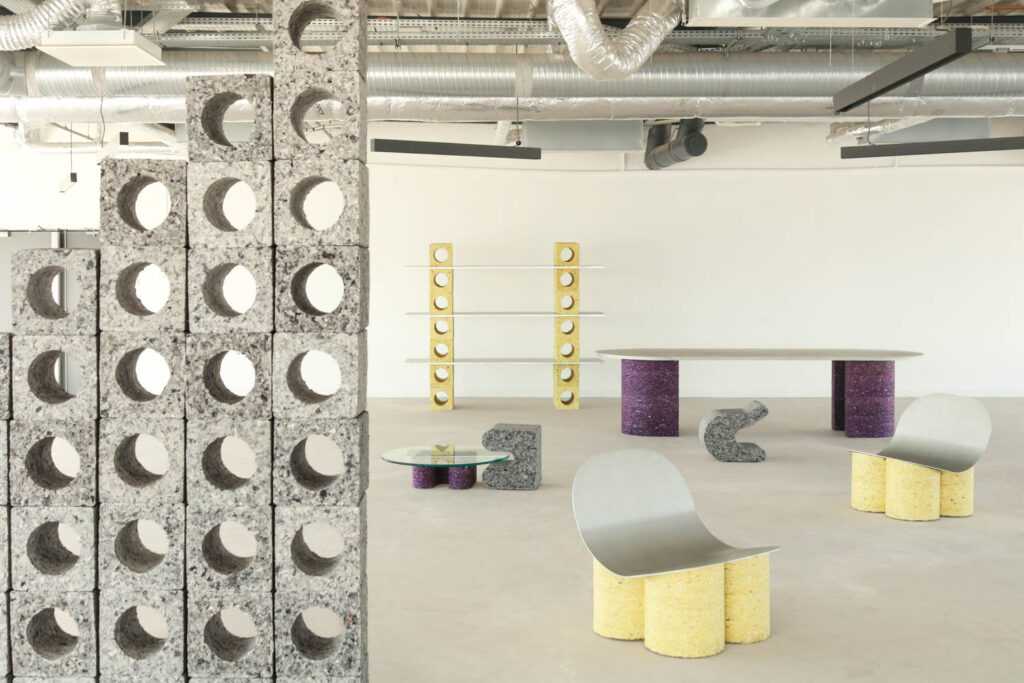
Clarisse Merlet, founder of Paris-based FabBRICK, is transforming discarded textiles into colorful architectural materials, pushing the medium with bold forms.

DesignWire
11 Top Picks From Feria Hábitat València 2026
Highlights from Feria Hábitat València, which featured over 1,200 exhibiting brands spread across 110,000 square meters of exhibition space.